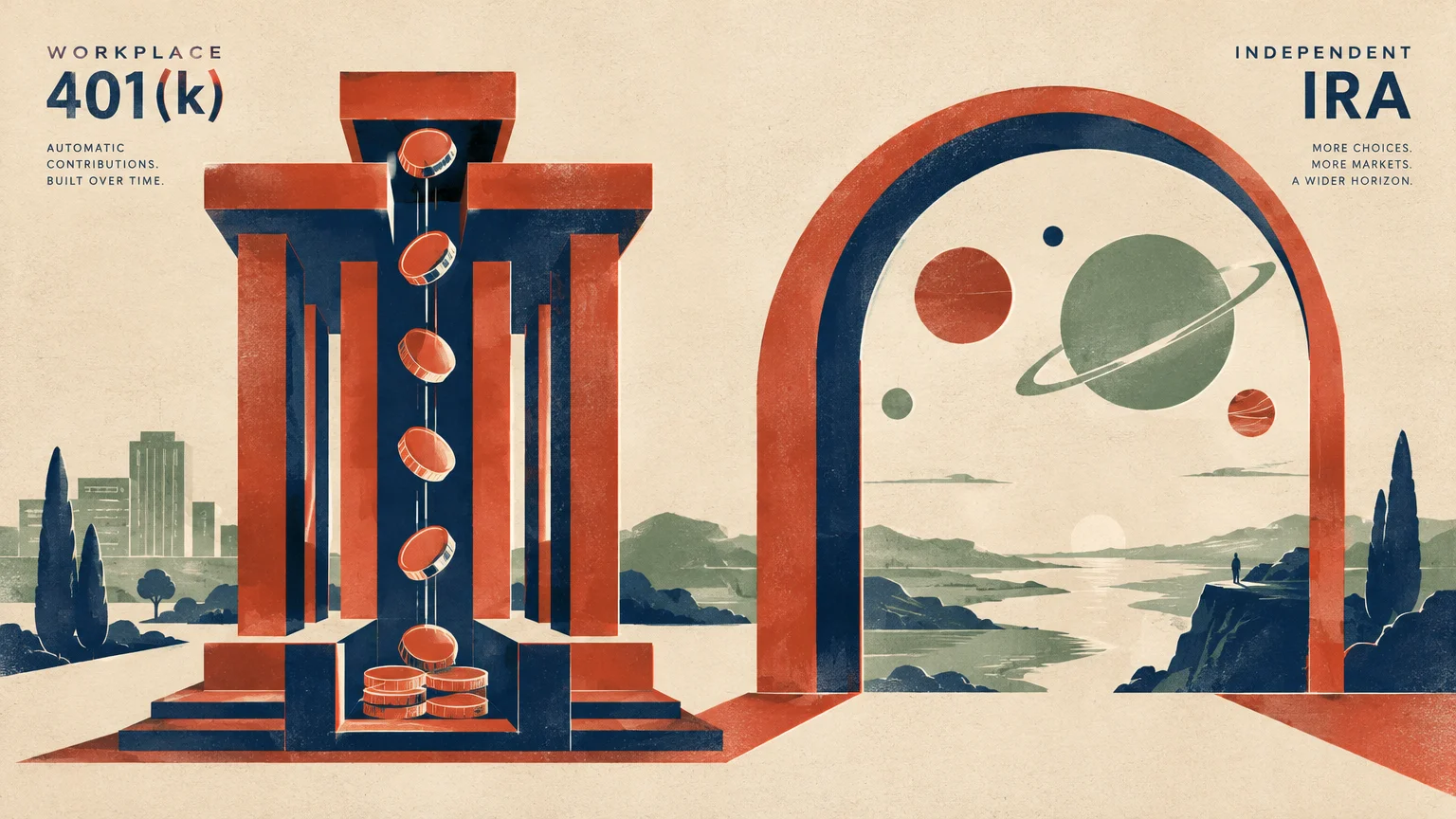
Deciding where to direct your retirement dollars shapes your household wealth for decades. Choosing the right account lets you cut your current tax bill immediately or build tax-free income for the future.
While an employer 401(k) provides automated payroll deductions and matching funds, an IRA grants you total investment freedom. Understanding how both accounts function helps you keep more cash in your household budget today.
This guide breaks down contribution caps, income thresholds, and withdrawal rules so you can maximize your retirement saving options.
Core Structural Differences Between a 401(k) and an IRA
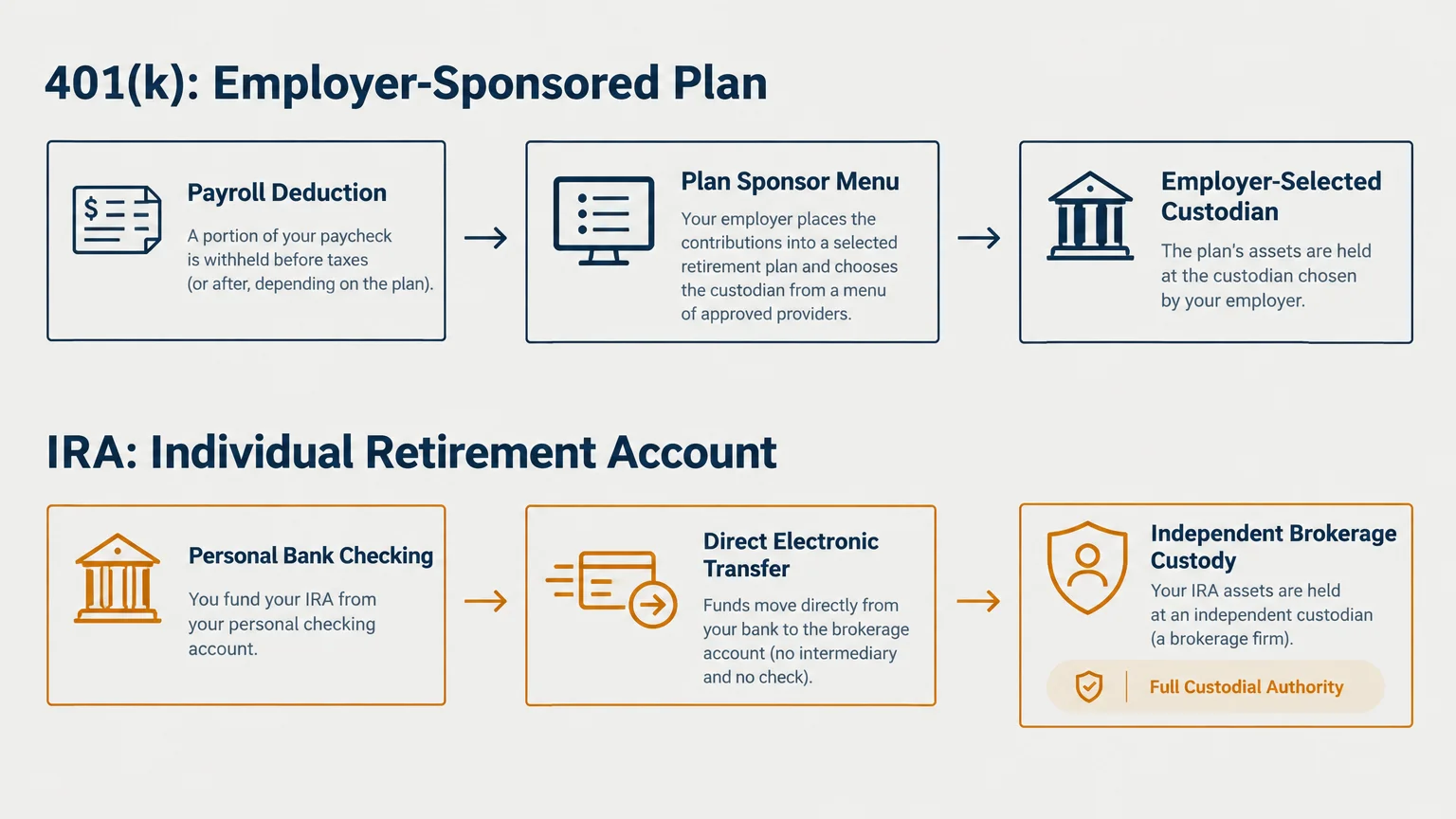
A 401(k) is an employer-sponsored retirement plan designed to help workers save money straight from their paychecks. Your company selects the plan provider, negotiates administrative costs, and determines the menu of available investments.
An Individual Retirement Account—commonly known as an IRA—belongs entirely to you. You open an IRA independently through a bank, brokerage firm, or mutual fund company of your choice.
The primary structural contrast lies in account ownership and funding mechanics. Your employer manages plan access for a 401(k), whereas you retain full custodial authority over an IRA from day one.
Workplace plans handle deposits automatically through regular payroll deductions before wages hit your checking account. IRAs require you to transfer funds manually or establish recurring electronic bank transfers.
You can learn more about federal standards for workplace retirement plans directly through the Department of Labor Employee Benefits Security Administration.
Annual Contribution Limits and Catch-Up Thresholds for 2026 and 2027
Workplace retirement accounts offer significantly higher contribution ceilings than personal retirement accounts. These elevated caps make the workplace plan an exceptional engine for shielding larger portions of your income from taxes.
For the 2026 tax year, the employee deferral limit for a 401(k) sits at $24,500. This threshold rises to $25,500 for tax year 2027.
In contrast, the annual IRA contribution limit is $7,500 for both 2026 and 2027. This dollar cap applies to your combined total deposits across all Traditional and Roth IRAs.
Savers age 50 and older can take advantage of statutory catch-up contributions to accelerate their progress. For a 401(k), the standard age-50 catch-up allowance is $8,000 in 2026 and $8,500 in 2027.
These figures allow older workers to defer up to $32,500 in 2026 and $34,000 in 2027. The IRA catch-up contribution remains fixed at $1,100 for both years, setting the age-50 maximum at $8,600.
The total combined limit for a 401(k)—including employee contributions and employer matching dollars—reaches $72,000 in 2026. That combined ceiling climbs to $75,000 for 2027.
SECURE 2.0 Rules: Super Catch-Ups and Mandatory Roth Contributions
Recent legislative updates under the SECURE 2.0 Act introduced powerful provisions for older savers. Workers aged 60, 61, 62, and 63 qualify for a special “super catch-up” contribution limit.
Instead of the standard age-50 catch-up, eligible participants in that four-year window receive an enhanced limit of $11,250 in 2026. This elevates their maximum 401(k) salary deferral to $35,750.
For tax year 2027, the super catch-up amount increases to $11,750, permitting a total employee deferral of $37,250. This rule provides a tremendous opportunity to build liquid wealth right before full retirement.
However, SECURE 2.0 also mandates a significant change for higher earners making catch-up contributions. Starting January 1, 2026, employees with prior-year FICA wages above $150,000 cannot make pre-tax catch-up deposits.
If your 2025 wages from the plan sponsor exceeded $150,000, your 2026 catch-up contributions must go into a Roth 401(k). That wage threshold increases to $155,000 for the 2027 tax year.
This statutory requirement applies strictly to employer-sponsored plans; it does not affect your standard IRA contributions.

Traditional vs. Roth Tax Treatment Across Accounts
Both 401(k)s and IRAs come in two primary tax varieties: Traditional and Roth. Choosing between these options depends on when you want to pay taxes on your earnings.
A Traditional account offers an upfront tax break. You contribute pre-tax dollars, which reduces your modified adjusted gross income in the year you make the deposit.
Your money grows tax-deferred inside the account, meaning you owe nothing on capital gains or dividends year to year. When you withdraw funds in retirement, the IRS taxes distributions as ordinary income.
A Roth account functions in the exact opposite manner. You fund the account with after-tax dollars today, meaning you receive no upfront tax deduction.
In exchange, your money compounds completely tax-free over your career. Once you reach eligible retirement age, every withdrawal of contributions and earnings comes out 100% tax-free.
“Do not save what is left after spending, but spend what is left after saving.” — Warren Buffett
If you expect to sit in a higher tax bracket during retirement, Roth contributions protect you from future tax hikes. If you currently occupy your peak earning years, Traditional contributions deliver immediate cash-flow relief.
Income Caps and Tax Deduction Phase-Out Ranges
Anyone with earned income can contribute to an employer 401(k), regardless of how much money they make. IRAs, however, enforce strict income ceilings that limit eligibility and tax deductions.
Direct contributions to a Roth IRA phase out once your Modified Adjusted Gross Income (MAGI) reaches specific statutory bands. In 2026, the phase-out range for single filers is $153,000 to $168,000, rising to $158,000 to $173,000 in 2027.
For married couples filing jointly, the Roth IRA phase-out spans $242,000 to $252,000 in 2026. For 2027, that joint phase-out window climbs to $250,000 to $260,000.
Married individuals filing separately face a restrictive phase-out range of $0 to $10,000 in both tax years. Once your household income exceeds these ceilings, direct Roth IRA contributions become prohibited.
Traditional IRAs allow anyone with earned income to deposit funds, but tax deductibility depends on workplace coverage. If you participate in an employer plan, your deduction phases out between $81,000 and $91,000 for single filers in 2026.
In 2027, that single deduction phase-out rises to $83,000 through $93,000. Married joint filers where the contributor has workplace coverage see phase-outs between $129,000 and $149,000 in 2026, rising to $133,000 to $153,000 in 2027.
If you lack workplace coverage but your spouse participates in a plan, your deduction phases out between $242,000 and $252,000 in 2026. That range shifts to $250,000 to $260,000 in 2027.
You can check the latest statutory schedules on the official IRS Retirement Plans portal.

Investment Choices, Management Fees, and Operational Control
When you evaluate retirement accounts compared side by side, investment flexibility stands out as a major factor. Workplace plans restrict your assets to a curated lineup selected by your employer’s plan committee.
A standard 401(k) menu typically features 15 to 30 mutual funds, target-date funds, and stable value products. Some employers offer excellent low-cost institutional index funds, while others provide expensive, actively managed funds.
In addition to fund expense ratios, 401(k) plans frequently pass administrative and recordkeeping fees onto participants. These operational charges quietly reduce your net portfolio performance over time.
An IRA puts you in complete command of your investment destiny. You can purchase almost any publicly traded asset, including broad-market exchange-traded funds (ETFs), individual dividend stocks, and individual Treasury bonds.
Independent brokerages rarely charge account maintenance fees for self-directed IRAs. This broad freedom lets you assemble an ultra-low-cost portfolio with expense ratios below 0.05% annually.
For everyday budget managers, lowering recurring fees is the easiest way to preserve long-term compounding. Managing costs inside an IRA ensures more of your saved money stays in your pocket.
Early Withdrawals, Exceptions, and Required Minimum Distributions
The IRS creates tax-advantaged accounts specifically for long-term retirement security, not short-term emergency spending. Withdrawing earnings before age 59½ generally triggers ordinary income taxes plus a stiff 10% penalty.
However, each account structure features distinct statutory relief exceptions. An employer 401(k) allows penalty-free distributions under the “Rule of 55” if you leave your job during or after the calendar year you turn 55.
Workplace plans may also permit you to take a 401(k) loan, borrowing up to 50% of your vested balance up to $50,000. You repay the principal and interest back to yourself through automated payroll deductions.
IRAs do not allow loans under any circumstances, but they provide different early-distribution penalty exemptions. You can withdraw up to $10,000 penalty-free for a qualified first-time home purchase.
IRAs also let you take penalty-free distributions to pay for qualified higher education expenses. Furthermore, you can withdraw your original Roth IRA contributions at any time without taxes or penalties.
Required Minimum Distributions (RMDs) currently begin at age 73 for Traditional accounts, rising to age 75 in 2033. Under SECURE 2.0, Roth 401(k)s are now exempt from lifetime RMDs, matching the permanent tax advantage of Roth IRAs.
401(k) vs. IRA: Direct Feature Comparison
Reviewing the structural rules of both accounts side by side clarifies which tool fits your immediate cash-flow strategy. The table below outlines the core operating rules for the 2026 and 2027 tax years.
| Account Feature | Employer 401(k) | Individual Retirement Account (IRA) |
|---|---|---|
| Sponsorship | Employer-sponsored workplace plan | Individual account opened at a brokerage |
| 2026 Contribution Limit | $24,500 (employee elective deferral) | $7,500 (combined across all IRAs) |
| 2027 Contribution Limit | $25,500 (employee elective deferral) | $7,500 (combined across all IRAs) |
| Standard Catch-Up (Age 50+) | $8,000 (2026) / $8,500 (2027) | $1,100 (2026 and 2027) |
| Super Catch-Up (Ages 60–63) | $11,250 (2026) / $11,750 (2027) | Not available |
| Income Caps on Contributions | None (open to all eligible employees) | Phased out for Roth; deduction limits for Traditional |
| Employer Match Availability | Yes (subject to company vesting schedules) | None |
| Investment Choices | Curated list of 15–30 mutual funds | Thousands of stocks, bonds, and ETFs |
| Loan Options | Yes (up to $50,000 or 50% of balance) | No loans permitted by law |
| Lifetime RMD Mandate | Traditional requires RMDs; Roth 401(k) exempt | Traditional requires RMDs; Roth IRA exempt |
The Optimal Cash-Flow Order for Everyday Savers
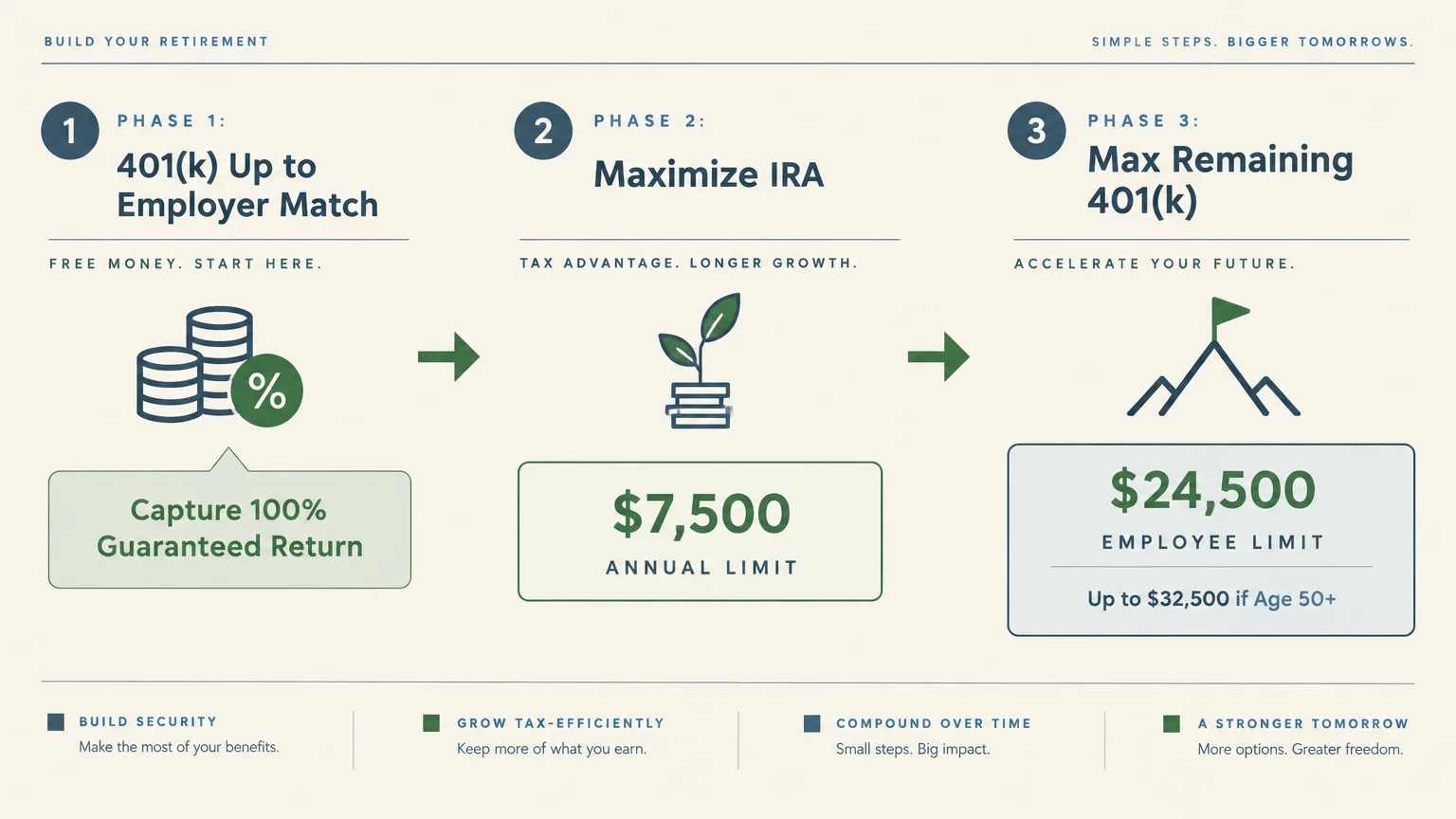
You do not have to view this decision as an all-or-nothing choice between accounts. Most financial plans yield the best mathematical results when you coordinate both vehicles in a clear sequence.
Step one is always capturing your full employer 401(k) match. If your employer offers a 50% match on the first 6% of your salary, contributing that 6% delivers an immediate, guaranteed 50% return.
Walking away from matching funds is equivalent to leaving earned compensation on the table. Secure every dollar of your match before directing savings anywhere else.
Step two involves shifting extra retirement savings into an IRA until you hit the annual cap. This move unlocks superior investment choices and lower administrative expenses than most company plans provide.
Targeting a Roth IRA at this stage also builds a pool of flexible, tax-free capital for your future. If your income exceeds Roth contribution caps, an IRA still gives you low-cost index fund access.
Step three directs surplus cash back into your employer 401(k) once your IRA is fully funded. Continuing to contribute up to the $24,500 limit in 2026 maximizes your total tax sheltering.
For more strategies on budgeting and building emergency savings alongside retirement, consult consumer tools from the Consumer Financial Protection Bureau.
Errors That Cost Families Thousands
Failing to understand workplace plan rules can cost your household tens of thousands of dollars over a career. One frequent mistake is allowing high administrative fees to erode compound returns without your knowledge.
Always review your plan’s annual fee disclosures to see if fund expense ratios exceed 0.50%. If costs run high, contribute only enough to capture the company match, then pivot to a low-cost IRA.
Another devastating financial blunder occurs when workers change jobs and cash out their 401(k) balances. Liquidating a $20,000 balance can cost you over $6,000 in early penalties and income taxes immediately.
Worse, cashing out permanently forfeits decades of compound market growth. Always execute a direct rollover into your new employer’s plan or an IRA rollover account.
Savers also trigger IRS penalties by making improper Roth IRA contributions when household income exceeds annual phase-out caps. Making an ineligible contribution triggers a 6% excise penalty each year the excess remains in the account.
Finally, monitor your contribution deadlines carefully. A 401(k) requires payroll deposits by December 31, while an IRA gives you until the federal tax filing deadline the following April.

When to Get Expert Help
Straightforward workplace saving rarely requires paid professional intervention. However, complex household tax situations warrant the expertise of a qualified professional.
If your household income borders the phase-out limits, speak with a Certified Public Accountant (CPA). A CPA can execute advanced strategies like a Backdoor Roth IRA without triggering costly tax reporting errors.
Families navigating career transitions or retirement buyouts should consult a fee-only fiduciary financial planner. Fiduciary advisors charge an hourly or flat fee and do not earn commissions by selling proprietary investments.
If you leave an employer with concentrated company stock inside your 401(k), consult a tax advisor before rolling funds over. Specialized rules like Net Unrealized Appreciation (NUA) can save you substantial sums on capital gains taxes.
Frequently Asked Questions
Can I contribute to both a 401(k) and an IRA in the same year?
Yes, you can contribute to both accounts simultaneously if you have sufficient earned income. Maximizing both options allows you to shield up to $32,000 in 2026, or $33,000 in 2027, from standard taxable accounts.
What happens to my 401(k) when I leave my job?
When you leave an employer, you can leave the balance in place, roll it into your new employer’s plan, or roll it into an IRA. Rolling into an IRA gives you the widest choice of low-cost investments without tax penalties.
Does my employer match count toward my annual 401(k) contribution limit?
No, your company match does not count against your employee elective deferral cap of $24,500 in 2026. The match only counts toward the overall plan limit of $72,000 in 2026 and $75,000 in 2027.
Can I borrow money from an IRA if I face an emergency?
No, federal law prohibits taking loans from an IRA. If you need temporary access to capital, workplace 401(k) plans are the only retirement accounts that may permit participant loans.
Building Your Personal Retirement Roadmap
Balancing daily living expenses with long-term investing requires deliberate cash management. You do not need a massive income to build significant wealth; you simply need an automated, disciplined framework.
Begin by checking your pay stub to ensure you capture your full company 401(k) match. Once that match is locked in, open an IRA to gain access to low-cost index funds and customizable tax options.
Review your contribution percentages whenever you receive a raise or eliminate an ongoing debt. Consistent, automated contributions turn today’s disciplined budget choices into tomorrow’s financial freedom.
Information in this article reflects rules and figures current as of the publication date and may change. Always confirm details directly with your bank, the IRS, the Social Security Administration, or other official sources before making decisions.
Last updated: November 2026. Rates, benefit amounts, and tax rules change—always verify current details at official sources.