Slashing your monthly food bill does not require extreme couponing or skipping meals. Choosing the right discount grocer can instantly cut your household grocery expenses by nearly ten percent.
When you compare a standard cart of staples, Aldi prices consistently undercut Walmart groceries on everyday essentials. Yet store proximity, product variety, and curbside fulfillment fees complicate that simple math.
Understanding how these retail giants price identical items helps you protect your monthly cash flow. Here is the data-driven verdict on which chain truly delivers the cheapest grocery store experience.
The Bottom Line Up Front: Key Price Differences
Comparing grocery chains requires looking past marketing claims to real checkout receipts. Both retailers dominate the discount grocery space, but they operate entirely different business models.
Independent research shows that Aldi holds a noticeable price edge on standard pantry staples. However, Walmart counters with unmatched variety and superior digital fulfillment programs.
| Comparison Factor | Aldi | Walmart Supercenter |
|---|---|---|
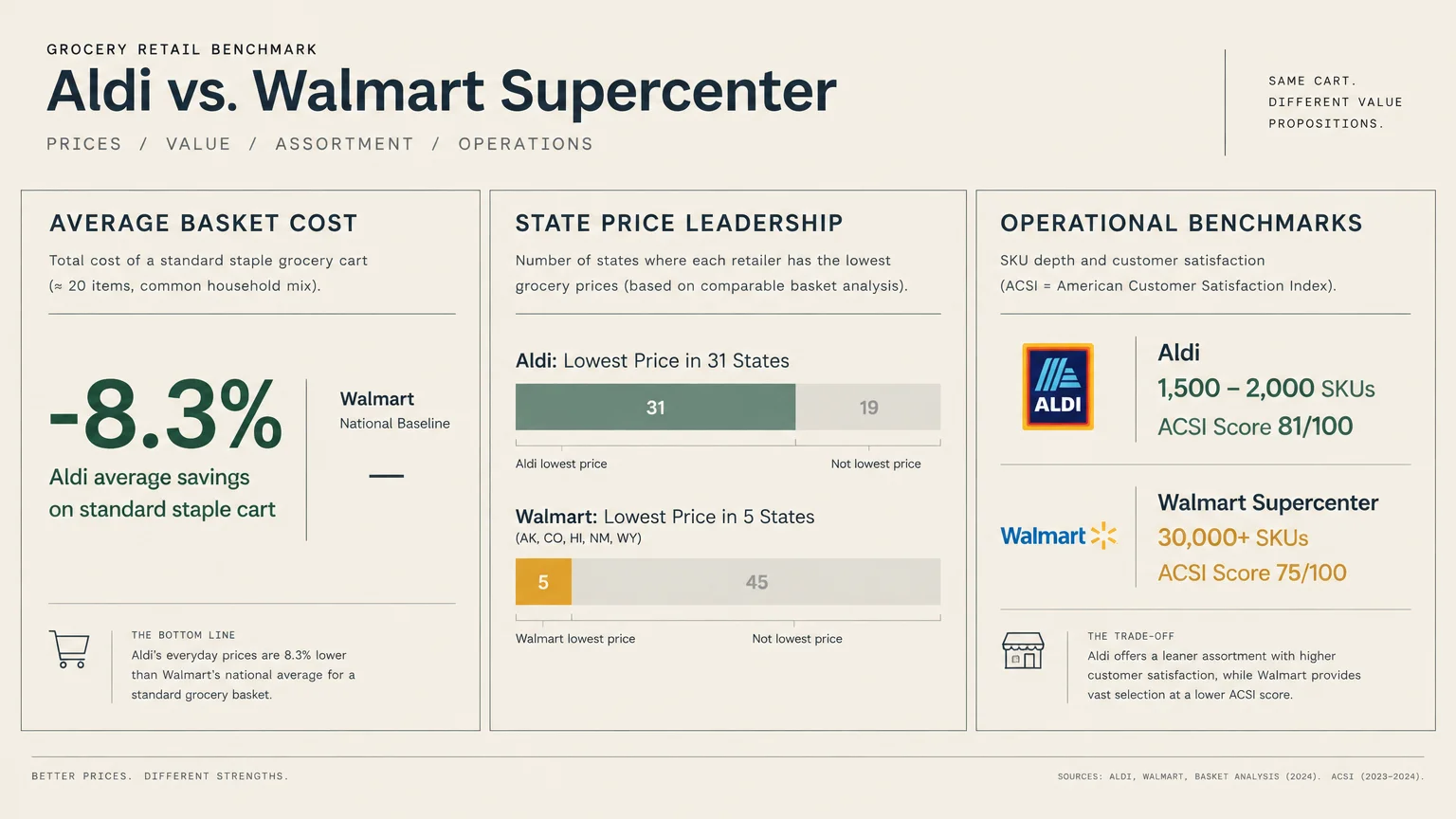
| Average Basket Cost Difference | 8.3% cheaper overall on standard staples | Baseline benchmark across national metros |
| Private-Label Inventory Share | Over 90% of total shelf stock | Substantial mix alongside national brands |
| Selection Size (SKUs) | Compact inventory of 1,500 to 2,000 items | Expansive catalog exceeding 30,000 items |
| Curbside Pickup Fees | Third-party fulfillment markups and fees apply | Free on store orders of $35 or more |
| Customer Satisfaction (2026 ACSI) | Rated 81 out of 100 | Rated 75 out of 100 |
| Return Guarantee | Twice as Nice Guarantee on store brands | Standard 90-day return policy with receipt |
| Statewide Price Leadership | Cheapest non-club grocer in 31 states | Cheapest non-club grocer in 5 states |
Your ultimate savings depend on how you shop. If you buy basic ingredients in person, Aldi almost always wins.
If you rely on name brands or curbside delivery, Walmart frequently saves you more net money. Balancing these tradeoffs keeps your recurring grocery budget firmly on track.
The Core Basket Comparison: Real Shelf Prices Compared
To determine the true winner, researchers analyze identical grocery baskets across multiple geographic regions. A comprehensive study by Consumer Reports and the Strategic Resource Group evaluated pricing across six major metropolitan markets.
That study revealed that Aldi averaged 8.3% cheaper than Walmart across a standardized cart of common household goods. While warehouse clubs like Costco and BJ’s beat Walmart by roughly 21%, Aldi took the crown among traditional retail format grocers.
A broader state-by-state analysis showed Aldi as the cheapest non-club grocer across 31 individual states. Walmart claimed the lowest pricing title in only five states: Alaska, Colorado, Hawaii, New Mexico, and Wyoming.
In those five regions, Aldi either lacked a retail presence or maintained a severely limited distribution footprint. Regional competitors like Lidl led pricing in eight states, while WinCo Foods ranked lowest in five.
Macroeconomic data underscores why finding the cheapest grocery store matters so much right now. According to the Bureau of Labor Statistics (BLS) and USDA Economic Research Service, food-at-home grocery prices rose 2.3% in 2025.
Analysts forecast an additional 2.4% increase in food-at-home costs through 2026. While that rate tracks below historical spikes, specific food categories continue to experience severe volatility.
The USDA projects beef and veal prices to climb 9.4% in 2026, alongside a 6.6% jump in sugar and sweets. Fresh vegetables are expected to rise 5.7%, though egg prices are forecast to decline roughly 27% to 29%.
When core ingredients fluctuate so wildly, small percentage differences at the checkout register multiply quickly. Saving 8.3% on an average $800 monthly grocery budget preserves nearly $800 in liquid capital every single year.
Store Brands and Selection: Great Value and bettergoods vs. Aldi Exclusives
Private-label products represent the secret weapon behind discount grocery pricing. Store brands eliminate massive marketing and advertising expenses, passing those production savings directly down to your cart.
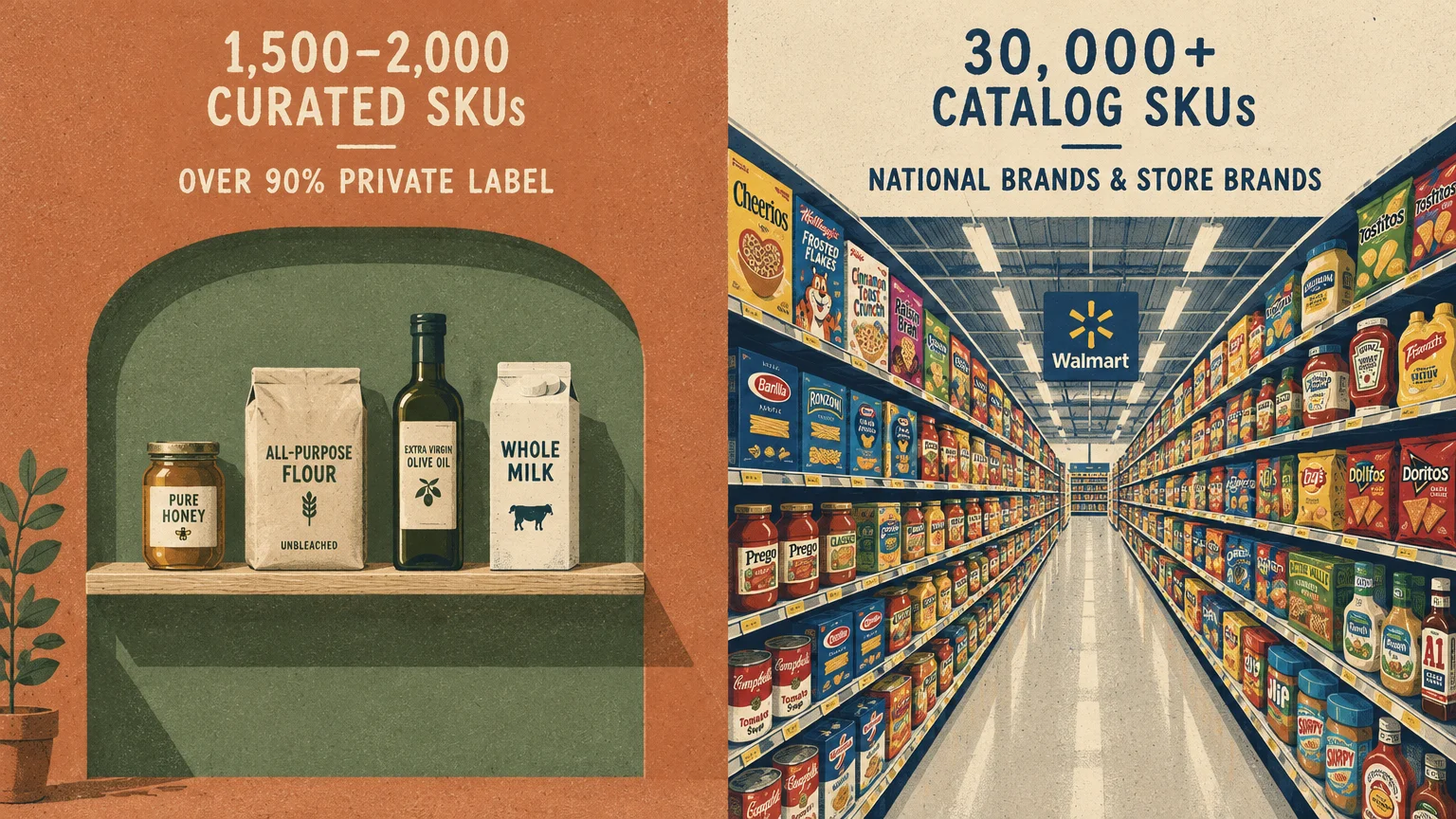
Aldi builds its entire retail model around this low-overhead principle. Over 90% of Aldi shelf stock consists of exclusive private-label brands like Simply Nature, Millville, and LiveGFree.
By limiting inventory to roughly 1,500 to 2,000 distinct stock-keeping units (SKUs), Aldi optimizes warehouse logistics. A standard Walmart Supercenter, by comparison, stocks more than 30,000 SKUs.
Walmart features its budget-friendly flagship brand, Great Value, across virtually every grocery aisle. Great Value prices match Aldi private labels closely, often coming within pennies on basic milk, flour, and sugar.
Walmart has also invested heavily in elevated private-label products to compete with specialty chains. It introduced and expanded its bettergoods brand toward 1,000 unique items after generating more than $500 million in sales.
Roughly 70% of bettergoods items cost under $5, delivering chef-inspired meal components at accessible price points. This expansion allows Walmart shoppers to access gourmet items without paying premium grocery store markups.
Consumer appetite for private brands has expanded nationwide. Research from Circana and FMI shows that annual private-label sales reached record levels between $282.8 billion and $330 billion.
Store brands now represent approximately 24% of all grocery unit sales across the country. Over 92% of American households regularly buy store brands, and 94% intend to keep buying them even if inflation cools.
Between the two retailers, Aldi still wins on uniform staple pricing. However, Walmart gives you far more private-label variety if your family requires specialized culinary ingredients or specific national brands.
Digital Convenience: Pickup and Delivery Price Realities
In-store shelf prices tell only half the financial story in a modern household budget. Busy work schedules make online ordering and curbside pickup essential time-saving tools for many families.
This is where Walmart seizes a massive operational and financial advantage. Walmart operates direct, company-managed fulfillment infrastructure through its proprietary mobile app and website.
Walmart provides completely free curbside pickup on all grocery orders of $35 or more. If an order falls below $35, Walmart charges a flat fulfillment fee of $6.99.
For home delivery, Walmart offers its Walmart+ subscription service for $98 annually or $12.95 per month. Subscribers receive unlimited free home grocery delivery on eligible orders over $35.
Walmart also supports lower-income households through its Walmart+ Assist program. Eligible recipients of qualifying government assistance programs, including SNAP, pay a discounted rate of $49 per year or $6.47 monthly.
Aldi handles digital fulfillment through an entirely different channel. Aldi relies primarily on third-party marketplace delivery platforms such as Instacart, DoorDash, and Uber Eats.
These third-party platforms charge visible checkout service fees, platform fees, and driver gratuities. More importantly, items ordered through these apps frequently carry a direct price markup above in-store shelf tags.
A grocery cart that costs $100 inside an Aldi store can easily reach $115 to $125 when purchased online. That markup instantly wipes out Aldi’s 8.3% in-store price advantage over Walmart.
If you plan to utilize curbside pickup or delivery every single week, Walmart is usually cheaper. The platform transparency and free pickup options at Walmart protect your total cash outlay far better than app-based ordering.
Quality, Freshness, and Waste: Produce and Meats
Sticker prices mean nothing if food rots inside your refrigerator before your family eats it. Food waste acts as an invisible tax on your monthly spending plan.
Shoppers often voice mixed opinions regarding produce quality at discount grocers. In independent customer surveys, however, Aldi consistently outranks its retail competitors on shopper satisfaction.
The 2026 American Customer Satisfaction Index (ACSI) Supermarket study awarded Aldi a score of 81 out of 100. That score tied Aldi with Costco and Whole Foods, comfortably exceeding the overall grocery industry average of 78.
Walmart scored 75 out of 100 in the same ACSI evaluation. While Walmart has made strides in supply chain refrigeration, shoppers continue to rate fresh food consistency lower at Supercenters.
One major functional difference between the stores involves fresh produce packaging. Aldi packages many vegetables and fruits in plastic bulk nets or sealed containers.
You can buy a three-pound bag of onions or a two-pound carton of apples at an exceptionally low unit price. But if you live alone and need only a single lime or one red potato, packaging forces you to overbuy.
Walmart sells a wider selection of loose produce priced by the individual pound. Selecting exact quantities helps single shoppers and small households prevent spoilage and unnecessary spending.
Both grocers carry standard USDA Choice beef cuts, fresh poultry, and frozen seafood. Aldi frequently discounts fresh chicken breasts and pork tenderloins mid-week to clear inventory quickly.
Consumer protection principles emphasize checking dates and inspecting cuts regardless of where you shop. The Consumer Financial Protection Bureau (CFPB) encourages consumers to monitor recurring necessities to keep disposable income secure.
Pay close attention to weight stickers and sell-by dates at both chains. Inspecting package seals before leaving the store guarantees you receive full culinary value for every dollar spent.
Return Guarantees: Twice as Nice vs. Standard Policies
A strong store return policy provides financial insurance against expired items or spoiled meats. When you test budget-friendly store brands, risk protection matters.
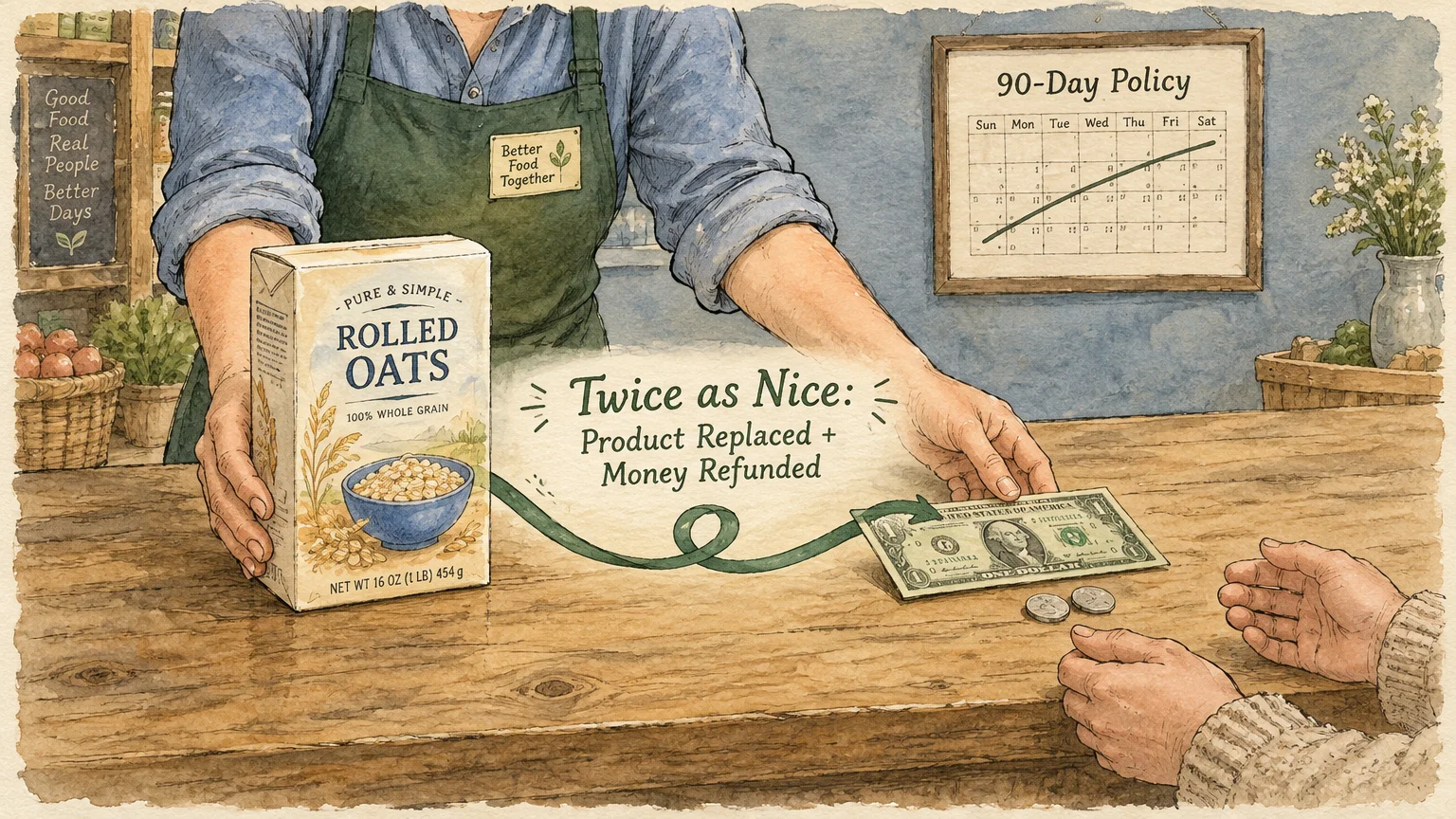
Aldi offers one of the most generous consumer protections in the retail food industry. Its famous “Twice as Nice” Guarantee applies to exclusive store-brand food items.
If you are dissatisfied with a qualifying Aldi-brand product, bring it back with your receipt within 90 days. Aldi will replace the physical product and refund your purchase price in cash or original payment.
This policy eliminates financial risk when trying off-brand cereals, yogurts, or frozen entrees. You never lose money when testing whether a discount alternative satisfies your household’s tastes.
Walmart offers a standard, reliable 90-day return window on general grocery items and produce. If an item spoils prematurely or fails your standards, customer service provides a direct refund or replacement with receipt.
Walmart does not provide a dual refund-plus-replacement feature like Aldi. Nevertheless, its automated app makes tracking digital receipts and submitting customer service requests straightforward.
“A budget is telling your money where to go instead of wondering where it went.” — John C. Maxwell
Maintaining purchase receipts on your smartphone protects your cash flow against retail errors. Never hesitate to return subpar food items to either retailer for a full refund.
Store Footprint and Shopping Efficiency
The layout of a grocery store directly shapes your spending discipline. Retail psychologists know that the longer you walk down grocery aisles, the more unplanned merchandise lands in your cart.
Walmart commands roughly 20% of the entire United States grocery market share. It operates between 4,601 and 4,615 stores across all 50 states, including approximately 3,569 massive Supercenters.
Walmart also runs 674 Neighborhood Markets, which focus solely on groceries and pharmacy needs. To modernize physical locations, Walmart launched multi-year remodeling programs across 650 stores.
Aldi operates a smaller yet rapidly accelerating retail footprint. As of late 2026, Aldi manages roughly 2,706 to 2,740 locations across 41 states and territories.
The company announced plans to reach nearly 2,800 active locations by the end of 2026. This push includes entering Maine and expanding stores across Phoenix, Las Vegas, and Colorado.
Aldi is backing that retail surge with a $9 billion capital investment to reach 3,200 operating stores by 2028. This rapid construction brings discount pricing directly into hundreds of new suburban communities.
Physical store layouts differ dramatically between the two competitors. A trip through Aldi takes 15 to 25 minutes due to wide aisles, simple pallet displays, and five or six total aisles.
Aldi requires a 25-cent refundable coin deposit to unlock shopping carts. This mechanical incentive ensures customers return their own carts, reducing labor overhead that would otherwise raise shelf prices.
Aldi also requires shoppers to bag their own groceries using their own reusable bags. These small consumer habits lower operational costs, supporting the chain’s lower baseline pricing.
Navigating a Walmart Supercenter, by comparison, requires substantial physical walking. Shoppers often spend 45 to 60 minutes navigating apparel, electronics, and home goods aisles before reaching the dairy wall.
That extended exposure creates endless opportunities for impulse purchases. A consumer focused strictly on saving money often finishes an Aldi shopping run with significantly fewer discretionary items.
Payment Options and Assistance Programs
Managing grocery spending requires leveraging payment methods that maximize liquid cash. Both Walmart and Aldi accommodate a wide range of household financial situations.
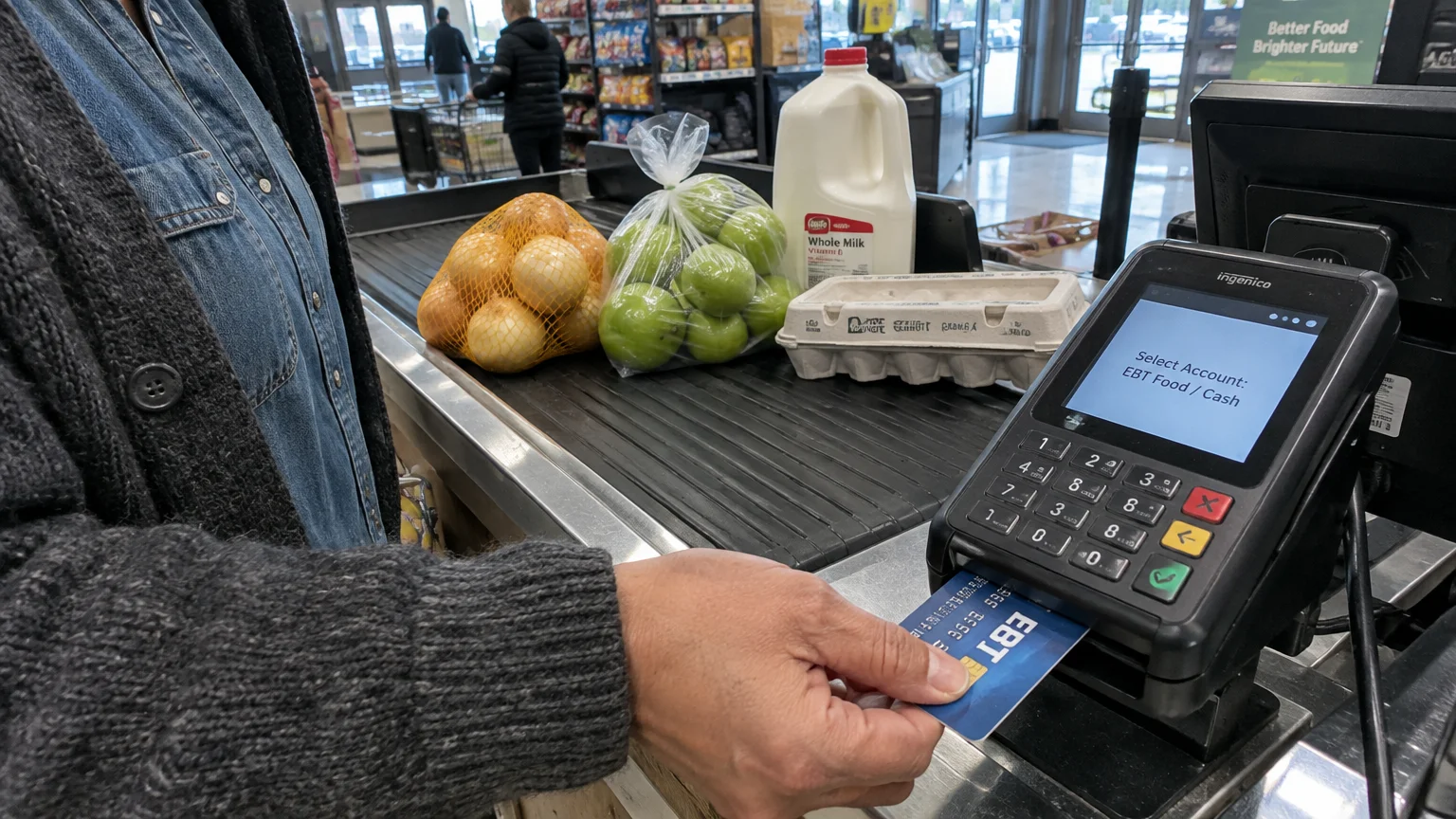
Both grocers fully support the Supplemental Nutrition Assistance Program (SNAP) and accept EBT cards. You can utilize SNAP/EBT funds directly at physical registers or when placing online pickup and delivery orders.
Federal resources through USA.gov Money and Taxes outline income guidelines for benefit qualification. Pairing assistance programs with discount grocers helps vulnerable households stretch assistance dollars significantly further.
Walmart accepts standard credit cards, debit cards, cash, and Walmart Pay via its smartphone app. Walmart does not accept Apple Pay or Google Pay at register terminals.
Aldi accepts major credit cards, debit cards, cash, Apple Pay, Google Pay, and contactless cards. Utilizing a cash-back credit card offering 3% to 6% rewards on grocery store purchases compounds your Aldi savings.
Keep in mind that certain credit card networks categorize Walmart Supercenters as general superstores rather than standalone supermarkets. That processing distinction can cause credit card rewards programs to award only 1% cash back on Walmart purchases.
Review your credit card terms to verify merchant classification codes before shopping. Maximizing category bonuses turns low shelf prices into even larger effective discounts.
Don’t Make These Mistakes
Saving money on groceries requires deliberate habits. Avoid these common retail pitfalls to ensure you keep more cash in your wallet.
- Ordering Aldi online via third-party apps: Third-party delivery platforms apply markups to Aldi shelf tags. The resulting markup and service fees eliminate the 8.3% savings you would gain by shopping in the store.
- Buying name brands at Aldi: Aldi stocks limited national brand products as special buys. These items rarely carry deep discounts and often cost more than identical products at Walmart.
- Ignoring the middle aisle impulse trap: The center section of Aldi features seasonal home goods, apparel, and cookware known as Aldi Finds. Purchasing unbudgeted decorative items destroys the savings you achieved on food staples.
- Purchasing bulk produce you cannot finish: Pre-bagged produce at Aldi saves money on unit pricing only if you consume every piece. Throwing away half a bag of rotten citrus erases your original savings.
- Shopping at Walmart without a written list: Walking through a 180,000-square-foot Supercenter without strict purchase parameters leads to impulse buying. Unplanned non-grocery purchases frequently ruin your monthly spending target.
The Strategic Hybrid Grocery Plan
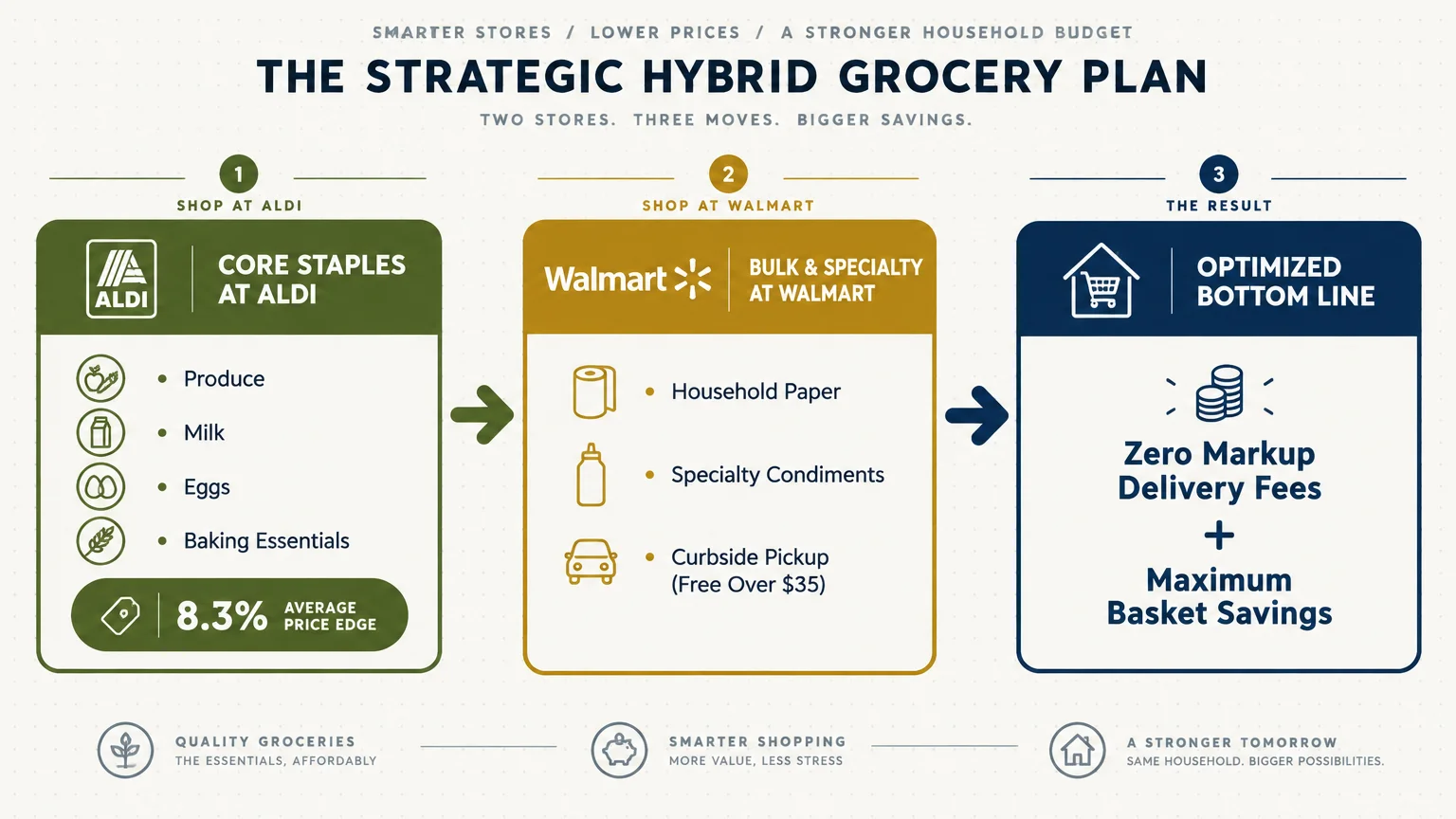
You do not need to pledge absolute loyalty to one single retailer. A balanced hybrid strategy consistently generates the lowest monthly grocery bill.
Smart household budget managers split their purchasing between both grocers based on product strengths. This dual approach leverages Aldi’s low staple pricing while utilizing Walmart for specialized goods.
“Do not save what is left after spending, but spend what is left after saving.” — Warren Buffett
Follow this practical shopping distribution model to optimize your total expenditure:
- Purchase weekly pantry basics at Aldi: Buy milk, eggs, butter, flour, oats, canned beans, and baking supplies at Aldi. You secure an automatic 8% to 10% discount on everyday necessities.
- Stock up on Aldi snacks and specialty cheeses: Aldi private labels offer exceptional charcuterie and snack values. Crackers, nuts, and cheeses cost substantially less than name-brand supermarket alternatives.
- Use Walmart for specific recipe ingredients: Head to Walmart when you need unique spices, ethnic seasonings, or specific cuts of meat. Walmart’s 30,000 SKUs prevent you from making extra stops at expensive high-end grocers.
- Buy household paper goods and toiletries at Walmart: Paper towels, trash bags, personal hygiene products, and cleaning chemicals are cheaper at Walmart. Walmart’s Great Value line dominates this specific household product category.
- Leverage Walmart free curbside pickup when pressed for time: If your schedule prohibits a manual shopping trip, use Walmart pickup. You avoid third-party markups and prevent impulsive in-store purchases completely.
This split method prevents burnout while optimizing your hard-earned cash flow. Direct the resulting weekly surplus into a dedicated liquid emergency fund or high-yield savings account.
Frequently Asked Questions About Walmart and Aldi
Is Aldi always cheaper than Walmart?
Aldi is roughly 8.3% cheaper than Walmart on everyday food staples and private-label goods. However, Walmart often beats Aldi on national name brands, specialty health foods, and household paper items.
Why are Aldi prices lower than traditional supermarkets?
Aldi limits its inventory to fewer than 2,000 SKUs and stocks mostly private-label products. It also uses quarter-deposit carts, displays products directly in shipping boxes, and requires customers to bag their own groceries.
Does Walmart price match Aldi store prices?
Walmart does not match competitor shelf prices or print advertisements from other grocers. Walmart dropped its widespread competitor price-matching program years ago to focus on its Everyday Low Price strategy.
Which store offers the best value for curbside grocery pickup?
Walmart offers superior value for pickup because it provides free curbside fulfillment on orders of $35 or more. Aldi relies primarily on third-party platforms that charge added service fees and per-item product markups.
Take Control of Your Grocery Budget
Review your grocery receipts from the past month to identify your household’s most frequent purchases. Shifting your core staples to Aldi while utilizing Walmart for household goods can easily save $150 to $300 each month.
Put those grocery savings directly toward debt payoff or automated emergency reserves. Financial outcomes vary based on individual income, credit history, and circumstances. This article provides general guidance only. Consult a qualified financial planner, CPA, or consumer attorney for advice specific to your situation.
Last updated: November 2026. Rates, benefit amounts, and tax rules change—always verify current details at official sources.