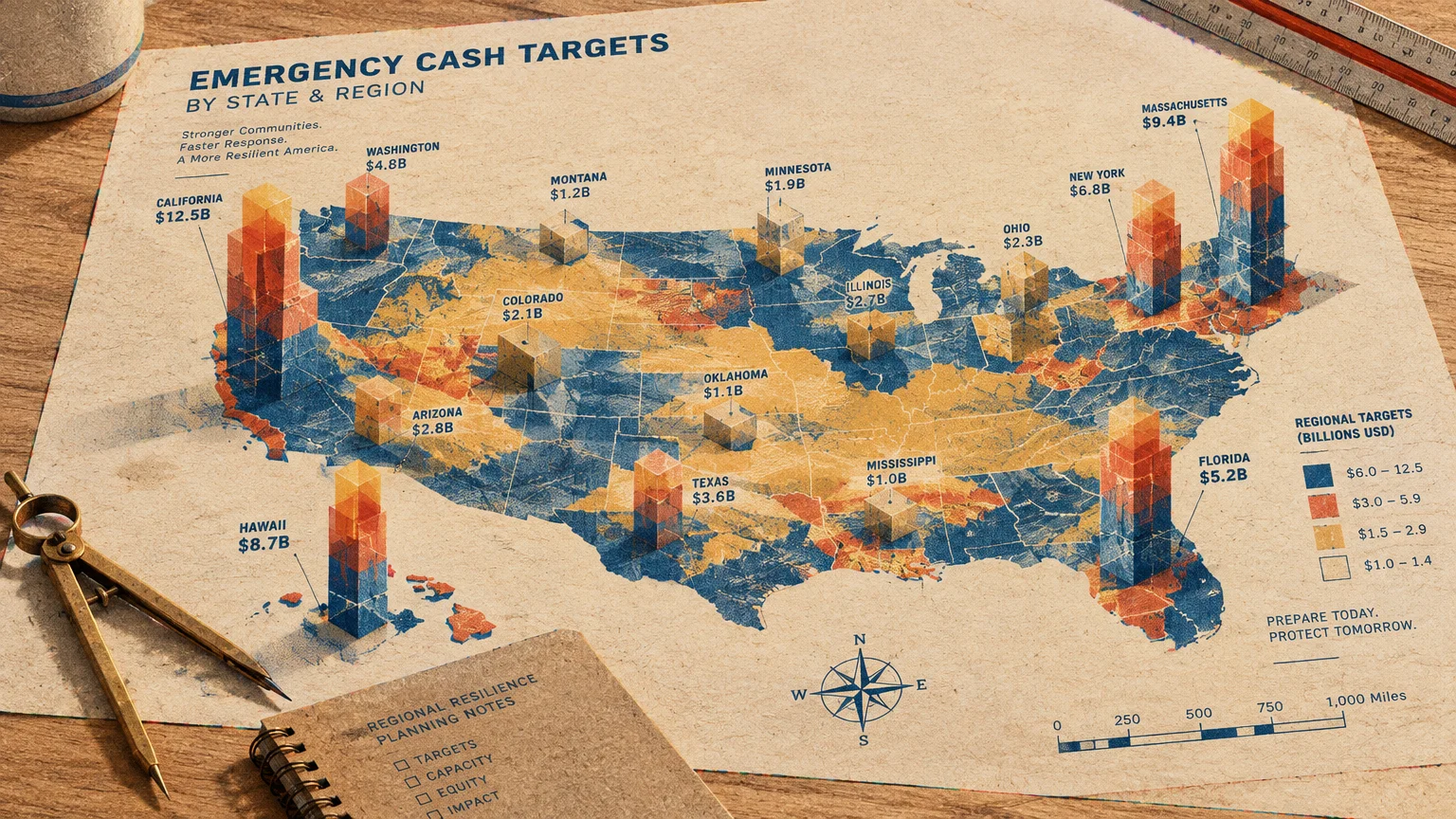
A standard three-to-six-month emergency fund means vastly different dollar amounts depending on your zip code. In 2025, average U.S. household spending hit $81,905—roughly $6,825 per month—according to the U.S. Bureau of Labor Statistics (BLS).
That national average hides steep state-by-state gaps in rent, groceries, and unemployment benefits. Covering six months of bills in Hawaii or Massachusetts requires far more cash than weathering the same downturn in Oklahoma or Mississippi.
You can calculate your true recession target by combining your state’s cost of living, realistic job-search timelines, and local safety-net limits.
Why the Standard Emergency Fund Rule Breaks Down in a Recession
Financial planners and FINRA commonly advise keeping three to six months of essential living expenses in cash. They also recommend holding an even larger reserve if you are self-employed or earn variable income.
The Consumer Financial Protection Bureau (CFPB) defines an emergency fund as a dedicated cash reserve for unplanned bills or lost income. Even a modest starter cushion helps your household recover from financial shocks without relying on high-interest debt.
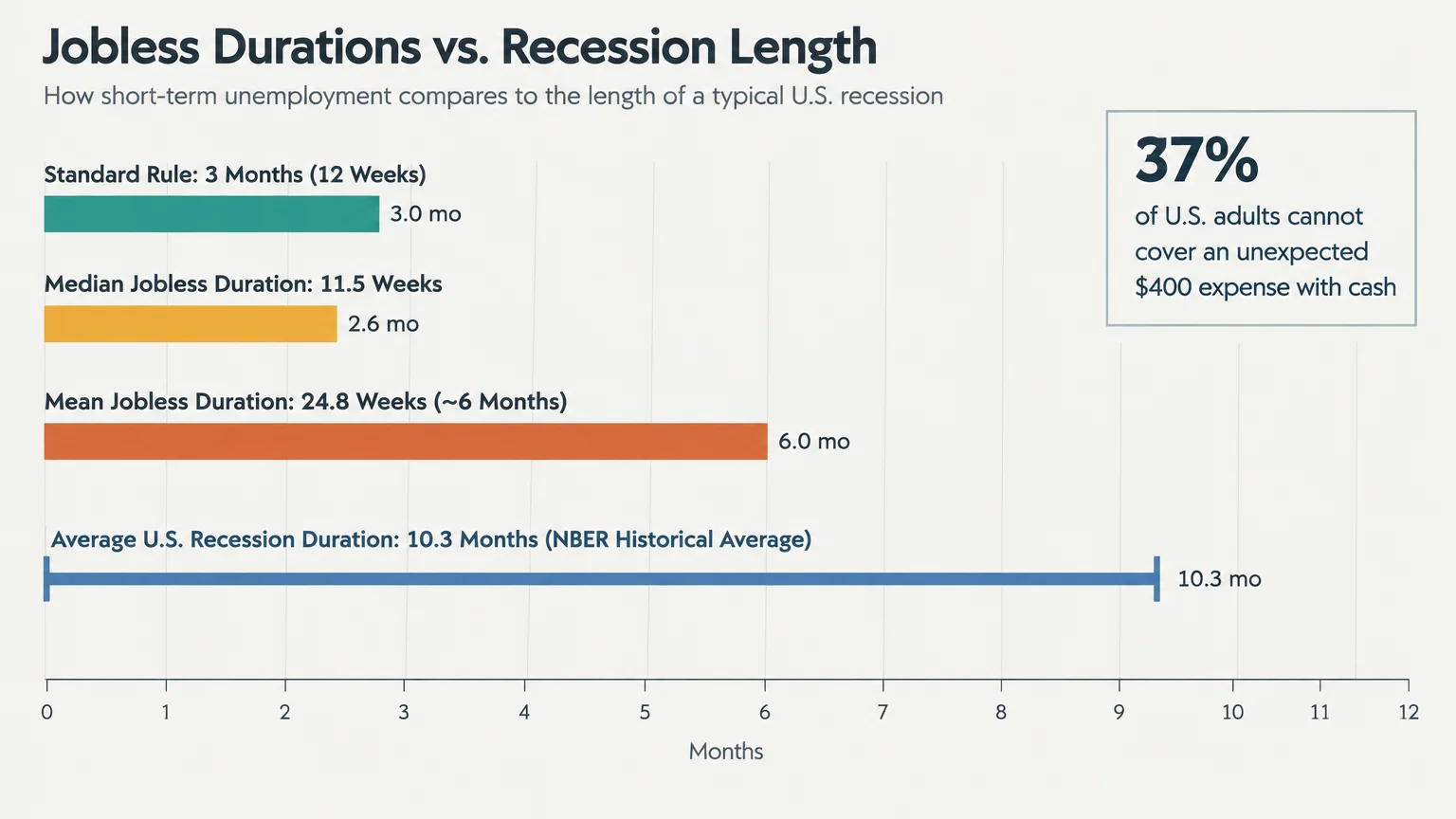
Yet most American households enter downturns well short of that benchmark. According to the Federal Reserve’s Survey of Household Economics and Decisionmaking (SHED) for 2025, published in May 2026, only 63% of U.S. adults could cover an unexpected $400 bill entirely with cash.
The remaining 37% would borrow, sell belongings, or be unable to pay. That readiness figure has stalled for three straight years and sits below the 68% recorded in 2021.
Longer-term readiness looks even tighter. Only 55% of adults held enough rainy-day savings in 2025 to cover three months of expenses, down from 59% in 2021, while 30% could not cover three months even by borrowing or selling assets.
Bankrate’s 2026 Annual Emergency Savings Report underscores that fragility across wider income groups. Just 46% of Americans hold at least three months of emergency savings—19% have three to five months, and 27% have six months or more.
Another 30% have less than three months saved, and 24% have no emergency savings at all. Only 30% would pay a $1,000 emergency from savings, while 33% would take on debt through credit cards, personal loans, or borrowing from relatives.
Inflation and existing balances make building reserves harder. Bankrate found that 54% of Americans say inflation forces them to save less, and 29% carry more credit card debt than emergency cash.
During a recession, small shocks collide with longer unemployment spells. Across the 12 U.S. recessions since 1945 tracked by the National Bureau of Economic Research (NBER), economic contractions lasted an average of 10.3 months—from two months in 2020 to 18 months during 2007–2009.
Even in a relatively steady job market, finding new work takes longer than many households budget for. In October 2026, BLS reported a 4.1% national unemployment rate representing 7.1 million jobless workers.
In September 2026, the median unemployment duration reached 11.5 weeks—nearly three months, up from 10.1 weeks a year earlier. Meanwhile, the mean duration climbed to 24.8 weeks, or nearly six months, pulled upward by 1.94 million people out of work for 27 weeks or longer.
Age can lengthen that job search further. In October 2026, BLS and AARP data showed long-term unemployment affecting 28.1% of jobseekers ages 16 to 54 and 32% of those 55 and older.
How Your State’s Cost of Living Shapes Your Monthly Baseline
Before you multiply anything by three or six months, you need a clear picture of where household dollars go. BLS Consumer Expenditure data for 2025, released in October 2026, shows U.S. households spent an average of $81,905—up 4.3% from $78,527 in 2024—against $110,847 in average pre-tax income.
Housing dominates every family budget. It consumed 33.9% of total spending in 2025, averaging $27,790 per year after rising 5.8% year-over-year—with shelter costs up 8.0% and rented dwellings climbing 10.8%.
Three other categories made up the bulk of remaining household outlays:
- Transportation: 16.5% of total spending, covering car payments, fuel, insurance, and maintenance.
- Food: 13.0% of total spending, split between groceries and dining out.
- Personal insurance and pensions: 12.4% of total spending, including life insurance and retirement contributions.
Because housing alone absorbs roughly one-third of spending, state housing markets drive massive differences in emergency targets. Missouri Economic Research and Information Center (MERIC) data for Q1 2026 shows Hawaii as the costliest state at an index of 184.8, where 100 equals the U.S. average.
Hawaii’s housing index sits at 302.4—more than triple the national baseline. Massachusetts follows overall at 147.8, with California at 140.5, Washington, D.C. at 134.3, Alaska at 129.0, New York at 124.7, Maryland at 121.1, and New Jersey at 118.8.
At the other end, Oklahoma ranks as the least expensive state at 83.5 overall and 66.9 for housing. U.S. Bureau of Economic Analysis (BEA) Regional Price Parities for 2024, released in February 2026, confirm similar gaps—from California at 110.7 to Arkansas at 86.9 and Mississippi at 87.0.
BEA’s rent price parities stretch even wider, from 154.3 in California down to 54.2 in West Virginia. Total personal consumption per resident in 2025 likewise ranged from $100,574 in D.C. down to $45,970 in Mississippi.
To see how geography shifts your cash target, the table below applies MERIC Q1 2026 state indices to the BLS $6,825 national monthly spending average. These figures reflect full average budgets before trimming discretionary costs.
| State | Q1 2026 Cost Index (U.S. = 100) | Estimated Monthly Spending | 3-Month Emergency Target | 6-Month Emergency Target |
|---|---|---|---|---|
| Oklahoma | 83.5 | $5,699 | $17,097 | $34,194 |
| U.S. Average | 100.0 | $6,825 | $20,475 | $40,950 |
| New Jersey | 118.8 | $8,108 | $24,324 | $48,648 |
| New York | 124.7 | $8,511 | $25,533 | $51,066 |
| California | 140.5 | $9,589 | $28,767 | $57,534 |
| Massachusetts | 147.8 | $10,087 | $30,261 | $60,522 |
| Hawaii | 184.8 | $12,613 | $37,839 | $75,678 |
You do not need to fund vacations, extra subscriptions, or retirement contributions out of an emergency reserve during a layoff. Stripping out nonessential outlays lowers your monthly burn rate, though fixed rent or mortgage payments remain hard to shrink quickly.

State Unemployment Benefits: The Hidden Gap in Your Safety Net
Many workers assume state unemployment insurance (UI) will cover most of their bills while they look for a new role. In reality, benefit caps and time limits vary by more than fivefold across state lines.
According to U.S. Department of Labor and state agency figures as of October 2026, Washington offers the nation’s highest base weekly maximum at $1,208, effective July 2026. Massachusetts follows at $1,154 per week as of October 2026, plus $25 per dependent child.
Across all 50 states, the median maximum weekly benefit sits at just $624—or $2,496 over four weeks before taxes. Mississippi caps weekly benefits at $235, and Alabama caps them at $275.
Even if you earn a six-figure salary, you cannot collect more than your state’s statutory ceiling. In a median-benefit state, a household with $6,825 in monthly spending faces more than a $4,300 monthly shortfall even while receiving maximum unemployment checks.
Benefit duration creates an equally dangerous trap. Roughly 34 to 35 states and D.C. pay regular unemployment benefits for up to 26 weeks, while Massachusetts pays up to 30 weeks.
Five states—Arkansas, Florida, Louisiana, North Carolina, and Tennessee—cap regular unemployment at just 12 weeks maximum. Alabama cuts off regular benefits after 14 weeks.
Remember that unemployment insurance counts as fully taxable federal income, and many states tax it as well. If you do not elect tax withholding on your claims, you can face an unwelcome tax bill the following spring.
Build your recession fund around your fixed bills and your state’s actual safety net, not around optimistic assumptions about how fast you will land your next paycheck.
The comparison below shows how state UI rules reshape the amount of cash you must self-fund during a six-month layoff.
| State UI Profile (2026) | Max Weekly Benefit | Four-Week Gross Benefit | Max Regular Weeks | Impact on Your Recession Reserve |
|---|---|---|---|---|
| Washington (High Cap / Standard Length) | $1,208 | $4,832 | 26 weeks | Covers a substantial share of core bills, though high local housing costs still require sizable cash savings. |
| Massachusetts (High Cap / Extended Length) | $1,154 (+$25/child) | $4,616 | 30 weeks | Provides strong support during long searches, yet high regional costs keep 6-month cash needs elevated. |
| 50-State Median (Typical Cap) | $624 | $2,496 | 26 weeks | Leaves a major monthly gap for average earners; you must fund most housing and food costs yourself. |
| Florida / North Carolina / Tennessee / Arkansas / Louisiana | Varies by state | Varies by state | 12 weeks | Benefits expire near the 3-month median job-search mark, forcing full self-funding for months 4 through 6. |
| Mississippi (Lowest Weekly Cap) | $235 | $940 | 26 weeks | Replaces very little income even in a low-cost state, requiring a self-funded cash buffer from week one. |
Step-by-Step: Calculate Your State-Adjusted Recession Emergency Fund
Generic rules of thumb leave you guessing when headlines turn sour. Follow these four steps to build a target tailored to your household, your career risk, and your state.
- Calculate your bare-bones monthly survival budget. Add up rent or mortgage, utilities, groceries, health and auto insurance, minimum debt payments, and essential transportation—while removing dining out, travel, and discretionary shopping.
- Add a buffer for persistent inflation. BLS data for October 2026 showed consumer prices rising 0.4% in a single month after a 0.6% jump in September, while producer prices rose 6.5% year-over-year—meaning grocery and repair costs can climb while you are out of work.
- Subtract conservative, after-tax state unemployment benefits. Check your state labor agency’s weekly cap and maximum week limit, reduce that figure for federal and state taxes, and assume zero UI support beyond week 12 if you live in a short-duration state.
- Multiply your monthly gap by your true risk window. Aim for at least three months of uncovered expenses in a stable dual-income household, six months for single-earner households given the 24.8-week average unemployment spell, and nine to twelve months if you work in a cyclical field, earn variable pay, or are 55 or older.
Suppose your stripped-down essential bills total $5,000 per month in a state that caps unemployment at $624 per week for 26 weeks. After setting aside money for taxes, UI might cover roughly $2,100 per month, leaving a $2,900 monthly cash gap.
Multiply that $2,900 gap by six months, and your baseline recession target becomes $17,400 instead of $30,000. Add $2,000 to $3,000 for an unexpected car repair—a shock 30% of U.S. adults experienced in 2025 according to the Federal Reserve—and your solid goal sits near $20,000.
If you live in Florida, North Carolina, or Tennessee, your benefits end at week 12. In that case, you need $2,900 per month for the first three months ($8,700) plus the full $5,000 per month for months four through six ($15,000), totaling $23,700 before adding repair buffers.
Where to Keep Your Recession Reserve—and How to Build It Faster
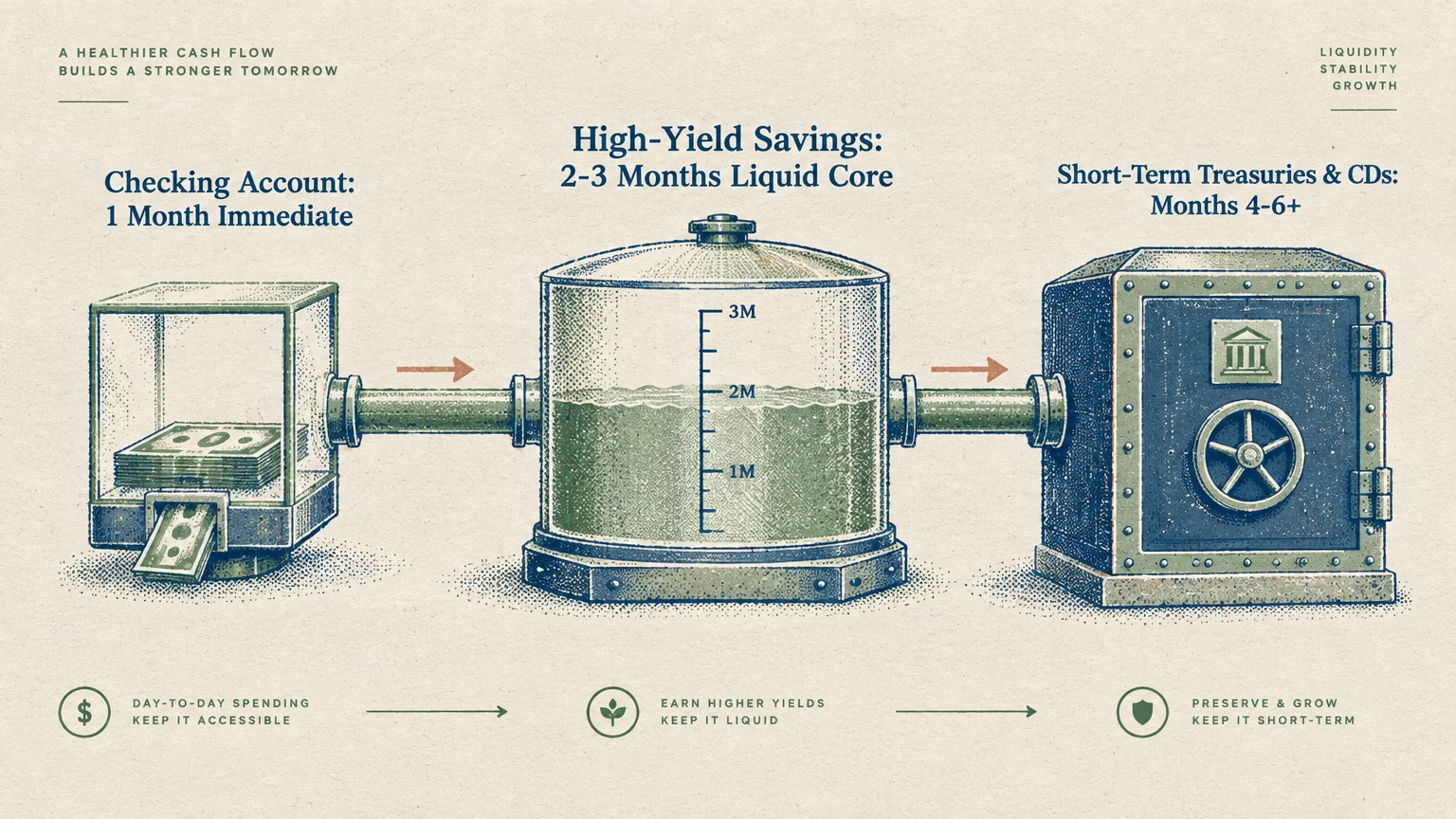
Your emergency fund has two non-negotiable jobs: stay safe from market drops and remain accessible within one to two business days. Keeping that money in the wrong account quietly costs hundreds of dollars every year.
As of October 19, 2026, the Federal Deposit Insurance Corporation (FDIC) reported a national average savings rate of just 0.38% APY, and 0.07% APY on interest checking accounts. Leaving $30,000 in an average savings account earns only $114 over an entire year.
Meanwhile, with the Federal Reserve holding its federal funds target range at 3.75% to 4.00% as of October 28, 2026, top FDIC-insured high-yield savings accounts (HYSAs) paid roughly 3.90% to 4.27% APY in October 2026—with select online accounts reaching 4.20% to 5.00% APY.
At 4.10% APY, that same $30,000 reserve earns $1,230 in a year—an extra $1,116 without taking on stock market risk. Verify that any bank holding your cash carries FDIC coverage, which protects up to $250,000 per depositor, per insured bank, per ownership category.
If you are starting from zero or rebuilding after an expense, skip extreme deprivation budgets that collapse after three weeks. Automated, low-friction habits steadily grow reserves without requiring constant willpower:
- Split your direct deposit at work. Route a fixed dollar amount—even $50 or $100 per paycheck—straight into a separate online HYSA so you never see it in checking.
- Audit recurring subscriptions every 90 days. Canceling three unused $15 streaming, software, or membership charges frees $45 a month, or $540 a year, with zero impact on your daily comfort.
- Assign windfalls before they arrive. Commit 50% to 75% of tax refunds, work bonuses, or rebates directly to your emergency account while keeping the rest for guilt-free spending.
- Name your account specifically. Labeling an account Recession Housing Buffer makes you far less likely to raid it for weekend impulse buys.
Costly Mistakes to Avoid
Even disciplined savers make structural errors that undermine their emergency cash right when a downturn hits. Watch out for these common traps:
- Treating credit cards or home equity as an emergency fund. Lenders routinely slash credit limits or freeze home equity lines during recessions, leaving households with 20%+ APR balances when jobs disappear.
- Keeping your reserve inside your everyday checking account. Earning 0.07% APY forfeits over $1,000 a year on a $30,000 fund and makes accidental overspending much easier.
- Investing emergency money in stocks or long-term bonds. Layoffs often strike during market sell-offs, forcing you to sell investments at a steep loss to pay rent.
- Assuming your emergency fund stays static year after year. With shelter costs rising 8.0% and rented dwellings climbing 10.8% in 2025, a reserve sized three years ago likely falls short today.
- Forgetting that 59% of adults hit a major surprise bill each year. Leaving zero buffer above bare-bones living costs means one vehicle repair can wipe out a month of rent coverage.

Don’t DIY These Decisions
Calculating a baseline savings goal is straightforward, yet several recession-related money moves carry steep legal or tax penalties if mishandled. Consider consulting a qualified specialist when facing these situations:
- CPA or enrolled agent: Get tax guidance before taking an early 401(k) hardship withdrawal, structuring severance payouts across tax years, or estimating quarterly taxes on unemployment and freelance income.
- Fee-only financial planner: Work with a fiduciary planner when balancing high-interest credit card payoff against emergency savings or coordinating cash reserves across a dual-income household in volatile industries.
- HUD-approved housing counselor: Contact a nonprofit housing counselor immediately if a prolonged job loss threatens your mortgage or rent so you can evaluate forbearance, loan modification, or local rental assistance options before missing payments.
- Consumer attorney or benefits counselor: Seek legal help if your state unemployment claim is wrongly denied, a severance agreement restricts future work, or debt collectors violate federal collection laws.
Frequently Asked Questions
How much emergency savings do I need for a recession in a high-cost state?
In high-cost states like Hawaii, Massachusetts, or California, six months of average total household spending ranges from $57,500 to over $75,000. After trimming discretionary expenses and accounting for state unemployment caps, most households still need $25,000 to $45,000 in liquid cash.
Does state unemployment insurance count toward my 6-month emergency fund?
Unemployment benefits can reduce how much cash you need, but never assume they replace your paycheck. With a 50-state median maximum of $624 per week and 12-week caps in states like Florida and North Carolina, you must self-fund most housing and food costs.
Should I pay off credit card debt or build a recession emergency fund first?
Build a starter cash cushion of $1,000 to one month of essential bills first so new emergencies do not push you deeper into debt. Once that floor sits safely in a high-yield savings account, split extra cash between high-APR debt payoff and reaching your full recession target.
Where is the safest place to keep a 6-month emergency fund right now?
An FDIC-insured online high-yield savings account offers the strongest mix of safety, liquidity, and yield. Top accounts paid roughly 3.90% to 4.27% APY in October 2026—over ten times the 0.38% national average—while insuring up to $250,000 per depositor, per bank.
Start this week by adding up one month of essential bills, looking up your state’s weekly unemployment cap, and transferring your existing savings into an FDIC-insured high-yield account. Even boosting your reserve by one month of rent puts you ahead of millions of households and buys priceless breathing room before the next downturn arrives.
Financial outcomes vary based on individual income, credit history, and circumstances. This article provides general guidance only. Consult a qualified financial planner, CPA, or consumer attorney for advice specific to your situation.
Last updated: November 2026. Rates, benefit amounts, and tax rules change—always verify current details at official sources.