The Federal Reserve released its 2025 Survey of Consumer Finances on October 9, 2026, revealing that the typical household aged 55 to 64 holds $239,000 in retirement accounts.
That headline figure only tells half the story because 36.9% of households in this bracket hold no dedicated retirement account at all. When you include those zero-dollar balances, the median drops to $45,000.
Whether you sit ahead of that benchmark or behind it, you still have powerful cash-flow levers to strengthen your finances before leaving the workforce.
What the 2025 Federal Reserve Data Shows for Ages 55 to 64
Every three years, the Federal Reserve publishes a snapshot of American household balance sheets in its summary report, Changes in U.S. Family Finances from 2022 to 2025. All dollar figures in the October 2026 release appear in constant 2025 dollars.
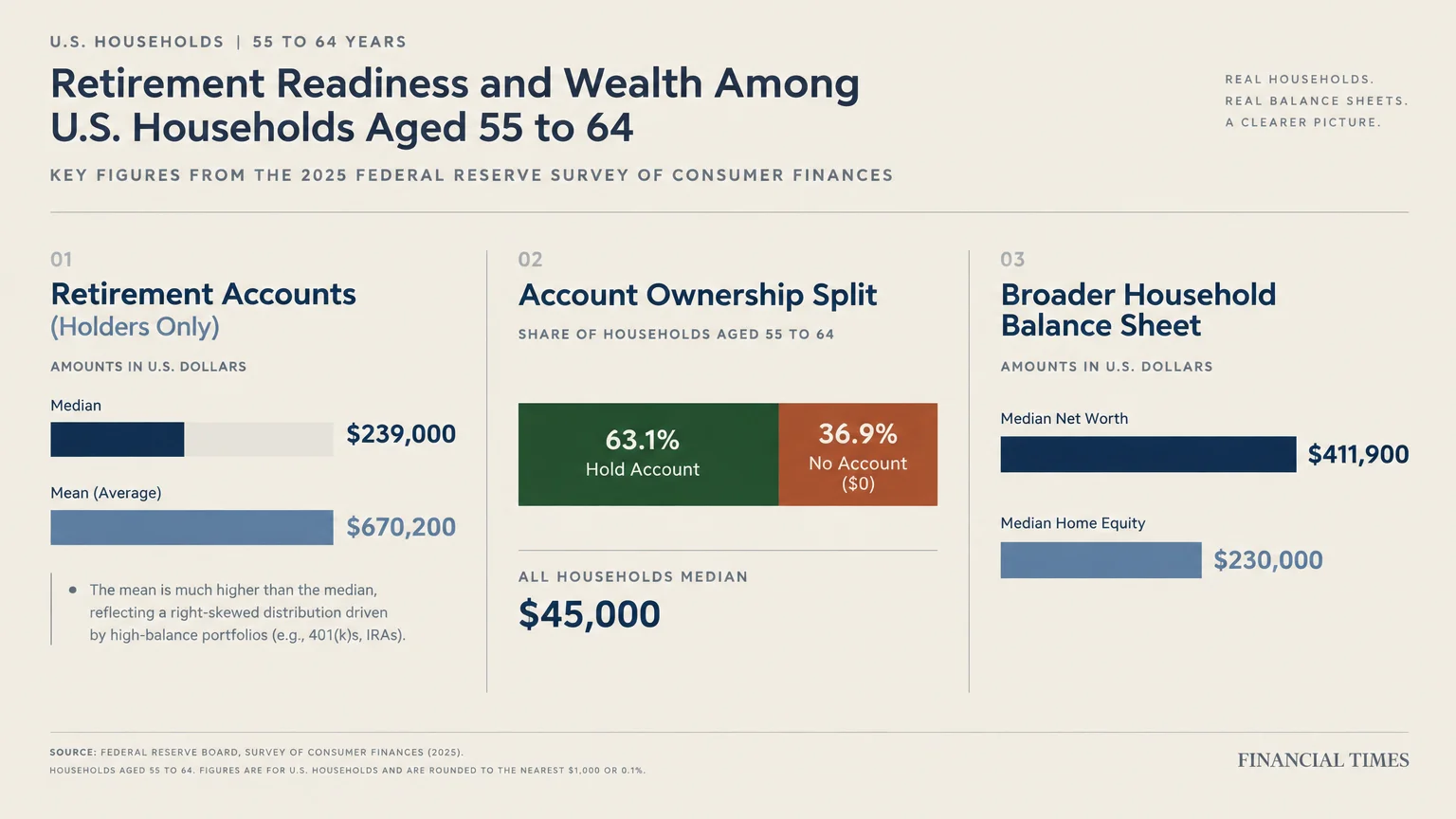
Among families headed by someone aged 55 to 64 who own at least one 401(k), 403(b), IRA, Keogh, or thrift plan, the median balance stands at $239,000. Half of account-holding households have saved more than that figure, and half have saved less.
Meanwhile, the mean—or average—balance for this same group jumped to $670,200 in 2025, up from $588,500 in 2022. A relatively small concentration of multi-million-dollar portfolios pulls that average far above what a typical family holds.
Account ownership reveals an equally important divide as you approach your final working decade. Only 63.1% of families aged 55 to 64 hold a dedicated retirement account, leaving 36.9% without one.
Traditional defined benefit pensions and Social Security do not appear in those account balances, which softens the gap for some workers. When defined benefit pensions count alongside personal accounts, roughly 70% of families aged 45 to 64 participated in a retirement plan in 2025.
Broader household wealth also provides critical context for pre-retirees managing tight monthly budgets. Families aged 55 to 64 carry a real median net worth of $411,900 and a mean net worth of $1,878,000, figures that include home equity and non-retirement savings.
Across all U.S. families, real median net worth rose 2% from 2022 to $215,900, while real median family income climbed 7% to $82,200. Roughly 66% of households own their homes, holding a median of $230,000 in home equity.
How Your Age Bracket Compares Across the Survey
Comparing your balance against peers in your exact decade helps you gauge momentum without getting distracted by outliers. The 2025 Survey of Consumer Finances breaks down account ownership, median balances, and averages across every adult age group.
| Age of Household Head | Families Holding a Retirement Account | Median Balance (Account Holders) | Average Balance (Account Holders) |
|---|---|---|---|
| Under 35 | 48.8% | $21,000 | $48,500 |
| 35 to 44 | 59.6% | $61,000 to $61,200 | $182,400 |
| 45 to 54 | 63.0% | $133,000 | $415,800 |
| 55 to 64 | 63.1% | $239,000 | $670,200 to $670,300 |
| 65 to 74 | 49.0% | $257,000 | $767,500 |
| 75 and Older | 44.6% | $257,000 | $798,700 |
| All U.S. Families | 54.9% | $106,000 | $451,100 |
Notice how the median balance nearly doubles from ages 45 to 54 ($133,000) to ages 55 to 64 ($239,000). Compounding returns on earlier contributions combine with higher peak-earning cash flow to accelerate growth during these years.
Across all U.S. families, the median retirement account balance rose 11% from 2022 to $106,000, while the overall average jumped 23% to $451,100. Yet 45.1% of American families still hold zero dollars in personal retirement accounts.
Private workplace data from Fidelity Investments offers a helpful cross-check for active corporate savers. Across 26,800 corporate plans and 25.6 million participants as of March 31, 2026, Fidelity reported average 401(k) balances of $260,800 for ages 55 to 59 and $257,400 for ages 60 to 64.
Those workers achieved an average combined employee-and-employer savings rate of 14.4%. Because Federal Reserve figures combine multiple IRAs and household accounts across all income tiers, its $670,200 average reflects broader wealth concentration than a single employer plan.

Measuring Readiness Beyond the Median Balance
Beating the $239,000 national median feels encouraging, yet a median balance does not automatically fund your monthly expenses in retirement. Your spending needs depend on your housing costs, debt load, health expenses, and expected lifestyle.
Fidelity Investments recommends saving at least 15% of pre-tax income annually, including employer matches, to hit clear salary-multiple milestones. Those targets aim for 6 times your annual salary saved by age 50, 8 times by age 60, and 10 times by age 67.
If you hit 10 times your final salary by age 67, personal savings can replace roughly 45% of your pre-retirement income. Combining that portfolio income with Social Security typically covers 55% to 80% of pre-retirement pre-tax income.
To translate a lump sum into a monthly paycheck, planners often reference the 4% rule developed by William Bengen for a 30-year retirement. Under that framework, you withdraw 4% of your initial portfolio in year one and adjust that dollar figure for inflation annually.
Fidelity estimates a sustainable initial withdrawal rate at no more than 4% to 5% per year, adjusted for inflation. Applying a 4% initial withdrawal to the $239,000 median yields just $9,560 in your first year—roughly $797 per month before taxes.
That math highlights why pairing your nest egg with disciplined spending habits and guaranteed income streams matters so much. Lowering your fixed monthly overhead reduces the portfolio size you need to stay comfortable.
Lasting financial security comes from building automated cash-flow systems that pay your future self first, rather than relying on whatever dollars happen to remain at the end of the month.
Where Social Security Fits Into Your Monthly Cash Flow
Because $9,560 a year from a median portfolio cannot cover most household budgets alone, Social Security serves as the foundation for ages 55 to 64. How and when you claim benefits permanently reshapes your monthly cash flow.
For everyone born in 1960 or later—which covers everyone aged 55 to 64 in 2026—Full Retirement Age sits at age 67. The Social Security Administration calculates your benefit using your highest 35 years of indexed earnings.
Claiming early at age 62 permanently reduces your monthly check by 30%. On the other hand, delaying benefits past age 67 earns 8% per year in delayed retirement credits up to age 70, creating a 24% boost above your full benefit.
In January 2026, the estimated average retired worker benefit stood at $2,071 per month following a 2.8% cost-of-living adjustment. By October 2026, that average check had edged up to roughly $2,092 to $2,095 per month.
In October 2026, federal officials announced a 3.6% cost-of-living adjustment for 2027, effective in January 2027 for Social Security and December 31, 2026 for SSI. That increase adds roughly $75 per month to the average retired worker benefit, lifting it to about $2,170 per month.
High earners who consistently hit the taxable wage base—$184,500 in 2026 and $192,300 in 2027—qualify for substantially larger checks. The maximum monthly benefit at Full Retirement Age is $4,152 in 2026 and $4,188 in 2027, rising to $5,181 in 2026 and $5,358 in 2027 at age 70.
Even with an average check around $2,170 per month in 2027, Social Security rarely replaces your full working paycheck. Closing the remaining gap requires taking full advantage of late-career contribution limits and trimming avoidable spending.
Catch-Up Contribution Limits for 2026 and 2027
On November 12, 2026, the IRS released Notice 2026-66 and IR-2026-136, raising workplace retirement plan limits for the 2027 tax year. Workers aged 55 to 64 enjoy the highest tax-advantaged savings caps in the entire tax code.
| Account Type and Saver Category | 2026 Contribution Limit | 2027 Contribution Limit |
|---|---|---|
| 401(k), 403(b), 457(b), and TSP Base Limit | $24,500 | $25,500 |
| Age 50+ Standard Workplace Catch-Up (Total Deferral) | $8,000 ($32,500 total) | $8,500 ($34,000 total) |
| Ages 60 to 63 Enhanced Catch-Up (Total Deferral) | $11,250 ($35,750 total) | $11,750 ($37,250 total) |
| Traditional or Roth IRA Base Limit | $7,500 | $7,500 |
| Age 50+ IRA Catch-Up (Total Limit) | $1,100 ($8,600 total) | $1,100 ($8,600 total) |
| HSA Individual / Family Base Limit | $4,400 / $8,750 | $4,500 / $9,000 |
| Age 55+ HSA Catch-Up Addition | $1,000 | $1,000 |
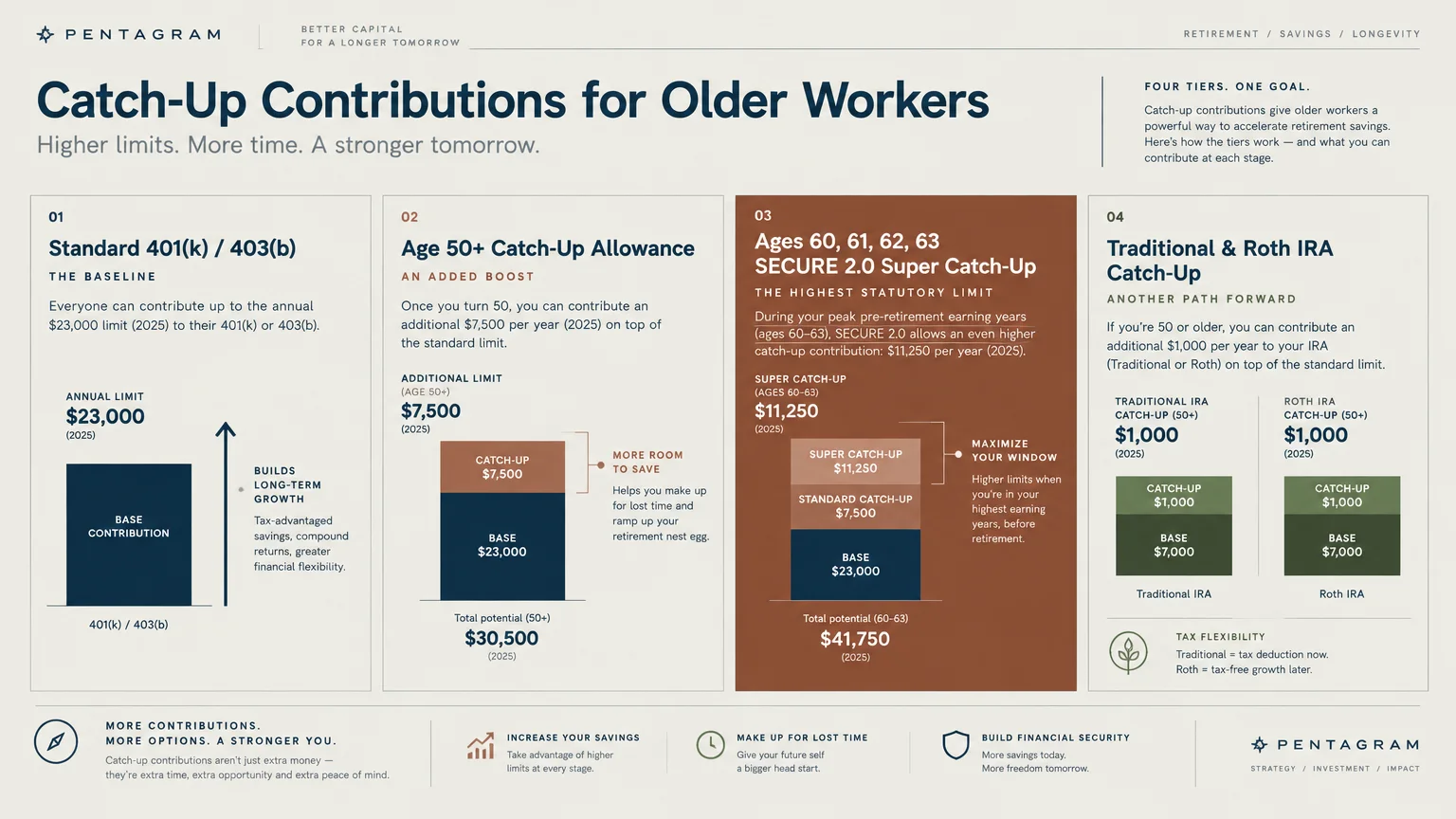
Under SECURE 2.0 rules, workers who turn 60, 61, 62, or 63 during the calendar year qualify for an enhanced workplace catch-up limit. That special window lets you defer $35,750 in 2026 and $37,250 in 2027 inside a 401(k) or 403(b).
High earners face an important tax rule that took effect on January 1, 2026. If your prior-year FICA wages from your sponsoring employer exceeded $150,000 for 2026 catch-ups—or $155,000 for 2027 catch-ups—you must direct age-based workplace catch-ups into a Roth account.
You can inspect current eligibility rules and phase-outs directly through IRS Retirement Plans. Roth IRA contributions phase out at modified adjusted gross incomes of $153,000 to $168,000 for single filers in 2026, rising to $158,000 to $173,000 in 2027.
For married couples filing jointly, the Roth IRA phase-out sits at $242,000 to $252,000 in 2026 and $250,000 to $260,000 in 2027. Married individuals filing separately remain capped at a $0 to $10,000 phase-out range.
Traditional IRA tax deductions also phase out if a workplace plan covers you. In 2026, that deduction phases out between $81,000 and $91,000 for single filers and $129,000 to $149,000 for covered joint filers, rising in 2027 to $83,000 to $93,000 and $133,000 to $153,000.
If only your spouse has a workplace plan, your Traditional IRA deduction phases out at $242,000 to $252,000 in 2026 and $250,000 to $260,000 in 2027. Meanwhile, savers aged 55 or older enrolled in an eligible high-deductible health plan can add $1,000 to their Health Savings Account under IRS Revenue Procedure 2026-24.
Budgeting Systems to Fund Those Late-Career Catch-Ups
Knowing the IRS allows $8,600 in an IRA or $34,000 in a 401(k) does not magically put extra cash in your checking account. You capture those limits by restructuring everyday cash flow so savings happen automatically before discretionary spending starts.
Avoid harsh, shame-based deprivation budgets that cut out every meal out or family trip, because those plans rarely last past month two. Instead, build repeatable cash-management habits that redirect low-value spending toward high-impact accounts.
- Run a 90-day recurring expense audit: Download your last three bank and credit card statements and highlight every automated subscription, streaming bundle, software renewal, and unused membership. Redirecting $100 a month in canceled charges generates $1,200 a year—more than enough to fund your entire $1,100 IRA catch-up or $1,000 HSA catch-up.
- Build dedicated sinking funds outside checking: Open separate high-yield savings buckets at an FDIC-insured bank or NCUA-insured credit union for predictable irregular costs like car repairs, property taxes, and home maintenance. Funding sinking funds monthly prevents sudden expenses from pushing you onto high-interest credit cards or forcing early retirement withdrawals.
- Maintain a true liquid emergency reserve: Keep three to six months of essential household expenses in a liquid high-yield savings account rather than a low-interest checking account. Strong liquid reserves protect your investment portfolio if you face a layoff or medical bill in your late fifties.
- Capture windfalls and lifestyle shifts automatically: Whenever you pay off an auto loan, see childcare or college costs end, or receive an annual raise, split at least half of that freed monthly cash flow directly into payroll deferrals before your lifestyle expands.
- Trim banking fees and recurring insurance creep: Eliminate monthly checking maintenance fees, overdraft charges, and unshopped auto or homeowners policies by comparing quotes annually. Moving that savings straight into an automated weekly IRA transfer compounds quietly without affecting your daily routine.
If debt payments currently choke your monthly budget, use free budgeting worksheets and debt-payoff guides from the Consumer Financial Protection Bureau. Even after accounting for debt, always contribute at least enough to your 401(k) to collect every dollar of your employer match first.
Withdrawal Rules and Key Age Milestones Between 55 and 75
Managing cash flow in your late fifties and early sixties requires watching IRS age thresholds just as closely as contribution caps. Moving money at the wrong age or into the wrong account type can trigger avoidable tax penalties.
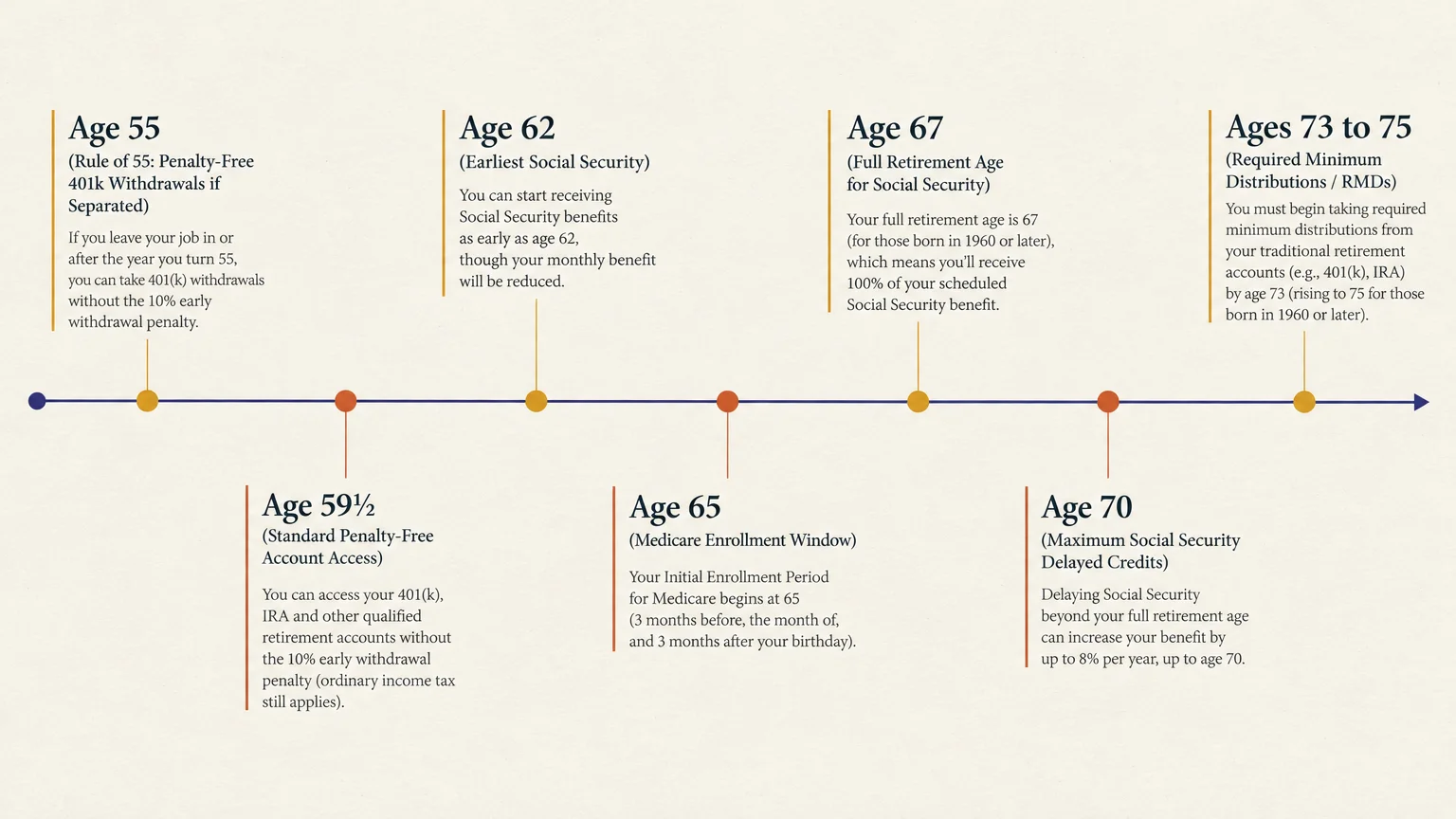
Normally, pulling funds from a Traditional IRA or 401(k) before age 59½ triggers a 10% early withdrawal penalty on top of ordinary income tax. However, a vital workplace exception called the Rule of 55 helps workers who retire or lose a job slightly early.
If you leave your job—voluntarily or involuntarily—in or after the calendar year you turn age 55, you can withdraw from that current employer’s 401(k) or 403(b) without the 10% penalty. Qualified public safety workers qualify for this exception starting at age 50.
Ordinary income tax still applies to pre-tax withdrawals, and the Rule of 55 never applies to IRAs. If you roll your employer 401(k) into an IRA right after leaving at age 56, you immediately erase penalty-free access until age 59½.
For workers who claim Social Security before age 67 while continuing part-time employment, the earnings test also affects cash flow. In 2026, Social Security withholds $1 in benefits for every $2 earned above $24,480 if you remain under Full Retirement Age all year, rising to $25,560 in 2027.
During the calendar year you reach Full Retirement Age, that annual earnings threshold jumps to $65,160 in 2026 and $67,920 in 2027, withholding $1 for every $3 over the cap. Once you hit Full Retirement Age, the earnings test disappears completely.
Looking further ahead, Required Minimum Distributions begin at age 73 for individuals born from 1951 through 1959. Anyone born in 1960 or later—which includes every American aged 55 to 64 in 2026—does not face Required Minimum Distributions until age 75, while Roth IRAs and designated Roth workplace accounts carry no lifetime distribution requirements.
Costly Mistakes to Avoid
Even disciplined savers lose tens of thousands of dollars between ages 55 and 64 through preventable administrative errors. Watch out for these frequent missteps as you tighten your budget and prepare for retirement.
- Rolling over a 401(k) prematurely: Transferring your workplace plan to an IRA before age 59½ forfeits penalty-free Rule of 55 withdrawals if you need bridge cash before Social Security begins.
- Ignoring the mandatory Roth catch-up rule: High earners above the $150,000 wage threshold in 2026 ($155,000 in 2027) must verify their payroll system routes catch-ups into a Roth bucket rather than rejecting contributions.
- Missing the ages 60 to 63 catch-up window: Failing to increase payroll deferrals when you enter your 60s leaves $3,250 of extra annual tax-advantaged capacity on the table in both 2026 and 2027.
- Leaving emergency cash in zero-yield checking: Keeping large cash reserves in a standard checking account lets inflation erode your purchasing power while missing out on competitive high-yield savings interest.
- Using retirement accounts as an emergency fund: Tapping a 401(k) or IRA for a roof repair or vehicle replacement triggers taxes, potential penalties, and permanent loss of tax-deferred compounding.

Don’t DIY These Decisions
Daily budgeting, subscription audits, and automated high-yield savings transfers are straightforward steps you can manage yourself. Other late-career decisions carry irreversible tax and benefit consequences that warrant hiring a qualified professional.
Consult a fee-only Certified Financial Planner or Certified Public Accountant before deciding whether to keep funds in a former employer’s 401(k) under the Rule of 55 or consolidate accounts into an IRA. A single mistimed rollover can lock up cash you expected to spend before age 59½.
Professional tax planning also pays off if your income approaches the $150,000 mandatory Roth catch-up threshold or IRA deduction phase-outs. A CPA can model whether Traditional deferrals, Roth conversions, or HSA contributions minimize your lifetime tax bill.
Married couples with wide age gaps, uneven earnings histories, or government pensions should also review Social Security claiming timing with a planner or benefits counselor. Optimizing spousal survivor benefits often outweighs rushing to claim checks at age 62.
Frequently Asked Questions
What is the median retirement savings for ages 55 to 64 according to the Federal Reserve?
Among families aged 55 to 64 who hold at least one retirement account, the 2025 Survey of Consumer Finances reports a median balance of $239,000 in 2025 dollars. Including the 36.9% of households in that age group with zero retirement savings drops the overall median to $45,000.
Why is the average retirement balance so much higher than the median?
The average balance for account holders aged 55 to 64 reached $670,200 in 2025 because a small share of ultra-wealthy households hold multi-million-dollar accounts. Those large balances pull the arithmetic average upward, making the median a far better gauge of what a typical household actually holds.
How much can I contribute to a 401(k) at age 60 to 63 in 2026 and 2027?
Workers turning 60, 61, 62, or 63 during the calendar year qualify for the enhanced SECURE 2.0 catch-up contribution. Combining the standard limit and enhanced catch-up lets you defer up to $35,750 in 2026 and $37,250 in 2027.
What happens if I leave my job at age 55 and need to access my 401(k)?
Under the Rule of 55, leaving your employer in or after the calendar year you turn 55 lets you withdraw from that specific employer’s 401(k) or 403(b) without paying the 10% early withdrawal penalty. You still owe ordinary income tax on pre-tax distributions, and this exception does not cover IRAs.
Your Next Step Before Payday
Log into your retirement plan portal and your checking account this week to compare your current savings rate against the 2026 and 2027 IRS limits. Trimming just one or two overlooked monthly expenses and increasing your automated deferral by 1% or 2% puts real momentum behind your numbers before your next birthday.
Financial outcomes vary based on individual income, credit history, and circumstances. This article provides general guidance only. Consult a qualified financial planner, CPA, or consumer attorney for advice specific to your situation.
Last updated: November 2026. Rates, benefit amounts, and tax rules change—always verify current details at official sources.