
Millions of dollars in Social Security benefits go unpaid each year due to administrative errors, missed retroactive eligibility, and outdated earnings records. If the government miscalculated your lifetime earnings or delayed your application, you could be owed a substantial lump-sum back payment.
Auditing your Social Security record is the fastest way to confirm whether the government underpaid you. Acting quickly helps you claim your rightful funds before strict federal statutory deadlines permanently close your recovery window.
Here are seven concrete strategies to identify missing funds, correct federal calculation errors, and collect the unclaimed Social Security benefits you rightfully earned.

1. Audit Your Social Security Earnings Record for Missing Wages
Your monthly retirement benefit depends entirely on your highest 35 years of indexed earnings. If a past employer misreported your wages or misspelled your name, your record may reflect zero earnings for that year.
A single missing year of wages drags down your average indexed monthly earnings calculation. Over a 20-year retirement, even a minor reporting omission can cost you tens of thousands of dollars in lost income.
You can review your complete wage history online by creating a personal account at the Social Security Administration (SSA). Carefully verify your posted earnings against your historical W-2 forms and filed tax returns.
Under federal regulations (20 CFR § 404.802), you generally have three years, three months, and 15 days following the tax year to correct earnings errors. Fortunately, the agency waives this strict deadline if you provide official W-2 copies or tax filings proving the mistake.
To request a formal correction, submit Form SSA-7008 (Request for Correction of Earnings Record) along with your supporting wage documentation. Once processed, the agency recalculates your Primary Insurance Amount and issues retroactive back pay for all past underpayments.
“The best time to plan for a financial goal was 20 years ago. The second best time is today.”
2. Claim Retroactive Retirement Benefits Past Full Retirement Age
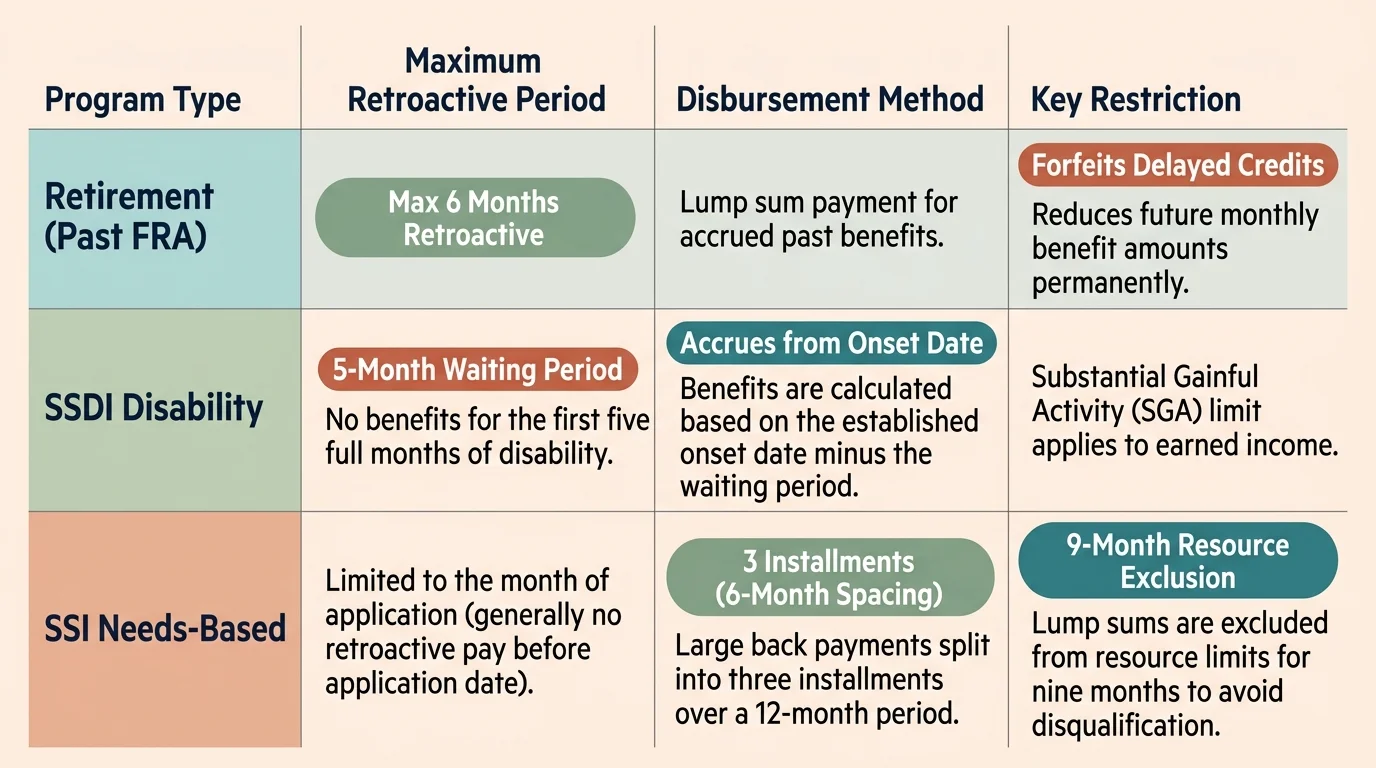
If you delay claiming your retirement benefits past your Full Retirement Age (FRA)—which is age 67 for workers born in 1960 or later—you accrue Delayed Retirement Credits. These credits permanently increase your monthly check by 8% per year until age 70.
If you apply after reaching your FRA, federal rules permit you to elect up to six months of retroactive cash benefits. This option delivers an immediate, substantial lump-sum deposit into your bank account.
Choosing retroactive benefits resets your official retirement start date up to six months backward. Consequently, you forfeit the Delayed Retirement Credits you would have earned during those specific six months, slightly reducing your ongoing monthly benefit.
You cannot claim retroactive retirement benefits before reaching Full Retirement Age. If you need upfront capital for home repairs or debt elimination, requesting these retroactive months can unlock thousands of dollars instantly.
Review your personal cash flow and life expectancy before making this choice. A benefits counselor can help you determine whether the immediate lump sum outweighs the lifetime value of a higher monthly payment.
3. Calculate Your SSDI Disability Back Pay and Onset Dates
Social Security Disability Insurance (SSDI) applications often require extensive medical evaluations and lengthy appeals. By the time the agency approves your claim, you may be entitled to thousands of dollars in accumulated back pay.
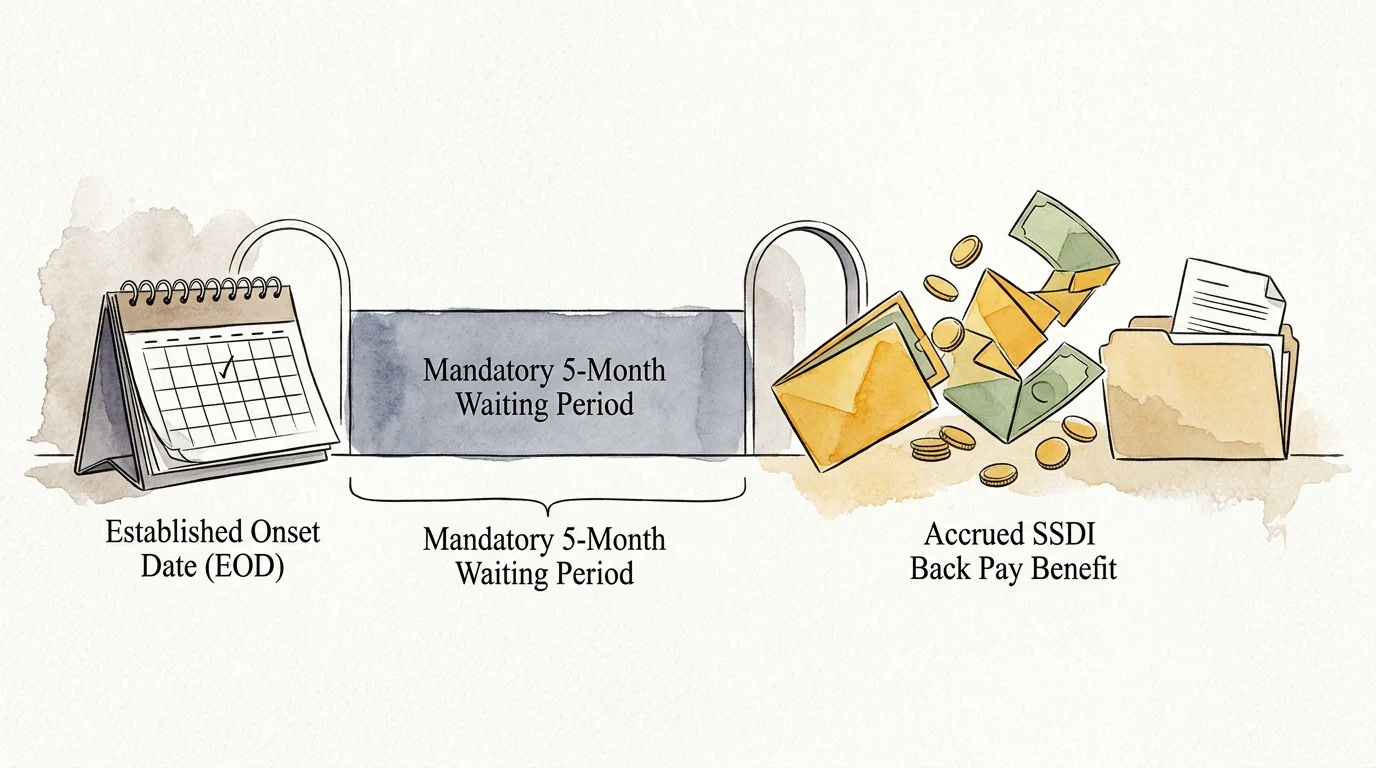
Federal law enforces a mandatory five-month waiting period from your Established Onset Date (EOD) before disability benefits can begin. Your cash benefits officially start accruing in the sixth full calendar month following your established disability onset.
In addition to back pay accumulated during the review process, you can receive up to 12 months of retroactive benefits for the period before your application date. The agency distributes this accumulated money as a single lump-sum payment upon approval.
Scrutinize your official award letter to confirm your Established Onset Date matches your original medical diagnosis. If the agency arbitrarily set a later onset date, you can file an administrative appeal to recover the missing back pay months.

4. Recover Underpayments from the WEP and GPO Repeal
For decades, public sector workers—including teachers, firefighters, police officers, and municipal employees—faced severe benefit reductions due to the Windfall Elimination Provision (WEP) and Government Pension Offset (GPO). These provisions significantly reduced benefits for individuals receiving non-covered pensions.
The passage of the Social Security Fairness Act eliminated both the WEP and GPO benefit penalties. This landmark reform restored full Social Security entitlements to more than 3.2 million impacted public service retirees and surviving spouses.
The legislation includes retroactive back payments dating back to January 2024 for all eligible retirees who had their benefits reduced. The agency is systematically adjusting account records to distribute these owed sums to qualifying individuals.
If your retirement or spousal benefits were previously slashed due to a state or local government pension, check your payment history. Contact your regional field office if your monthly benefit amount has not automatically adjusted to reflect the full statutory repeal.
“It’s not how much money you make, but how much money you keep, how hard it works for you, and how many generations you keep it for.” — Robert Kiyosaki

5. Discover Unclaimed Spousal and Survivor Benefits for Divorced Spouses
Many divorced Americans forfeit thousands of dollars annually because they assume they are restricted to benefits based on their own earnings history. If your prior marriage lasted at least 10 consecutive years, you may qualify for divorced spousal or survivor benefits.
To claim divorced spousal benefits, you must be at least age 62, currently unmarried, and your ex-spouse must be entitled to retirement benefits. You can collect up to 50% of your ex-spouse’s Full Retirement Age benefit without reducing their payments in any way.
If your ex-spouse is deceased, you can claim divorced survivor benefits starting at age 60 (or age 50 if you have a qualifying disability). Survivor benefits can equal up to 100% of the deceased worker’s benefit amount.
The agency does not automatically track your marital history or notify you when an ex-spouse claims benefits or passes away. You must proactively contact the agency with your marriage and divorce certificates to request a comprehensive social security benefit review.

6. File Form SSA-1724 for Deceased Family Member Underpayments
When a Social Security beneficiary passes away, the agency frequently owes them retroactive payments or underpaid monthly benefits. Because the federal government does not disburse these funds automatically, surviving family members must submit a formal claim.
You can recover these funds by filing Form SSA-1724 (Claim for Amount Due in the Case of Deceased Beneficiary). Under federal regulation 20 CFR § 404.503, the agency disburses underpayments according to a strict legal priority order.
A surviving spouse living in the same household receives highest priority, followed by a spouse entitled to benefits on the deceased worker’s record. If no surviving spouse exists, unpaid benefits flow to surviving children, followed by dependent parents, and finally the legal representative of the estate.
Eligible surviving spouses and dependent children can also claim the statutory Lump-Sum Death Payment of $255 under 20 CFR § 404.390. You must file Form SSA-8 to claim this payment within two years of the beneficiary’s death.

7. Track SSI Underpayment Installments and Asset Rules
Supplemental Security Income (SSI) provides vital financial assistance to low-income seniors and individuals with disabilities. If your SSI application was delayed during processing, the government may owe you a substantial retroactive underpayment.
When an SSI underpayment exceeds three times the maximum monthly federal benefit rate, the agency distributes the funds in up to three separate installment payments. These disbursements are spaced six months apart to comply with federal program rules.
SSI recipients must adhere to strict countable resource limits of $2,000 for individuals and $3,000 for married couples. Fortunately, under POMS SI 01130.600, retroactive payments are excluded from your countable asset limits for nine calendar months following receipt.
You must spend down, shelter, or deposit these funds into an ABLE account before the nine-month exclusion window closes. Tracking these installment dates prevents an unexpected asset surplus from temporarily suspending your ongoing monthly SSI benefits.
Comparing Social Security Underpayment and Back Pay Rules
Navigating the various categories of Social Security back pay requires understanding specific statutory rules, recovery windows, and required forms. The table below outlines how each category operates under current federal guidelines.
| Claim Category | Retroactive Limit | Key Statutory Rule | Required Action or Form |
|---|---|---|---|
| Earnings Record Correction | Full career recalculation | 3 years, 3 months, 15 days (waived with W-2 proof) | Submit Form SSA-7008 with wage records |
| Post-FRA Retirement Back Pay | Up to 6 months | Must have reached Full Retirement Age (age 67 for 1960+) | Elect retroactive option during application |
| SSDI Disability Back Pay | Up to 12 months prior to filing | Mandatory 5-month waiting period from onset date | Establish medical onset date during application |
| WEP / GPO Repeal Adjustments | Retroactive to January 2024 | Social Security Fairness Act elimination of offsets | Monitor statement or contact local field office |
| Divorced Spousal Benefits | Up to 6 months (if post-FRA) | Marriage must have lasted at least 10 consecutive years | Submit marriage certificate and divorce decree |
| Deceased Beneficiary Underpayment | All unpaid past benefits | Follows strict statutory hierarchy under 20 CFR § 404.503 | Submit Form SSA-1724 with death certificate |
| Lump-Sum Death Payment | Fixed $255 benefit | Must apply within two years of worker’s death | Submit Form SSA-8 |
| SSI Large Underpayments | Full accumulated back pay | Paid in 3 installments; 9-month asset grace period | Review award notice; track 9-month spend-down |
Costly Mistakes to Avoid
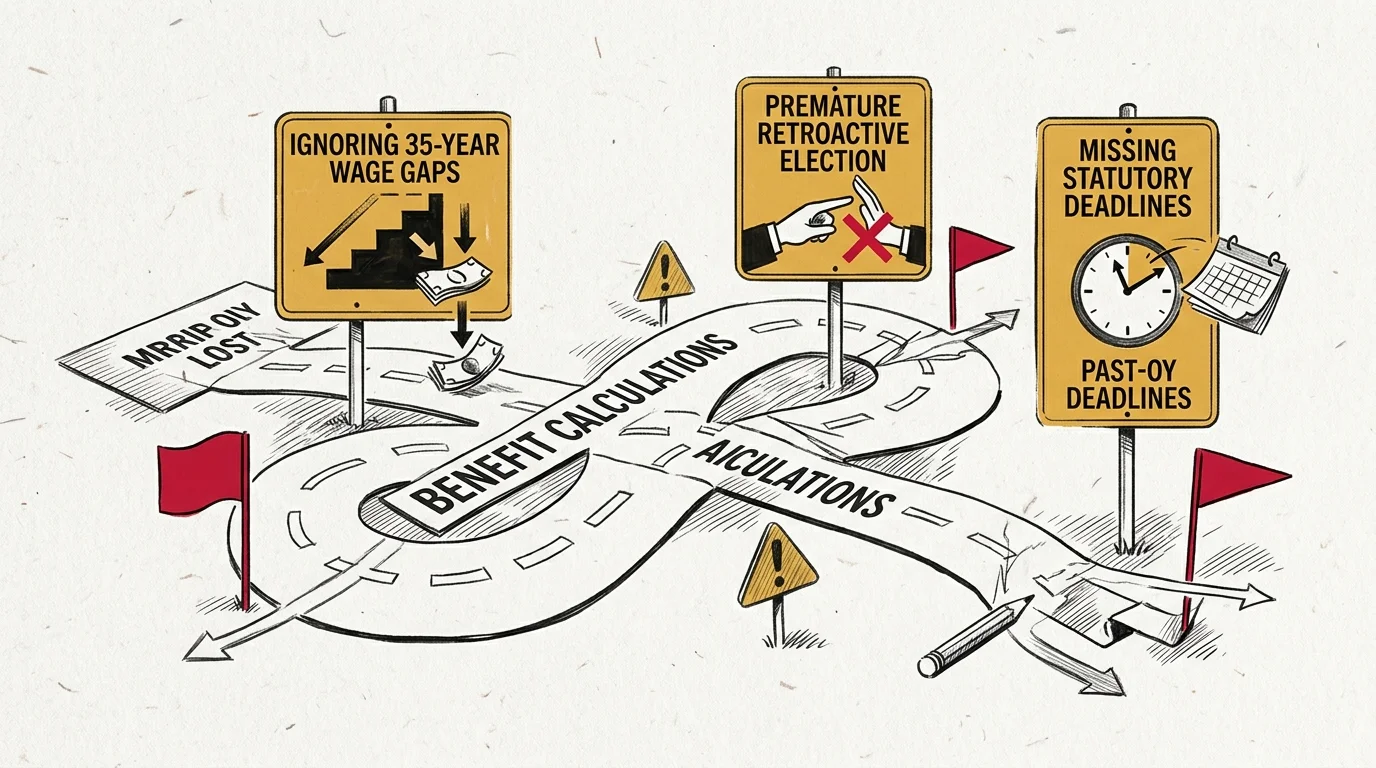
Failing to follow administrative procedures can permanently forfeit money the government owes you. Watch out for these common errors when auditing your benefit history.
- Shredding Historical Tax Records: Tossing old W-2 forms eliminates your primary evidence for correcting wage omissions that occurred more than three years ago.
- Assuming the Agency Corrects Records Automatically: Social Security staff cannot monitor changes in your marital status, ex-spouse earnings, or unlisted dependents without a formal request.
- Exceeding the SSI Nine-Month Spend-Down Window: Letting retroactive SSI funds sit in a regular checking account past nine months can trigger an immediate suspension of monthly benefits.
- Overlooking Tax Liabilities on Large Lump Sums: Receiving multi-year back pay in a single calendar year can artificially inflate your taxable income. Review reporting options through the IRS to apportion back pay across prior years.
- Failing to Update Direct Deposit Information: Closing a bank account without updating your federal profile causes retroactive deposits to bounce back to the Treasury, creating months of administrative delays.

Don’t DIY These Decisions
Navigating federal benefit formulas and tax rules can become overwhelming, especially when substantial back pay sums are involved. Seeking professional guidance ensures you maximize your lifetime benefit payout.
Consult a fee-only financial planner or accredited Social Security analyst before electing a six-month retroactive retirement lump sum. They can calculate the breakeven age to determine whether permanent monthly reductions harm your long-term retirement security.
If you receive a large SSDI or retroactive settlement, hire a certified public accountant (CPA). Special tax provisions under Internal Revenue Code Section 86 allow you to allocate back pay to prior years, preventing an unexpected tax spike.
For complex benefit disputes or contested disability onset dates, work with an accredited disability attorney or legal aid specialist. You can also explore consumer financial rights through the Consumer Financial Protection Bureau (CFPB) or review benefit guides on USA.gov Money and Taxes.
Frequently Asked Questions
How do I check if Social Security owes me money?
You can check for owed money by logging into your account at SSA.gov to review your historical earnings record and monthly payment calculations. You can also contact your local field office to request a complete benefit review.
How far back can Social Security pay retroactive retirement benefits?
If you apply after reaching your Full Retirement Age, Social Security can pay up to six months of retroactive retirement benefits in a lump sum. You cannot claim retroactive retirement benefits prior to reaching Full Retirement Age.
Are Social Security back pay lump sums taxable?
Yes, Social Security back payments may be taxable depending on your combined provisional income for the year you receive the funds. However, IRS rules allow you to use a special lump-sum election method to apportion payments to the tax years they were earned.
What form is required to claim underpayments for a deceased family member?
Surviving family members must file Form SSA-1724 (Claim for Amount Due in the Case of Deceased Beneficiary) to collect unpaid benefits. The agency pays these funds according to a statutory priority list, starting with the surviving spouse.
Take an hour this week to log into your online Social Security profile and cross-reference your earnings history with your past tax records. If you discover a wage discrepancy or qualify for unclaimed benefits, contact your local Social Security office immediately to start your review.
This article is for informational purposes only and does not constitute financial, legal, or tax advice. Rates, benefit amounts, and tax rules change regularly—verify current details with the relevant agency or a licensed professional.
Last updated: February 2026. Rates, benefit amounts, and tax rules change—always verify current details at official sources.