
Claiming Social Security at the wrong time can permanently slash your household retirement income. Choosing the right claiming age gives you maximum financial control over your later years.
Most Americans believe their only options are filing early at 62 or waiting until full retirement age. In reality, federal guidelines establish eight distinct milestone ages that dictate benefit sizes, spousal rights, and survivor payouts.
Understanding how each milestone affects your monthly check lets you coordinate benefits with your overall savings plan. Here is every major Social Security claiming age explained in plain English.
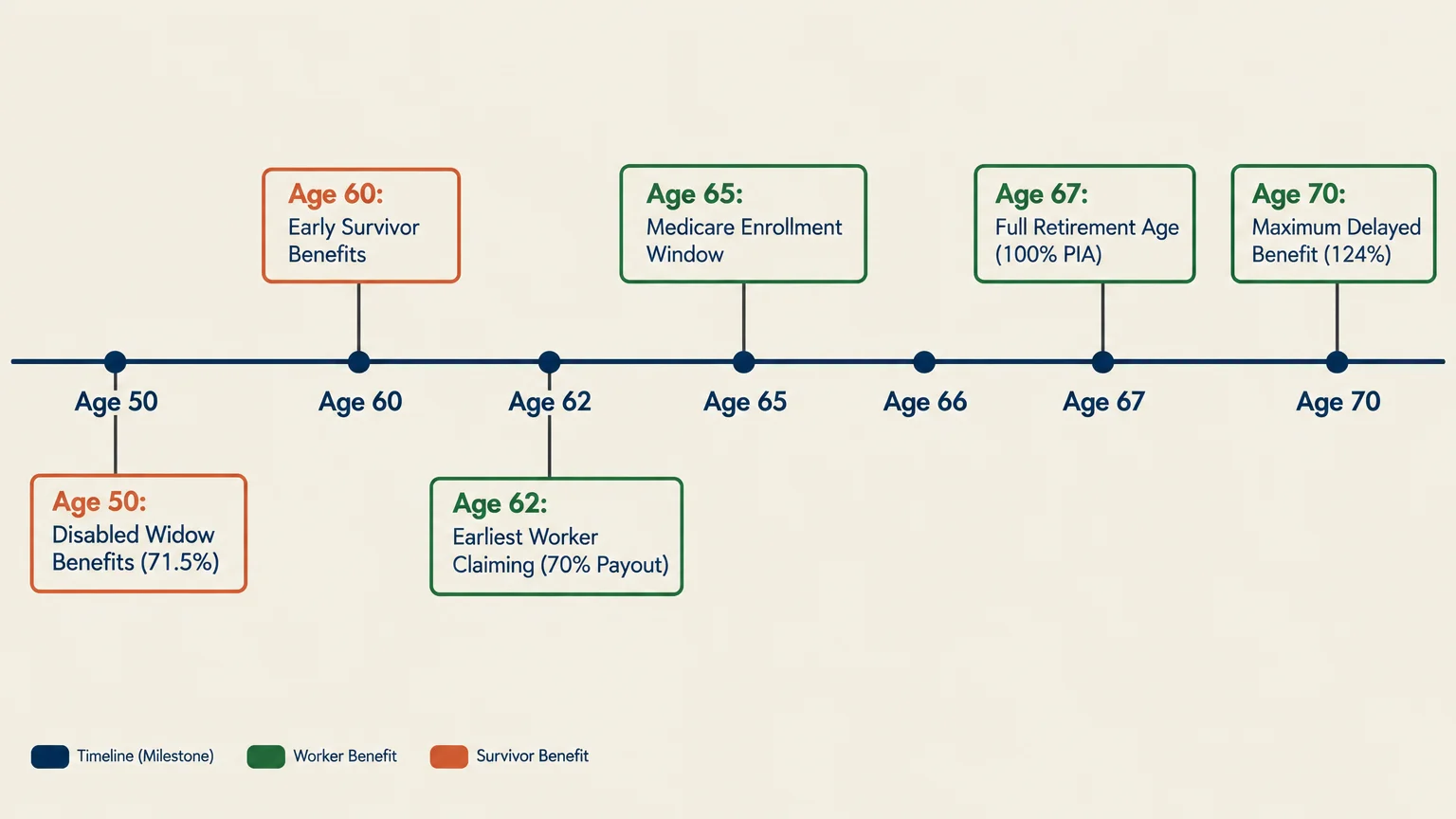
The 8 Milestone Claiming Ages and What They Mean for You
The Social Security Administration (SSA) operates on rigid statutory milestones. Each age tier triggers different benefit calculations, earnings limits, and qualification criteria.
Your primary insurance amount (PIA) serves as the baseline for all retirement calculations. Claiming before or after your designated baseline permanently alters that monthly amount.
1. Age 50: Disabled Widow or Widower Benefits
Age 50 marks the earliest eligibility point for any survivor-based benefit program. Surviving spouses who become disabled can claim monthly benefits up to a decade before regular retirement begins.
To qualify, your disability must have started before or within seven years of your spouse’s death. This seven-year window protects vulnerable survivors during critical transition periods.
Filing at age 50 provides 71.5% of your deceased spouse’s primary insurance amount. That percentage remains locked for life unless you later qualify for a higher benefit on your own work record.
2. Age 60: Early Survivor Benefits for Surviving Spouses
Non-disabled surviving spouses become eligible for survivor benefits starting at age 60. Surviving divorced spouses also qualify if the previous marriage lasted at least ten consecutive years.
Claiming survivor benefits at age 60 locks in a reduced payout equal to 71.5% of the deceased worker’s benefit. Each month you delay past 60 increases that percentage until it reaches 100%.
Filing early as a survivor does not reduce your personal retirement benefit. You can collect survivor benefits first, allowing your own retirement benefit to grow until age 70.
3. Age 62: The Earliest Worker and Spousal Claiming Age
Age 62 serves as the earliest age you can claim your personal retirement benefit. It also represents the first opportunity for your spouse to claim benefits based on your work record.
Filing at 62 comes with a steep, permanent financial penalty. For anyone born in 1960 or later, claiming at 62 results in an immediate 30% lifetime reduction.
You receive only 70% of your primary insurance amount each month. Spousal benefits claimed at 62 drop by 35%, paying just 32.5% of the earner’s primary benefit.
In 2026, the maximum possible monthly benefit for someone filing at age 62 is $2,969. By comparison, the average retired worker collects approximately $2,071 per month.
Claiming at 62 also triggers the strict Retirement Earnings Test if you continue working. The SSA withholds benefits if your earned wages exceed annual federal limits.
4. Age 65: The Critical Medicare Coordination Milestone
For decades, age 65 served as the traditional full retirement age for American workers. While federal law raised the retirement age, 65 remains the universal threshold for Medicare coverage.
Coordinating Social Security and Medicare requires careful timing. If you delay Social Security past 65, you must proactively enroll in Medicare Part A and Part B.
Your Initial Enrollment Period spans seven months surrounding your 65th birthday. Missing this window without qualifying employer coverage leads to permanent, lifetime Part B late-enrollment penalties.
When you collect Social Security at 65, the government automatically deducts Medicare Part B premiums from your monthly check. If you delay Social Security, Medicare bills you quarterly instead.
5. Age 66: Survivor Full Retirement Age and Historical Transition
Age 66 previously served as the full retirement age for workers born between 1943 and 1954. For workers born between 1955 and 1959, full retirement age phased up gradually in two-month increments.
More importantly, age 66 remains an essential benchmark for survivor benefit schedules. Survivor full retirement age phases up on a different timetable than regular retirement benefits.
Surviving spouses reach full survivor benefits between age 66 and 67 depending on birth year. Reaching your survivor full retirement age unlocks 100% of the deceased worker’s original monthly benefit.
6. Age 67: Universal Full Retirement Age (FRA)
Under the 1983 Social Security Amendments, age 67 serves as full retirement age for all Americans born in 1960 or later. Reaching age 67 entitles you to 100% of your primary insurance amount.
Claiming at age 67 eliminates all early-filing reductions on your monthly checks. In 2026, the maximum monthly retirement payout at age 67 reaches $4,152.
Spouses claiming on your record receive the full 50% spousal allowance once they reach age 67. Furthermore, the federal Retirement Earnings Test completely disappears in the month you turn 67.
You can earn unlimited wage income from employment past age 67 without losing a single dollar of Social Security benefits. This milestone provides maximum career and filing flexibility.
7. Age 68: The Strategic Mid-Delay Stepping Stone
Waiting past age 67 earns you Delayed Retirement Credits. The federal government rewards your patience by adding two-thirds of 1% to your monthly benefit for every month you delay.
This accrual equals an 8% simple annual boost to your baseline benefit. By waiting until age 68, you lock in a permanent 108% payout for the rest of your life.
Age 68 acts as an ideal middle ground for workers who want higher guaranteed income but cannot wait until 70. It provides substantial protection against inflation and longevity risk.
8. Age 70: The Maximum Benefit Ceiling
Age 70 represents the ultimate claiming milestone for retired workers. Delayed Retirement Credits permanently stop accumulating the month you reach your 70th birthday.
For those with a full retirement age of 67, waiting until 70 produces a permanent 24% benefit increase. You receive 124% of your original primary insurance amount every month.
In 2026, a top-earning worker filing at age 70 can receive up to $5,181 per month. There is zero financial reason to delay claiming Social Security past age 70.
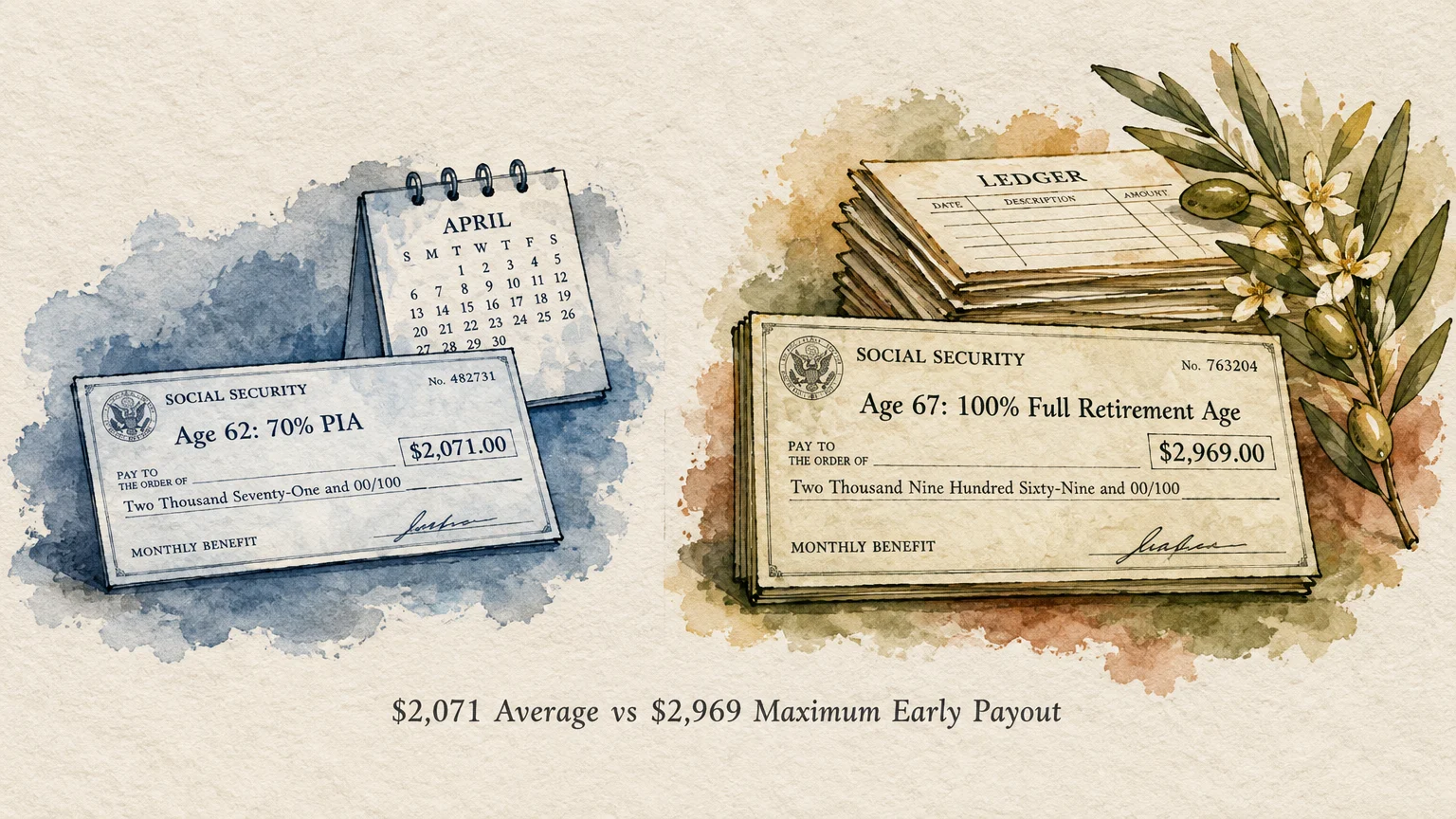
Early vs Full Retirement Age Social Security: Comparing Payouts
Deciding when to start Social Security requires analyzing monthly checks against cumulative lifetime benefits. Early filing provides immediate cash flow, while delayed filing offers superior longevity protection.
The difference between claiming at age 62 and age 70 is dramatic. A monthly benefit increases by roughly 77% when you transition from filing at 62 to waiting until 70.
| Claiming Age | Benefit Category | Percent of Baseline PIA | 2026 Maximum Monthly Benefit | Earnings Test Applies? |
|---|---|---|---|---|
| Age 50 | Disabled Survivor | 71.5% | Varies by Record | Yes |
| Age 60 | Standard Survivor | 71.5% | Varies by Record | Yes |
| Age 62 | Early Retirement | 70.0% | $2,969 | Yes ($24,480 limit) |
| Age 65 | Medicare / Early Retirement | 86.7% | $3,446 | Yes ($24,480 limit) |
| Age 66 | Phased / Survivor FRA | 93.3% | $3,799 | Yes ($24,480 limit) |
| Age 67 | Universal Full Retirement Age | 100.0% | $4,152 | No (Earnings cap ends) |
| Age 68 | Delayed Retirement | 108.0% | $4,484 | No |
| Age 70 | Maximum Delayed Benefit | 124.0% | $5,181 | No |
Every dollar you secure through delayed credits increases your baseline for future Cost-of-Living Adjustments (COLA). Higher baseline benefits yield larger annual dollar increases when inflation adjustments occur.
Spousal benefits do not earn Delayed Retirement Credits past age 67. A spouse reaches their maximum payout of 50% at their own full retirement age.
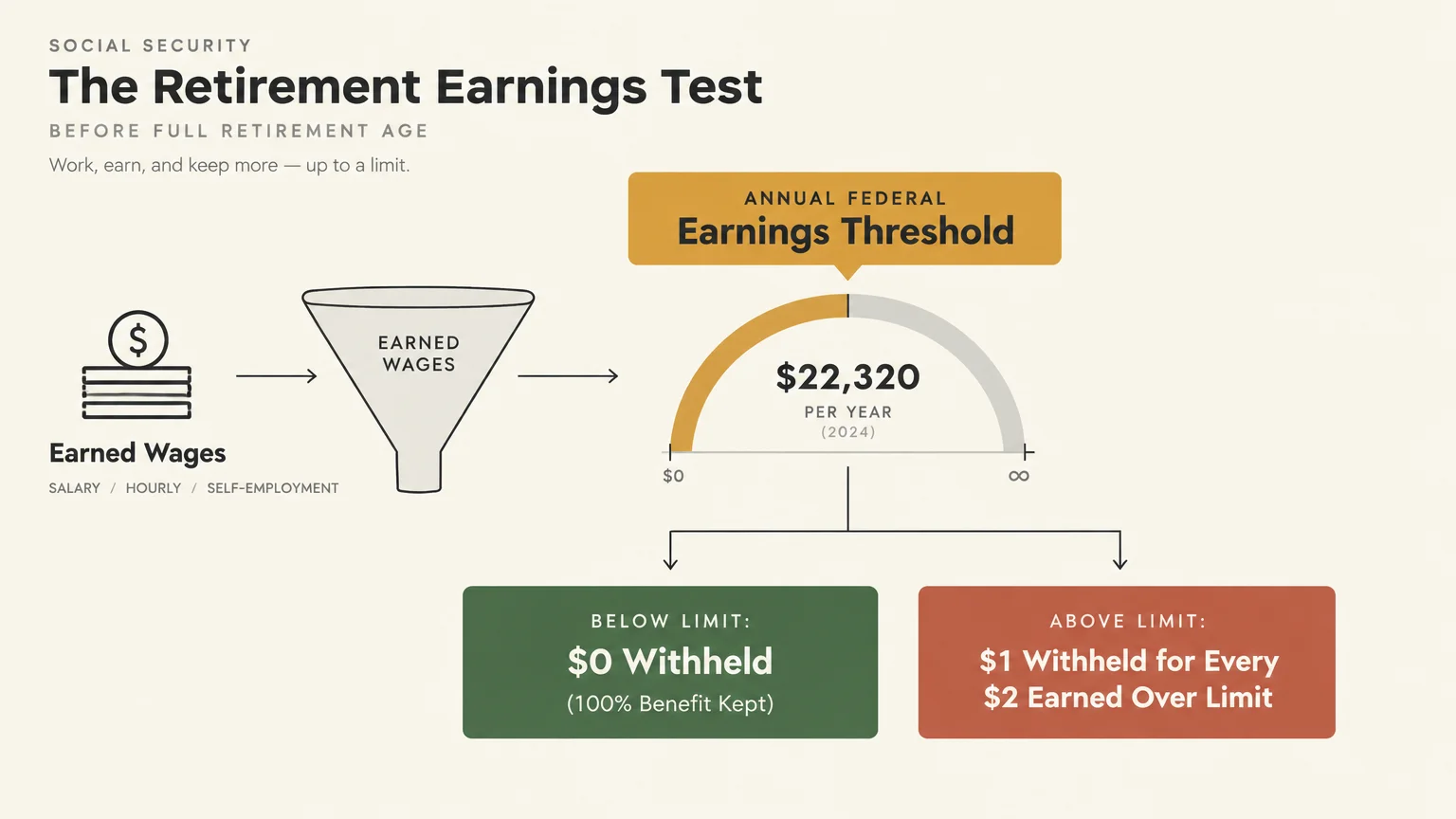
How the 2026 Retirement Earnings Test Impacts Working Retirees
If you claim benefits before age 67 and continue working, the federal earnings test limits your income. The government restricts wages from active employment or net self-employment earnings.
For 2026, the annual exempt limit for workers under full retirement age all year is $24,480. The SSA withholds $1 in benefits for every $2 you earn above this threshold.
A higher limit applies in the calendar year you reach full retirement age. In 2026, the exempt threshold rises to $65,160 for the months preceding your birthday.
During that specific year, the SSA withholds $1 for every $3 you earn above the higher limit. Once you reach your exact birth month, the earnings test ceases completely.
Withheld benefits are not forfeited forever. When you reach age 67, the agency recalculates your monthly check to credit back the withheld payments over your remaining life.
Investment income, pensions, capital gains, and IRA withdrawals do not count toward the earnings limit. Only gross wages and business profits trigger earnings test withholding.
The taxable maximum wage base for Social Security in 2026 stands at $184,500. Earned income above this threshold incurs no additional Social Security payroll taxes.

Deciding When to Start Social Security: Key Decision Factors
Determining the best age to claim Social Security requires evaluating your personal balance sheet and family health. No single age works best for every household.
“A budget is telling your money where to go instead of wondering where it went.” — John C. Maxwell
Begin by assessing your personal health and family longevity history. If serious health challenges suggest a shorter life expectancy, filing earlier often maximizes cumulative lifetime income.
Conversely, individuals with family histories of living into their late 80s or 90s benefit substantially by waiting. Delaying to 70 acts as longevity insurance against outliving your assets.
Evaluate your employment stability and existing retirement savings. If continuing to work covers your living expenses, letting your benefit grow at 8% annually outperforms most conservative investments.
Consider survivor protection if you are the primary household earner. Your surviving spouse inherits your higher monthly benefit upon your death, making delaying an act of family protection.
Review the tax implications governed by the Internal Revenue Service (IRS). Up to 85% of your Social Security benefits become subject to federal income tax if combined income exceeds statutory thresholds.

Errors That Cost Families Thousands
Filing errors frequently cause irreversible financial loss for retirees. Understanding common claiming traps ensures you keep every dollar you earned.
- Filing early while earning high active wages: Working full-time while collecting at 62 often causes the SSA to withhold the majority of your benefits under the earnings test.
- Neglecting Medicare enrollment at age 65: Delaying Social Security does not excuse you from Medicare enrollment deadlines, resulting in permanent premium surcharges.
- Waiting past age 70 to submit your application: Benefits stop growing at 70, meaning delay past your 70th birthday results in forfeited monthly income.
- Failing to coordinate spousal claiming strategies: Both spouses filing at 62 permanently locks the household into reduced baseline benefits and lower survivor checks.
- Ignoring tax torpedo thresholds: Withdrawing large sums from tax-deferred accounts alongside Social Security can trigger substantial taxes on your benefits.
Carefully review your earnings history on your official online Social Security statement before submitting paperwork. Correcting wage errors with the agency prior to filing ensures accurate baseline calculations.
The Consumer Financial Protection Bureau (CFPB) offers interactive planning tools to help you model different claiming scenarios. Comparing multi-year cash flow projections prevents premature filing decisions.

When to Get Expert Help
Navigating the interaction between Social Security, pensions, and taxable accounts can overwhelm family finances. Professional guidance clarifies complex claiming rules.
Consult a fee-only Certified Financial Planner (CFP) to design an integrated retirement income strategy. Independent fiduciary planners do not earn commissions on financial products they recommend.
Hire a Certified Public Accountant (CPA) to model provisional income thresholds. A CPA helps minimize federal taxes on your benefits while planning required minimum distributions.
Reach out to an accredited benefits counselor or your local Area Agency on Aging. These specialists offer unbiased guidance on survivor benefits, disability transitions, and Medicare coordination.
Frequently Asked Questions About Social Security Claiming Ages
What is the single best age to claim Social Security?
There is no universally ideal claiming age. Filing at 62 provides immediate income, while waiting until 70 maximizes guaranteed lifetime purchasing power and survivor benefits.
Can you change your mind after claiming Social Security early?
Yes, but strict federal limitations apply. You can withdraw your application within 12 months of filing, provided you repay every dollar of benefits received.
How does working after age 67 affect my monthly benefit?
Working past full retirement age never reduces your monthly check. If your current earnings rank among your top 35 inflation-adjusted earning years, the SSA increases your benefit.
Are Social Security benefits taxed by the federal government?
Yes, depending on your provisional income. If your combined income exceeds $32,000 for married couples or $25,000 for individuals, up to 85% of benefits face income tax.
Next Steps for Your Retirement Plan
Create a personal account on the Social Security website today to verify your work history and projected monthly payments. Reviewing your statement prevents administrative reporting errors from diminishing your benefits.
Schedule a family budget review to determine how long your private savings can bridge living expenses before claiming. Taking deliberate control of your claiming timeline builds lasting financial security.
Financial outcomes vary based on individual income, credit history, and circumstances. This article provides general guidance only. Consult a qualified financial planner, CPA, or consumer attorney for advice specific to your situation.
Last updated: February 2026. Rates, benefit amounts, and tax rules change—always verify current details at official sources.