
Bringing in an extra $500 a month in retirement bridges the gap between a tight budget and genuine breathing room. This steady cash flow covers groceries, utility spikes, or leisure travel without forcing withdrawals from your long-term investments.
A supplemental income of $6,000 each year pays for rising healthcare premiums or recurring property taxes. It transforms how comfortably you manage monthly cash flow while keeping your retirement savings intact.
You do not need to take on grueling shifts or commit to rigid schedules to hit this financial target. Selecting the right flexible gig allows you to monetize your existing skills on your own terms.
Why $500 a Month Makes a Measurable Difference in Retirement
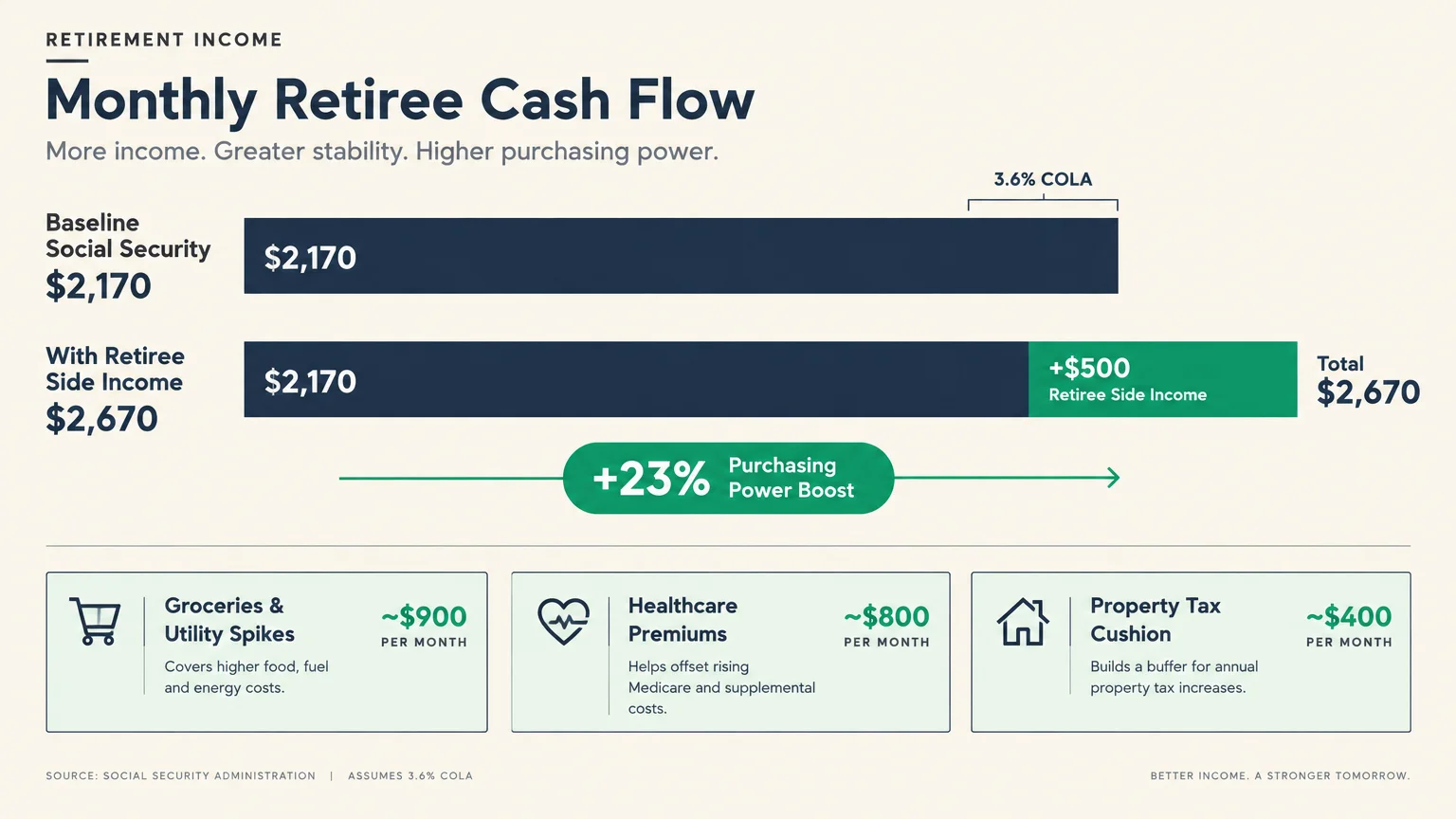
In late 2026, the average monthly Social Security retired-worker benefit hovered between $2,089 and $2,095. Starting in January 2027, an announced 3.6% cost-of-living adjustment elevates that average check to approximately $2,170.
Adding $500 in retiree side income provides an immediate 23% to 24% boost to that baseline monthly benefit. That supplemental cushion absorbs sharp price increases for groceries, car insurance, and out-of-pocket medical expenses.
Recent data indicates that working during retirement has become an increasingly popular financial strategy. A February 2026 AARP survey found that 7% of retired Americans ages 50 and older unretired within the previous six months.
Among those returning to work, 48% cited needing additional money as their primary motivation. Furthermore, 41% of all older workers noted that their primary goal was simply affording everyday living expenses.
Survey data from ResumeBuilder in 2026 revealed that roughly 12% of seniors ages 65 and older have either re-entered the workforce or are actively applying. A notable 54% cited the cost of living, while an equal 54% cited work enjoyment.
The 2026 EBRI Retirement Confidence Survey reinforces this dynamic. While 74% of current workers expect to work in retirement, only 31% of retirees report having actually worked for pay.
Yet among those who do work, 91% report doing so to stay active and involved. Another 85% state that they simply enjoy working when the terms remain flexible.
Generating $500 each month hits a sweet spot. It provides tangible financial protection without consuming your schedule or triggering punitive tax penalties.
“A budget is telling your money where to go instead of wondering where it went.” — John C. Maxwell

1. Local Pet Sitting and Dog Walking
Pet care provides dependable extra monthly income alongside built-in physical exercise. Neighborhood pet owners frequently seek reliable, mature adults to care for their companions while they work or travel.
Professional dog walkers typically charge between $25 and $35 for an individual 30-minute walk. Pet sitters handling drop-in feeding visits charge similar rates in suburban and urban communities.
To reach $500 a month, you only need to schedule roughly four to five 30-minute visits per week. Completing 16 to 20 visits a month hits your revenue target while keeping your mornings largely free.
Overnight in-home pet sitting represents an even faster route to your financial goal. Overnight sitters routinely command between $50 and $75 per night.
Hosting or watching a dog for just seven to ten days each month clears $500 in gross revenue. You can offer services directly through neighborhood platforms or list your availability on specialized pet apps.
Startup expenses remain negligible for pet care providers. You only need comfortable walking footwear, reliable leashes, waste collection bags, and a basic phone for owner updates.
Always hold an introductory meeting before accepting any pet assignment. This meet-and-greet lets you observe the animal’s temperament and determine whether the physical demands suit your comfort level.
Consider carrying specialized independent pet-sitter liability insurance. Annual policies cost very little and protect your personal assets against unexpected accidents or property damage.

2. Specialized Academic and Skills Tutoring
Tutoring lets you translate decades of accumulated professional knowledge into premium part-time earnings. School districts, parents, and adult learners consistently seek patient educators for personalized instruction.
Academic tutors instructing elementary through high school students generally charge between $35 and $60 per hour. Specialists covering advanced placement mathematics, laboratory sciences, or college entrance exams command significantly higher rates.
At an average rate of $45 per hour, you only need to teach 11 to 12 hours per month. That translates to working just under three hours per week to earn $500 a month.
You can structure sessions around your personal lifestyle. Instruct students at your dining table, book study rooms at public libraries, or conduct video sessions online.
Academic subjects are not your only option for teaching. Retirees also earn steady fees teaching musical instruments, conversational English, foreign languages, or basic office software to adult students.
Connecting with neighborhood school parent-teacher organizations or posting notices on community message boards yields fast client leads. Former colleagues and extended family networks also serve as fruitful referral sources.
Establish clear cancellation terms before commencing any tutoring relationship. Requiring 24 hours of advance notice for cancellations protects your earnings against last-minute scheduling changes.
Prepare targeted worksheets or follow the student’s assigned classroom curriculum to keep prep time minimal. This efficiency ensures your billable hours accurately reflect your actual time investment.

3. Seasonal Tax Preparation and Bookkeeping
Tax preparation and bookkeeping offer lucrative side hustles $500 and beyond for individuals with basic accounting fluency. Small businesses and seasonal accounting practices face severe staffing crunches during peak quarters.
Seasonal tax preparers earn between $25 and $45 per hour assisting commercial firms from January through mid-April. Putting in 12 to 15 weekly hours during tax season generates thousands of dollars in aggregate pay.
By banking your seasonal earnings, you can distribute a $500 monthly payout to your household budget year-round. Major tax preparation franchises provide comprehensive training courses every autumn to prepare new hires.
If you prefer steady monthly income, freelance bookkeeping provides reliable recurring revenue. Local contractors, trade specialists, and boutique retailers often struggle to keep their accounting ledgers up to date.
A freelance bookkeeper generally charges $250 to $350 per client each month for reconciling bank accounts and tracking invoices. Managing basic books for just two small local businesses generates $500 to $700 monthly.
Modern cloud accounting software enables you to execute your bookkeeping duties entirely from a home computer. You choose your working hours, whether that means early morning reviews or afternoon balance reconciliations.
Earning an online certification in popular small-business accounting platforms builds immediate credibility with potential clients. Most platform certifications are free and require only a few days of self-paced study.
Always maintain separate digital workspaces and encrypted storage for each business client. Protecting proprietary financial data maintains trust and ensures professional compliance.

4. Home Organizing and Downsizing Assistance
Decades of homeownership result in overcrowded basements, overflowing attics, and cluttered storage garages. Many seniors and busy families feel overwhelmed by the physical and logistical chore of decluttering their spaces.
Professional home organizers charge between $40 and $65 per hour for hands-on residential sorting and downsizing. At a rate of $50 per hour, delivering ten billable hours monthly secures your $500 target.
You can complete that monthly workload through two five-hour weekend sessions or several short weekday appointments. Your life experience equips you with the patience and empathy needed to guide emotional sorting decisions.
Downsizing assistance represents a booming subfield within this industry. Many aging homeowners want to relocate into condos or retirement communities but struggle to liquidate excess furniture and possessions.
You can assist clients by cataloging items for donation, managing consignment drop-offs, and staging rooms for moving sales. Real estate agents represent prime referral partners because they frequently need homes organized before open houses.
This side income path requires organizational talent and interpersonal diplomacy rather than heavy physical lifting. You direct the process and help make sorting choices while movers or family members handle bulky items.
Bring basic supply kits to each job, including clear labeling bins, marker pens, packing tape, and heavy-duty bags. Providing practical tools reinforces your professionalism and speeds up the sorting process.
Set clear project boundaries from the outset to avoid scope creep. Clarify whether your service includes hauling donations or strictly organizing items inside the residence.

5. Substitute Teaching and School District Support
Public and private school systems across the nation continually seek dependable substitute teachers and instructional aides. This occupation offers exceptional flexibility because you decide precisely which days you want to work.
Daily pay for substitute teachers ranges from $110 to $160 for full days, depending on school district resources. Working just three to four days per month comfortably produces your $500 monthly side income.
Many districts also hire substitutes for half-day shifts that pay between $60 and $85. Completing six half-day morning shifts leaves your afternoons wide open while hitting your exact financial target.
Most school jurisdictions do not require a permanent state teaching license for day-to-day substitute teachers. A bachelor’s degree in any field, combined with a standard background clearance, satisfies baseline criteria in many states.
School districts utilize automated smartphone apps and websites where available shifts post daily. You simply log in and accept assignments that match your preferred schools, subjects, and grade levels.
The role carries zero after-hours grading, lesson planning, or administrative parent conferences. When the afternoon dismissal bell rings, your workday concludes entirely.
If classroom instruction feels too demanding, inquire about auxiliary support positions within the district. Schools hire retirees for standardized exam proctoring, library assistance, cafeteria monitoring, and school bus aide duties.
These auxiliary support roles pay hourly rates ranging from $15 to $22 per hour. They deliver consistent, low-stress part-time earnings within a community-focused environment.

6. Handyman Services and Light Home Maintenance
Major construction contractors generally refuse small home maintenance tasks because their overhead demands larger projects. This market gap creates enormous local demand for honest, dependable handyman specialists.
Handyman operators bill between $40 and $75 per hour for common household repairs and light installation work. Completing seven to ten hours of service across an entire month produces $500 in gross revenue.
Routine requests include replacing kitchen faucets, hanging window blinds, repairing drywall dings, mounting flat-screen televisions, and weatherstripping doors. Many elderly neighbors prefer hiring a trusted contemporary who treats their home with care.
You select the specific tasks you feel comfortable performing based on your physical stamina and available tools. You do not need a commercial van; a standard vehicle trunk holds most essential hand and power tools.
Always avoid hazardous projects such as steep roof repairs, major structural carpentry, or complex electrical service panel upgrades. High-risk jobs require specialized municipal trade licensing and carry significant physical liability.
Distribute basic business cards at local community centers, senior centers, hardware stores, and neighborhood gathering places. Word of mouth regarding dependable, tidy handyman work spreads rapidly throughout residential neighborhoods.
Bill your customers separately for your labor time and the actual wholesale cost of replacement materials. Keep project receipts organized so homeowners can verify supply charges without friction.
Check local municipal licensing requirements before launching your handyman operation. Many jurisdictions permit unlicensed handymen to perform small repairs provided total project bills remain under statutory dollar limits.

7. Tour Guiding and Local Experience Hosting
If you live near a historic district, national park, culinary corridor, or scenic waterfront, consider tour guiding. This role pays you to walk outdoors, share local history, and socialize with visitors.
Commercial tour operators and municipal historical societies pay docents and guides between $25 and $35 per hour. Tour guests also frequently provide cash tips, pushing your effective hourly compensation substantially higher.
Leading two 2-hour walking tours per week easily generates over $500 per month in total compensation. You stay physically active, log several thousand steps per shift, and expand your community engagement.
You can also design independent experiential outings on international booking portals. Specialized walking tours highlighting neighborhood ghost lore, architecture, historic churches, or regional bakeries attract steady vacationer traffic.
Hosting independent experiences allows you to charge per attendee, often $30 to $50 per person. Guiding a modest group of six participants on two Saturday walks per month easily clears your $500 goal.
Independent experience hosting requires no physical storefront or specialized inventory. Your primary asset is your authentic storytelling, deep neighborhood familiarity, and hospitable demeanor.
Ensure your walking routes feature safe pedestrian crossings, even sidewalks, and accessible public restrooms. Planning your route carefully keeps tour participants comfortable and earns your service five-star customer reviews.
In colder regions, tour volume drops substantially during winter months. Plan to pair summer tour guiding with an indoor winter hustle to maintain consistent cash flow across all seasons.

8. Reselling Curated Vintage Goods and Books
Reselling transforms estate sale hunting, flea market browsing, and thrift store shopping into systematic side income. This side hustle allows you to work completely at your own pace from home.
Experienced resellers routinely achieve average net margins between $20 and $35 per sold item. Sourcing and selling 15 to 25 items each month produces $500 in clean net profit.
Success in reselling depends on specializing in niches where you already hold personal expertise. Rather than buying random items, focus on vintage tools, first-edition books, mid-century kitchenware, or collectible porcelain.
Established online platforms like eBay provide immediate access to millions of active collectors worldwide. You simply photograph items using a smartphone, write accurate descriptions, and package purchases for mail delivery.
If you dislike packing boxes and traveling to the post office, explore local antique mall booths. Renting a booth inside a local collective costs between $100 and $250 monthly plus a small commission.
In an antique mall, you simply stock and arrange your display shelves once or twice each week. The store’s staff manages the cash register, processes payments, and remits a monthly sales check to you.
Keep your initial inventory acquisitions lean to avoid cluttering your personal living quarters. Reinvest your initial sales proceeds into higher-margin merchandise rather than tapping your household checking account.
Save all acquisition receipts, packing material invoices, and platform fee statements. Deducting these legitimate inventory costs minimizes your net taxable profit at the end of the year.

Comparing Side Income Paths for Retirees
Choosing the best side gig depends on your physical stamina, technical skills, and available hours. The following comparison highlights what you can expect from each of the eight income strategies.
| Retiree Side Income Path | Typical Hourly Potential | Monthly Hours for $500 | Physical Demand Level | Initial Startup Expense |
|---|---|---|---|---|
| Local Pet Sitting & Walking | $25 – $35 / visit | 16 – 20 hours | Moderate (walking daily) | Very Low ($50 – $150) |
| Academic & Skills Tutoring | $35 – $60 / hour | 10 – 14 hours | Low (sedentary) | Minimal ($0 – $50) |
| Tax Prep & Bookkeeping | $25 – $45 / hour | 12 – 18 hours | Low (desk work) | Low ($100 – $300) |
| Home Organizing & Downsizing | $40 – $65 / hour | 8 – 12 hours | Moderate (bending, sorting) | Very Low ($25 – $75) |
| Substitute Teaching Support | $15 – $25 / hour equiv. | 20 – 30 hours | Low to Moderate | Low (background check fees) |
| Handyman & Home Repairs | $40 – $75 / hour | 7 – 12 hours | Moderate to High | Moderate (existing tools help) |
| Tour Guiding & Hosting | $25 – $40 / hr + tips | 12 – 16 hours | Moderate (standing, walking) | Very Low ($0 – $50) |
| Reselling Curated Goods | $20 – $35 profit / item | 15 – 25 items sold | Low to Moderate | Moderate ($150 – $400 stock) |
Understanding Social Security Earnings Limits and Rules
Many retirees worry that earning part-time earnings will trigger penalties on their monthly Social Security checks. Fortunately, earning $500 a month—or $6,000 annually—remains well below federal statutory clawback thresholds.
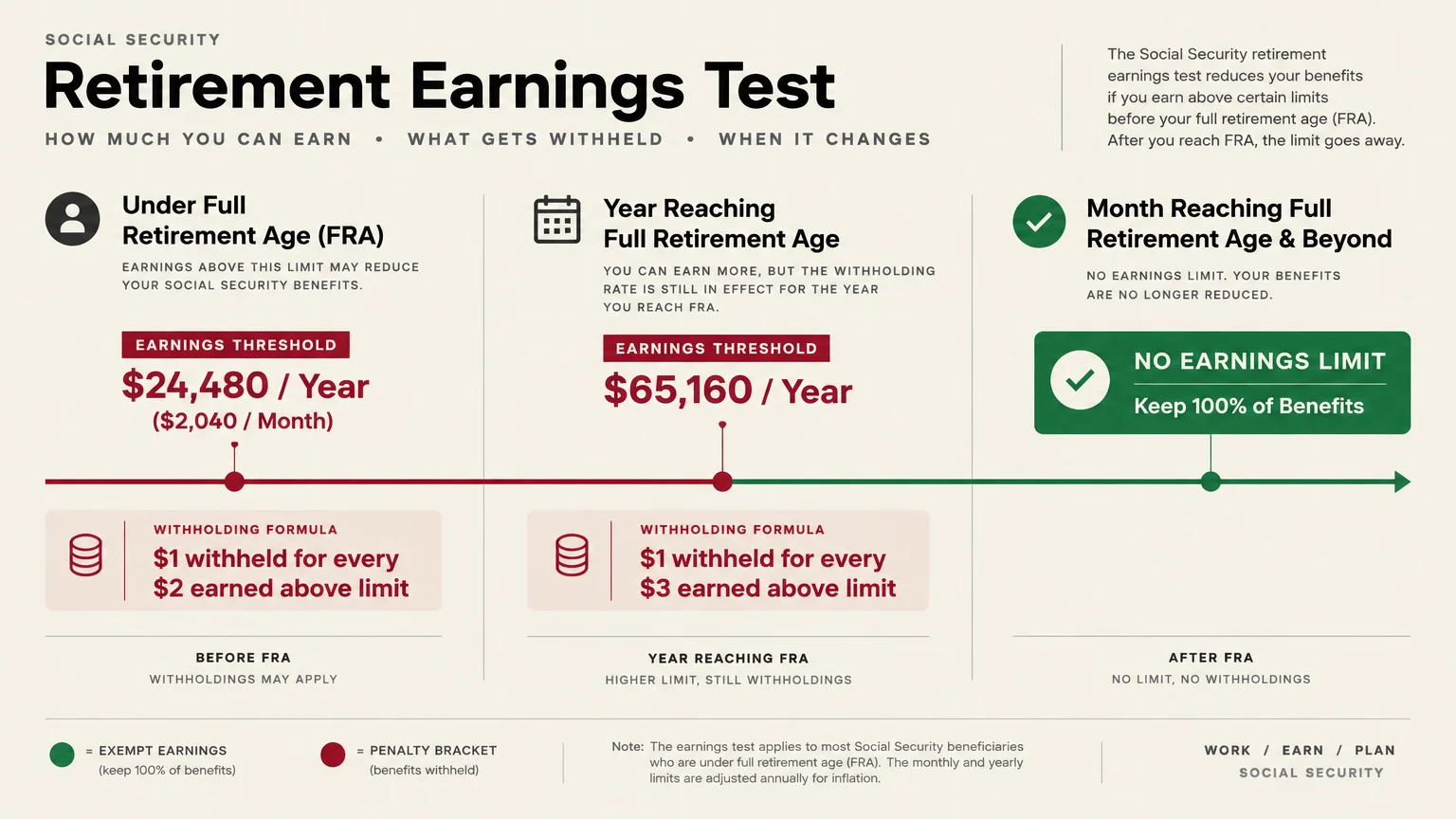
The Social Security Administration enforces an earnings test strictly on beneficiaries who collect retirement checks before their full retirement age. For anyone born in 1960 or later, full retirement age is 67.
In 2026, retirees collecting early benefits can earn up to $24,480 per year without losing a single dollar of benefits. That earnings limit rises to $25,560 for the 2027 calendar year.
If you exceed that limit before full retirement age, the government withholds $1 of benefits for every $2 earned above the threshold. Earning $6,000 annually leaves you roughly $18,480 below the 2026 threshold, meaning zero benefits are withheld.
In the specific calendar year you reach your full retirement age, the earnings limit jumps substantially. The threshold reaches $65,160 in 2026 and increases to $67,920 for 2027.
In that transition year, the SSA withholds only $1 for every $3 earned above the limit until your birthday month arrives. Again, earning $500 a month will never approach this elevated ceiling.
Once you reach full retirement age, federal earnings limits disappear completely. You can earn unlimited side income without any reduction to your monthly Social Security benefits.
Furthermore, any benefits temporarily withheld under early retirement rules are not lost permanently. The SSA recalculates your monthly check upward at full retirement age to credit back withheld amounts over time.

Managing Taxes on Your Retiree Side Income
Earning extra money requires planning for federal and state tax obligations. Even modest independent contractor income impacts your tax return and requires accurate accounting.
Every dollar of net self-employment earnings of $400 or more is subject to federal self-employment tax. The self-employment tax rate remains 15.3%, consisting of 12.4% for Social Security and 2.9% for Medicare.
When you work as an independent contractor, you pay both the employee and employer portions of these payroll taxes. However, the IRS permits you to deduct half of your total self-employment tax from your adjusted gross income.
Under the One Big Beautiful Bill Act, the reporting threshold for businesses issuing Form 1099-NEC increased to $2,000 in 2026. This threshold adjusts for inflation starting in 2027.
If an individual corporate client or school district pays you $500 monthly, your annual compensation totals $6,000. That client will issue a Form 1099-NEC summarizing your gross earnings for the year.
Conversely, the federal reporting threshold for third-party payment settlement apps remains permanently set at $20,000 and 200 transactions. Payment networks like PayPal or Venmo will not send a Form 1099-K unless you breach both metrics.
Remember that you must report all earned side income on Schedule C regardless of whether you receive a 1099 form. Failing to report cash or digital payments violates federal tax reporting statutes.
Lower your net taxable earnings by tracking all legitimate business expenses directly related to your gig. Deductible items include software subscriptions, client supplies, hand tools, advertising fees, and dedicated business phone lines.
If your side gig requires driving to clients, take advantage of the federal standard mileage deduction. For 2026, the IRS business mileage rate was 72.5 cents per mile through June 30, rising to 76 cents per mile through December 31.
To prevent penalties, submit quarterly estimated tax payments using Form 1040-ES if you expect to owe $1,000 or more. Estimated tax deadlines occur four times annually: April 15, June 15, September 15, and January 15.
“It’s not how much money you make, but how much money you keep, how hard it works for you, and how many generations you keep it for.” — Robert Kiyosaki
Costly Mistakes to Avoid
Launching a side hustle should enhance your retirement lifestyle, not introduce administrative headaches or financial traps. Avoid these common mistakes when starting your side income venture.
- Ignoring Self-Employment Tax Liabilities: Spending all your gross revenue without setting aside 25% to 30% for federal and state taxes leads to distressing tax season surprises.
- Failing to Track Business Miles and Receipts: Losing paper receipts or failing to log business driving forfeits valuable Schedule C deductions that legally lower your tax bill.
- Underpricing Your Specialized Services: Setting prices too low forces you to work double the hours to reach your $500 monthly target, leading directly to physical burnout.
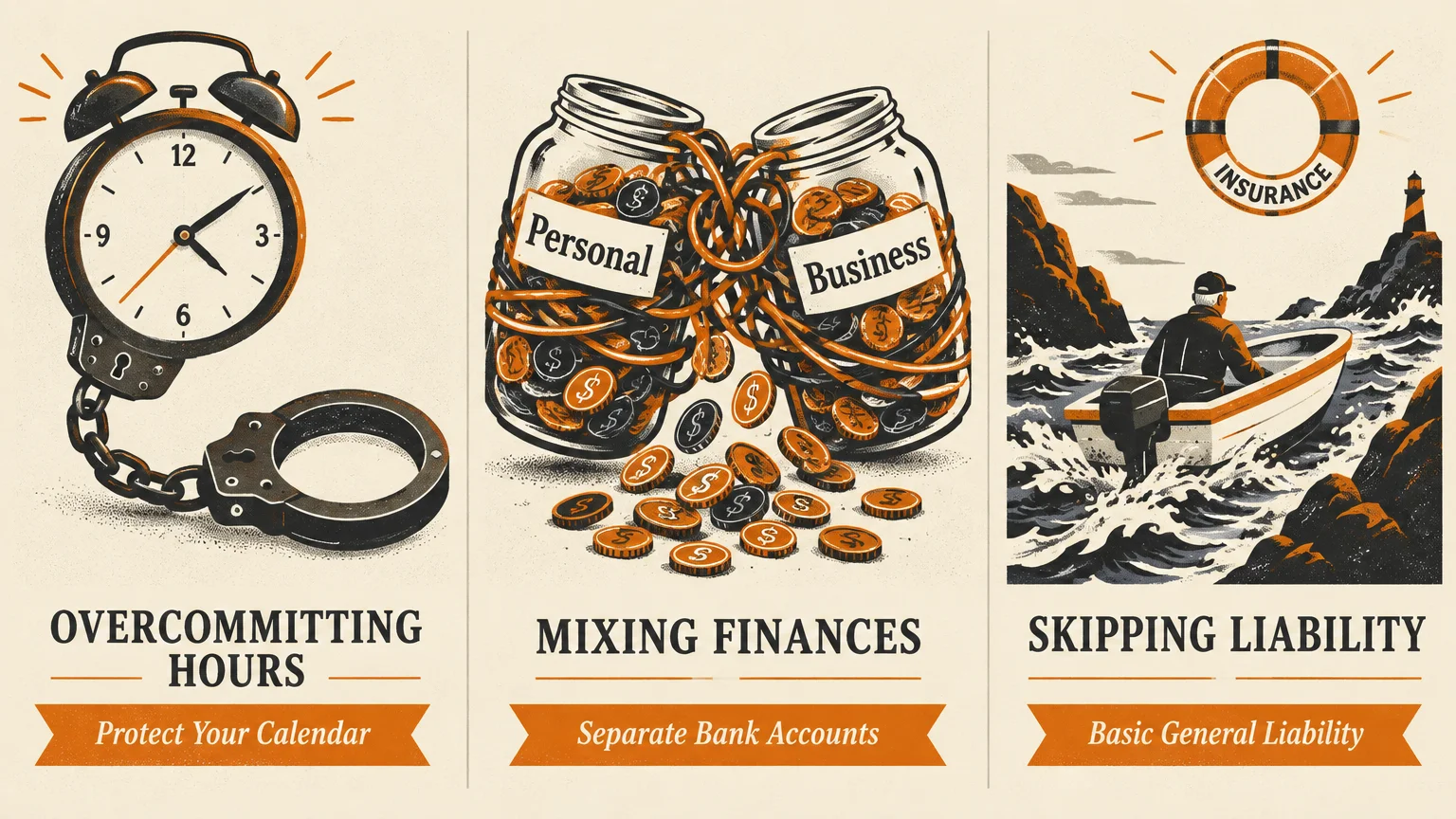
- Overcommitting Your Free Calendar: Accepting too many client bookings destroys the schedule freedom and leisure you worked decades to achieve in retirement.
- Triggering Medicare IRMAA Surcharges: Failing to monitor how extra income impacts your modified adjusted gross income could push you across income cliffs that raise Medicare Part B and Part D premiums.
Protect your health and personal time by setting strict client boundaries from your very first week. Never hesitate to decline an assignment that interferes with personal travel, hobbies, or family obligations.
Keep a dedicated business checking account for all side income and business-related purchases. Mingling personal household funds with freelance earnings creates chaotic bookkeeping and complicates tax preparation.

Don’t DIY These Decisions
Managing basic part-time earnings is straightforward, but certain financial intersections require professional guidance. Making uninformed decisions can affect healthcare subsidies, tax brackets, and long-term estate structures.
Consult a Certified Public Accountant (CPA) or Enrolled Agent (EA) if your side income pushes your household into a higher tax bracket. A tax professional ensures you maximize Schedule C write-offs while keeping your estimated tax vouchers accurate.
Engage a fee-only financial planner to analyze how side earnings interact with your overall retirement withdrawal sequence. Extra income may allow you to delay tapping tax-deferred accounts, reducing lifetime income tax liabilities.
Financial planners also calculate whether extra revenue triggers taxes on your Social Security benefits. Up to 85% of your Social Security benefits become taxable once your combined provisional income crosses statutory limits.
If you encounter complex consumer billing problems or credit disputes while operating your venture, consult resources from the Consumer Financial Protection Bureau. For broad guidance on government programs and tax filing help, review portals provided by USA.gov Money and Taxes.
Consult an attorney if you operate a service that involves entering private residences or performing physical repairs. A brief legal consultation helps you choose between operating as a sole proprietor or forming a limited liability company.
Frequently Asked Questions About Retiree Side Income
Will earning $500 a month reduce my Social Security benefits?
No, earning $500 a month will not reduce your Social Security benefits. Earning $500 monthly equals $6,000 annually, which falls well below the 2026 earnings limit of $24,480 for retirees under full retirement age.
Do I have to pay self-employment tax on only $500 a month?
Yes, you must pay self-employment tax on net freelance earnings exceeding $400 per year. The combined rate is 15.3% to cover Social Security and Medicare, though you deduct half that amount on Form 1040.
Will my side hustle income increase my Medicare premiums?
Generally, an extra $6,000 per year will not trigger higher Medicare premiums unless your total income already sits near an IRMAA threshold. Income-Related Monthly Adjustment Amounts apply only to high earners crossing specific statutory income tiers.
Do I need to form an LLC to earn side income as a retiree?
No, you do not need an LLC to earn side income. Most retirees operate as sole proprietors, reporting earnings directly on Schedule C, though an LLC can offer liability protection for high-risk work.
Your Next Step Toward Steady Extra Income
Pick one side hustle idea that aligns with your natural skills and matches your desired physical activity level. Commit to testing that service for three months by taking on two to three local clients.
Open a separate checking account today to collect client fees, save tax reserves, and track your incoming cash flow cleanly. Taking control of this extra income gives you renewed financial independence and flexibility throughout your retirement years.
Financial outcomes vary based on individual income, credit history, and circumstances. This article provides general guidance only. Consult a qualified financial planner, CPA, or consumer attorney for advice specific to your situation.
Last updated: November 2026. Rates, benefit amounts, and tax rules change—always verify current details at official sources.