
Entering the final decade before retirement shifts your financial strategy from aggressive wealth accumulation to wealth preservation. A severe market downturn during these crucial years can permanently alter your planned exit date.
You must actively balance long-term growth against sequence-of-returns risk while optimizing your retirement accounts. Strategic portfolio adjustments protect your hard-earned principal without leaving you vulnerable to persistent inflation.
Taking full advantage of updated 401(k) catch-up rules and rebalancing your investments will secure your future. Implementing these actionable moves today ensures your portfolio lasts throughout retirement.

Guarding Against Sequence of Returns Risk
Market timing matters little during your early career, but it becomes critical during the five years before and after you retire. Financial planners refer to this vulnerable window as the retirement red zone.
A severe market slump right before you retire forces you to liquidate depressed assets to fund early withdrawals. Selling equities at depressed valuations locks in losses and permanently depletes your portfolio longevity.
Managing sequence-of-returns risk requires building dedicated cash and short-term fixed-income reserves before leaving work. These liquid buffers provide living expenses so you never have to sell equities during sharp downturns.
Benchmark 10-year U.S. Treasury yields traded near 4.9% in late 2026, creating strong income generation opportunities. This rate environment allows you to secure dependable income without carrying excessive equity risk.
Calibrating Your Stock-to-Bond Allocation
The Department of Labor Employee Benefits Security Administration emphasizes diversifying across asset classes as you approach retirement. Shifting toward lower-risk investments moderates volatility while protecting your accumulated nest egg.
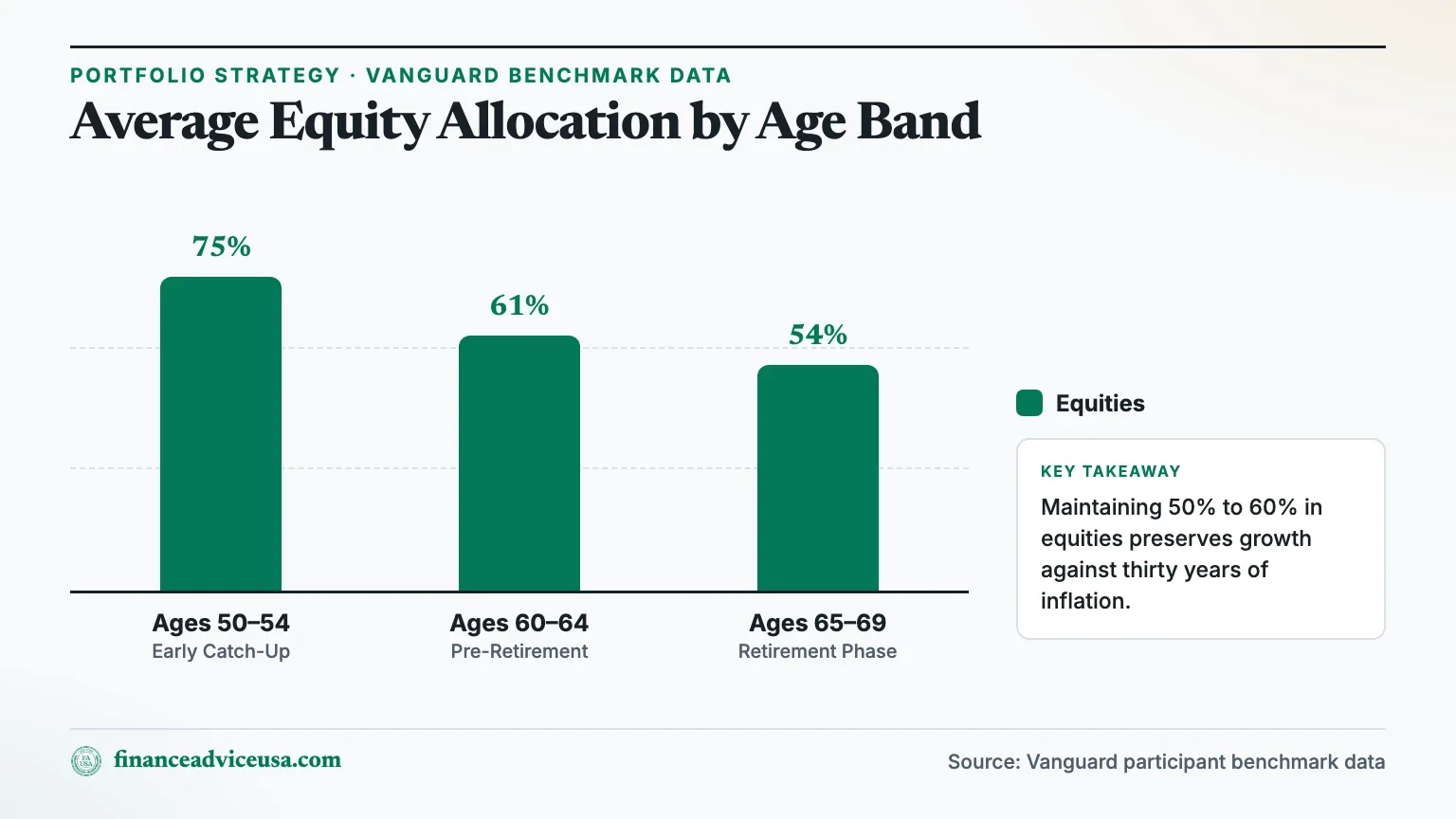
According to Vanguard benchmark data, average equity allocations drop from 75% for workers ages 50 to 54 down to 61% for ages 60 to 64. By ages 65 to 69, participant equity exposure tapers further to roughly 54%.
Do not eliminate equities entirely in a hasty attempt to avoid market volatility. Retaining 50% to 60% equity exposure provides the vital growth needed to outpace inflation across a thirty-year retirement.
Pair your equities with short-to-intermediate bonds, Treasury securities, and cash equivalents. This balanced framework generates stable income for near-term spending while preserving long-term purchasing power.
“The best time to plan for a financial goal was 20 years ago. The second best time is today.” — Proverb
Maximizing 401(k) Catch-Up Contributions
Catch-up contributions allow older workers to accelerate their retirement savings during their highest-earning career years. Reaching age 50 opens substantial tax-advantaged savings capacity under IRS retirement plans guidelines.
In 2026, the standard elective deferral limit is $24,500, with an $8,000 catch-up for workers age 50 and older. In 2027, the standard deferral limit rises to $25,500, and the age 50+ catch-up climbs to $8,500.
Under SECURE 2.0, workers turning ages 60, 61, 62, or 63 qualify for a higher super catch-up limit if their employer’s plan allows it. This cap reached $11,250 in 2026 and increases to $11,750 in 2027.
Once you reach age 64, your maximum catch-up deferral reverts to the standard age 50+ limit. Maximizing these contributions during your early sixties substantially bolsters your overall portfolio value.
| Contribution Category | 2026 Limit | 2027 Limit |
|---|---|---|
| Standard Employee Elective Deferral | $24,500 | $25,500 |
| Age 50+ Standard Catch-Up Limit | $8,000 | $8,500 |
| Total Employee Limit (Age 50+) | $32,500 | $34,000 |
| Ages 60–63 Super Catch-Up Limit | $11,250 | $11,750 |
| Total Employee Limit (Ages 60–63) | $35,750 | $37,250 |
| Combined Employee + Employer Cap (§415(c)) | $72,000 | $75,000 |
Understanding the High-Earner Roth Catch-Up Mandate
SECURE 2.0 introduced significant structural tax changes for high earners making catch-up contributions. The rule mandates that participants earning above specific thresholds must direct their catch-up contributions into after-tax Roth accounts.
For 2026 contributions, the mandate applies if your prior-year FICA wages from your plan sponsor exceeded $150,000. In 2027, this threshold rises to $155,000 based on your 2026 FICA earnings.
This statutory test evaluates only your individual Form W-2 Box 3 wages from the specific employer sponsoring your plan. Your spouse’s earnings and outside business income do not affect your threshold status.
You may continue directing your standard elective deferrals into traditional pre-tax accounts. However, if your employer plan lacks a Roth feature, affected high earners cannot make any catch-up contributions.

Key Milestones: Rule of 55 and Social Security
Coordinating account withdrawals requires navigating specific federal distribution rules before leaving your career. The Rule of 55 allows penalty-free 401(k) withdrawals if you leave your job during or after the calendar year you turn 55.
This exception applies exclusively to the 401(k) plan maintained by the employer you separated from. Rolling those funds into an IRA eliminates this early distribution exception and locks the capital until age 59½.
Your Social Security Administration Full Retirement Age is 67 if you were born in 1960 or later. Claiming benefits at age 62 permanently reduces your monthly payout by approximately 30%.
Delaying benefit claims past Full Retirement Age until age 70 increases your monthly check up to 124% of your baseline amount. Spending down taxable or tax-deferred 401(k) assets first often produces higher guaranteed lifetime income.
Common Money Traps
Pre-retirees frequently make critical financial errors during their final working years. Avoiding these missteps preserves your purchasing power and keeps your retirement timeline secure.
- Fleeing entirely into cash: Stashing your entire portfolio in money market accounts eliminates volatility but leaves you exposed to decades of inflationary erosion.
- Assuming your plan offers super catch-up: Employers are not legally required to adopt the SECURE 2.0 super catch-up provisions, so verify plan rules first.
- Rolling over funds prematurely: Transferring your final 401(k) into an IRA before age 59½ forfeits your penalty-free Rule of 55 withdrawal flexibility.
- Overlooking high-earner Roth requirements: Failing to designate catch-up funds as Roth when your wages exceed the FICA cap can trigger administrative rejections.
When to Consult a Professional
Shifting your asset mix while navigating indexed wage thresholds can create intricate tax consequences. Partnering with a fee-only certified financial planner or a CPA provides objective guidance tailored to your household goals.
A professional helps identify Roth conversion opportunities before Required Minimum Distributions begin at age 73 or 75. They also ensure your asset location minimizes annual income taxes across all taxable and tax-deferred accounts.
Frequently Asked Questions
Can I make catch-up contributions if I am under 50 but within 10 years of retirement?
No, IRS regulations require you to turn at least age 50 by December 31 of the contribution year. Retiring early does not accelerate your eligibility for catch-up contributions.
Does my spouse’s income trigger the mandatory Roth catch-up rule?
No, the wage threshold test applies solely to your individual FICA wages from the employer sponsoring the plan. Your spouse’s income has no bearing on your catch-up status.
What happens to my catch-up contributions at age 64?
The enhanced super catch-up limit applies only through the calendar year you turn age 63. At age 64, your maximum allowable catch-up contribution reverts to the standard age 50+ limit.
Review your elective deferrals today and adjust your payroll withholding to secure every available catch-up dollar. Schedule an asset allocation review to ensure your portfolio remains well protected against sequence-of-returns risk.
Information in this article reflects rules and figures current as of the publication date and may change. Always confirm details directly with your bank, the IRS, the Social Security Administration, or other official sources before making decisions.
Last updated: November 2026. Rates, benefit amounts, and tax rules change—always verify current details at official sources.