
To rank among Florida’s top 10 percent of earners, your household must generate at least $280,649 in annual gross income. If you file taxes individually, entering the state’s 90th percentile requires an adjusted gross income of $205,567.
While Florida’s median household income reached $80,846, the threshold for top earners Florida has surged rapidly in recent years. Wealth migration from high-tax states and steady wage expansion have reshaped the state’s economic landscape.
Whether you are evaluating your household budget or setting long-term career goals, tracking income percentiles clarifies where your earnings stand today.
Understanding the Florida Top 10 Percent Income Benchmark
Reaching the upper tier of Florida household income requires substantially more revenue than it did just a few years ago. Economic shifts and population inflows have elevated earning standards statewide.
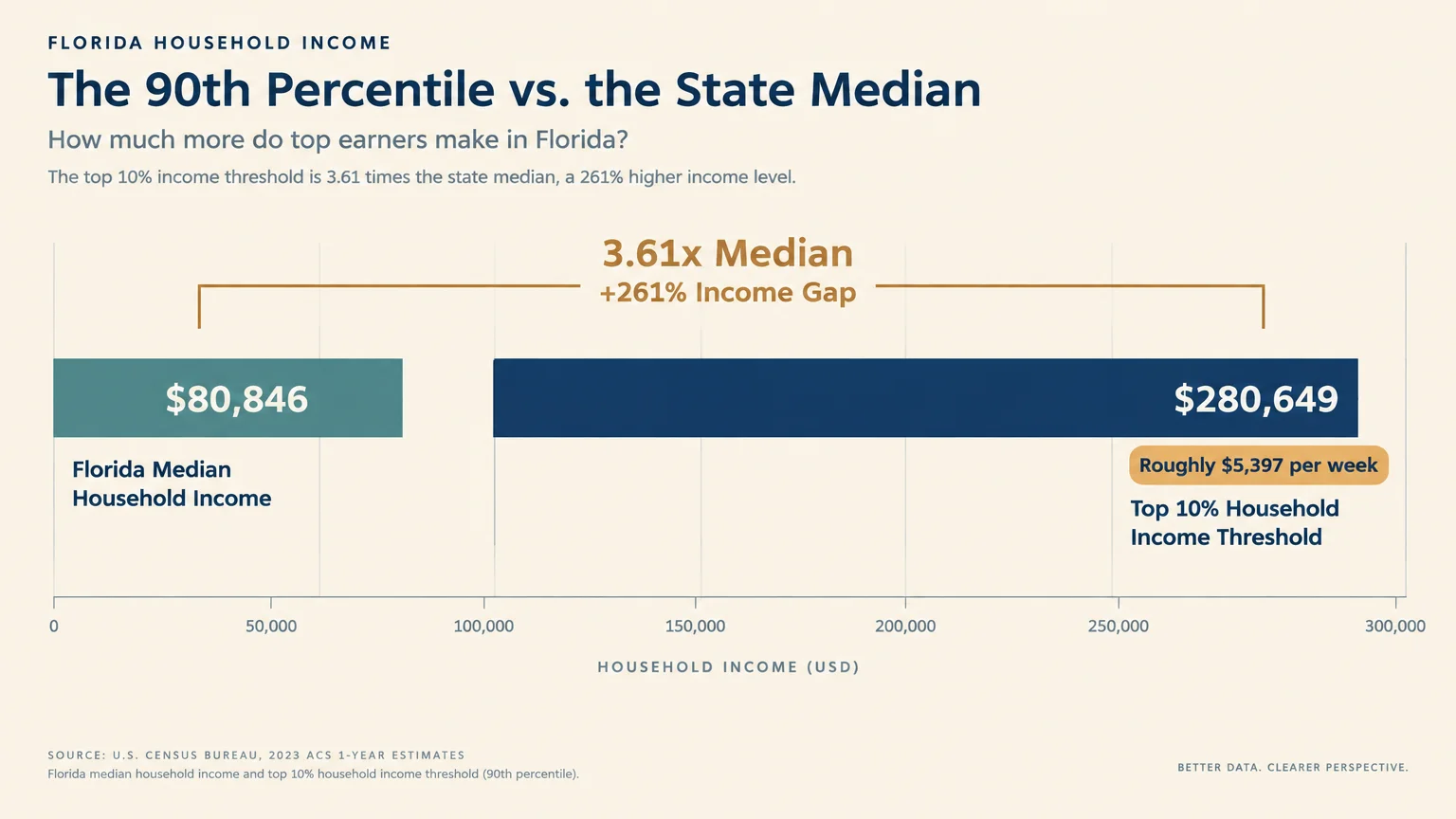
A Florida household needs an annual income of $280,649 to cross the 90th percentile mark. That figure translates to roughly $5,397 per week in gross household earnings.
This benchmark sits 3.61 times higher than the median household baseline across the state. In percentage terms, your household must make 261 percent more than the midpoint Florida family to enter this cohort.
Household income aggregates all earnings generated by individuals who share a single residential address. This metric captures salaried wages, contractor income, investment returns, business profits, and retirement distributions.
Because household income frequently combines two working professionals, the financial threshold climbs significantly faster than individual worker data. Dual-earner households in medical, corporate, legal, and engineering sectors frequently power this upper bracket.
Individual Filers vs. Household Earnings: Key Distinctions
When measuring your financial status, you must differentiate between total household earnings and individual tax returns. Comparing a solo earner’s paycheck against a multi-income household number distorts your financial assessment.
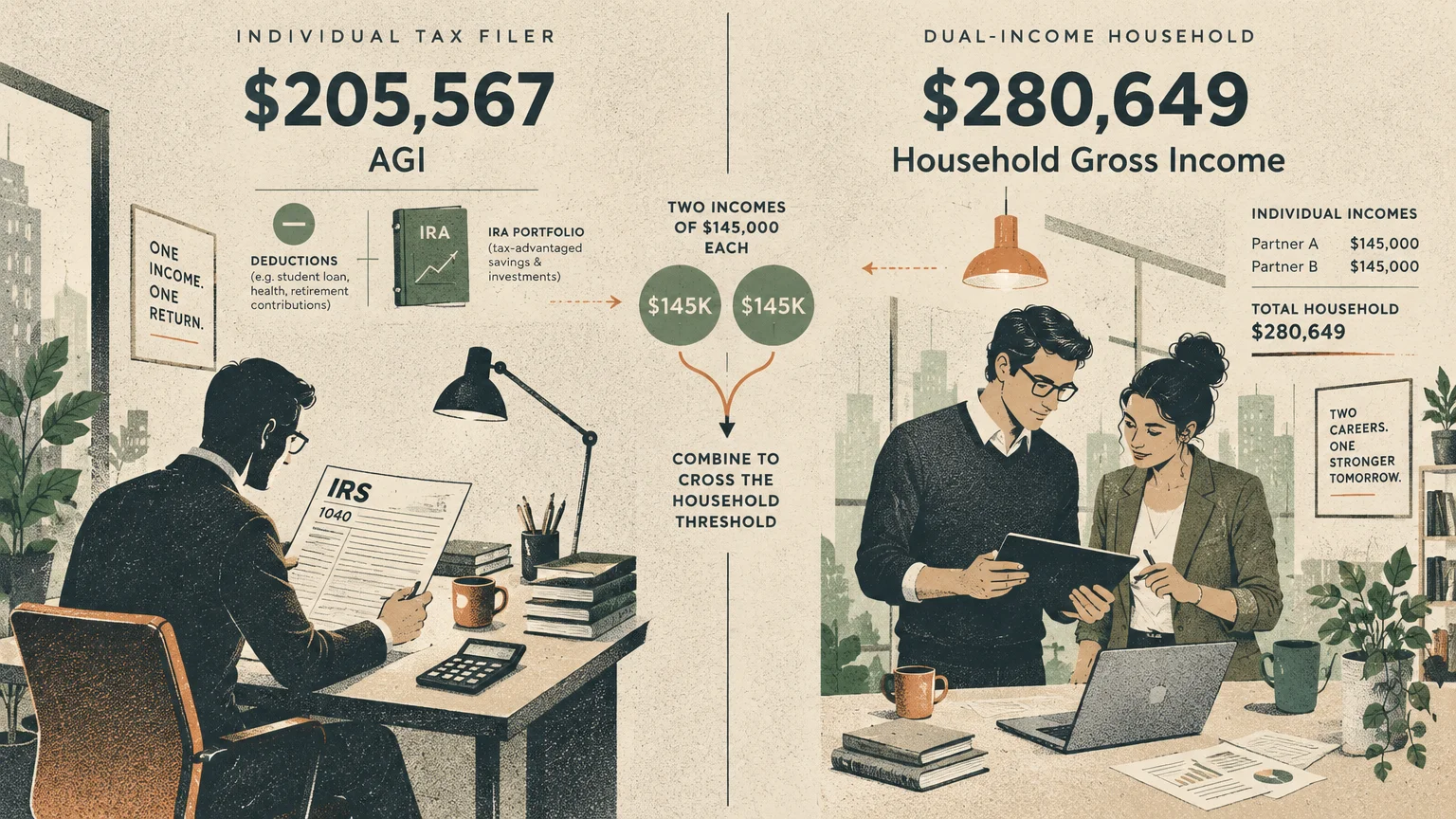
For individual tax filers, entering Florida’s top 10 percent requires an Adjusted Gross Income (AGI) of $205,567. This baseline reflects data derived from IRS tax returns adjusted for real personal income growth.
Adjusted gross income measures your total income minus specific above-the-line tax deductions. These deductions include student loan interest, educator expenses, and contributions to traditional individual retirement accounts.
Review the primary structural differences between these two measurement methods:
- Filing Status Variability: Individual AGI metrics include single filers, heads of household, and married taxpayers filing separately.
- Income Source Aggregation: Household metrics combine all paychecks under one roof, whereas individual AGI isolates single tax returns.
- Pre-Tax Adjustments: AGI reflects earnings after IRS adjustments; gross household income tallies earnings before deductions.
- Labor Pool Changes: Two mid-tier earners making $145,000 each elevate a single household past the $280,649 line easily.
If you earn $205,567 as an individual wage earner, you already rank among the premier individual earners statewide. You do not need to hit the higher household number alone to achieve 90th percentile standing.
Comparing Florida Household Income Across Percentiles
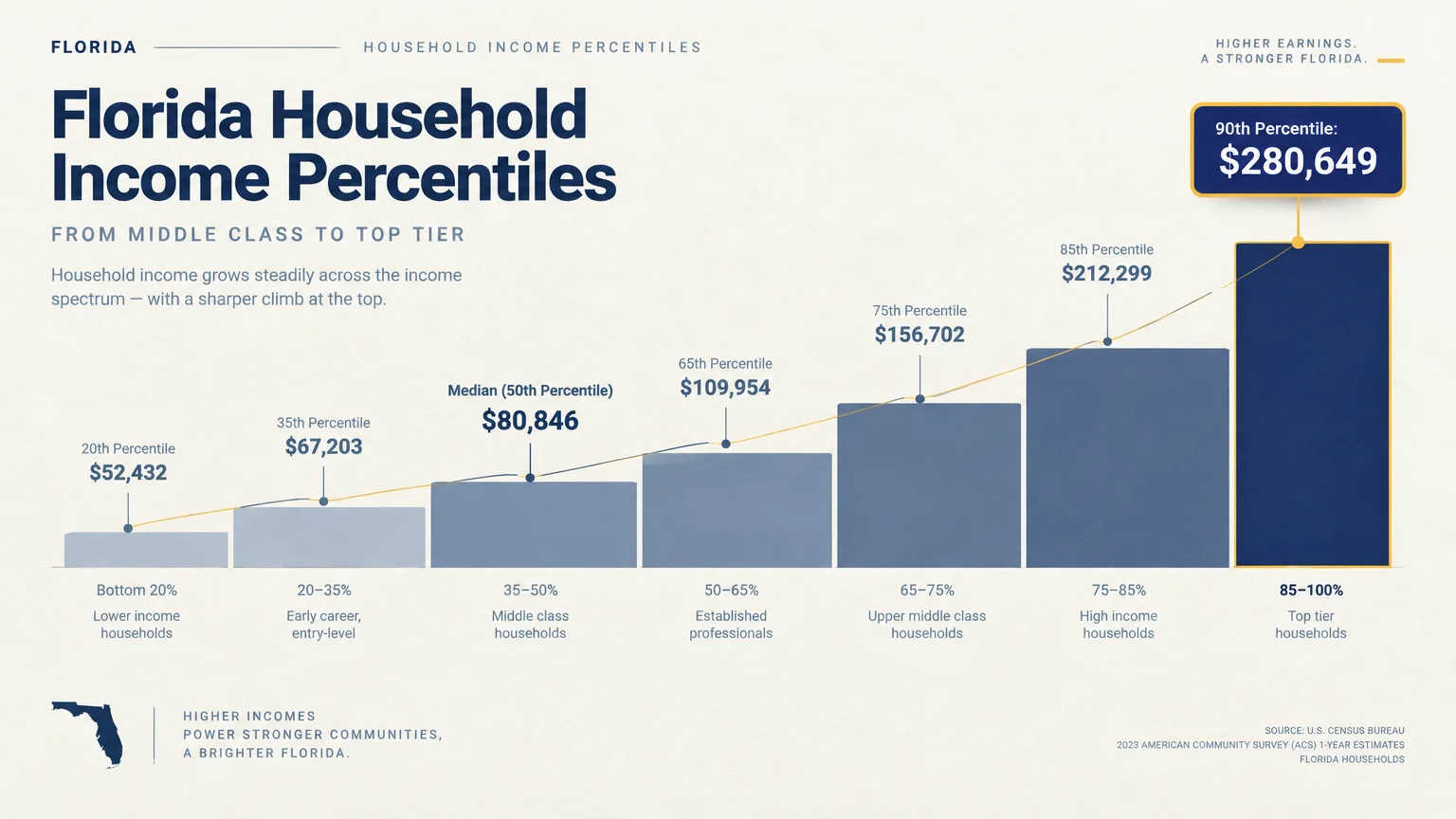
Examining income percentiles illustrates the sharp gap between typical Florida families and the state’s highest earners. Wealth concentration creates a steep climb between middle-class stability and high-earner status.
Florida’s median household income reached $80,846 according to U.S. Census Bureau data, rising 1.3 percent after adjusting for inflation. When economists round this figure, they frequently cite the state median at $80,800.
By contrast, Florida’s average household income measures $105,967 across five-year Census estimates. The substantial gap between the median and the mean demonstrates how high earners pull overall state averages upward.
The table below outlines Florida’s income tiers alongside national benchmarks to show where your earnings fall.
| Income Percentile | Florida Household Income | Florida Individual AGI | National Comparison Benchmark |
|---|---|---|---|
| Median (50th Percentile) | $80,846 | $48,500 | $84,780 (U.S. Household Median) |
| Top 10% (90th Percentile) | $280,649 | $205,567 | $261,300 (U.S. Household 90th) |
| Top 5% (95th Percentile) | $410,000 | $313,641 | $375,000 (U.S. Household 95th) |
| Top 1% (99th Percentile) | $1,120,000 | $956,449 | $785,000 (U.S. Household 99th) |
Entering the top 5 percent of Florida tax filers requires an individual adjusted gross income of $313,641. At this tier, households routinely draw substantial income from capital assets, equity compensation, or executive salaries.
Entering Florida’s top 1 percent requires an extraordinary individual AGI of $956,449. This demanding threshold ranks Florida seventh highest nationwide for top 1 percent qualification, reflecting massive inflows of high-net-worth residents.

How Florida Compares to the Rest of the Nation
Florida presents an interesting economic dynamic when evaluated against national income metrics. While everyday wages trail national midpoints, top-tier thresholds outpace most other states.
The national median household income stands at $84,780, placing Florida’s median of $80,846 roughly 4.6 percent below the nationwide midpoint. The Federal Reserve’s FRED database records Florida’s inflation-adjusted real median income at $77,920.
According to the Bureau of Labor Statistics (BLS), the average weekly wage per worker in Florida is $1,228. This weekly rate reflects a strong service, hospitality, and healthcare economy that traditionally pays close to national averages.
Yet Florida’s top 10 percent household threshold of $280,649 exceeds the national 90th percentile threshold of $261,300. Florida’s high-income bar remains significantly higher than the country as a whole.
State-by-state comparisons highlight these wide economic variations:
- Connecticut: Holds the nation’s highest top 10 percent household threshold at $370,003, with an individual AGI requirement of $257,312.
- Florida: Requires $280,649 for households and $205,567 for individual tax filers to secure 90th percentile placement.
- West Virginia: Registers among the lowest thresholds, requiring $201,400 for top 10 percent household standing.
- Mississippi: Demands an individual AGI of $153,067 to join its top 10 percent bracket.
Income momentum continues to build across Florida. Data from the Bureau of Economic Analysis showed Florida personal income expanding at an annualized 5.7 percent, comfortably beating the 4.7 percent national pace.
The Geography of Florida Wealth: High-Income Pockets
Income distribution inside Florida varies dramatically depending on the county and metropolitan area you examine. Earning $280,649 delivers vastly different purchasing power in rural northern counties compared to coastal southeast metros.
South Florida contains several of the wealthiest postal codes in the entire United States. These concentrated enclaves skew state wealth statistics and attract substantial global investment capital.
Consider the income metrics recorded in Florida’s most affluent zip codes:
- 33109 (Fisher Island / Miami Beach): Florida’s richest zip code records an average household income of $755,945, with median earnings exceeding $250,001.
- 33480 (Palm Beach): This iconic enclave posts an average household income of $326,272, driven by generational wealth and finance executives.
- 33149 (Key Biscayne): This island community generates an average household income of $309,291.
These coastal enclaves contrast sharply with inland agricultural regions and smaller central cities. In several rural Florida counties, median household incomes linger below $55,000 annually.
A household earning $280,649 in Pensacola, Ocala, or Lakeland enjoys tremendous local purchasing leverage. In contrast, that same income faces fierce housing competition and high living expenses in Miami, Naples, or Sarasota.
The 0% State Income Tax Advantage and Its Realities
Florida’s tax structure represents one of its strongest magnets for high earners. The state levies a 0 percent individual income tax, written directly into the Florida Constitution.
For an individual earning $205,567 or a household generating $280,649, zero state income tax provides substantial yearly cash savings. In states like California or New York, state and local taxes could extract $18,000 to $28,000 from those earnings.
Federal tax obligations still apply to every dollar you earn. High earners must plan carefully for federal income brackets and capital gains through the Internal Revenue Service (IRS).
Florida funds government services through alternative revenue mechanisms rather than state income taxes. The state utilizes a 6 percent sales tax, local discretionary sales surtaxes, documentary stamp fees, and commercial taxes.
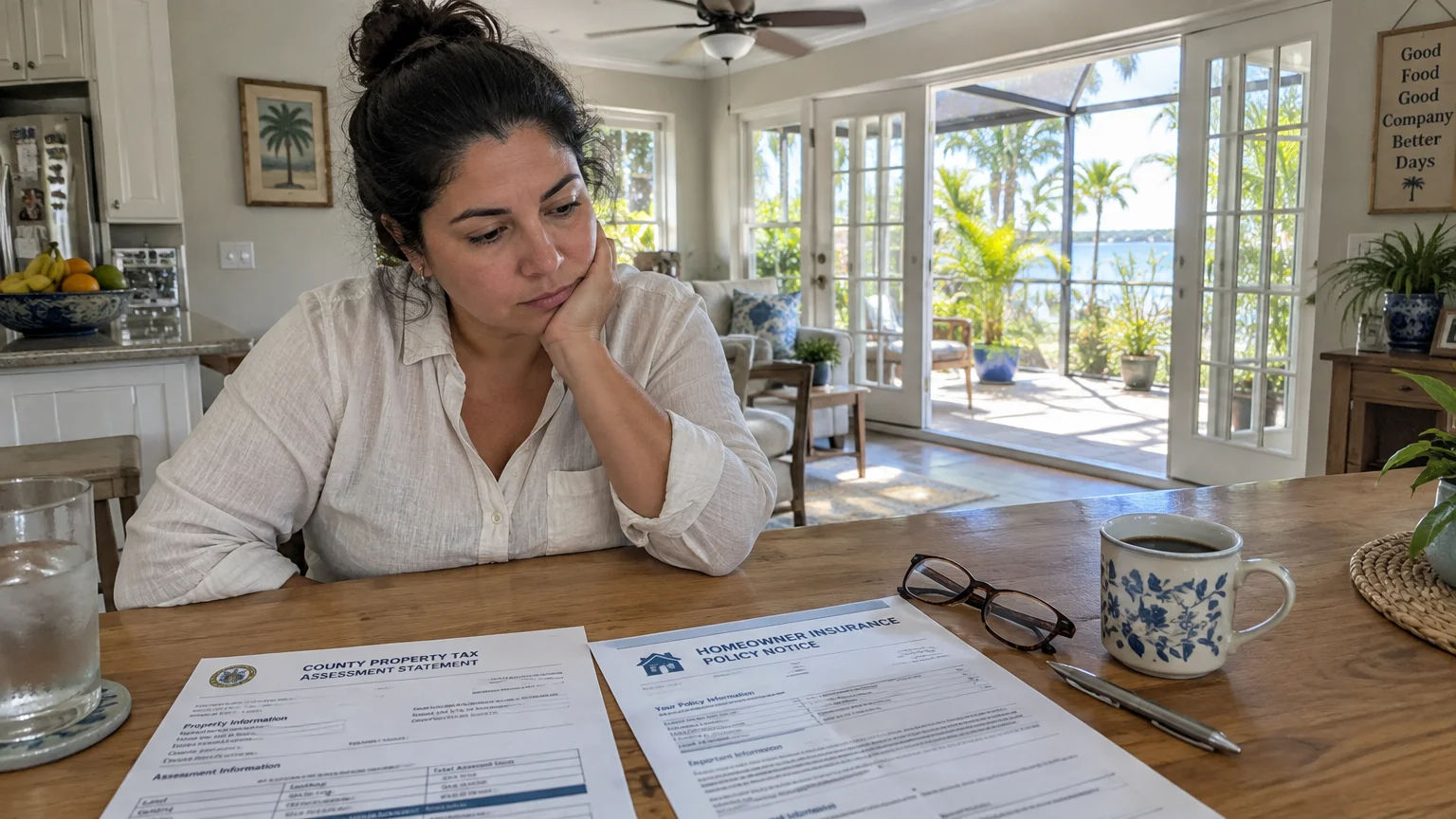
High home prices and surging property insurance premiums frequently erode some of those tax savings. Coastal homeowners often pay thousands more in insurance and property taxes than counterparts in Midwestern states.
To optimize your Florida tax position, maximize contributions to tax-deferred retirement accounts. Reducing your taxable gross income lowers your federal liability, preserving the full benefit of living in a zero-income-tax state.
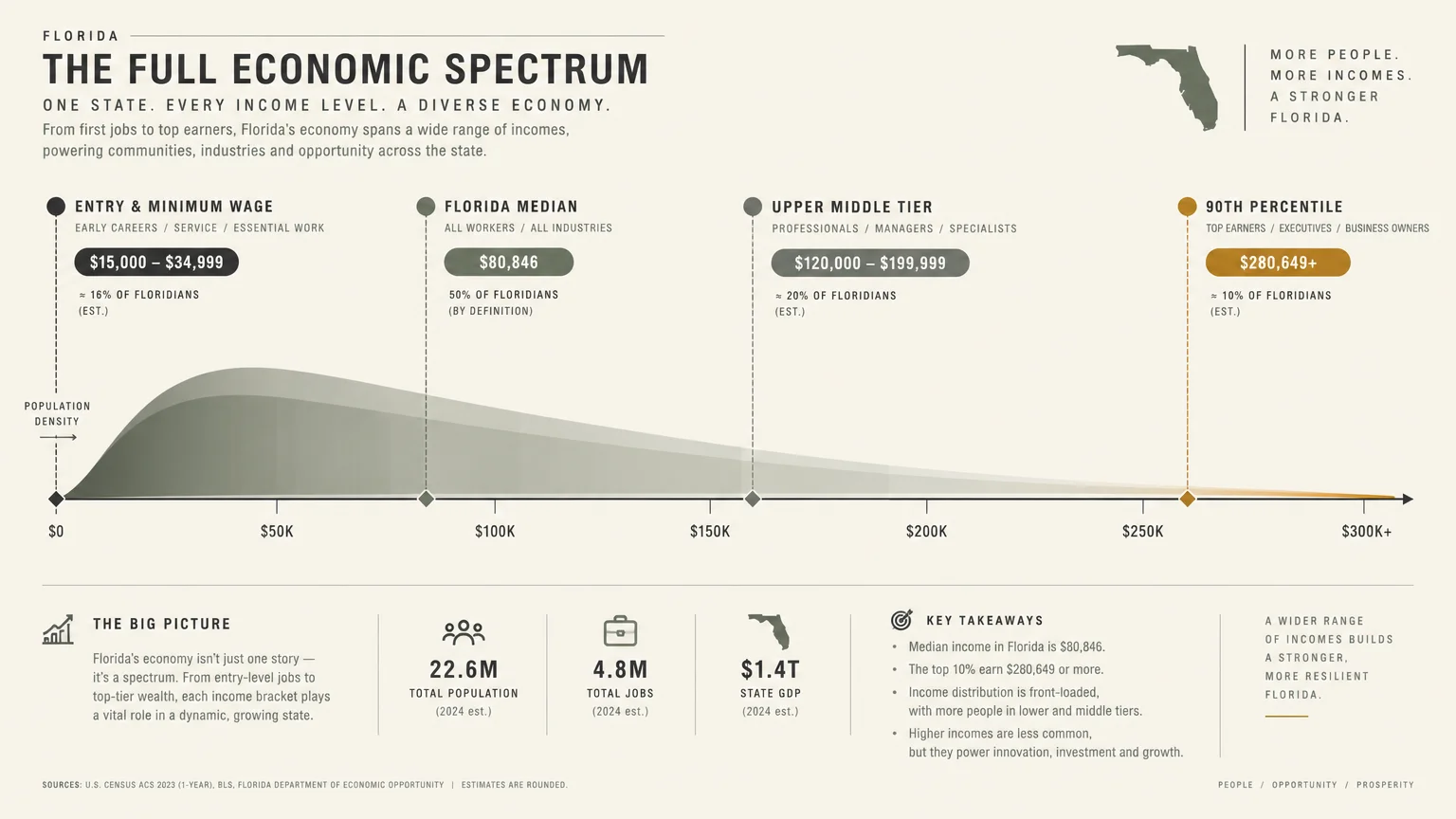
The Income Spectrum: Minimum Wage to the Top Tier
Understanding Florida’s economic landscape requires examining both ends of the earning spectrum. While high-earner thresholds climbed, base wages underwent mandatory legal adjustments.
On September 30, 2026, Florida’s statewide minimum wage officially reached $15.00 per hour. Tipped employees saw their base cash wage advance to $11.98 per hour.
This increase marked the completion of voter-approved Amendment 2, passed in 2020 to raise the wage floor by $1.00 annually. Future minimum wage adjustments will resume in September 2027 based on Consumer Price Index inflation data, taking effect January 1, 2028.
A full-time worker earning $15.00 per hour earns roughly $31,200 annually before taxes. That reality demonstrates the immense scale of Florida’s economic spectrum.
It takes nearly nine full-time minimum-wage earners to match the entry point for Florida’s top 10 percent household threshold. Matching Florida’s top 1 percent threshold requires the earnings of more than 30 full-time base-wage workers.
This wide wage spread influences housing affordability and service costs across all major Florida metro areas. Navigating these economic realities requires intentional budgeting and active career asset management.

Converting High Income into Lasting Florida Wealth
Reaching the top 10 percent in annual income does not automatically make you wealthy. Earning high income simply represents cash flow; building lasting wealth requires turning earnings into productive assets.
“It’s not how much money you make, but how much money you keep, how hard it works for you, and how many generations you keep it for.” — Robert Kiyosaki
Without disciplined savings systems, high-income earners frequently find themselves trapped in expensive lifestyles. High cash flow can disappear quickly into private school tuitions, luxury vehicle leases, club memberships, and coastal dining.
“Do not save what is left after spending, but spend what is left after saving.” — Warren Buffett
Applying structured saving methods helps convert high earnings into durable net worth. Review these core financial habits to secure your balance sheet:
- Automate Investment Portfolios: Direct automated monthly transfers into diversified, low-cost index funds before allocating discretionary spending.
- Maximize Retirement Plans: Fully fund employer-sponsored 401(k) or 403(b) accounts, reaching statutory federal maximums annually.
- Leverage Backdoor Roth Options: Execute non-deductible traditional IRA contributions converted into Roth IRAs if income limits restrict direct contributions.
- Utilize Health Savings Accounts: Maximize triple-tax-advantaged HSA contributions if enrolled in high-deductible health coverage.
Florida law offers robust statutory asset protection advantages for wealth accumulators. The state’s constitutional homestead exemption provides unlimited equity protection for your primary home against judgment creditors, subject to acreage restrictions.
Florida also shields the cash surrender value of life insurance policies, annuity proceeds, and qualified retirement assets. Structuring your assets within these legal protections guards your family’s financial future against unforeseen business or personal liabilities.
Common Money Traps for High Earners
Earning an upper-tier income often creates financial overconfidence. Without careful boundaries, top earners frequently fall into predictable traps that delay financial independence.
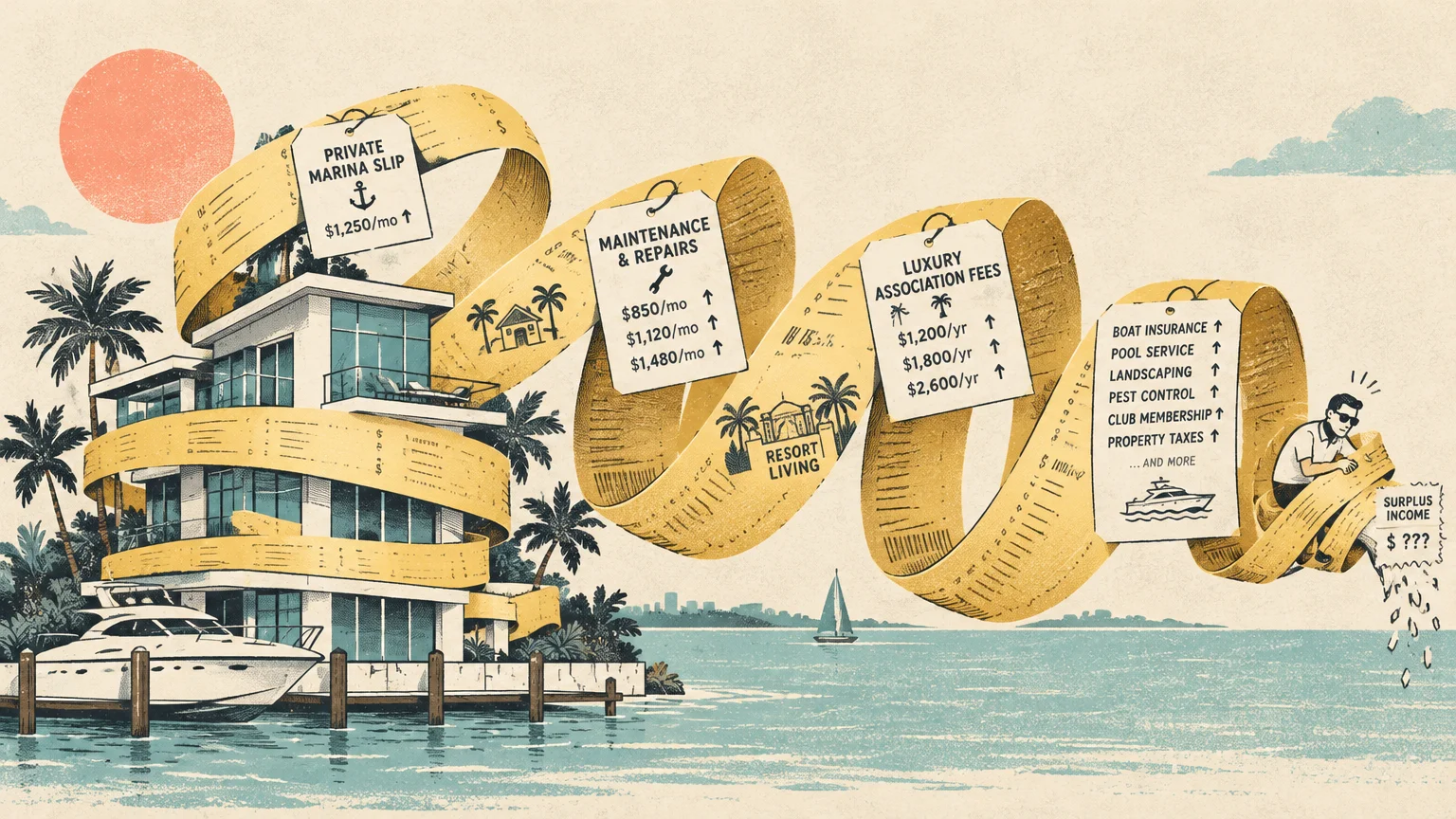
Lifestyle inflation represents the most pervasive hazard for professionals crossing the $200,000 threshold. Upgrading homes, buying boats, and funding luxury vacations can absorb earnings before investments accumulate.
Underestimating Florida’s unique real estate overhead catches many relocators off guard. In addition to property taxes, homeowners face steep property insurance rates and potential HOA special assessments for storm reserves.
Neglecting liability protection exposes high earners to severe downside risk. Operating without an umbrella liability policy leaves personal assets vulnerable to lawsuits stemming from auto accidents or property injuries.
Carrying high-interest debt while earning significant income indicates cash-flow mismanagement. Financing depreciating toys or maintaining credit card balances undermines wealth-building potential. You can review debt management resources through the Consumer Financial Protection Bureau (CFPB).
Failing to establish verified Florida tax domicile leaves former residents exposed to home-state tax audits. Failing to sever official ties with high-tax states can result in retroactive state tax bills.

When to Consult a Professional
Navigating an income above $200,000 introduces intricate tax, legal, and investment considerations. Collaborating with qualified professionals ensures your money works efficiently under federal and state rules.
Work with a Certified Public Accountant (CPA) when managing business entities, pass-through distributions, or multistate tax liabilities. A CPA structures deductions, manages estimated federal payments, and documents tax residency compliance.
Partner with a fee-only Certified Financial Planner (CFP) to design an overarching wealth management roadmap. Fee-only fiduciaries do not sell commissioned products, keeping their investment guidance aligned with your interests.
Retain an estate planning attorney licensed in Florida to draft essential legal instruments. An attorney establishes revocable living trusts, structures durable powers of attorney, and records homestead declarations.
Consult an independent insurance specialist to navigate Florida’s complex property and casualty market. A knowledgeable broker balances private market coverage with Citizens Property Insurance policies to protect your primary real estate.
Frequently Asked Questions
What is the top 10 percent household income in Florida?
To rank in the top 10 percent of Florida households, you need an annual income of at least $280,649. This amounts to approximately $5,397 per week in combined household gross earnings.
What income puts an individual tax filer into Florida’s top 10 percent?
An individual tax filer needs an Adjusted Gross Income (AGI) of $205,567 to enter Florida’s top 10 percent. This IRS benchmark isolates single filers and married individuals filing separately.
How much income does a household need to be in Florida’s top 1 percent?
Entering Florida’s top 1 percent requires an individual adjusted gross income of $956,449. For total household gross income, the threshold exceeds $1,120,000 annually.
Is an income of $100,000 considered good in Florida?
An income of $100,000 sits comfortably above Florida’s median household income of $80,846. However, it remains below the state’s average household income of $105,967 and falls well short of the top 10 percent threshold.
Building Your Long-Term Financial Foundation
Understanding Florida’s income percentiles gives you clear targets for evaluating career earnings and setting financial milestones. Whether your household brings in $80,846 or surpasses $280,649, intentional cash management determines your actual wealth.
Take time this week to review your household cash flow, check your retirement savings rates, and review your asset protection measures. Earning a high salary creates opportunity, but consistent saving and disciplined investing build lasting independence.
This article is for informational purposes only and does not constitute financial, legal, or tax advice. Rates, benefit amounts, and tax rules change regularly—verify current details with the relevant agency or a licensed professional.
Last updated: November 2026. Rates, benefit amounts, and tax rules change—always verify current details at official sources.