
High-paying remote careers do not require grueling schedules or constant digital emergencies. You can earn over $30 an hour from your home while protecting your schedule and mental well-being.
The national median wage sits at $24.51 per hour, or $50,980 annually. Stepping into a quiet, remote role gives your household budget immediate breathing room above that baseline.
Many flexible fields reward independent output over reactive meetings and high-pressure phone queues. Securing these roles starts with knowing which occupations combine generous compensation with everyday autonomy.
The Anatomy of Low-Stress Remote Work
Stress in remote work rarely comes from the workload alone. It usually stems from micro-management, unpredictable emergencies, and constant customer conflict.
Data from the Bureau of Labor Statistics reveals that roughly 22.4% of American employees work from home for pay. About 11.0% perform their duties entirely off-site.
Gallup surveys show that 26% of remote-capable workers operate exclusively from home, while 52% maintain hybrid schedules. The most peaceful positions share three specific operational traits.
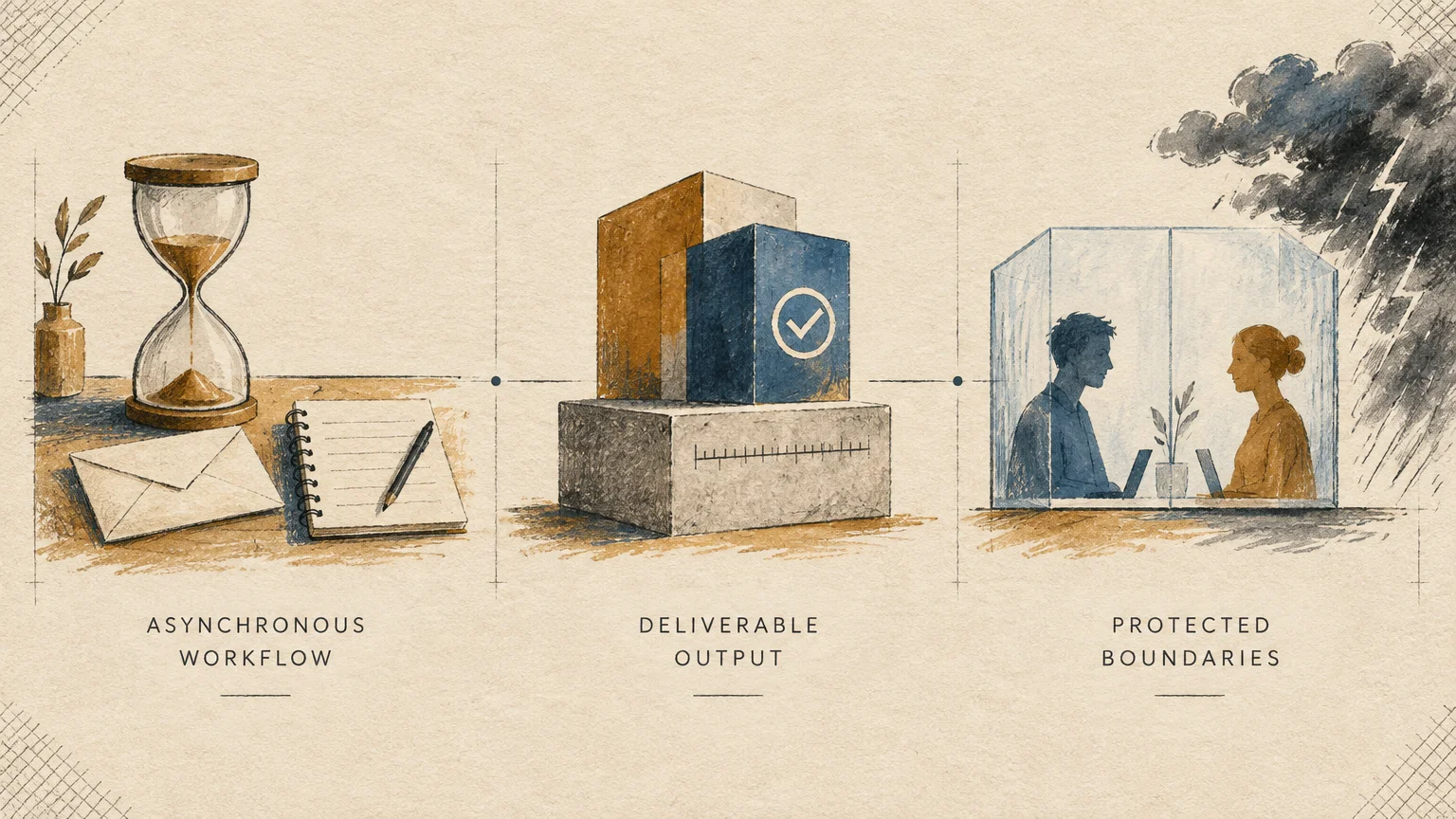
First, low-stress roles rely on asynchronous communication rather than immediate replies. You complete assignments without someone monitoring your keyboard activity every second.
Second, these roles evaluate you on deliverables rather than arbitrary desk hours. When you finish a project early, you reclaim your afternoon.
Third, low-stress positions keep external client confrontations to a minimum. You work alongside professional colleagues rather than fielding angry inbound customer phone calls.
Key Benchmarks: The Top 10 High-Paying, Low-Stress Remote Careers
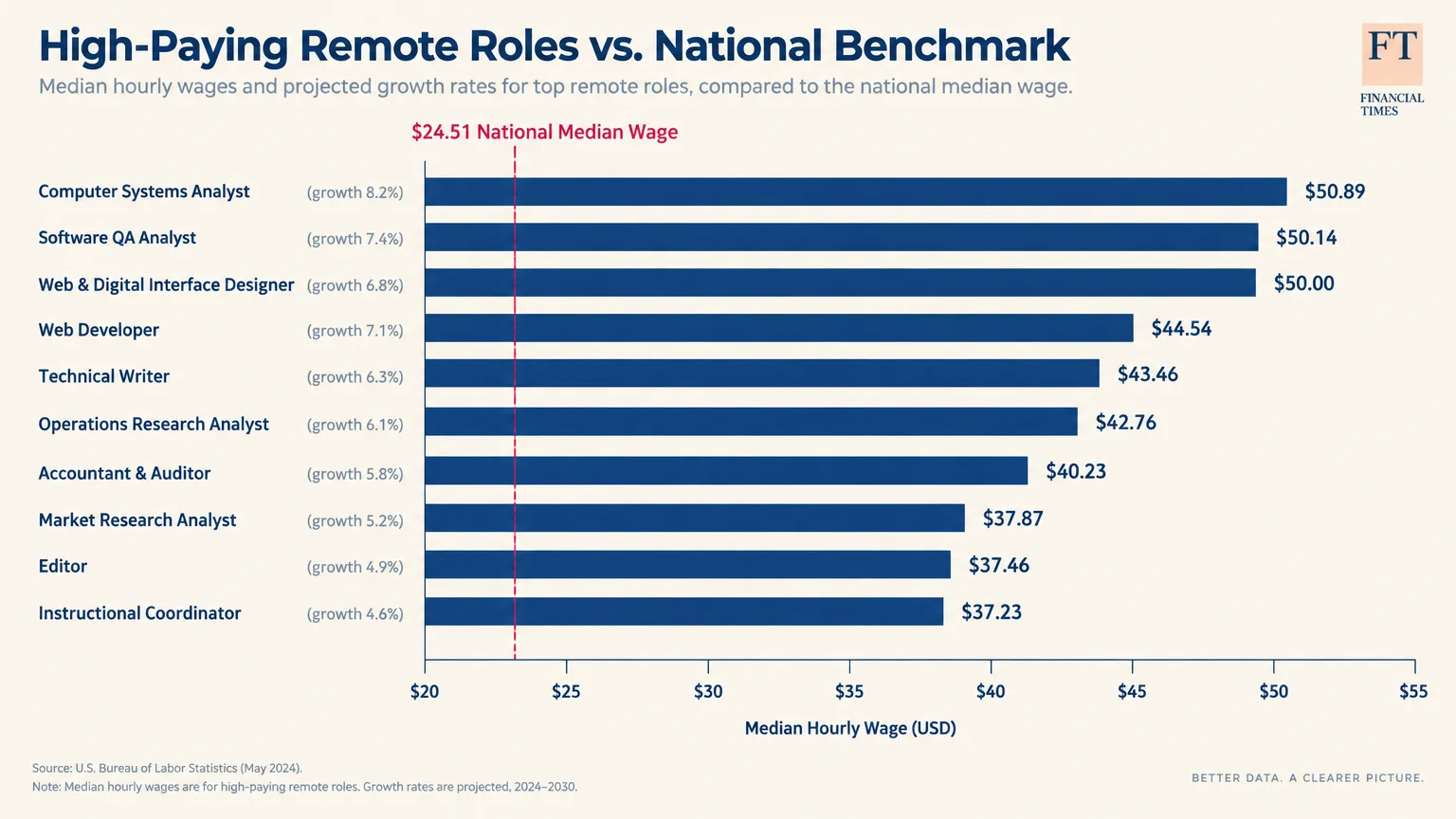
The following table outlines ten established remote occupations that pay well above $30 per hour. Each role emphasizes specialized knowledge and project-based execution over daily chaos.
| Career Field | Median Hourly Wage | Median Annual Salary | Projected Growth (2025–2035) | Primary Low-Stress Advantage |
|---|---|---|---|---|
| Computer Systems Analyst | $50.89 | $105,850 | 8% | Structured project milestones |
| Software QA Analyst & Tester | $50.14 | $104,300 | 3% to 4% | Predictable testing protocols |
| Web & Digital Interface Designer | $50.00 | $104,000 | 6% | Creative focus with clear briefs |
| Web Developer | $44.54 | $92,650 | 4% | Independent, asynchronous coding |
| Technical Writer | $43.46 | $90,390 | 1% | Solitary research and documentation |
| Operations Research Analyst | $42.76 | $88,940 | 12% | Analytical modeling without public contact |
| Accountant & Auditor | $40.23 | $83,680 | 5% | Routine monthly cycles and compliance |
| Market Research Analyst | $37.87 | $78,760 | 7% | Data analysis and report preparation |
| Editor | $37.46 | $77,920 | 3% | Quiet manuscript and text refinement |
| Instructional Coordinator | $37.23 | $77,440 | 2% | Internal curriculum and training design |
Every occupation listed above exceeds the national median wage by at least $12 per hour. They provide sustainable income while allowing you to preserve a quiet home work space.

10 Lucrative Work-From-Home Careers Paying Over $30 an Hour
Examining the daily reality of each role helps you match your existing background with the right opportunity. Here is how each career operates day to day.
1. Computer Systems Analysts
Computer systems analysts examine an organization’s existing data systems and design practical hardware or software solutions. They earn a median wage of $50.89 per hour, which equals $105,850 annually.
The field is projected to grow by 8% through 2035, producing roughly 32,900 openings each year. You spend your days mapping technical requirements and interviewing internal department heads.
The stress level remains low because analysts work on extended project timelines. You rarely handle emergency system crashes or live troubleshooting.
Employers usually expect a bachelor’s degree in computer science, business information systems, or a related field. Practical experience with systems architecture often substitutes for advanced degrees.
2. Software Quality Assurance Analysts and Testers
Software QA analysts test applications to identify bugs and usability defects before products reach the public. This role commands a median pay of $50.14 per hour, or $104,300 per year.
Instead of writing code from scratch under tight launch pressure, QA testers follow established testing matrices. You run automated scripts and document unexpected software behaviors in tracking databases.
This work offers high autonomy and predictable hours. You complete testing suites at your own pace without constant managerial oversight.
A bachelor’s degree or an industry certification in automated testing tools will qualify you for most entry-level remote openings.
3. Web and Digital Interface Designers
Digital interface designers create the visual layout, navigation schemes, and user flows for corporate software and websites. The median wage reaches $50.00 per hour, providing an annual income of $104,000.
Job growth sits at 6% through 2035, outpacing the national average for all occupations. Designers spend long stretches designing digital assets in specialized design software.
Client communication occurs through organized feedback loops rather than spontaneous interruptions. You receive written briefs, generate wireframes, and submit revisions according to set calendar checkpoints.
A polished design portfolio matters far more to prospective employers than formal academic credentials.
4. Web Developers
Web developers write clean code to build and maintain websites, database connections, and web services. They earn a median rate of $44.54 per hour, totaling $92,650 annually.
The profession projects a steady 4% growth rate, generating approximately 5,300 new job openings each year. Developers manage tasks through asynchronous project boards like Jira or GitHub.
Because the work is highly technical and measurable, managers rarely practice intrusive oversight. You focus on solving technical puzzles in your code editor throughout the quiet workday.
You can enter this field by building practical web applications and mastering modern programming languages through self-directed study.
5. Technical Writers
Technical writers translate complex medical, scientific, and software information into clear operating manuals and guides. They earn a median rate of $43.46 per hour, which equates to $90,390 per year.
The Bureau of Labor Statistics projects about 3,200 annual openings across manufacturing, technology, and healthcare sectors. Most technical writers spend their days researching technical specs and interviewing engineers.
The daily pace is quiet and contemplative. You dictate your writing schedule and work without external client interruptions.
A degree in English, communications, or a technical discipline paired with solid technical writing samples opens the door to remote roles.
6. Operations Research Analysts
Operations research analysts use advanced mathematical models and data analytics to help organizations allocate resources efficiently. This analytical role earns a median wage of $42.76 per hour, or $88,940 per year.
Demand for this discipline is surging, with a projected 12% growth rate through 2035. Analysts work quietly behind the scenes optimizing supply chains and production schedules.
Your value comes from analytical depth rather than interpersonal negotiation. You build statistical simulations in quiet isolation and present your findings in scheduled briefings.
A bachelor’s degree in mathematics, data analytics, or engineering gives you the foundation necessary for remote corporate openings.
7. Accountants and Auditors
Accountants and internal auditors manage financial statements, reconcile bank ledgers, and ensure regulatory compliance. They make a median wage of $40.23 per hour, which yields $83,680 per year.
The occupation anticipates 5% growth through 2035, adding 79,400 jobs and generating roughly 115,300 annual openings. Corporate and internal auditing roles offer predictable, structured workflows.
Unlike public tax accounting during filing season, remote corporate accounting follows an orderly monthly close schedule. You balance balance sheets and review invoices without frantic deadlines.
Most employers require a bachelor’s degree in accounting or finance. A Certified Public Accountant license boosts your earning power even further.
8. Market Research Analysts
Market research analysts study consumer habits, competitor pricing, and market conditions to forecast product sales. They earn a median wage of $37.87 per hour, or $78,760 each year.
This occupation is expanding rapidly, with a projected 7% growth rate over the coming decade. Remote analysts design surveys, aggregate customer data, and prepare graphic summaries.
The position avoids live sales pressure and aggressive performance quotas. You act as an internal consultant delivering objective factual reports to marketing leadership.
A degree in business, economics, or marketing combined with statistical analysis skills qualifies candidates for remote research openings.
9. Editors and Content Specialists
Editors evaluate, rewrite, and polish manuscripts, articles, and corporate educational content. They earn a median rate of $37.46 per hour, translating to $77,920 annually.
Related freelance writers and authors earn a median of $36.98 per hour. Editing requires intense, solitary focus as you refine syntax, check facts, and enforce house style guides.
The work happens almost entirely in word processors and publishing platforms without meeting fatigue. You receive content batches, complete line edits, and return the drafts by agreed deadlines.
A bachelor’s degree in communications, journalism, or English alongside demonstrated proofreading acumen will secure remote corporate editing contracts.
10. Instructional Coordinators and Curriculum Developers
Instructional coordinators evaluate teaching standards and develop educational materials for schools, corporations, and non-profits. They earn a median pay of $37.23 per hour, or $77,440 per year.
The BLS projects 23,100 openings per year as organizations expand online learning libraries. Coordinators build self-paced training programs and online learning courses.
This role removes the daily behavioral stress of managing live students or corporate attendees. You focus entirely on pedagogical design, lesson layouts, and digital learning modules.
Most positions require a master’s degree in education or curriculum design, though corporate e-learning developers often enter with corporate training experience.
How to Identify Truly Low-Stress Employers
A job title alone does not guarantee a calm work environment. The culture of the company hiring you determines your day-to-day stress level.
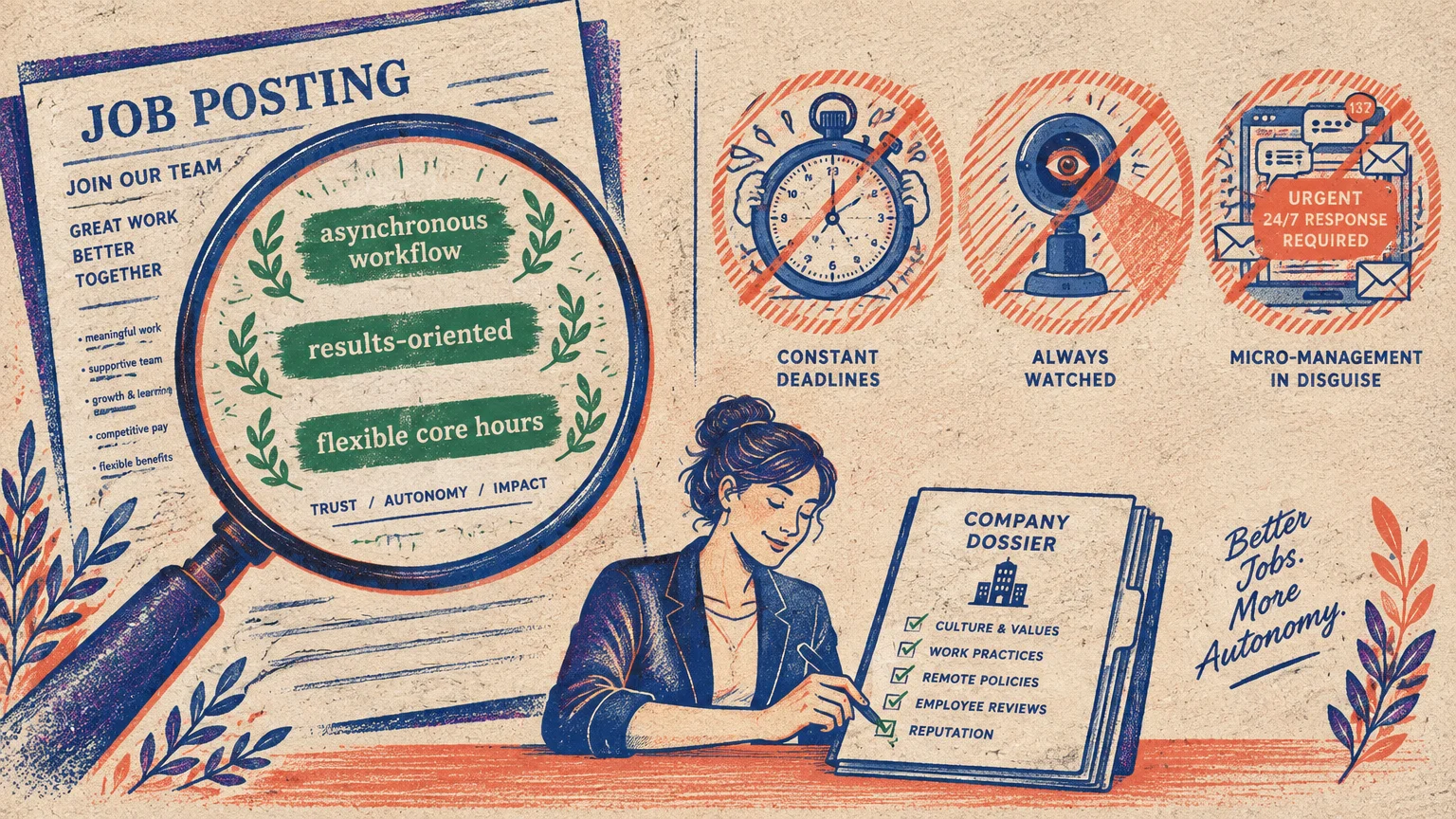
During the interview process, ask how the organization communicates internally. Companies that rely primarily on Slack messages and email respect your focused working time.
Beware of companies that require continuous webcam monitoring or screen tracking software. These practices signal toxic micromanagement and destroy the primary benefits of working remotely.
Inquire about their policy regarding after-hours communications. Healthy remote employers establish clear boundaries around when team members should log off for the evening.

Protecting Your Income: Avoiding Work-From-Home Scams
The demand for remote jobs has led to an explosion of fraudulent employment listings. Protecting your personal information is essential during your job search.
The Federal Trade Commission warns job seekers against employers who conduct interviews exclusively via encrypted messaging apps like Telegram. Legitimate companies conduct professional video interviews or telephone screenings.
Never accept an assignment where the company sends you a check to purchase home office equipment. The check will inevitably bounce after you wire funds back to the scammer.
Real employers provide equipment directly or issue a reimbursement through established corporate payroll systems. Trust your instincts whenever an offer seems unusually generous for minimal work.
Don’t Make These Mistakes
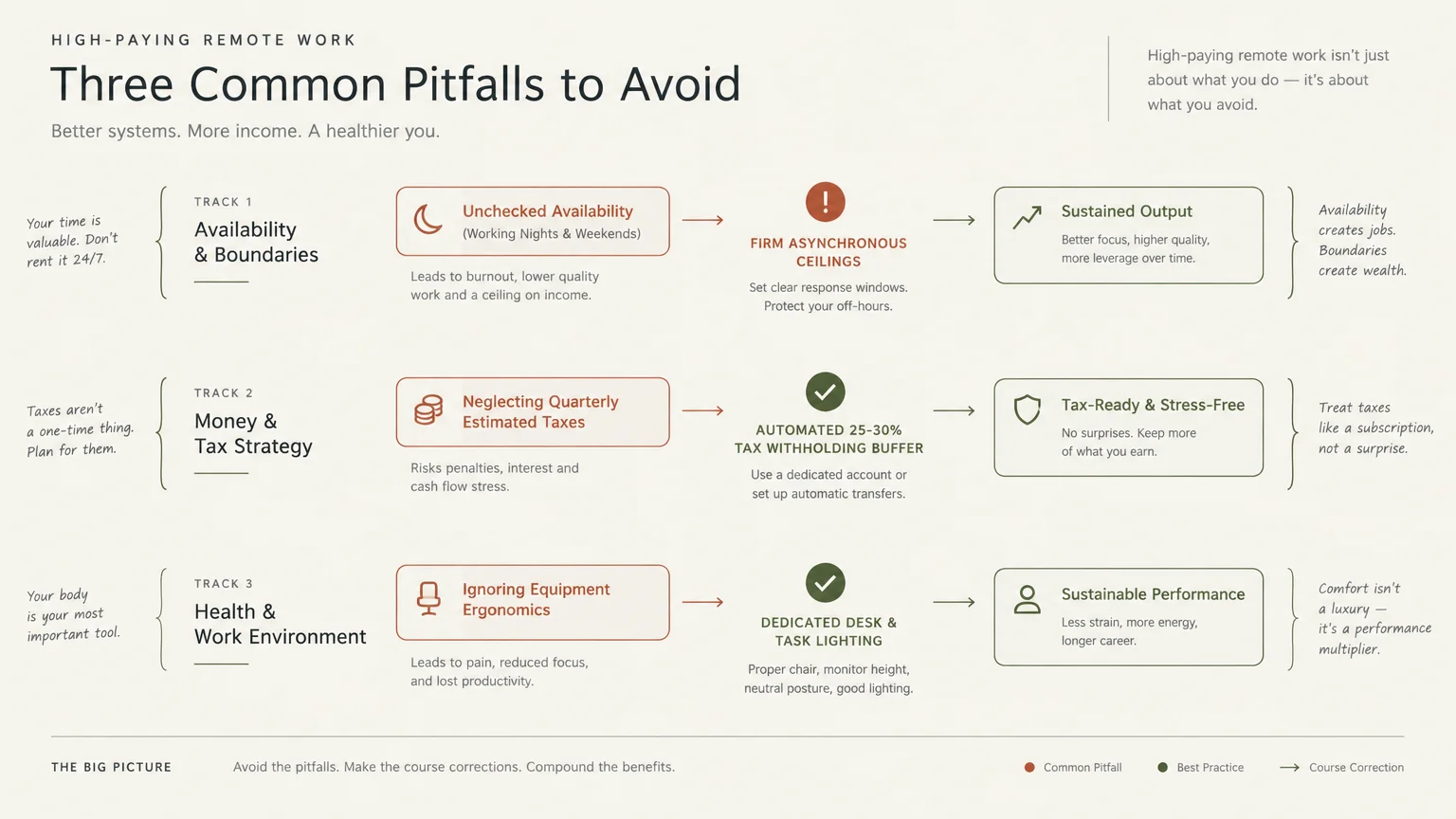
Transitioning into a remote career requires deliberate professional adjustments. Avoiding common operational errors will protect both your income and your peace of mind.
- Letting work bleed into personal hours: Without a physical commute, you might check emails late into the night. Establish a hard stopping time to protect your personal recovery.
- Overlooking self-employment tax liabilities: If your remote role operates as a 1099 contract, taxes are not withheld automatically. Consult the Internal Revenue Service guidelines to submit quarterly estimated taxes.
- Working from high-distraction living spaces: Working from the kitchen counter invites family interruptions. Dedicate a quiet, closed-door space specifically for professional tasks.
- Failing to upgrade basic home infrastructure: Slow residential internet creates unnecessary friction during file uploads. Invest in high-speed wired connections to keep your workday smooth.
Maintaining these professional boundaries ensures your home remains a sanctuary rather than a source of stress.

Smart Financial Planning for Remote Workers
Earning $30 or more per hour provides a tremendous opportunity to build long-term household wealth. Higher earnings should directly strengthen your family’s financial security.
“A budget is telling your money where to go instead of wondering where it went.” — John C. Maxwell
Working remotely reduces standard commuting expenses, wardrobe costs, and daily meal spending. Direct those automatic savings straight into an emergency reserve fund.
The Consumer Financial Protection Bureau recommends holding three to six months of essential living expenses in a dedicated account. This cash buffer prevents panic if client contracts fluctuate.
“It’s not how much money you make, but how much money you keep, how hard it works for you, and how many generations you keep it for.” — Robert Kiyosaki
Take full advantage of tax-advantaged retirement accounts offered by your employer. If you work as an independent contractor, explore a Simplified Employee Pension (SEP) IRA or a Solo 401(k).
Automating your investments ensures your increased hourly wage translates into lasting generational wealth.

When Professional Advice Is Worth It
Earning high hourly rates often introduces new tax and financial planning complexities. Professional guidance can safeguard your hard-earned revenue.
If you transition from a traditional W-2 position to independent contract work, hire a Certified Public Accountant. A qualified CPA helps you maximize legitimate home office deductions without triggering audit penalties.
Similarly, consulting a fee-only fiduciary financial planner helps you align your retirement contributions with your long-term goals. These professionals charge flat fees rather than earning commissions on financial products.
Paying a professional for several hours of targeted planning pays for itself in avoided tax mistakes and optimized investments.
Frequently Asked Questions
Do you need a four-year college degree to earn $30 an hour remotely?
No. While roles like computer systems analysis generally prefer degrees, web development and digital design prioritize demonstrated skills and portfolios over diplomas.
Are these positions full-time W-2 jobs or independent 1099 contracts?
Both employment structures are common. Many corporations hire full-time W-2 technical writers and accountants, while smaller agencies frequently retain contractors for project-based work.
How do you prove your qualifications when changing careers?
Focus on building tangible proof of competence. Complete recognized certification programs, build public portfolio projects, and highlight transferable skills on your resume.
What equipment do you need to start working remotely?
You need a dependable computer, dual monitors, a noise-canceling headset, and high-speed broadband internet. Many W-2 employers ship corporate laptops directly to your residence.
Begin by auditing your current professional skills against the roles outlined above. Update your resume to emphasize independent project delivery and apply for positions that match your strengths.
Financial outcomes vary based on individual income, credit history, and circumstances. This article provides general guidance only. Consult a qualified financial planner, CPA, or consumer attorney for advice specific to your situation.
Last updated: November 2026. Rates, benefit amounts, and tax rules change—always verify current details at official sources.