
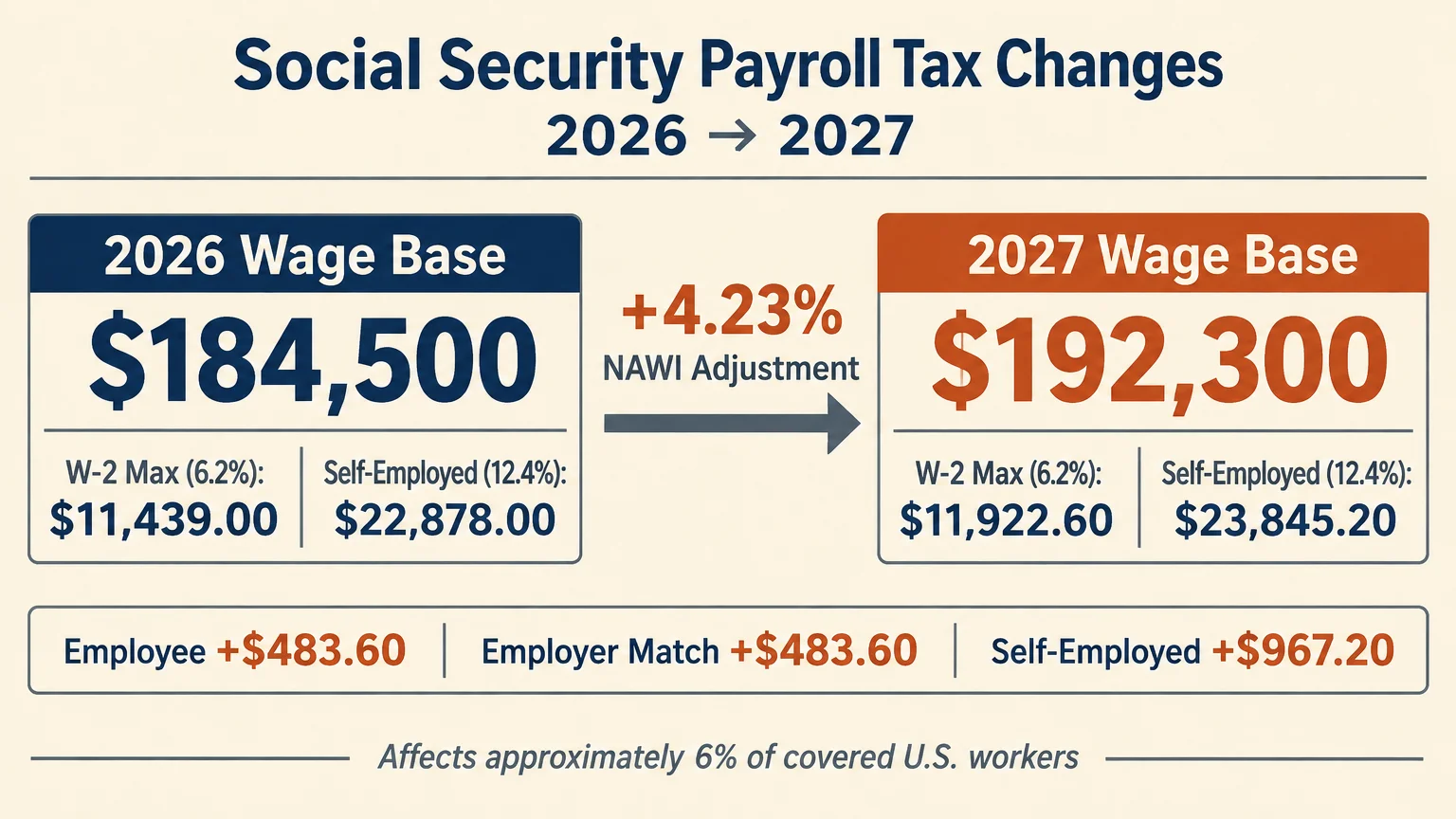
The Social Security Administration (SSA) is raising the 2027 taxable maximum to $192,300, up $7,800 from 2026. If you earn at or above that cap, your Social Security payroll tax increases by $483.60 starting January 1, 2027.
Your employer matches that extra $483.60, while self-employed workers face up to $967.20 in added tax. Most workers earning $184,500 or less will pay nothing extra.
Knowing how the social security wage base works helps you plan for thinner high-earner paychecks, coordinate multiple jobs, and use pre-tax benefits effectively.
What You Need to Know About the 2027 Payroll Tax Increase
Every fall, federal wage formulas recalculate how much of your annual income is subject to Social Security payroll taxes. For 2027, that adjustment pushes the ceiling higher for top earners while leaving tax rates unchanged.
- Taxable maximum 2027: Wages and self-employment income up to $192,300 face Social Security tax, up 4.23% from $184,500 in 2026.
- Unchanged tax rate: W-2 employees still pay 6.2%, employers match 6.2%, and self-employed filers pay 12.4%.
- Maximum W-2 increase: Employees earning $192,300 or more pay $11,922.60 in 2027, which is $483.60 more than the $11,439.00 cap in 2026.
- Self-employed maximum: Independent contractors and sole proprietors can owe up to $23,845.20, an increase of $967.20.
- Share of workers affected: SSA analysts estimate roughly 6% of covered U.S. workers earn above the annual taxable maximum.
How the 2027 Social Security Wage Base Works
On October 14, 2026, the SSA announced the new $192,300 contribution and benefit base for 2027. That notice appeared in the Federal Register on October 26, 2026, setting the legal ceiling for payroll systems nationwide.
Unlike federal income tax brackets, the Social Security tax uses a flat rate that stops once your year-to-date covered pay hits the cap. In 2025, that ceiling stood at $176,100; in 2026, it moved to $184,500.
Under Section 230 of the Social Security Act, the SSA adjusts the social security wage base each year using the National Average Wage Index (NAWI). When national average wages rise, the payroll cap climbs in lockstep.
The 2025 NAWI reached $72,800.33, up 4.23% from $69,846.57 in 2024. Applying that growth rate under the statutory formula produced $192,353.14, which the SSA rounded to the nearest $300 increment to establish $192,300.
Because the adjustment tracks historical wage growth rather than consumer inflation, a strong labor market automatically triggers a higher payroll tax increase for top earners. You can review annual wage base history and benefit rules directly through the Social Security Administration (SSA).
The Old-Age, Survivors, and Disability Insurance (OASDI) tax rate itself has not changed. You continue paying 6.2% on covered W-2 wages, and your employer contributes another 6.2%, totaling 12.4%.
Pay close attention to which tax year applies to your January paperwork. Your W-2 forms delivered in January 2027 report 2026 earnings and still follow the $184,500 cap.
The $192,300 cap governs paychecks and net self-employment income received from January 1 through December 31, 2027. Those higher deductions will show up on the W-2s you receive in early 2028.
Who Pays the Extra $484—and Who Pays Nothing More
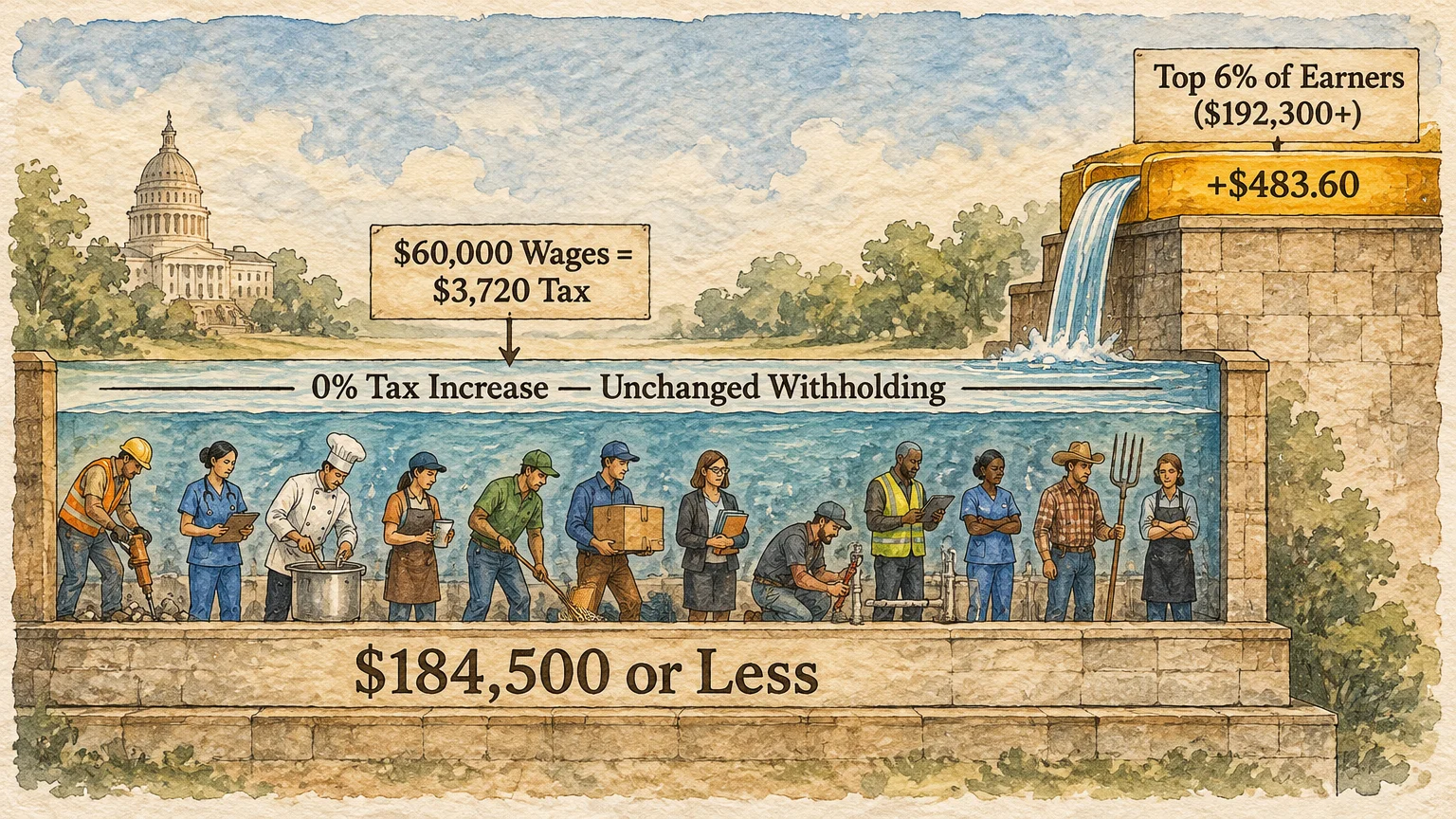
Whether the social security tax 2027 adjustment hits your take-home pay depends entirely on where your annual covered earnings land. Most American households fall below the threshold and will notice zero change in their 6.2% withholding.
If you earn $60,000 in both 2026 and 2027, your Social Security tax remains $3,720.00 each year. In fact, every W-2 worker earning $184,500 or less sees no added Social Security tax from this cap change.
If your pay falls between $184,500 and $192,300, you pay 6.2% only on the dollars above $184,500. For example, a worker earning $188,500 pays 6.2% on that extra $4,000 slice, adding $248.00 in annual tax.
Once your covered wages reach $192,300 or higher, you absorb the full $483.60 increase, bringing your annual maximum from $11,439.00 to $11,922.60. Your employer absorbs an identical $483.60 increase on your behalf.
| 2027 Covered Earnings | Worker Type | 2026 Max Social Security Tax | 2027 Max Social Security Tax | Year-over-Year Change |
|---|---|---|---|---|
| $60,000 | W-2 Employee | $3,720.00 | $3,720.00 | $0.00 |
| $120,000 | W-2 Employee | $7,440.00 | $7,440.00 | $0.00 |
| $184,500 | W-2 Employee | $11,439.00 | $11,439.00 | $0.00 |
| $188,500 | W-2 Employee | $11,439.00 | $11,687.00 | +$248.00 |
| $192,300 | W-2 Employee | $11,439.00 | $11,922.60 | +$483.60 |
| $250,000 | W-2 Employee | $11,439.00 | $11,922.60 | +$483.60 |
| $208,231+ net profit | Self-Employed | $22,878.00 | $23,845.20 | +$967.20 |
For high earners social security withholding feels heavier in late autumn rather than January. Your paycheck looks identical early in the year because 6.2% is withheld from dollar one either way.
The difference shows up when your year-to-date pay crosses the old ceiling. Consider a worker earning $220,000 across 26 biweekly paychecks of roughly $8,461.54 each.
In 2026, that worker crossed the $184,500 cap during paycheck 22 and enjoyed four cap-free paychecks afterward. In 2027, that same salary crosses $192,300 during paycheck 23, keeping 6.2% withholding active longer and reducing late-year take-home cash by $483.60.
If you rely on those larger November and December paychecks to fund holiday travel, property taxes, or year-end savings goals, build the $483.60 difference into your cash-flow plan early. A slight adjustment now prevents a surprise shortfall in the fourth quarter.
The Bigger Hit for Self-Employed Workers and Contractors
Independent contractors, freelancers, and sole proprietors pay both the employee and employer shares of Social Security tax. That combined 12.4% rate doubles the impact of the taxable maximum 2027 increase.
In 2026, self-employed workers paid a maximum Social Security tax of $22,878.00. In 2027, that ceiling rises to $23,845.20—an extra $967.20 out of pocket.
You do not pay the 12.4% rate on every dollar of raw business profit, however. Under IRS Schedule SE rules, self-employment tax applies to 92.35% of your net self-employment earnings whenever net profit equals $400 or more.
Because of that 92.35% multiplier, you hit the $192,300 taxable maximum at roughly $208,231 in net profit. Any net business income above that level escapes the 12.4% Social Security portion, though Medicare taxes still apply.
Federal tax rules offer partial relief when you file your annual return. You can deduct one-half of your total self-employment tax as an above-the-line adjustment to income on Form 1040 via Schedule 1.
That deduction lowers your adjusted gross income and federal income tax bill even if you take the standard deduction. Still, it does not reduce your actual Social Security tax liability.
If you balance both a W-2 day job and 1099 consulting income, the order of operations works in your favor. Your W-2 wages count toward the $192,300 cap first.
Suppose you earn $150,000 at a salaried job and $75,000 in net freelance profit during 2027. Your employer withholds 6.2% on $150,000, leaving only $42,300 of remaining room under the $192,300 ceiling.
On Schedule SE, you pay the 12.4% Social Security rate on just that $42,300 gap rather than on 92.35% of your entire $75,000 profit. Keeping clean records of both income streams helps you avoid overpaying your quarterly estimated taxes.
Medicare Taxes and High Earner Thresholds Stay Uncapped
While Social Security payroll withholding stops at $192,300, Medicare taxes never stop. Every dollar of covered wages and net self-employment profit remains subject to Medicare Hospital Insurance (HI) tax.
Employees pay 1.45% and employers match 1.45% on all covered compensation, with no upper limit. Self-employed workers pay the combined 2.9% rate across all net earnings subject to Schedule SE.
High earners also face the 0.9% Additional Medicare Tax once earned income clears statutory filing thresholds. Unlike the social security wage base, those Additional Medicare Tax thresholds are not indexed for inflation.
- Single or head of household: The 0.9% surtax applies to earned income above $200,000.
- Married filing jointly: The 0.9% surtax applies to combined earned income above $250,000.
- Married filing separately: The 0.9% surtax applies to earned income above $125,000.
Employers must begin withholding that extra 0.9% once your individual wages with that company pass $200,000, regardless of your marital status. If your household crosses $250,000 jointly through two separate $140,000 salaries, neither employer will withhold the extra 0.9% automatically.
In that dual-income scenario, you settle the 0.9% balance on your joint Form 1040 at tax time. Checking your combined household paystubs mid-year helps you set aside enough cash or adjust your W-4 withholding early.
How Workplace Benefits and Paycheck Deductions Interact With FICA
Many high earners assume maximizing workplace retirement plans shrinks their Social Security tax bill. That assumption is wrong, and confusing how different payroll deductions work can distort your take-home pay projections.
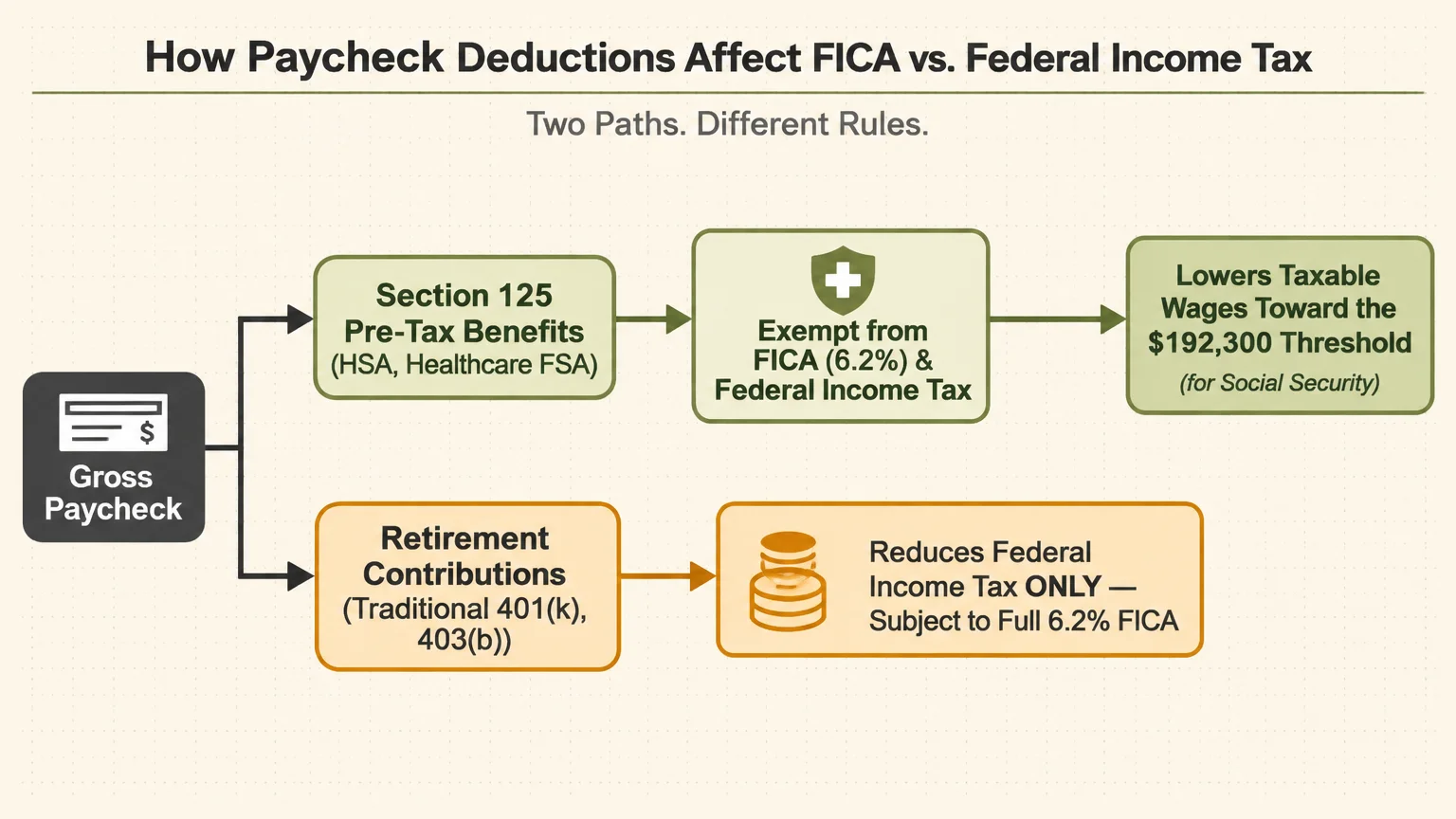
Traditional 401(k), 403(b), and governmental 457(b) deferrals reduce your federal and state income tax wages, not your FICA wages. Even if you defer the maximum allowed into a traditional 401(k), Social Security and Medicare taxes still apply to your full gross salary up to the cap.
Section 125 cafeteria plan benefits operate under different IRS rules. Employer-sponsored health, dental, and vision insurance premiums paid through payroll deduction generally reduce your FICA-taxable wages.
The same FICA exemption applies to payroll-deducted Health Savings Account (HSA) contributions, Healthcare Flexible Spending Accounts (FSAs), and Dependent Care FSAs. When you fund an HSA directly through your employer’s cafeteria plan, you save 6.2% in Social Security tax on every dollar below the $192,300 cap—plus 1.45% in Medicare tax.
Tracking how payroll caps interact with pre-tax deductions keeps more of your paycheck working for you instead of disappearing into surprise withholding.
If you fund an HSA independently with after-tax bank transfers instead of payroll deductions, you still claim the income tax deduction on Form 1040, but you forfeit the 7.65% FICA payroll tax savings. Routing HSA contributions through payroll is almost always more efficient for W-2 employees.
You should also review how Section 125 deductions interact with your earnings if you sit just above $192,300. If your gross salary is $198,000 and you deduct $8,000 in Section 125 health and HSA premiums, your FICA wages drop to $190,000.
At $190,000 in FICA wages, you stay slightly under the 2027 ceiling and save 6.2% on that $2,300 difference, saving $142.60 in Social Security tax on top of Medicare and income tax savings. Review plan documents through the Department of Labor Employee Benefits Security Administration and check IRS Retirement Plans guidance to confirm your employer plan eligibility.
What the Higher Cap Means for Your Future Social Security Benefits
Paying up to $483.60 more in 2027 is not pure deadweight cost if you are still building your earnings history. Because the $192,300 figure is both a contribution cap and a benefit cap, higher taxed earnings can raise your future monthly check.
The SSA calculates your retirement benefit using your highest 35 years of wage-indexed earnings. If 2027 replaces a lower-earning year from earlier in your career—or fills in a zero-earning year—earning up to $192,300 increases your lifetime average.
The SSA also announced several companion 2027 updates on October 14, 2026 that affect working adults and retirees alike. The maximum monthly Social Security benefit for someone claiming at full retirement age climbs from $4,152 in 2026 to $4,188 in 2027.
Current beneficiaries receive a 3.6% cost-of-living adjustment (COLA) for 2027, up from 2.8% in 2026. That increase reaches nearly 72 million Social Security beneficiaries in January 2027 and about 7.3 million Supplemental Security Income (SSI) recipients on December 31, 2026.
For the average retired worker, the 3.6% COLA lifts monthly payments by roughly $75, moving from $2,095 to $2,170. Meanwhile, workers still qualifying for coverage need $1,970 in earnings during 2027 to earn one Social Security work credit, up from $1,890 in 2026, or $7,880 for the maximum four annual credits.
If you plan to claim benefits early while continuing to work, the Retirement Earnings Test limits also move higher in 2027. Beneficiaries under full retirement age for all of 2027 can earn up to $25,560 per year ($2,130 per month) without benefit reductions, up from $24,480 in 2026.
Above that exempt limit, the SSA withholds $1 in benefits for every $2 earned. During the calendar year you reach full retirement age, the exempt limit rises from $65,160 to $67,920 ($5,660 per month) for months prior to full retirement age, with $1 withheld per $3 earned over the limit.
Common Money Traps
High-income payroll rules create several expensive mistakes when households switch jobs, marry, or juggle side income. Knowing these traps ahead of time protects your cash flow and prevents missed tax refunds.
Assuming married couples share one $192,300 cap: Social Security taxes apply strictly on an individual basis, even when you file a joint return. If each spouse earns $192,300 in 2027, your household pays $23,845.20 in combined employee Social Security tax—not $11,922.60.
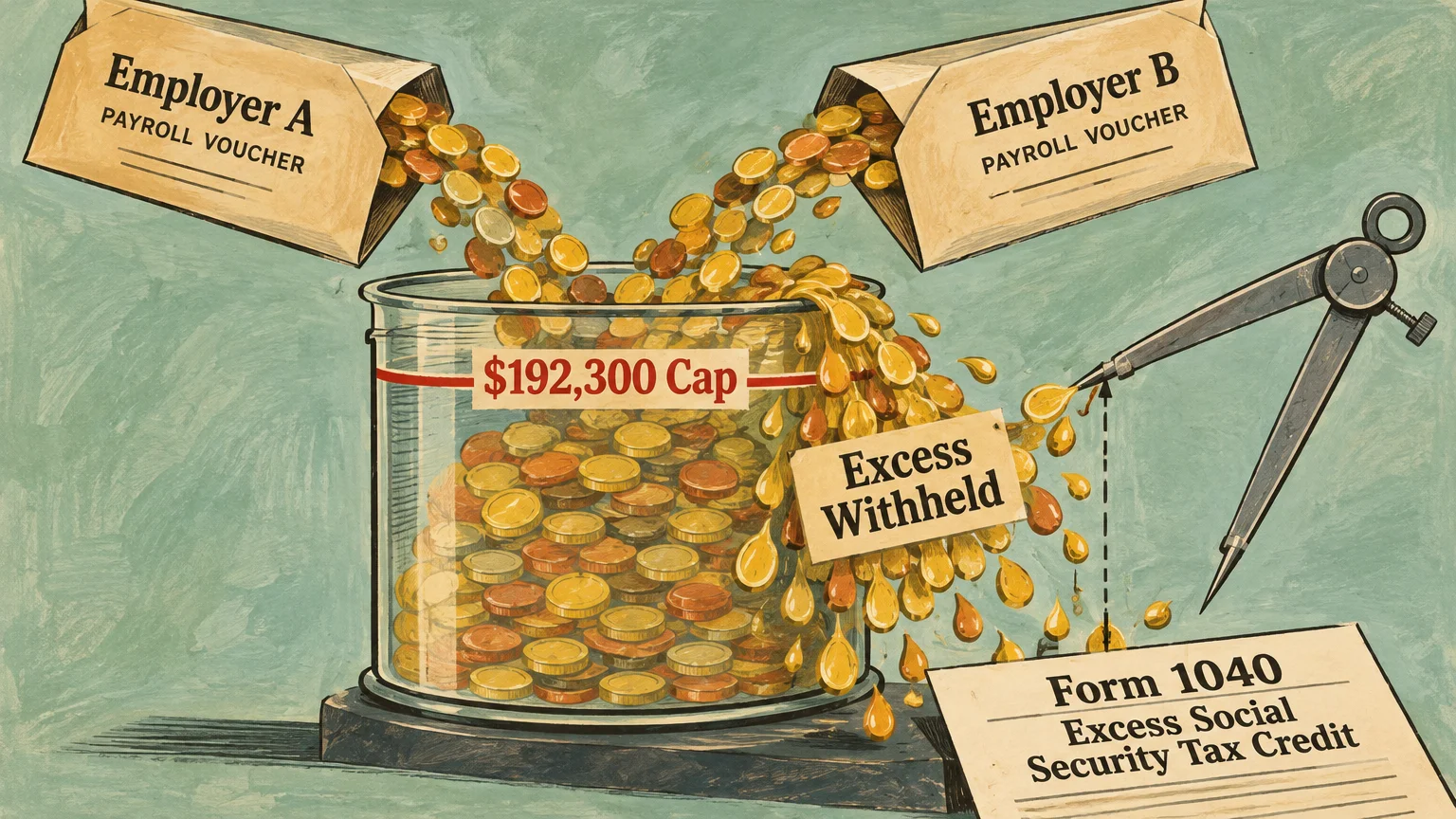
Overlooking excess withholding after changing jobs: If you work for two employers during 2027, each company must withhold 6.2% up to $192,300 independently because neither payroll department tracks what the other paid you. Suppose you earn $130,000 at Employer A and then switch to Employer B for another $130,000.
Both employers will withhold $8,060.00 in Social Security tax, totaling $16,120.00 across both W-2 Box 4 entries. Because the 2027 individual maximum is $11,922.60, you overpaid by $4,197.40 and must claim that excess as a credit on Form 1040 Schedule 3.
Using Schedule 3 when a single employer over-withholds: You cannot use Schedule 3 to fix a payroll error committed by one employer. If a single company accidentally withholds more than $11,922.60 in 2027, you must request a refund directly from that employer’s payroll team.
If the employer refuses or goes out of business without correcting your W-2, you must file IRS Form 843 to recover the excess tax. Keep your final December paystub and W-2 handy to spot single-employer mistakes quickly via the Internal Revenue Service (IRS).
Ignoring quarterly estimated tax updates as a contractor: Self-employed workers who leave their 2026 quarterly payment amounts on autopilot can fall short in 2027. Factoring the extra $967.20 Social Security ceiling into your Q1 estimated payment schedule helps you avoid underpayment penalties.
Misunderstanding bonus and equity vesting timing: Year-end bonuses, commissions, and vested restricted stock units (RSUs) count toward the wage base in the year they are paid, not when you earned them. A December 2026 bonus paid in January 2027 falls under the $192,300 cap rather than $184,500.
When to Consult a Professional
Most salaried workers with one employer do not need specialized tax help simply because the social security wage base rose by $7,800. Payroll software updates automatically on January 1.
However, you should consider hiring a Certified Public Accountant (CPA) or Enrolled Agent if you hold multiple high-paying W-2 jobs, combine W-2 salaries with six-figure 1099 profits, or need to file Form 843 for an uncooperative employer’s payroll error. A tax professional can also model whether electing S-corporation status and setting reasonable W-2 compensation makes financial sense for a profitable business.
Working with a fee-only financial planner makes sense if you are within ten years of retirement and weighing when to claim Social Security benefits while still earning above $192,300. A planner can map your top-35 earnings years, coordinate Section 125 deductions, and align your retirement timing with the 2027 earnings test rules.
Frequently Asked Questions
Does the $192,300 Social Security tax cap apply to combined household income for married couples?
No, the $192,300 taxable maximum applies individually to each worker’s covered wages or self-employment earnings. If you and your spouse each earn $192,300 in 2027, you each pay the full $11,922.60 maximum even when filing jointly.
Will bonuses, RSUs, or commissions push me over the 2027 taxable maximum?
Yes, supplemental wages—including performance bonuses, sales commissions, and vested RSUs—count toward the $192,300 Social Security limit in the calendar year they are paid. Once your combined regular pay and supplemental wages cross $192,300 at a single employer, the 6.2% withholding stops until January 2028.
What happens if I work two jobs in 2027 and both employers withhold 6.2% up to $192,300?
Each employer is legally required to withhold 6.2% independently without crediting wages earned elsewhere. When you file your 2027 Form 1040, add your W-2 Box 4 amounts together and claim anything above $11,922.60 as a credit on Schedule 3.
Does contributing to a 401(k) or HSA reduce my 2027 Social Security tax?
Traditional 401(k) contributions do not lower your Social Security tax because FICA applies before retirement plan deferrals. However, payroll-deducted HSA contributions and health insurance premiums under a Section 125 cafeteria plan do reduce your FICA-taxable wages.

Next Steps for Your 2027 Paycheck Plan
Check your projected 2027 salary, bonus schedule, and Section 125 benefits during open enrollment so you know whether your income crosses $184,500 or $192,300. If you are self-employed or work two jobs, update your tax withholding or quarterly estimates early to cover the higher cap cleanly.
This article is for informational purposes only and does not constitute financial, legal, or tax advice. Rates, benefit amounts, and tax rules change regularly—verify current details with the relevant agency or a licensed professional.
Last updated: November 2026. Rates, benefit amounts, and tax rules change—always verify current details at official sources.