
Your workplace 401(k) is undergoing its biggest shift in decades, and the changes could put riskier, costlier investments inside your retirement paycheck deductions. Under President Trump, federal regulators are clearing the way for private equity, real estate, and cryptocurrency inside employer plans.
At the same time, pending court battles and regulatory safe harbors could limit your ability to sue employers over bad funds. Combined with new 2026 and 2027 IRS catch-up rules, these shifts directly affect your paycheck and retirement savings.
Understanding what is changing—and how to audit your plan menu before your money moves—gives you control over your workplace benefits.
What You Need to Know
Recent executive orders, agency proposals, and statutory deadlines are reshaping workplace retirement plan rules across three fronts. Here are the key developments affecting more than 90 million Americans in employer-sponsored defined-contribution plans:
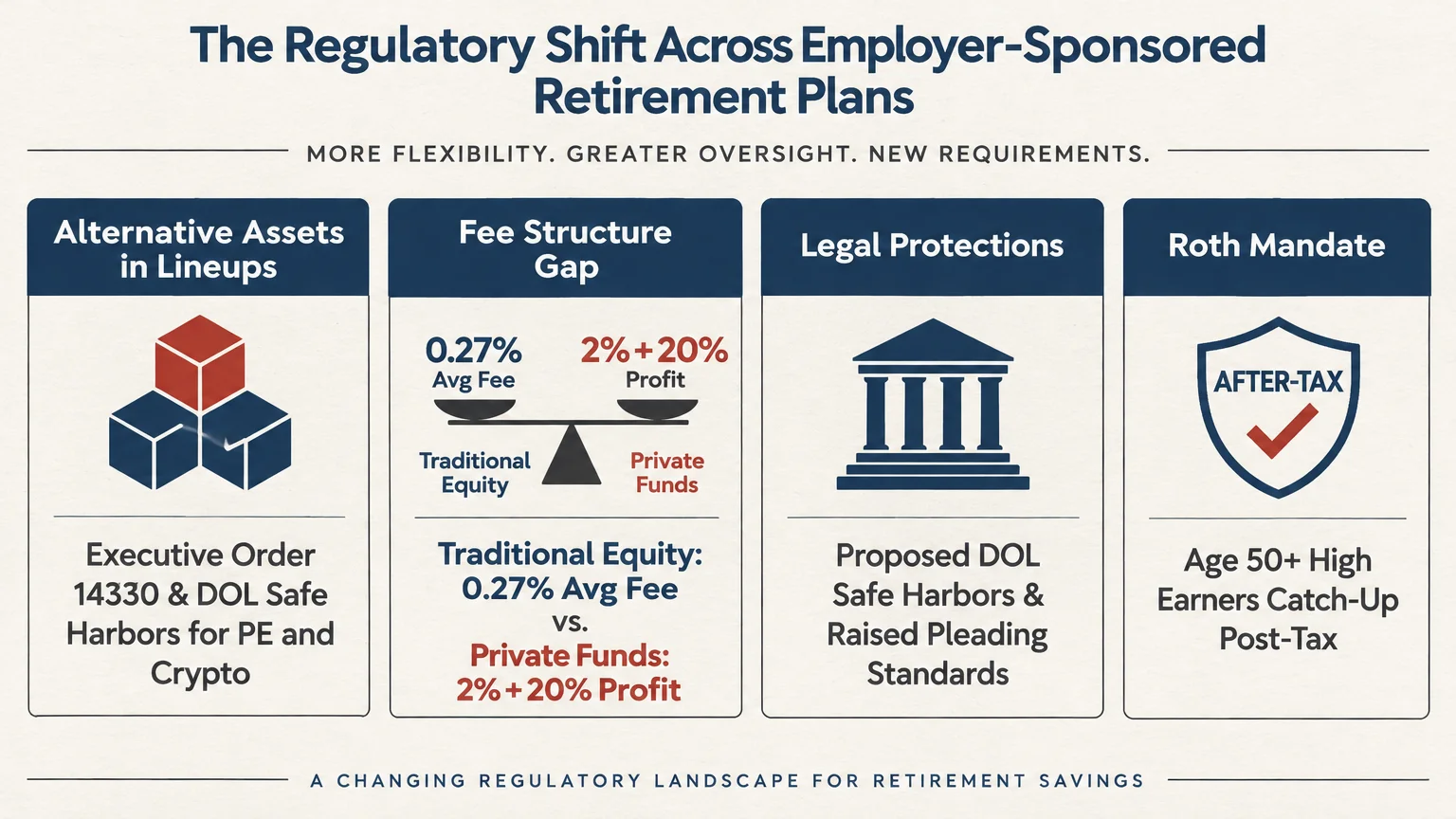
- Alternative assets in default menus: An August 2025 executive order and a pending Department of Labor (DOL) safe harbor rule make it easier for employers to add private equity, private credit, real estate, and crypto funds to 401(k) lineups.
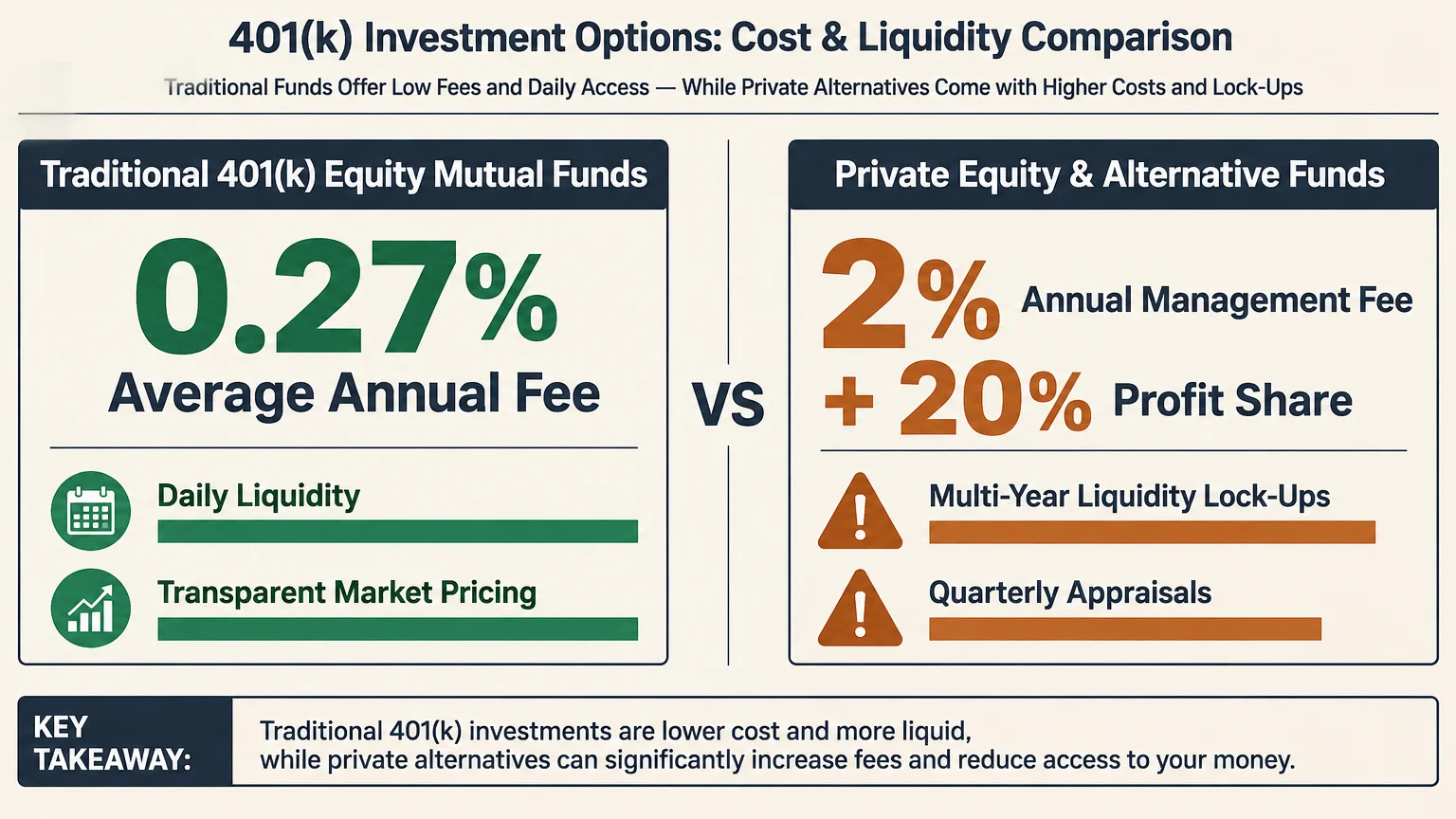
- Higher fee and liquidity risks: Traditional 401(k) equity mutual funds averaged just 0.27% in annual fees in 2025, whereas private funds often charge 2% annually plus 20% of profits and restrict when you can withdraw money.
- Weaker worker lawsuit protections: Proposed DOL safe harbors and a U.S. Supreme Court case argued in October 2026 could raise the legal bar for workers suing employers over high-fee or underperforming funds.
- Tighter ESG restrictions: Pending DOL rules and April 2026 guidance aim to bar fiduciaries from considering nonfinancial environmental or social factors when choosing plan funds or voting proxies.
- New IRS limits and Roth catch-up mandate: Contribution caps rise for 2026 and 2027, while workers age 50 and older earning above prior-year FICA wage thresholds must make catch-up contributions on an after-tax Roth basis.
How Trump 401(k) Changes Open the Door to Private Equity and Crypto
Workplace retirement accounts hold massive sums of household wealth—$10.1 trillion in 401(k) plans alone at the end of 2025, according to the Investment Company Institute (ICI). Total employer-sponsored defined-contribution assets reached $12.5 trillion by August 2025, per Proskauer, with Congressional Democrats citing $14.2 trillion in June 2026.
For years, federal regulators discouraged employers from placing volatile or illiquid investments inside core 401(k) lineups. That regulatory posture reversed rapidly during 2025 and 2026.
On May 28, 2025, the DOL Employee Benefits Security Administration (EBSA) issued Compliance Assistance Release No. 2025-01. That guidance rescinded a March 10, 2022 warning that had urged plan fiduciaries to exercise “extreme care” before offering cryptocurrency.
In place of that warning, the DOL adopted a neutral stance stating it “neither endorses, nor disapproves of” crypto options in 401(k) menus. Soon after, on August 7, 2025, President Trump signed Executive Order 14330, titled Democratizing Access to Alternative Assets for 401(k) Investors.
Executive Order 14330 directed the DOL and the Securities and Exchange Commission (SEC) to lower regulatory barriers and litigation risks keeping alternative assets out of workplace plans. Five days later, on August 12, 2025, the DOL rescinded its December 2021 caution against private equity in 401(k) plans.
The executive order defines alternative assets broadly to cover these major categories:
- Private equity and private credit funds
- Private real estate and infrastructure investments
- Actively managed investment vehicles holding digital assets such as cryptocurrency
- Commodities
- Lifetime income strategies
To turn that directive into binding regulation, the DOL published a proposed rule on March 31, 2026, titled Fiduciary Duties in Selecting Designated Investment Alternatives (RIN 1210-AC38). Crucially, this rule applies to your employer’s core investment menu rather than optional self-directed brokerage windows.
That distinction matters for everyday W-2 workers. Many employees leave their paycheck deductions in a plan’s default target-date fund rather than opening a separate brokerage account.
Under the proposal, an employer or plan fiduciary receives a process-based safe harbor—a rebuttable presumption of prudence under federal ERISA law—when adding alternative assets. To qualify for that legal shield, fiduciaries must document that they evaluated six specific factors:
- Expected performance
- Fees and expenses
- Liquidity terms
- Valuation methods
- Performance benchmarks
- Investment complexity
Public pushback was immediate and overwhelming. When the comment period closed on June 1, 2026, the DOL had received 47,103 comments, with an overwhelming majority opposing the change according to NW Labor Press.
Despite that opposition, the DOL submitted the final rule—designated “economically significant”—to the White House Office of Information and Regulatory Affairs (OIRA) on November 5, 2026. Final rule text remained pending pre-publication review in early November 2026.
Workplace retirement plans work best when fees stay low, pricing stays transparent, and every investment option serves your long-term financial security rather than Wall Street sales commissions.
Why Many Savers Dislike the Shift: Fees, Lock-Ups, and Volatility
Expanding 401(k) private equity and crypto access sounds like giving workers more choice, yet retirement savers face steep trade-offs. Unlike public index funds, private investments introduce higher costs, harder-to-verify prices, and restrictions on accessing your own money.
Consider what you currently pay inside standard workplace plans. According to 2026 ICI data, 401(k) participants invested in equity mutual funds paid an average expense ratio of 0.27% in 2025—down 64% from 0.76% in 2000.
Index equity mutual funds averaged just 0.05% in 2025, per ICI, while 401(k) target-date mutual funds averaged 0.29% in 2024. Those workplace averages sit well below the 0.40% industry-wide fund average and the 0.47% IRA average.
By contrast, private equity and hedge funds traditionally rely on a “2 and 20” fee structure—charging 2% of your assets every year plus 20% of investment profits. Even small differences in annual expenses compound into tens of thousands of dollars lost over a career.
On September 30, 2026, SEC Chairman Paul S. Atkins unveiled parallel proposals under a “responsible retailization” initiative, published in the Federal Register on October 5, 2026, with comments due December 4, 2026. Those SEC proposals would make private-fund structures much easier to package for everyday savers.
First, proposed amendments to SEC Rule 205-3 would let advisers to registered funds and business development companies charge performance-based fees up to 20% of net gains—including gains on unrealized paper appreciation. The rule would also expand “qualified client” eligibility to include accredited investors.
Second, the SEC released five notices seeking comment on six new exam- or credential-based pathways—including a FINRA-developed test—to qualify more everyday Americans as accredited investors. Third, proposed updates to Rules 23c-3, 12b-1, and 18f-3 target interval funds often used to hold illiquid private assets.
Those interval fund changes would let fund managers delay initial repurchase offers for up to two years and remove the requirement to hold 100% of each repurchase offer in liquid assets. If you change jobs or need an emergency rollover, your money could face delays.
| Feature | Traditional 401(k) Index & Target-Date Funds | Private Equity & Alternative Asset Funds |
|---|---|---|
| Typical Annual Fees | 0.05% (index equity) to 0.29% (target-date mutual funds) | Often “2 and 20” (2% annual fee plus 20% of gains) |
| Pricing Transparency | Daily market pricing at close of each trading day | Periodic estimates; unrealized gains can trigger fees |
| Liquidity & Rollovers | Daily trading for job changes, rollovers, or rebalancing | Interval funds may delay initial buybacks up to two years |
| Fiduciary Legal Risk | Easy to compare against public market indexes | Pending DOL safe harbor and benchmark rules shield sponsors |
Cryptocurrency adds acute price volatility on top of fee concerns. FINRA warns that crypto assets swing far more violently than traditional investments and that “the risk of losing all of your investment is significant.”
Everyday Americans remain deeply skeptical of putting digital tokens into long-term retirement accounts. Pew Research Center polling cited by The Regulatory Review in August 2026 found 63% of Americans have little to no confidence in current ways to invest in or trade crypto.
Only 5% of respondents expressed extreme or high confidence in crypto reliability and safety. On June 2, 2026, Senators Bernie Sanders and Elizabeth Warren alongside Representative Bobby Scott urged the DOL to scrap its alternative-assets rule.
The lawmakers pointed to OECD figures showing 22.8% of U.S. seniors live in poverty and highlighted extreme crypto crashes—noting President Trump’s memecoin fell from over $75 in January 2025 to $2 by June 2026. Mixing speculative assets into retirement accounts threatens basic household security.

How New Legal Hurdles Make It Harder to Challenge Bad Funds
When an employer selects overpriced or poorly managed funds, federal ERISA law traditionally gives workers a powerful remedy: the right to sue plan fiduciaries for breaching their duty of prudence. Recent 401(k) rule changes and a Supreme Court battle threaten to weaken that backstop.
On October 6, 2026, the U.S. Supreme Court heard oral arguments in Anderson v. Intel Corp. Investment Policy Committee, with a decision expected by June 2027. The lawsuit began when former Intel employees challenged custom target-date and diversified funds inside their 401(k).
Those custom Intel funds allocated worker retirement money into hedge funds and private equity, which plaintiffs alleged drove up fees and dragged down returns. On May 22, 2025, the Ninth Circuit dismissed the case before discovery could even begin.
The appellate court ruled that workers failed to identify a “meaningful benchmark”—an apples-to-apples comparable fund—at the initial pleading stage. The Trump administration’s Department of Justice and DOL filed a supporting brief backing Intel’s position.
Think about how that affects you as a W-2 employee. Private equity and custom alternative funds rarely publish standardized daily performance data, making it nearly impossible for workers to identify an exact comparable fund before obtaining internal records through a lawsuit.
If the Supreme Court upholds that strict pleading standard and the DOL finalizes its RIN 1210-AC38 safe harbor, employers gain double protection. As long as plan committees check off the DOL’s six documentation boxes, workers face steep odds proving imprudence in court.
Tighter Rules on ESG Options and Proxy Voting
While opening 401(k) menus to crypto and private equity, the administration is simultaneously restricting environmental, social, and governance (ESG) options. For employees who prefer socially screened funds, choices inside workplace plans may shrink.
Following a December 2025 executive order targeting diversity and ESG practices at proxy advisory firms, the DOL issued a Technical Release on April 1, 2026. That guidance stated proxy advisers may qualify as ERISA fiduciaries under the 1975 five-part test.
The release also warned that state-level anti-ESG laws might escape federal ERISA preemption, creating fresh legal exposure for employers that offer ESG funds. Then, on June 30, 2026, the DOL sent a draft proposed rule (RIN 1210-AC37) to OIRA.
That draft rule seeks to replace the 2022 rule that allowed plan fiduciaries to use ESG considerations as a “tiebreaker” between financially equivalent investments. Meanwhile, the U.S. House passed the Protecting Prudent Investment of Retirement Savings Act on January 15, 2026, though it stalled in the Senate.
In practical terms, many corporate HR departments respond to conflicting state and federal legal threats by removing ESG funds altogether. If your workplace plan drops a socially screened fund, check whether a self-directed brokerage window remains available inside your plan.
2026 and 2027 IRS Contribution Limits and the Roth Catch-Up Mandate
Beyond investment menus, statutory retirement plan rules taking effect across 2026 and 2027 directly reshape how much you can shelter from taxes through your paycheck. On November 12, 2026, the IRS released Notice 2026-66 (IR-2026-136) announcing inflation adjustments for 2027.
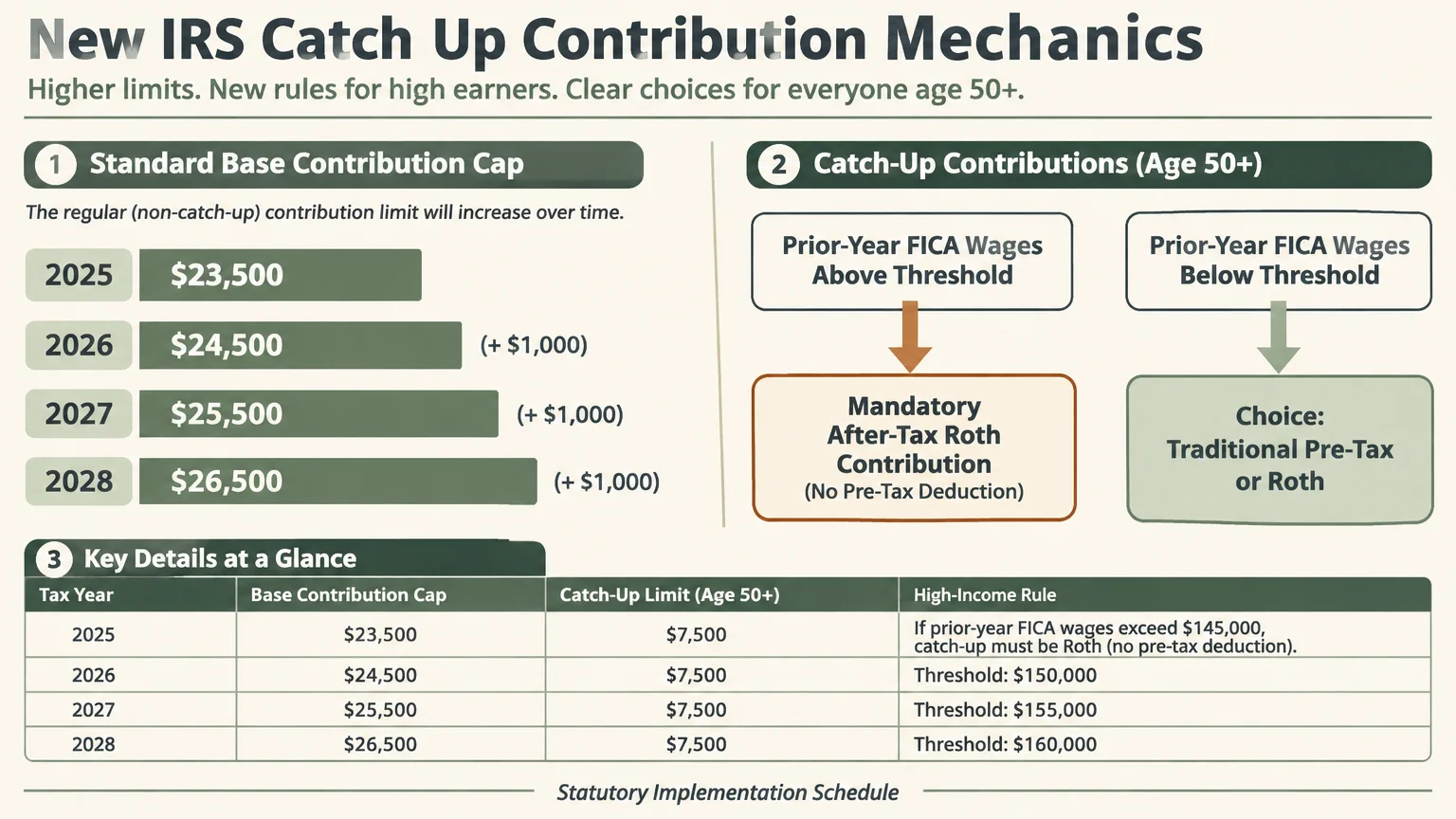
Standard employee 401(k) elective deferrals rise from $24,500 in 2026 to $25,500 in 2027. Combined employee and employer contributions—including your employer match and profit-sharing deposits—increase from $72,000 in 2026 to $75,000 in 2027.
Workers age 50 and older receive higher catch-up limits, rising from $8,000 in 2026 to $8,500 in 2027. That allows older savers to defer up to $34,000 of their own pay into a 401(k) in 2027.
Under SECURE 2.0 rules, employees ages 60 through 63 qualify for an even larger “super” catch-up limit of $11,250 in 2026 and $11,750 in 2027. Meanwhile, standalone IRA limits remain flat at $7,500 in 2027, with the age 50-plus IRA catch-up unchanged at $1,100.
| Contribution Category | 2026 Limit | 2027 Limit |
|---|---|---|
| Employee 401(k) Elective Deferral | $24,500 | $25,500 |
| Combined Employee + Employer 401(k) Cap | $72,000 | $75,000 |
| Age 50+ Standard 401(k) Catch-Up | $8,000 | $8,500 |
| Ages 60–63 “Super” 401(k) Catch-Up | $11,250 | $11,750 |
| Traditional or Roth IRA Annual Limit (Age 50+ Catch-Up) | — | $7,500 ($1,100) |
However, a major payroll tax catch accompanies these higher limits for older, higher-earning employees. Under SECURE 2.0 Section 603—statutorily effective January 1, 2026, with IRS final regulations published September 16, 2025, and formally applicable after December 31, 2026—high earners lose pre-tax catch-up deductions.
Specifically, if you are age 50 or older and your prior-year FICA wages (reported in Box 3 of your W-2) exceeded $150,000 in 2025, any catch-up contributions in 2026 must go into an after-tax Roth 401(k) bucket. That wage threshold rises to $155,000 in 2026, governing 2027 catch-up deposits.
This rule hits your net take-home pay immediately during peak earning years. Because Roth contributions are deducted after income taxes rather than before taxes, shifting an $8,500 or $11,750 catch-up to Roth increases your current-year taxable income and payroll withholding.
Even worse, if your employer’s 401(k) plan does not offer a Roth contribution feature, high-earning workers above the FICA threshold are barred from making catch-up contributions altogether. Independent 1099 contractors without W-2 FICA wages follow different plan rules, making employment classification critical.
Steps to Protect Your Workplace 401(k) Now
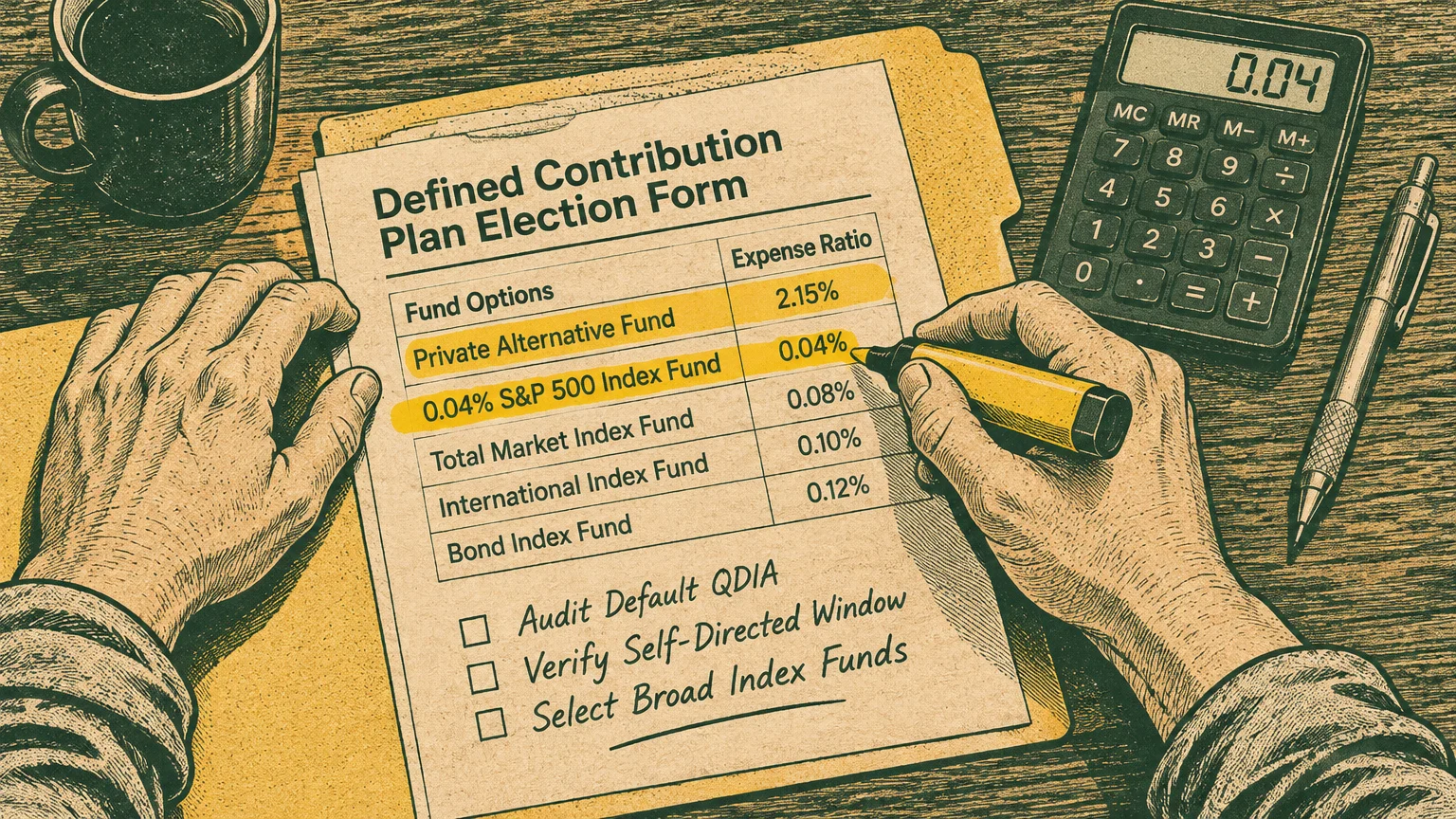
You do not have to wait for final federal rules or Supreme Court decisions to safeguard your retirement savings. Review your workplace benefits portal using this practical action plan:
- Inspect your target-date fund holdings: Download the latest quarterly fact sheet for your default target-date fund and check whether the glidepath includes private equity, private credit, real estate, or digital assets.
- Benchmark your expense ratios: Compare every fund’s annual fee against standard 2025 workplace averages—0.05% for index equity funds, 0.27% for equity mutual funds, and 0.29% for target-date funds.
- Check lock-up and redemption rules: Before selecting any newly added interval fund or private-asset option, verify whether withdrawals or job-change rollovers face multi-month or two-year restrictions.
- Verify your W-2 FICA wages and Roth access: Check Box 3 on your prior-year W-2 against the $150,000 (for 2026) and $155,000 (for 2027) thresholds, and confirm with HR that your plan includes a Roth 401(k) bucket.
- Protect your employer match first: Adjust your payroll withholding percentage carefully so switching catch-up dollars to Roth never reduces your cash flow enough to forfeit free matching contributions.
If your employer begins adding opaque alternative investments to default funds, you can switch into plain-vanilla public stock and bond index funds inside the core menu. Reviewing your benefit elections once a year keeps retirement savings news from turning into an expensive surprise.
Don’t Make These Mistakes
Fast-moving regulatory shifts often catch busy workers off guard during annual benefits enrollment. Avoid these costly errors when managing your workplace 401(k):
- Assuming default target-date funds never change: Employers can swap underlying sub-funds or add private equity sleeves to custom target-date funds after giving standard plan notices, quietly raising your fees without requiring your signature.
- Chasing past private-fund returns without checking net fees: Marketing materials often highlight gross gains before subtracting 2% annual management fees and 20% performance cuts, which can erase any return advantage over low-cost index funds.
- Overlooking liquidity traps before a job change: Moving money into illiquid interval funds can complicate rolling your 401(k) into an IRA or new employer plan if you get laid off or switch jobs.
- Ignoring your W-2 FICA wage threshold: Failing to confirm Roth catch-up payroll coding after earning over $150,000 in 2025 or $155,000 in 2026 can trigger corrective payroll adjustments or missed catch-up savings if your plan lacks a Roth feature.

When Professional Advice Is Worth It
Most workers managing simple index funds do not need ongoing portfolio management, yet these new 401(k) rule changes create situations where specialized guidance pays off. Consider hiring a fee-only financial planner if your employer rolls custom private-asset target-date funds into your plan and you want an independent fee and risk audit.
A certified public accountant (CPA) is worth the cost if you are age 50 or older and hovering near the $150,000 or $155,000 FICA wage cliff. A CPA can project how mandatory Roth catch-up contributions alter your W-4 tax withholding, tax credits, and net take-home pay.
If you suspect your employer replaced low-cost index funds with high-fee private vehicles or blocked a legitimate rollover, consult an ERISA or consumer benefits attorney. You can also review free federal resources at the Consumer Financial Protection Bureau to understand your financial rights.
Frequently Asked Questions
Can my employer put crypto or private equity in my 401(k) without asking me?
Employers generally cannot force you to pick a standalone crypto fund, and the pending DOL safe harbor rule applies to core designated investment alternatives rather than self-directed brokerage windows. However, plan sponsors can include private equity or alternative sleeves inside default custom target-date funds unless you actively switch funds.
Are Trump 401(k) changes finalized as of November 2026?
The DOL rescinded prior crypto and private equity warnings in May and August 2025, and submitted its final alternative-asset safe harbor rule to OIRA on November 5, 2026. Parallel SEC proposals on interval funds and 20% performance fees remain open for public comment through December 4, 2026.
Why do critics oppose 401(k) private equity and crypto options?
Critics point to steep “2 and 20” fees compared with 0.05% to 0.27% averages in traditional 401(k) equity funds, alongside multi-year lock-up risks and extreme volatility. Combined with pending legal hurdles in the Intel Supreme Court case, savers face higher losses with less legal recourse.
What happens if I earn over $155,000 in 2026 and my 401(k) lacks a Roth option?
Under SECURE 2.0 Section 603, workers age 50 and older whose prior-year FICA wages exceed $155,000 in 2026 must make 2027 catch-up contributions on a Roth basis. If your employer’s plan does not offer a Roth 401(k) feature, you are barred from making catch-up contributions.
How can I check if my 401(k) fees are too high?
Review your plan’s annual fee disclosure notice and each fund’s expense ratio inside your benefits portal. If your equity or target-date funds cost significantly more than the 0.27% to 0.29% 401(k) averages, look for lower-cost index alternatives on your plan menu.
Log in to your workplace retirement portal this week, download your default fund’s fact sheet, and verify both your expense ratios and your Roth catch-up eligibility before 2027 payroll deductions begin. Financial outcomes vary based on individual income, credit history, and circumstances—this article provides general guidance only, so consult a qualified financial planner, CPA, or consumer attorney for advice specific to your situation.
Last updated: November 2026. Rates, benefit amounts, and tax rules change—always verify current details at official sources.