
Most married couples treat Social Security as two independent financial decisions. They calculate individual breakeven ages, compare benefit estimates, and file whenever it feels convenient for their personal careers.
This approach overlooks the single most critical figure in household retirement: the survivor income cliff. Failing to calculate how your joint cash flow drops when one spouse dies can cost hundreds of thousands of dollars.
By learning how to calculate your household survivor gap today, you can protect the surviving spouse and optimize your joint benefits for life.
The Hidden Number: Your Household Survivor Cliff
When you are married, Social Security provides two monthly benefit checks to your household. Those two streams of income help cover your mortgage, property taxes, utilities, and daily living costs.
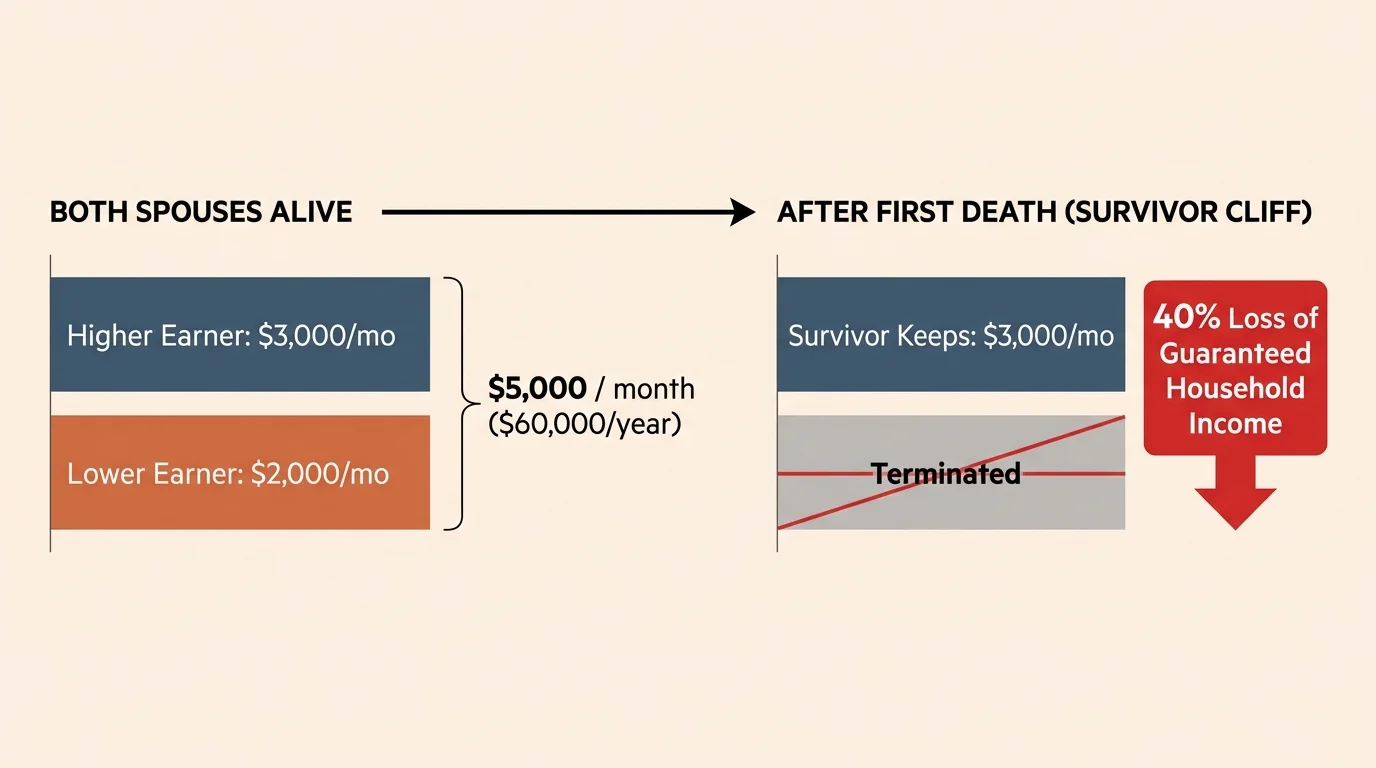
However, the moment the first spouse passes away, one of those checks vanishes completely. The Social Security Administration (SSA) terminates the smaller benefit and pays only the single larger benefit to the survivor.
This sudden drop in household revenue is the survivor cliff. Most couples never calculate this gap, yet it represents the largest guaranteed income reduction you will ever experience in retirement.
Consider a couple receiving $3,000 and $2,000 each month in Social Security benefits. While both partners are alive, they collect a combined gross income of $5,000 per month, or $60,000 annually.
When the first spouse dies, the $2,000 monthly check disappears immediately. The surviving spouse keeps only the $3,000 check, suffering an instant 40% loss of guaranteed household income.
Meanwhile, fixed household expenses rarely drop by 40% when a spouse passes away. Housing expenses, auto insurance, real estate taxes, and utility bills remain largely unchanged for a single individual.

How Social Security Actually Works for Married Couples
To calculate your survivor gap accurately, you must understand your Primary Insurance Amount (PIA). Your PIA is the baseline monthly benefit you earn at your Full Retirement Age (FRA).
For anyone born in 1960 or later, your Full Retirement Age is 67. For individuals born in 1959, your FRA is 66 years and 10 months.
A non-working or lower-earning spouse can claim social security spousal benefits based on the higher earner’s record. This spousal benefit tops out at exactly 50% of the primary earner’s PIA at Full Retirement Age.
Your spouse cannot receive this spousal top-up until you actually file for your own retirement benefit. Furthermore, claiming any benefit before your own FRA permanently reduces your monthly payout.
Claiming your own worker benefit at age 62 reduces your monthly check by up to 30%. Claiming a spousal benefit at age 62 results in an even steeper 35% permanent reduction.
“It’s not how much money you make, but how much money you keep, how hard it works for you, and how many generations you keep it for.” — Robert Kiyosaki
The Power of the 8% Delayed Retirement Credit on Survivor Benefits
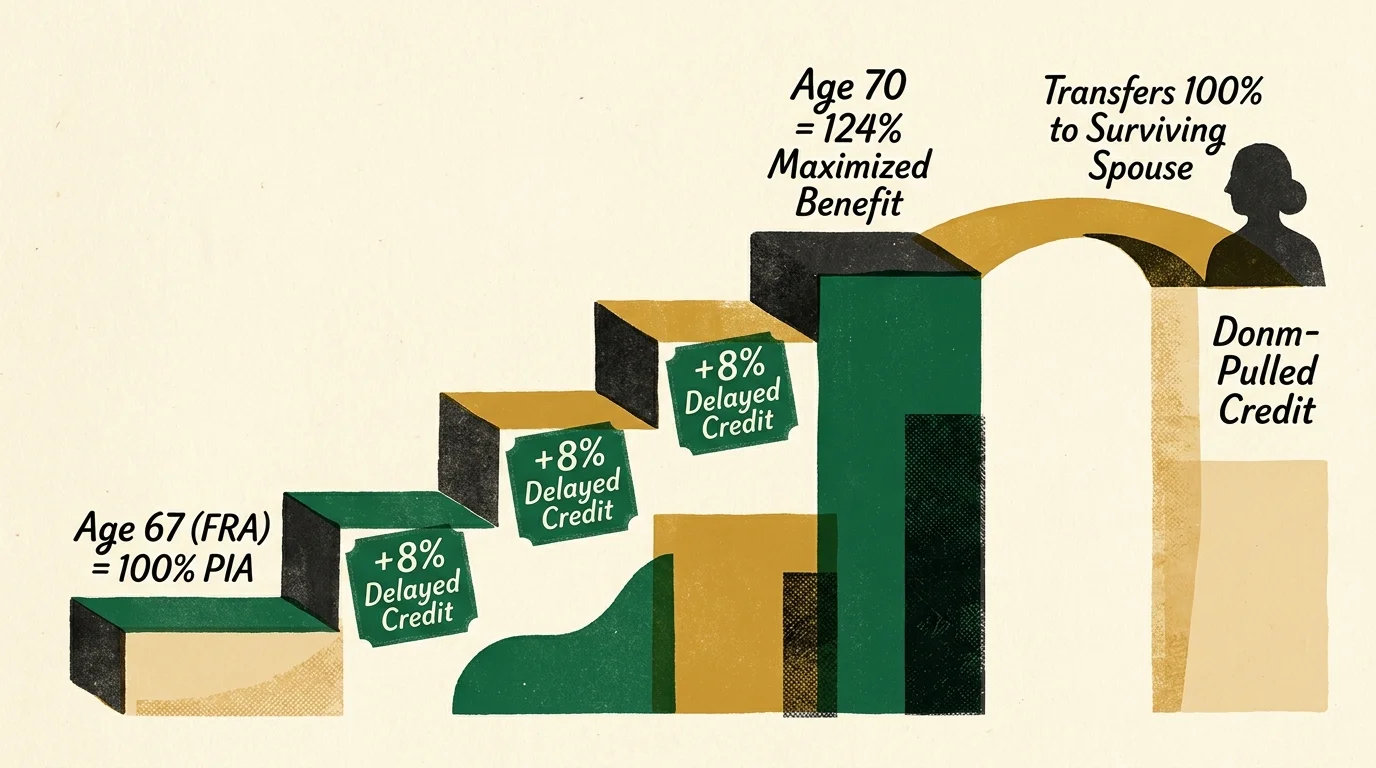
If you delay claiming your retirement benefit past your Full Retirement Age, you earn Delayed Retirement Credits (DRCs). These credits grow your benefit by 8% per year (two-thirds of 1% per month) until age 70.
For someone with an FRA of 67, waiting until age 70 produces a permanent 24% boost above their baseline PIA. This is one of the highest guaranteed, inflation-adjusted returns available in modern finance.
Delayed retirement credits do not increase the spousal benefit while both partners remain alive. A living spouse’s benefit is strictly capped at 50% of the worker’s PIA at FRA.
However, those accumulated credits transfer directly to the survivor benefit. If the higher earner delays until age 70, the surviving spouse steps into that full, maximized 124% benefit upon the higher earner’s death.
This makes the higher earner’s claiming decision an essential life insurance policy for the surviving partner. Maximizing the larger benefit establishes the absolute floor for survivor cash flow.
The Single Filer Tax Trap
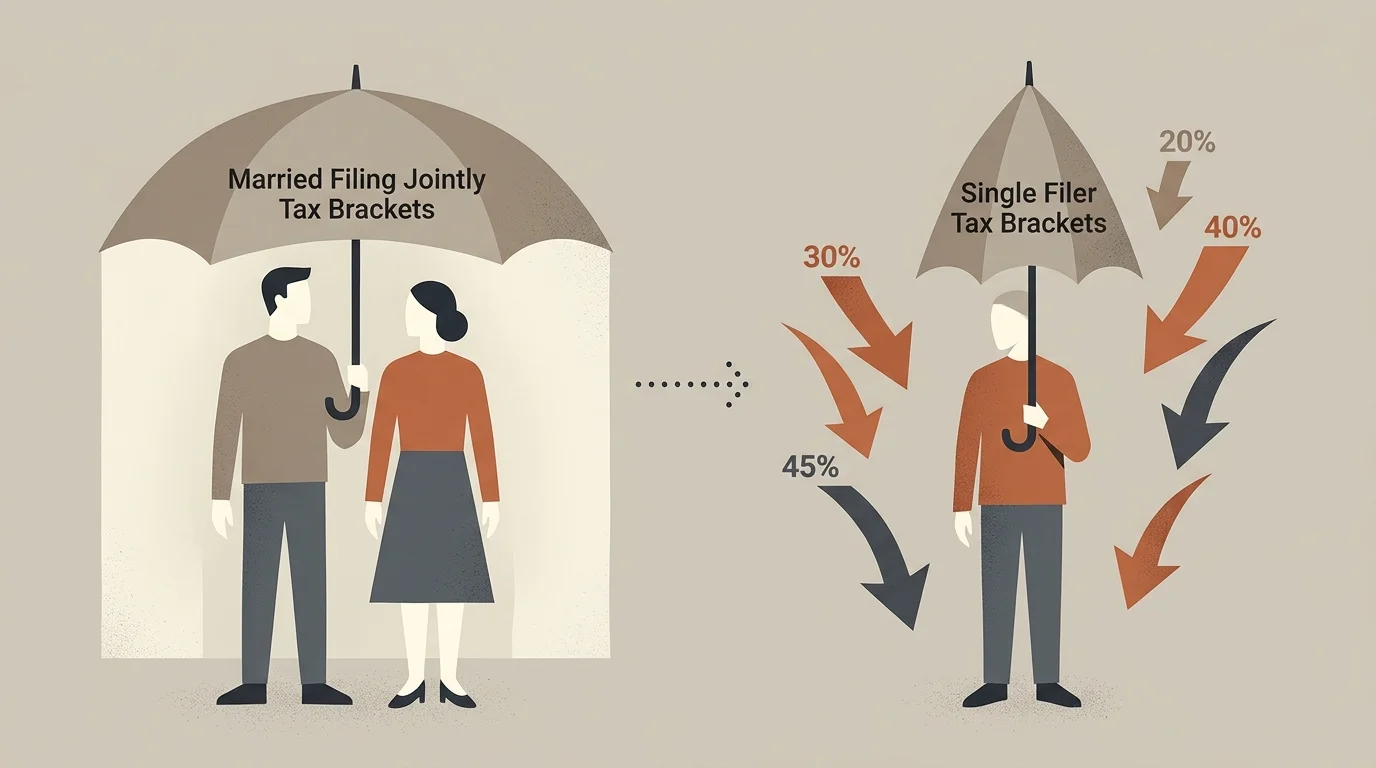
The survivor cliff creates a compounding financial problem because of federal tax law. When your spouse dies, your tax filing status shifts from Married Filing Jointly to Single.
Single filers face much narrower tax brackets and a standard deduction that is sliced directly in half. As a result, the surviving spouse pays higher tax rates on less total income.
Furthermore, the IRS thresholds for taxing Social Security benefits are not indexed to inflation. According to IRS retirement rules, up to 85% of your benefits can become taxable as income rises.
For single filers, combined income over $34,000 exposes 85% of Social Security benefits to income tax. For married couples, that top threshold begins at $44,000 of combined income.
This reality means the surviving spouse loses a check and pays higher taxes on remaining withdrawals. Calculating this number early allows you to build tax-efficient reserves before disaster strikes.

Comparing Social Security Claiming Strategies for Couples
Evaluating different social security claiming strategies illustrates how timing changes both living income and survivor income. The numbers below reflect a primary earner with a $3,000 PIA and a spouse with a $1,500 PIA (both born in 1960 or later, FRA 67).
| Claiming Strategy | Primary Monthly Benefit | Spousal Monthly Benefit | Combined Living Benefit | Surviving Spouse Benefit |
|---|---|---|---|---|
| Both Claim at Age 62 (Early Reduction) |
$2,100 (30% reduction) |
$1,050 (30% reduction) |
$3,150 / month ($37,800 / year) |
$2,100 / month ($25,200 / year) |
| Both Claim at Age 67 (Full Retirement Age) |
$3,000 (100% of PIA) |
$1,500 (100% of PIA) |
$4,500 / month ($54,000 / year) |
$3,000 / month ($36,000 / year) |
| Split Strategy (Spouse at 62, Primary at 70) |
$3,720 (+24% DRC at 70) |
$1,050 (30% reduction) |
$4,770 / month ($57,240 / year) |
$3,720 / month ($44,640 / year) |
| Both Claim at Age 70 (Maximum Optimization) |
$3,720 (+24% DRC at 70) |
$1,860 (+24% DRC on own) |
$5,580 / month ($66,960 / year) |
$3,720 / month ($44,640 / year) |
Notice the massive difference in the surviving spouse benefit column between the early strategy and the split strategy. Delaying the primary earner’s benefit increases survivor income by $1,620 every single month.
Over a 15-year survivorship period, that single decision generates nearly $300,000 in additional guaranteed income. That calculation ignores annual Cost-of-Living Adjustments (COLA), which widen the gap even further.

Deemed Filing and the Earnings Test: Rules You Must Know
When executing social security benefit optimization, you must navigate several strict administrative rules. The Bipartisan Budget Act eliminated older loopholes such as “file and suspend” for anyone born after January 1, 1954.
Under current deemed filing rules, applying for your own retirement benefit automatically triggers an application for spousal benefits. The SSA will simply pay you whichever amount is higher; you cannot claim one and delay the other.
If you continue working while claiming benefits before reaching your FRA, the Retirement Earnings Test applies. Earning too much money from employment will cause the SSA to temporarily withhold part of your benefit.
For beneficiaries under Full Retirement Age for the entire year, you forfeit $1 in benefits for every $2 earned above $24,480. If you reach FRA during the calendar year, you forfeit $1 for every $3 earned above $65,160 before your birthday month.
The SSA removes all earnings caps once you reach your exact Full Retirement Age. In addition, the agency recalculates your benefit at FRA to credit you back for any previously withheld payments.
Keep in mind that Social Security payroll taxes apply up to the OASDI maximum taxable earnings base, set at $184,500. Knowing these limits prevents unexpected benefit suspensions while you remain employed.

Step-by-Step: How to Calculate Your Household Survivor Gap
Calculating your household survivor gap requires a clear assessment of your actual retirement expenses and income sources. Follow these steps to find your household’s true number.
- Retrieve Official PIA Figures: Create an account on the official SSA website and download the latest Social Security statement for both spouses.
- Identify the Primary and Secondary Earners: Determine which spouse has the higher PIA at Full Retirement Age; this check will dictate the ultimate survivor benefit.
- Model Combined Living Cash Flow: Calculate total household Social Security income under different claiming ages (such as age 62, 67, and 70).
- Subtract the Smaller Benefit: Remove the lower earner’s projected benefit entirely to determine the raw survivor income.
- Estimate the Adjusted Tax Burden: Recalculate your estimated income taxes using the Single filing status brackets to reveal net after-tax survivor income.
- Compare Against Fixed Living Expenses: Match the net survivor income against your household budget to calculate the exact dollar shortfall.
Once you see this dollar deficit clearly, you can structure your remaining retirement assets to fill the hole. You might allocate IRA withdrawals or purchase term life insurance during the transition years to protect the survivor.
Errors That Cost Families Thousands
Couples make several common social security calculation mistakes when planning their retirement timelines. Avoiding these pitfalls can protect your family’s long-term financial stability.
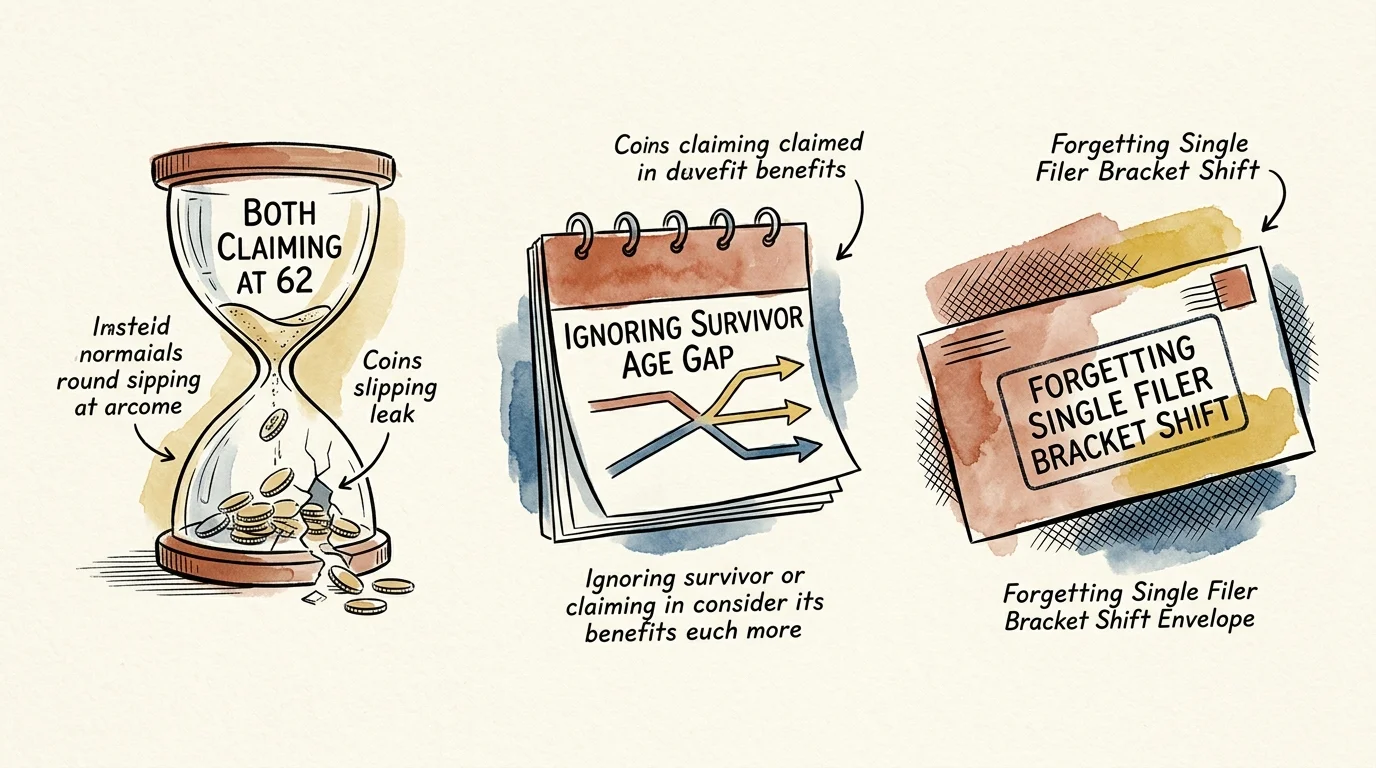
- Rushing to Claim at Age 62: Claiming early permanently locks in a 30% reduction on the primary earner’s benefit and permanently damages the survivor benefit.
- Treating Claiming as an Individual Race: Spouses often claim based on their own life expectancy rather than calculating joint household survival odds.
- Ignoring the Age Difference: If the higher earner is significantly older, claiming early severely penalizes a younger surviving spouse who may outlive them by decades.
- Overlooking the Single Tax Bracket Shift: Failing to plan for the jump from joint filing to single filing can lead to higher Medicare premiums and taxation of benefits.
- Working While Claiming Early: Exceeding the $24,480 earnings limit leads to surprise benefit withholdings and tax complications.
“A budget is telling your money where to go instead of wondering where it went.” — John C. Maxwell

When to Get Expert Help
Social security benefit optimization is rarely a standalone decision. It connects directly with your pension options, required minimum distributions (RMDs), and healthcare planning.
You should consult a fee-only CERTIFIED FINANCIAL PLANNER™ (CFP®) or a CPA if you have complex assets. Specialized planning software can model thousands of longevity scenarios to find the mathematically ideal filing date.
Professional guidance is particularly valuable if you have significant age differences between spouses or substantial pre-tax retirement accounts. A planner can help you execute Roth conversions before Social Security begins, reducing future tax burdens.
You can also access free resources through the Consumer Financial Protection Bureau (CFPB) to review basic retirement budgeting tools. Expert guidance ensures you do not leave hundreds of thousands of dollars on the table.
Frequently Asked Questions
Can a surviving spouse switch between their own benefit and a survivor benefit?
Yes. Unlike living spousal benefits, survivor benefits are exempt from deemed filing rules. A widow or widower can claim a survivor benefit at age 60 while letting their own worker benefit grow until age 70.
What happens to spousal benefits if my spouse dies before claiming?
If the higher-earning spouse dies before claiming, the surviving spouse still receives a survivor benefit based on the deceased worker’s accrued credits. If the deceased spouse passed away after FRA without filing, DRCs earned up to death are included.
Does remarrying affect my Social Security survivor benefit?
If you remarry after reaching age 60 (or age 50 if disabled), your remarriage will not affect your eligibility for survivor benefits. However, remarrying before age 60 generally makes you ineligible for survivor benefits on a former spouse’s record.
How does a divorce affect spousal and survivor benefits?
If your marriage lasted at least 10 years, you can receive benefits on your ex-spouse’s record without reducing their payout or their current spouse’s benefit. You must be currently unmarried to claim spousal benefits, though remarriage after 60 allows divorced survivor claims.
Maximizing Social Security as a Couple
Maximizing Social Security as a couple requires looking beyond your individual retirement dates. The decision of when to claim dictates not only your lifestyle today, but your spouse’s financial survival tomorrow.
Take the time this week to log into the SSA portal, calculate your household survivor cliff, and align your claiming strategy. Financial outcomes vary based on individual income, credit history, and circumstances. This article provides general guidance only. Consult a qualified financial planner, CPA, or consumer attorney for advice specific to your situation.
Last updated: February 2026. Rates, benefit amounts, and tax rules change—always verify current details at official sources.