
The transition into retirement feels like complete financial freedom until you file your first tax return without an employer handling withholdings. Suddenly, your income arrives from multiple disconnected accounts, creating unexpected tax liabilities.
Filing taxes after retiring reveals rules that operate entirely differently from your working years. You quickly discover that managing retirement taxes requires proactive coordination rather than passive compliance.
These seven critical lessons from a first tax return in retirement will help you protect your nest egg and avoid costly mistakes.
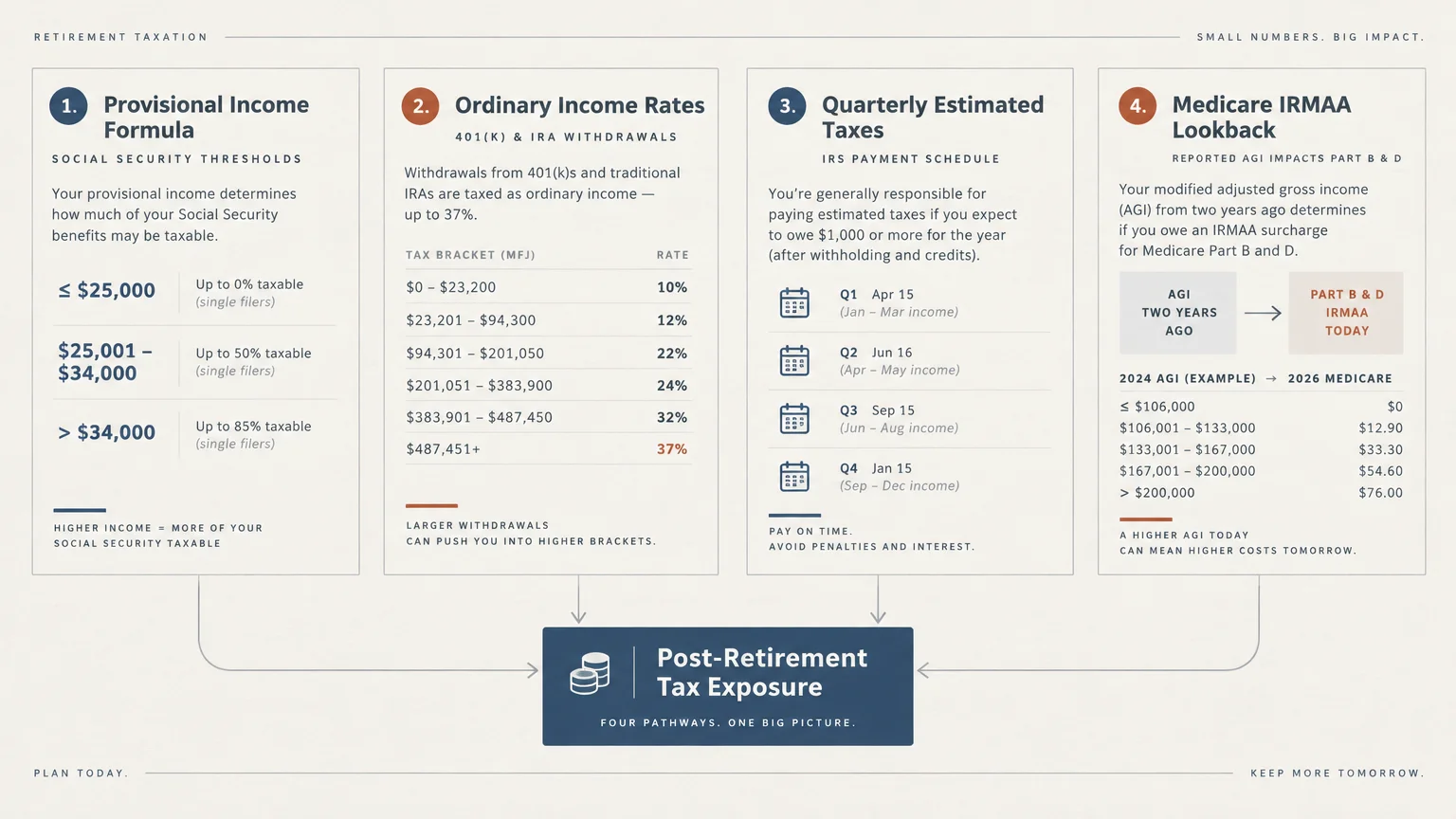
What You Need to Know
- Social Security benefits become taxable once your combined provisional income crosses outdated federal thresholds.
- Traditional 401(k) and IRA withdrawals are taxed as ordinary income rather than lower long-term capital gains rates.
- Without payroll withholding, you must actively schedule quarterly estimated payments or set up voluntary withholding.
- Your reported adjusted gross income directly impacts your Medicare Part B and Part D premiums two years later.
1. Social Security Benefits Are Often Taxable
Many new retirees assume Social Security benefits arrive completely tax-free. However, your first post-retirement tax filing often delivers an unpleasant surprise regarding taxes on Social Security.
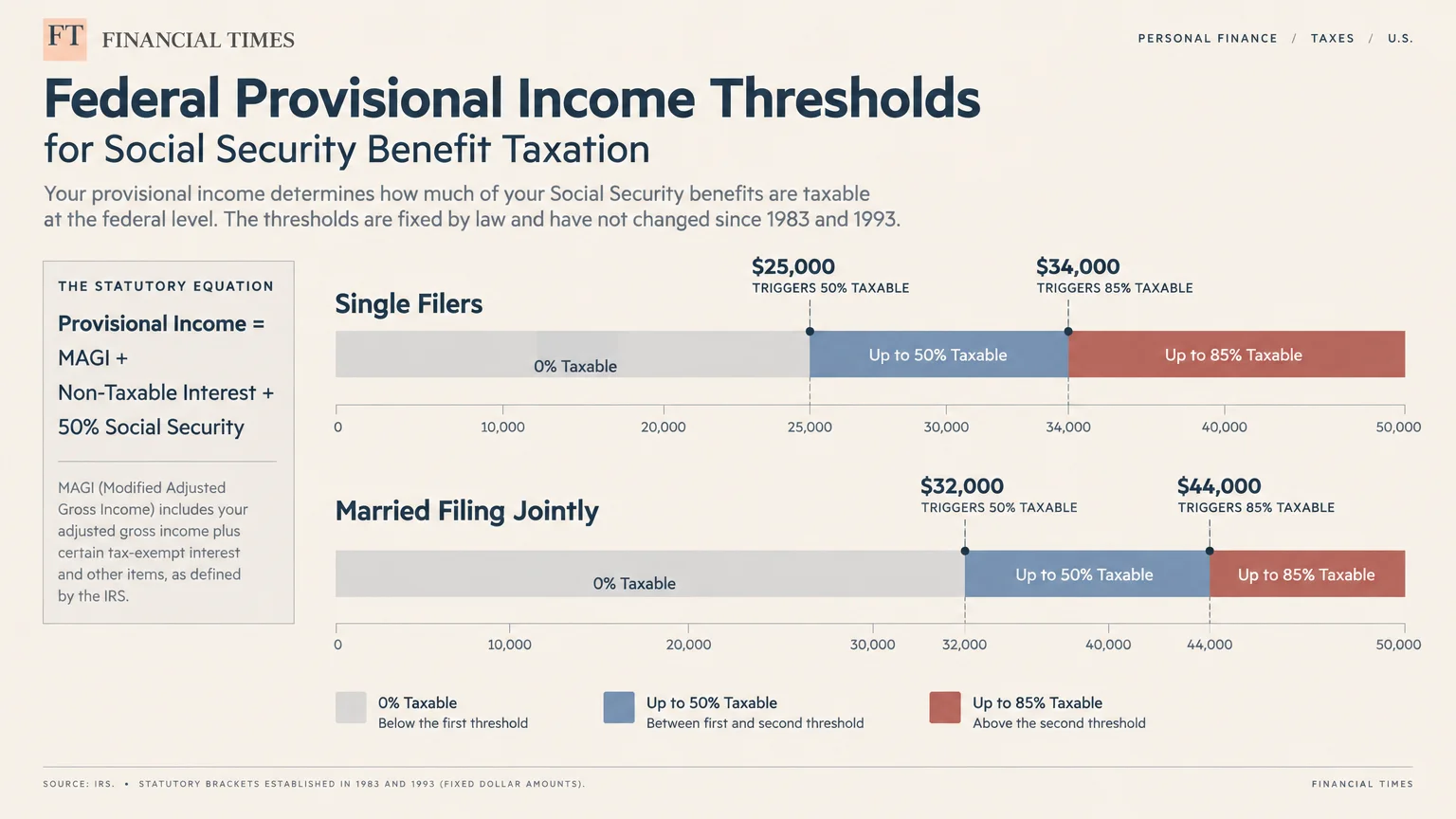
The IRS uses a specific formula called provisional income to determine benefit taxation. You calculate this by adding your modified adjusted gross income, non-taxable interest, and half of your annual Social Security benefits.
For single filers, provisional income between $25,000 and $34,000 makes up to 50% of benefits taxable. If your provisional income exceeds $34,000, up to 85% of your benefits face federal income tax.
For married couples filing jointly, provisional income between $32,000 and $44,000 triggers taxation on up to 50% of benefits. Exceeding $44,000 exposes up to 85% of your benefits to federal tax brackets.
Congress established these thresholds in 1983 and 1993 without indexing them for inflation. Because of wage growth and inflation, even modest pensions or IRA distributions push average retirees past these limits.
You can verify your official benefit records and annual tax statements through the Social Security Administration (SSA). Proactive planning helps you manage distributions to keep provisional income as low as possible.
2. Traditional Retirement Accounts Are Taxed as Ordinary Income
You spent decades watching your retirement accounts grow through long-term capital investments. Many retirees mistakenly believe that distributions qualify for preferential capital gains tax rates.
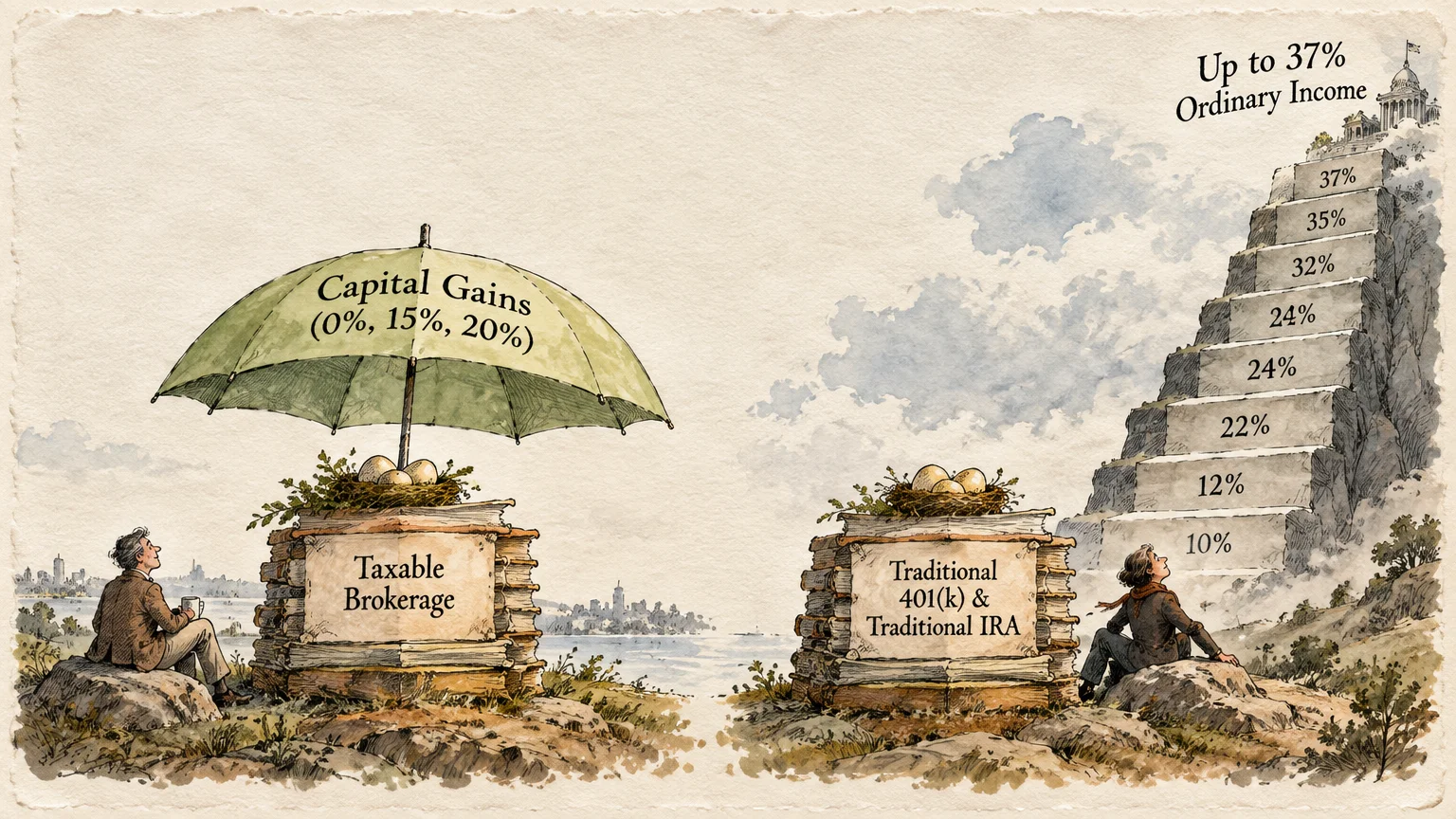
Every dollar pulled from a traditional 401(k), 403(b), or traditional IRA counts as ordinary income. The IRS taxes these distributions at ordinary income rates reaching up to 37%, regardless of how long funds remained invested.
Preferential long-term capital gains rates—which top out at 0%, 15%, or 20%—apply only to taxable brokerage accounts. Pre-tax retirement plans simply deferred ordinary income taxes until withdrawal.
Withdrawing a large sum to pay off your mortgage or purchase an RV can unintentionally launch you into a higher tax bracket. Spreading large purchases across multiple calendar years protects your overall tax position.
Review comprehensive distribution guidelines directly through the IRS retirement plan guidance portal. Understanding your distribution rules prevents expensive surprises during tax season.

3. The IRS Expects Quarterly Estimated Payments
During your career, your employer handled tax withholding automatically on every paycheck. When you retire, that automatic withholding disappears entirely unless you take deliberate action.
If you fail to pay sufficient taxes throughout the year, the IRS imposes an underpayment penalty using Form 2210. Owing more than $1,000 at tax time often triggers this avoidable financial penalty.
To avoid penalties, you must satisfy IRS safe harbor requirements. You generally must pay at least 90% of your current year tax liability or 100% of your prior year tax liability.
If your adjusted gross income exceeded $150,000 in the prior tax year, your safe harbor threshold increases to 110%. Missing these targets means owing interest charges on top of your standard tax balance.
You can solve this problem by filing Form 1040-ES to make quarterly estimated payments four times a year. Alternatively, you can establish voluntary withholding on your distributions to simplify your cash management.
Retirees receiving Social Security can file Form W-4V to request voluntary withholding. The IRS allows fixed withholding rates of 7%, 10%, 12%, or 22% directly from your monthly benefit.
“It’s not how much money you make, but how much money you keep, how hard it works for you, and how many generations you keep it for.” — Robert Kiyosaki
4. Your Tax Return Dictates Your Medicare Premiums
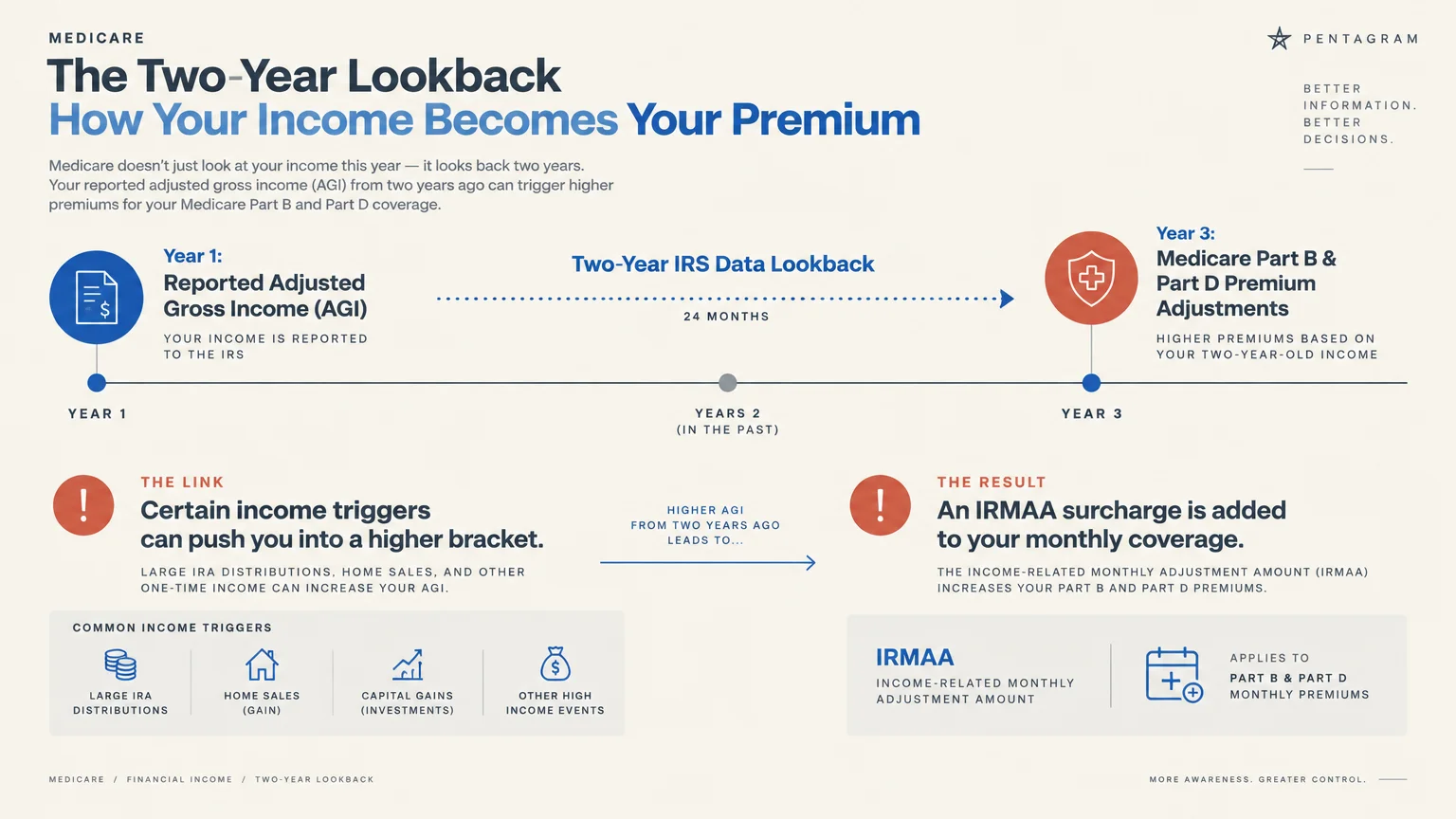
Your tax return does more than settle your annual tax bill; it also determines your healthcare expenses. The federal government uses your tax filing to set your Medicare Part B and Part D premiums.
This adjustment is called the Income-Related Monthly Adjustment Amount, commonly known as IRMAA. IRMAA acts as a monthly surcharge on high earners, utilizing a two-year lookback window.
For example, your 2024 tax return determines your 2026 Medicare premiums. For 2025 premiums, based on 2023 returns, standard Part B costs $185.00 monthly before surcharges trigger at $106,000 for singles.
For married couples filing jointly in 2025, surcharges begin at an adjusted gross income of $212,000. In 2026, the standard Part B premium rises to $202.90 per month.
The 2026 IRMAA surcharges begin when your 2024 modified adjusted gross income exceeds $109,000 for single filers or $218,000 for joint filers. Crossing an IRMAA threshold by a single dollar increases your premiums for the entire year.
You can track coverage rules and standard Part B costs directly through Medicare.gov. Monitoring your annual income keeps you safely beneath costly healthcare pricing cliffs.
5. You Receive an Extra Standard Deduction at Age 65
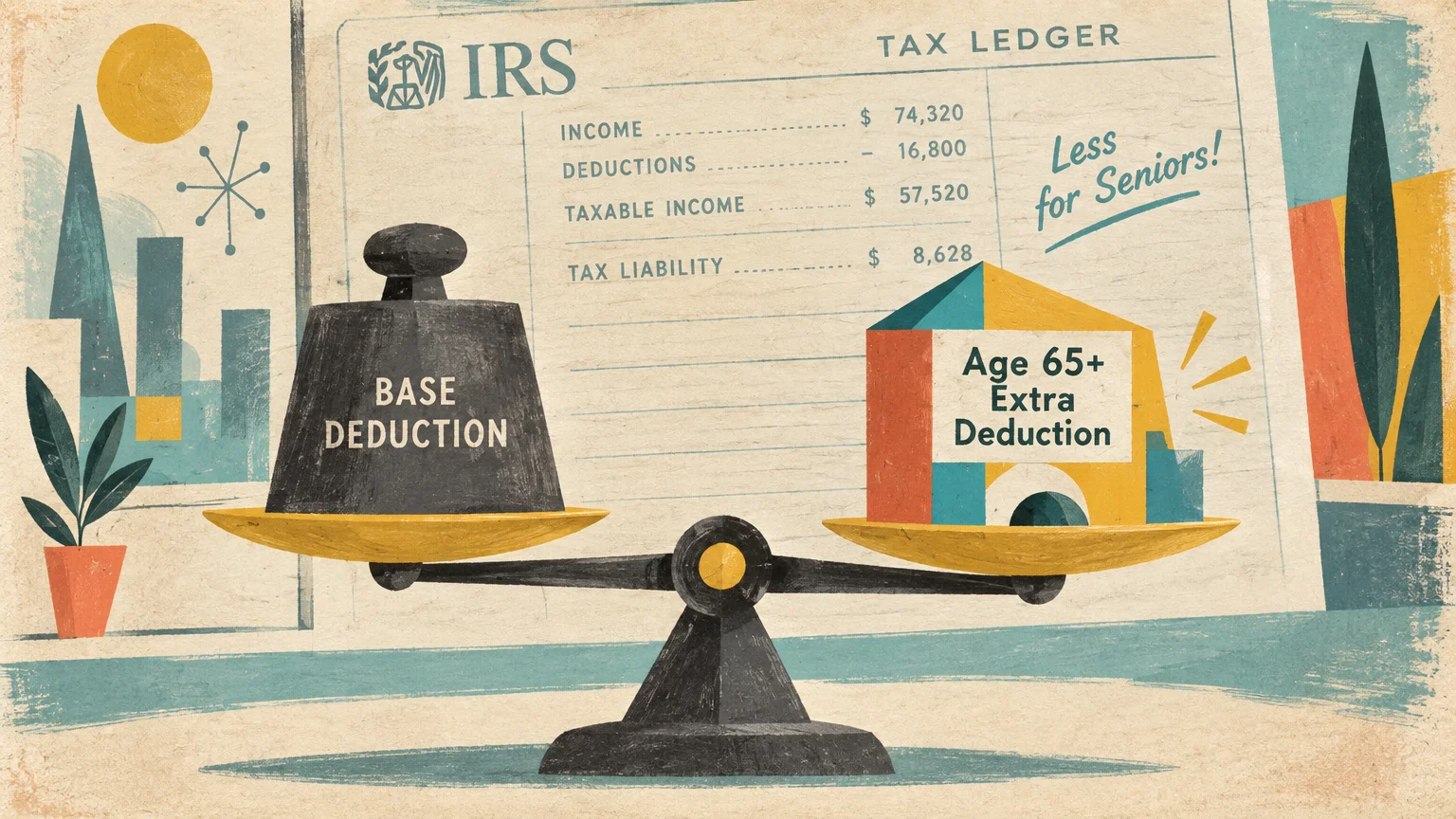
Your first tax return after turning 65 unlocks an important federal tax benefit. The tax code awards seniors an additional standard deduction beyond the base amount available to younger filers.
For the 2025 tax year, unmarried taxpayers age 65 or older receive an additional $2,000 deduction. Married couples receive an additional $1,600 per qualifying spouse who meets the age requirement.
For the 2026 tax year, the additional standard deduction increases to $2,050 for single filers. Married couples filing jointly receive an extra $1,650 for each spouse who has reached age 65.
If you and your spouse are both 65 or older in 2026, you gain an extra $3,300 in deductions. This additional deduction helps shield pension income and retirement distributions from higher taxable brackets.
Many new retirees miss this deduction when calculating estimated payments early in the year. Factoring this higher deduction into your tax calculations prevents you from overpaying the government throughout the season.

6. State Taxes on Retirement Income Vary Drastically
Federal rules represent only part of the equation when filing taxes after retiring. State revenue departments enforce widely divergent rules regarding pensions, investment gains, and Social Security income.
As of 2025 and 2026, only eight states continue to tax Social Security benefits under certain income thresholds. Those states are Colorado, Connecticut, Minnesota, Montana, New Mexico, Rhode Island, Utah, and Vermont.
Several states recently eliminated benefit taxes; Kansas, Missouri, and Nebraska ended theirs in 2024. West Virginia completed its full phaseout of Social Security benefit taxes beginning in 2026.
Furthermore, many states provide substantial exclusions for military pensions, government retirement plans, or private distributions. Other states tax every distributed dollar without providing any retirement income exemptions.
Understanding your state’s specific deductions ensures you do not overpay state authorities. If you plan to relocate during retirement, comparing state tax codes can protect thousands of dollars annually.
7. Delaying Withdrawals Can Trigger a Future Tax Trap
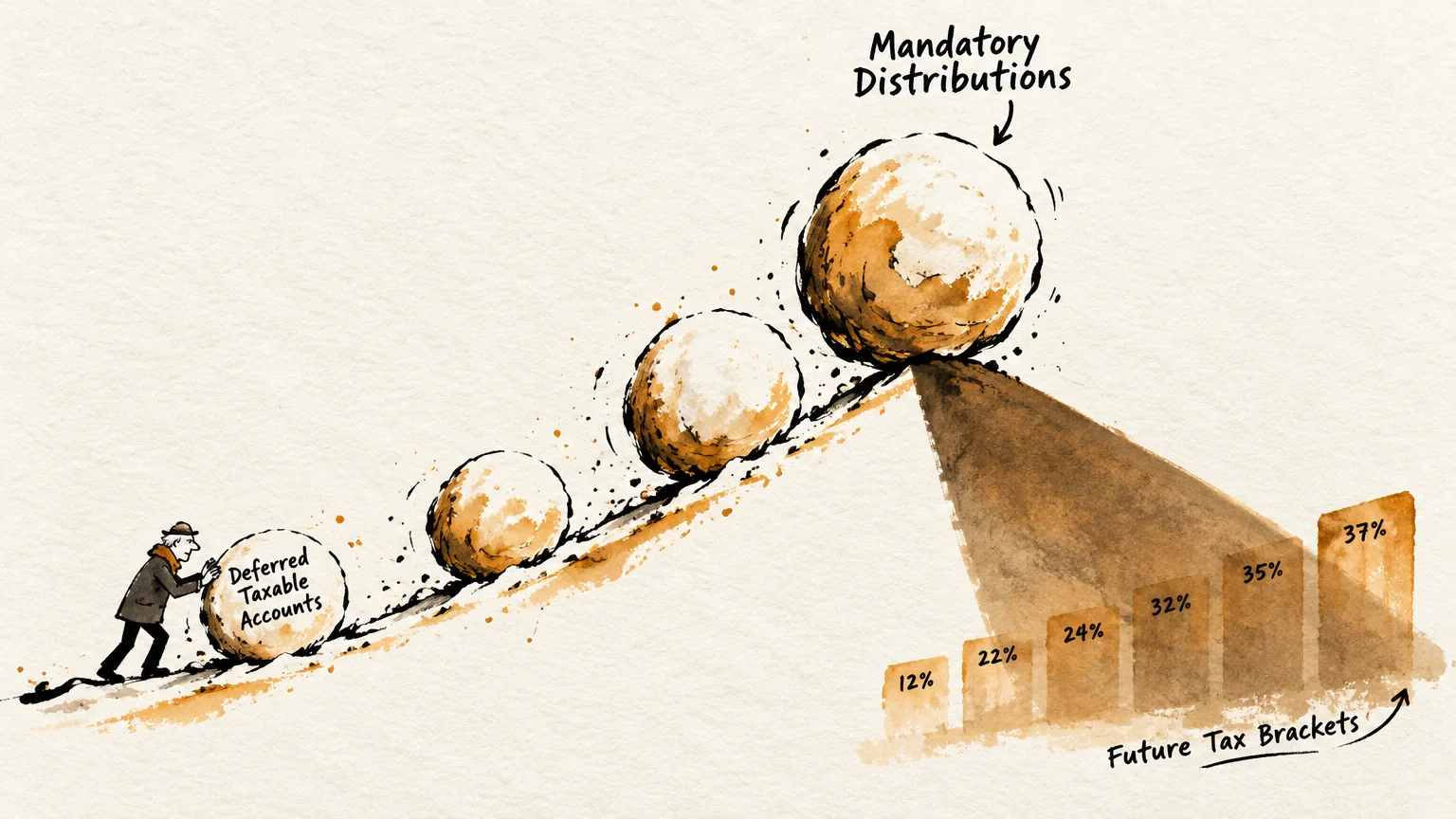
Many retirees spend non-retirement cash first while leaving traditional IRA and 401(k) accounts untouched. While deferring taxes feels intuitive, leaving pre-tax balances alone can trigger substantial tax liabilities down the road.
Under the SECURE 2.0 Act, Required Minimum Distributions (RMDs) begin at age 73 for those born between 1951 and 1959. For individuals born in 1960 or later, RMD requirements begin at age 75 starting in 2033.
Once RMDs start, the IRS forces you to withdraw escalating percentages of your portfolio annually. These mandatory withdrawals can push you into higher tax brackets and trigger higher Medicare premiums automatically.
Failing to take a required minimum distribution incurs a severe 25% excise tax penalty under federal rules. If you correct the missed distribution within two years, the IRS reduces the penalty to 10%.
Savvy retirees use the early retirement years—between their final paycheck and age 73—to execute deliberate Roth conversions. Converting modest amounts in lower tax brackets flattens lifetime tax liability significantly.
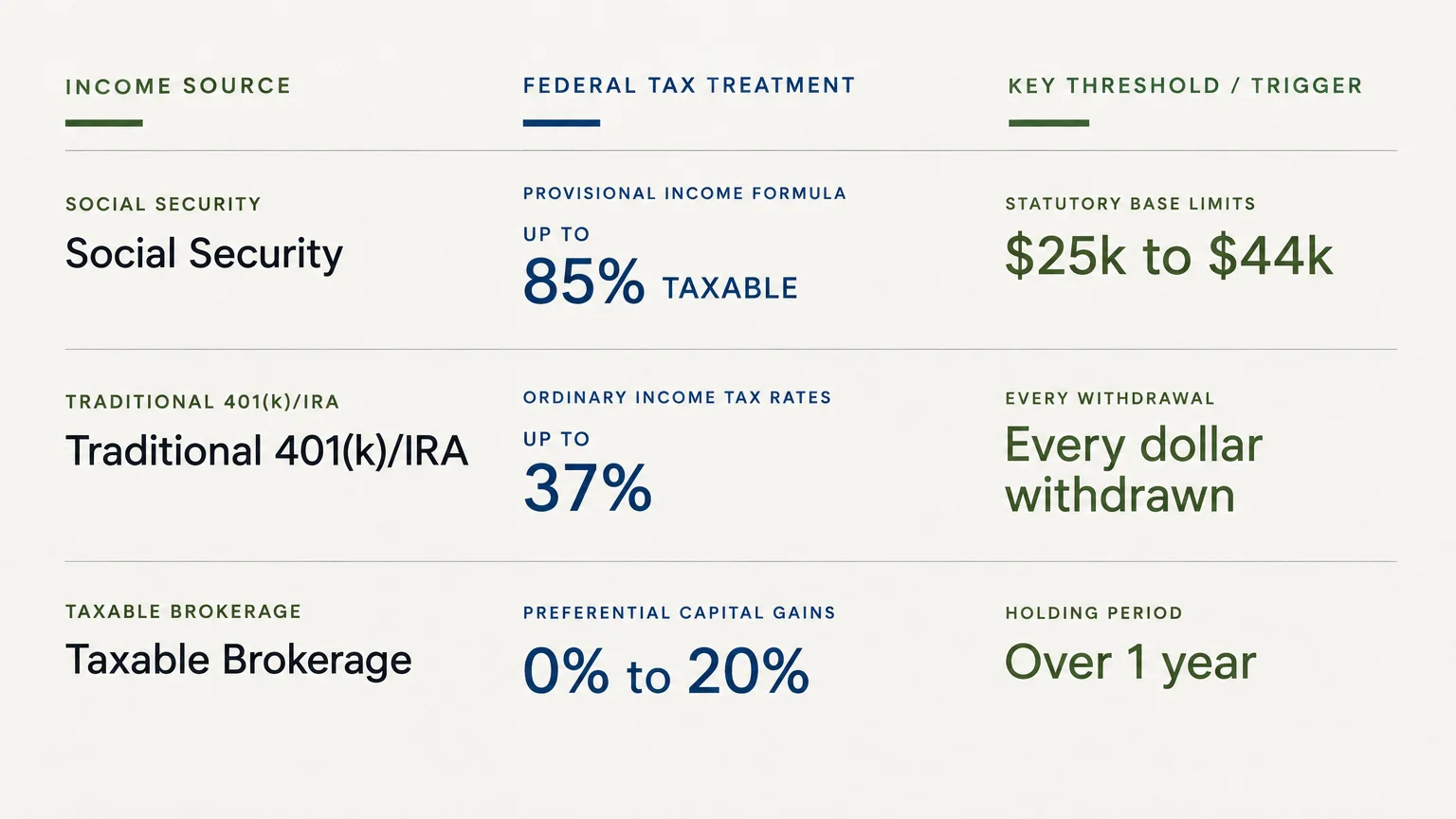
Retirement Income Federal Tax Comparison
Different retirement income streams receive distinct tax treatments from the IRS. The table below outlines how common post-retirement cash flows are taxed at the federal level.
| Income Source | Federal Tax Classification | Withholding Options | Key Planning Factor |
|---|---|---|---|
| Social Security | Provisional income (0% to 85% taxable) | Form W-4V (7%, 10%, 12%, or 22%) | Thresholds are never adjusted for inflation. |
| Traditional 401(k) / IRA | Ordinary income (up to 37%) | Mandatory 20% on 401(k); optional on IRA | Subject to RMD rules starting at age 73 or 75. |
| Roth IRA Distributions | Tax-free (if qualified) | None required | Does not increase provisional income or Medicare MAGI. |
| Brokerage Capital Gains | Preferential capital gains (0%, 15%, or 20%) | None; quarterly estimates usually required | Holding assets over one year secures lower tax rates. |
| Pension Payments | Ordinary income (up to 37%) | Form W-4P | State tax exemptions vary widely across state lines. |

Common Money Traps for New Retirees
Navigating your first tax return in retirement often reveals operational blind spots. Avoiding these recurring traps keeps your retirement plan secure and reduces unnecessary IRS penalties.
- Liquidating lump sums for major lifestyle upgrades: Withdrawing large amounts from traditional accounts spikes your ordinary income tax bracket and Medicare surcharges simultaneously.
- Assuming low tax rates continue forever: Leaving pre-tax retirement accounts completely untouched guarantees massive required minimum distributions later in life.
- Ignoring quarterly estimated deadlines: Waiting until April to pay taxes generates Form 2210 underpayment penalties that deplete your liquid reserves.
- Missing the IRMAA two-year lookback: Selling property or realizing capital gains during your final working years can double Medicare premiums during early retirement.

When to Consult a Professional
Managing taxes during your working years often required nothing more than commercial tax software. Retirement tax planning involves coordinated withdrawals across diverse accounts, making professional guidance far more valuable.
You should consult a Certified Public Accountant (CPA) or Enrolled Agent (EA) if you manage multiple distribution streams. They can structure quarterly estimated payments accurately and prevent costly underpayment penalties.
Consider hiring a fee-only Certified Financial Planner (CFP) to design a comprehensive multi-year distribution strategy. A fee-only planner analyzes Roth conversions, Social Security timing, and capital gains harvesting without pushing proprietary investment products.
Professional advice proves especially critical when facing major life transitions, such as selling real estate or relocating out of state. Professional planning fees frequently pay for themselves in long-term tax savings.
Frequently Asked Questions
Do all retirees pay taxes on their Social Security benefits?
No, benefit taxation depends entirely on your total provisional income across the tax year. Single filers earning under $25,000 and joint filers earning under $32,000 pay zero federal tax on benefits.
How do I stop owing large balances every April in retirement?
You can establish voluntary federal tax withholding on your distributions using Form W-4P for pensions or Form W-4V for Social Security. Alternatively, make quarterly estimated tax payments via Form 1040-ES.
Why did my Medicare Part B premium increase after I retired?
Medicare uses a two-year lookback window on your reported modified adjusted gross income. High earnings or asset sales from your final working years can trigger temporary IRMAA surcharges two years later.
Can traditional IRA distributions qualify for lower capital gains rates?
No, distributions from traditional retirement accounts are always taxed as ordinary income. The IRS taxes these withdrawals at your standard federal income tax bracket rather than preferential capital gains rates.
Protecting Your Wealth in Retirement
Your first post-retirement tax return provides the baseline for your long-term financial decumulation strategy. Take time this month to evaluate your current income streams, review your withholdings, and schedule estimated payments.
Financial outcomes vary based on individual income, credit history, and circumstances. This article provides general guidance only. Consult a qualified financial planner, CPA, or consumer attorney for advice specific to your situation.
Last updated: February 2026. Rates, benefit amounts, and tax rules change—always verify current details at official sources.