
A simple misunderstanding of Medicare terms can quietly drain thousands of dollars from your retirement nest egg. Confusing deductibles, enrollment periods, or plan structures exposes you to surprise medical bills and lifetime premium surcharges.
Federal healthcare regulations change each year, creating genuine confusion for anyone navigating Medicare Part A, Part B, or private plans. Mastering this specialized terminology protects your household finances and guarantees seamless access to medical care.
Here are seven essential Medicare terms retirees routinely mix up, along with the precise financial numbers you need to plan ahead.
1. Medicare Part A vs. Part B
Original Medicare consists of two distinct foundations that address completely different healthcare settings. Understanding Medicare Part A vs. B is the first step toward building a predictable retirement budget.
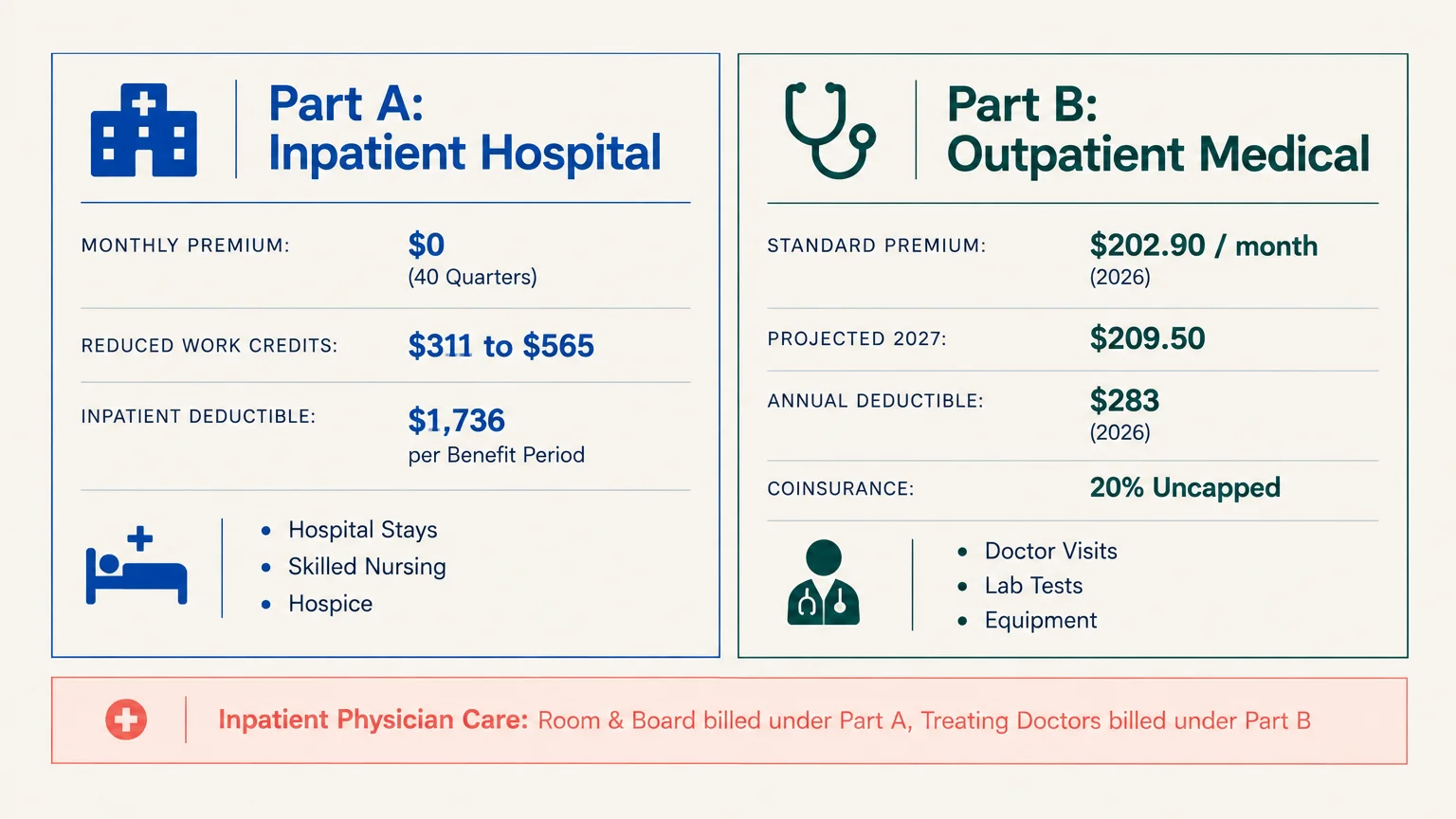
Medicare Part A provides inpatient hospital insurance. It covers inpatient hospital stays, skilled nursing facility care, hospice, and certain home health services.
Most Americans pay a $0 monthly premium for Part A if they worked and paid Medicare payroll taxes for at least 40 calendar quarters. That equals roughly ten years of covered employment.
If you have between 30 and 39 work quarters, you must buy Part A for $311 each month in 2026. Beneficiaries with fewer than 30 quarters pay the full Part A premium of $565 per month.
Medicare Part B covers outpatient medical insurance. This includes routine doctor visits, diagnostic tests, lab work, mental healthcare, and durable medical equipment.
Unlike Part A, Part B always requires an ongoing monthly premium from every enrollee. In 2026, the standard Medicare Part B monthly premium is $202.90.
The Medicare Trustees project that the standard Part B premium will rise to $209.50 in 2027. You also face an annual outpatient deductible of $283 in 2026, projected to reach $292 in 2027.
After meeting your annual deductible, Part B generally requires you to pay 20% coinsurance for covered outpatient services. Original Medicare has no annual cap on that 20% coinsurance obligation.
A frequent point of Medicare confusion occurs when you receive care from doctors while admitted inside a hospital. While room and board fall under Part A, the physicians who treat you bill their services under Part B.
You can review detailed service categories directly at Medicare.gov. Keeping these distinct billing categories straight prevents unexpected out-of-pocket costs on your doctor bills.
2. Benefit Period vs. Calendar Year Deductibles
Most private employer health insurance plans reset their deductible once each calendar year on January 1. Medicare Part A operates on a completely different system known as a benefit period.
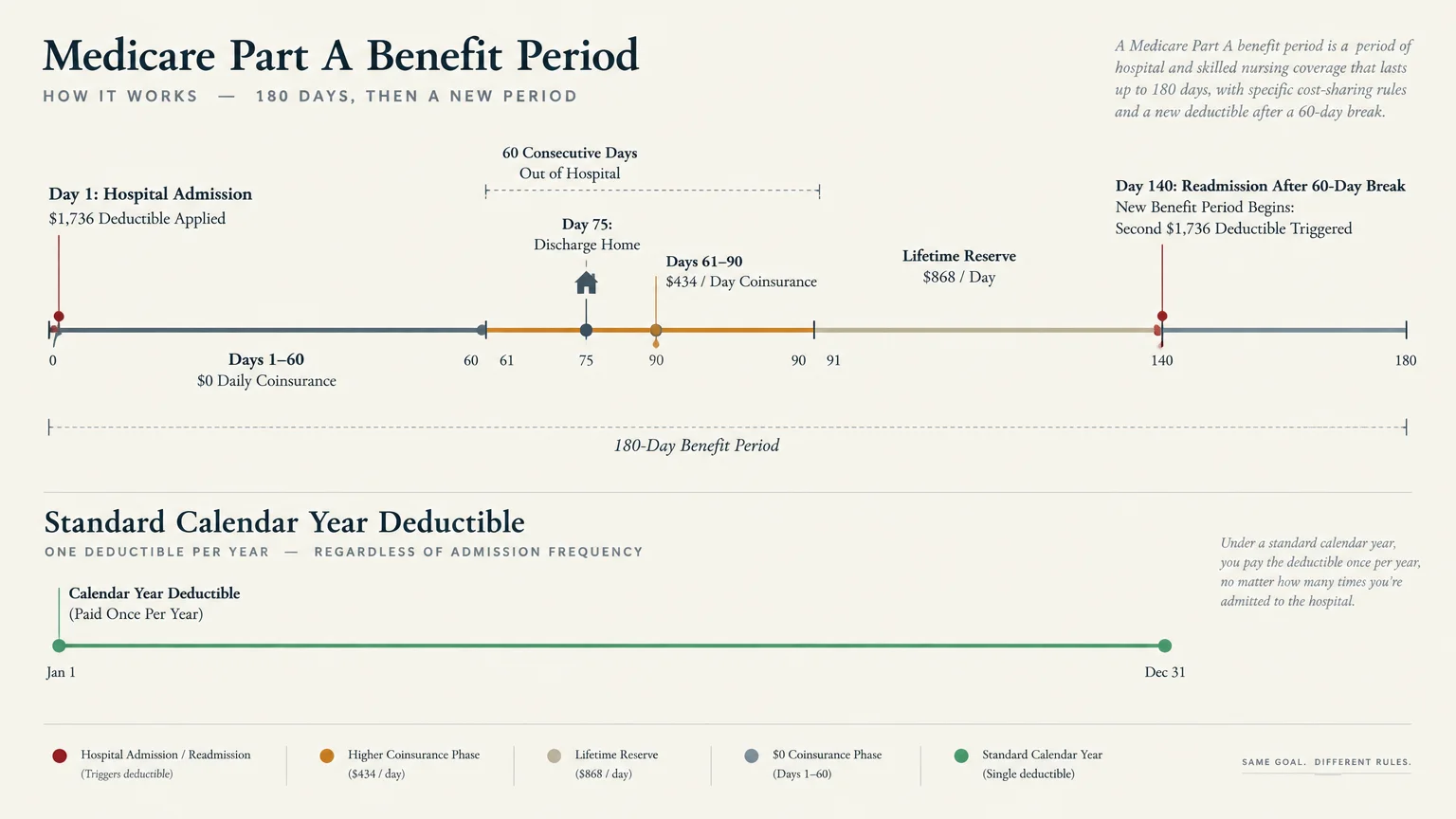
A Part A benefit period starts the day you are admitted as an inpatient to a hospital or skilled nursing facility. It ends only after you have been out of inpatient care for 60 consecutive days.
For every new benefit period in 2026, you must pay an inpatient hospital deductible of $1,736. There is no limit to the number of benefit periods you can experience in a single year.
Suppose you enter the hospital in January, discharge home, and suffer a medical relapse 65 days later. You must pay the full $1,736 deductible a second time because a new benefit period began.
Your daily hospital costs also escalate as your stay within a single benefit period lengthens. For days 1 through 60, you pay $0 in daily coinsurance after satisfying the deductible.
For days 61 through 90 in 2026, you pay $434 per day in coinsurance. Stays extending into your 60 lifetime reserve days require a daily payment of $868.
Skilled nursing facility stays follow this same benefit period framework. In 2026, you pay $0 for days 1 through 20 and $217 per day for days 21 through 100.
Retirees also confuse inpatient hospital admission with outpatient observation status. If a hospital places you under observation, Medicare classifies you as an outpatient under Part B rather than an inpatient under Part A.
Observation stays do not trigger Part A hospital coverage or qualify you for skilled nursing benefits. Clarifying your admission status with hospital staff protects your wallet from expensive billing surprises.

3. Medicare Advantage (Part C) vs. Medigap (Medicare Supplement)
Retirees frequently confuse Medicare Advantage with Medigap, assuming they are interchangeable supplemental policies. In reality, they represent two mutually exclusive paths for receiving your healthcare.
Medigap policies work alongside Original Medicare Parts A and B. Private insurers sell standardized Medigap plans to cover your remaining out-of-pocket gaps, including hospital deductibles and 20% Part B coinsurance.
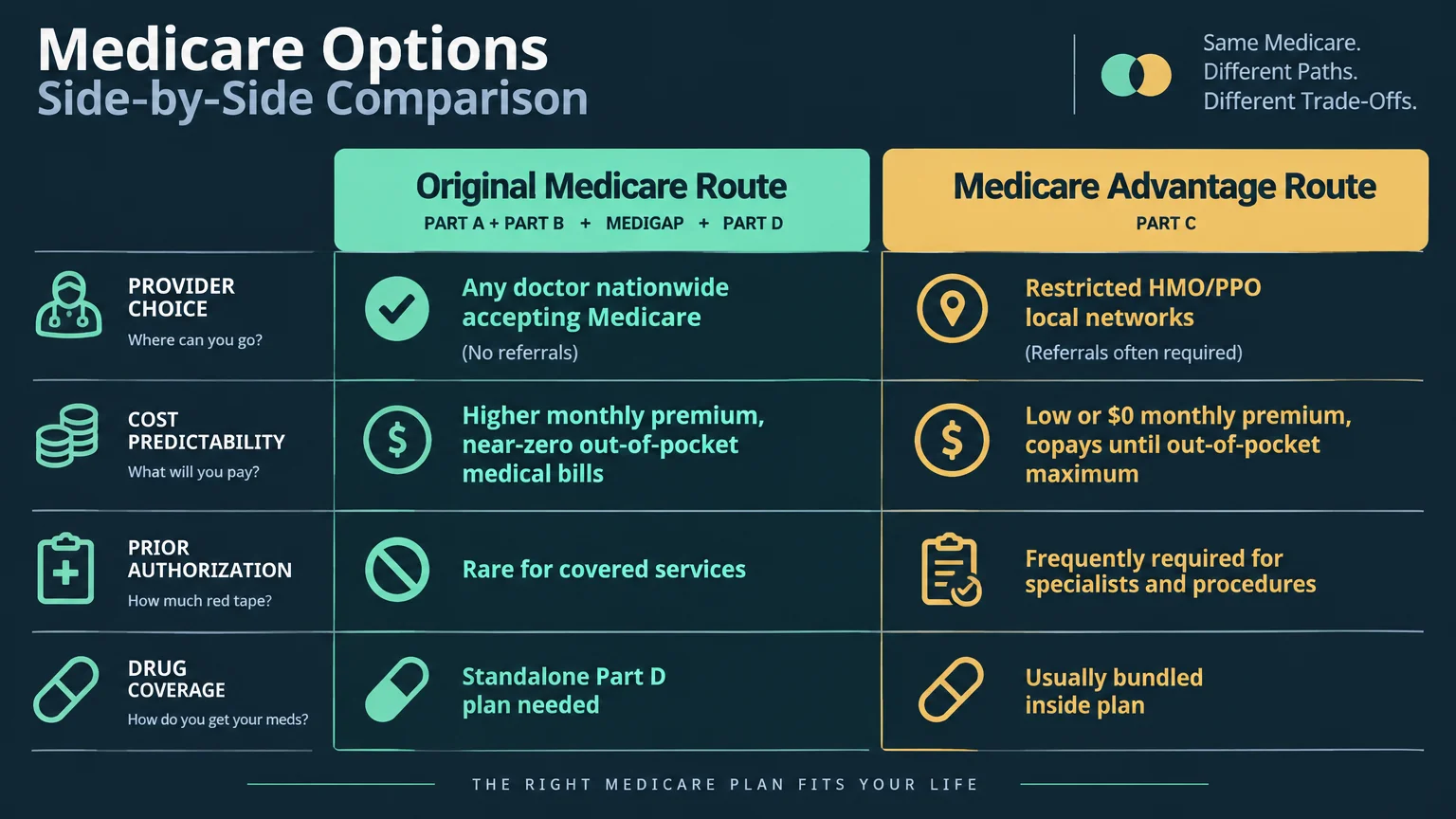
With Medigap, you can visit any doctor, specialist, or hospital across the country that accepts Original Medicare. You do not need network approvals, and you rarely face prior authorization delays.
Some budget-conscious retirees choose high-deductible Medigap Plan G. For 2026, this option requires you to pay out of pocket up to a $2,950 deductible before the policy begins paying.
Medicare Advantage, or Part C, replaces the administration of Original Medicare with a private health insurance company. When you enroll in Part C, you leave the traditional fee-for-service system.
Private Advantage plans typically require you to seek treatment within defined HMO or PPO provider networks. They also routinely require primary care referrals and prior authorization before covering expensive procedures.
The Centers for Medicare & Medicaid Services projects the average Part C monthly premium will drop from $14.37 in 2026 to $12.00 in 2027. However, you must continue paying your standard Part B monthly premium.
Unlike Original Medicare, which has no financial safety net, Medicare Advantage plans must establish an annual out-of-pocket maximum. In 2026, CMS caps in-network out-of-pocket spending at $9,250, rising to $9,850 in 2027.
For Advantage PPO plans, the combined in- and out-of-network limit is $13,900 in 2026, increasing to $14,800 in 2027. Medigap plans do not use out-of-pocket maximums because they pay covered costs upfront.
Federal regulations strictly prohibit anyone from holding both a Medigap policy and a Medicare Advantage plan simultaneously. You must deliberately choose between nationwide provider flexibility and managed private plan perks.
Comparing Original Medicare and Medicare Advantage
Choosing between traditional coverage and private managed care requires balancing your financial resources against provider flexibility. Use this side-by-side comparison to clarify the core differences.
| Feature | Original Medicare + Medigap | Medicare Advantage (Part C) |
|---|---|---|
| Provider Network | Any U.S. provider accepting Medicare | Restricted local HMO or PPO network |
| Referrals for Specialists | Never required | Often required in HMO plans |
| Annual Out-of-Pocket Cap | Original Medicare has none; Medigap covers gaps | Capped at $9,250 in 2026 ($9,850 in 2027) |
| Prior Authorization Rules | Rarely required | Frequently required for tests and procedures |
| Average Monthly Plan Premium | Varies by age, gender, and zip code | $14.37 in 2026; projected $12.00 in 2027 |
| Part B Premium Payment | Required ($202.90 in 2026) | Required ($202.90 in 2026) |
| Prescription Drug Coverage | Requires a standalone Part D plan | Usually bundled into the plan |
| High-Deductible Option | $2,950 deductible in 2026 (Plan G/F) | Not applicable |
Neither coverage model is inherently superior for every retiree. Your personal health profile, travel frequency, and budget will dictate which path offers the best long-term security.
4. Initial Enrollment Period (IEP) vs. Annual Election Period (AEP)
Medicare enrollment timelines follow rigid federal calendars. Mixing up your one-time entry window with the recurring fall enrollment period can leave you uninsured or facing steep lifetime penalties.
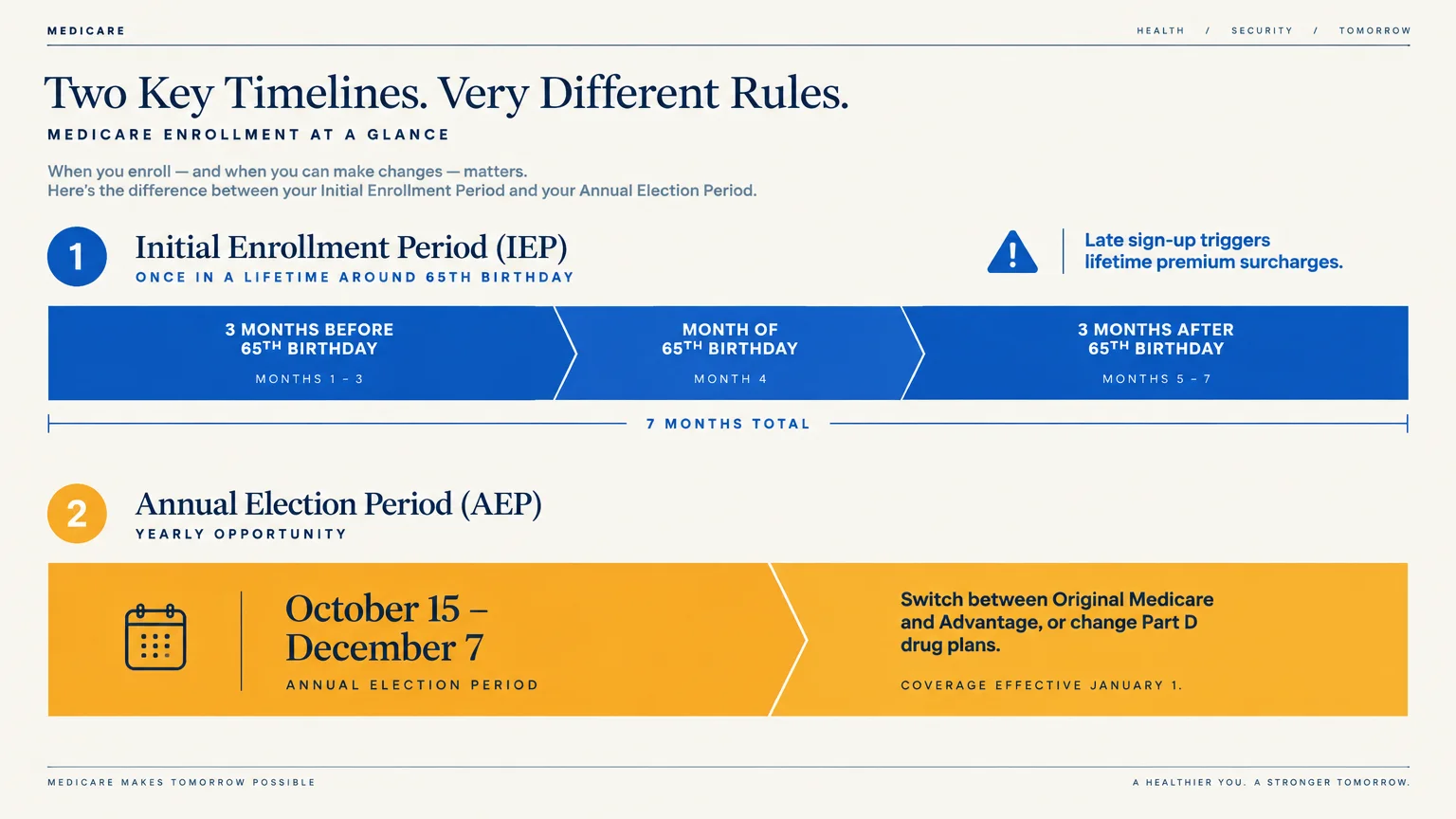
Your Initial Enrollment Period is a 7-month window tied directly to your 65th birthday. It spans the three months before your birth month, your birth month, and the three months after.
During your IEP, you can sign up for Part A, Part B, and Part D with complete legal protection. You do not need evidence of current employer group coverage to avoid late penalties during this window.
By contrast, the Annual Election Period runs every year from October 15 through December 7. Any plan selections or coverage switches made during AEP take effect on January 1 of the following year.
Many retirees incorrectly assume they can skip their initial age-65 enrollment and simply enroll in Part B during AEP. That is a dangerous mistake that triggers significant delays and financial penalties.
AEP is designed for current beneficiaries who wish to switch between Medicare Advantage plans or adjust their standalone Part D coverage. It is not an open window for first-time Part B enrollment.
If you miss your IEP without qualifying employer coverage, you must wait for the General Enrollment Period. The GEP runs from January 1 to March 31, with coverage starting the month after you sign up.
Retirees leaving active employment past age 65 receive a distinct 8-month Special Enrollment Period. Confusing that 8-month job-loss window with the fall AEP often results in missed deadlines and lifetime premium surcharges.

5. Medigap Open Enrollment vs. Fall Open Enrollment
The similarity in terminology between Medigap Open Enrollment and fall Open Enrollment causes severe financial harm to retirees each year. These two enrollment windows operate under completely different legal rules.
Fall Open Enrollment, running October 15 through December 7, lets you change Advantage and Part D plans. It grants zero rights or guarantees if you want to buy a Medigap supplemental policy.
Your true Medigap Open Enrollment Period is a strict, one-time 6-month window. It begins the very first month you are both age 65 or older and enrolled in Medicare Part B.
During this six-month window, private insurance carriers must sell you any Medigap plan they offer at standard rates. They cannot reject your application or charge higher premiums due to pre-existing health conditions.
Once this single six-month window closes, you permanently lose federal guaranteed issue protections in most states. Insurance companies can then review your complete medical records through a process called medical underwriting.
If you have diabetes, heart disease, or past cancer diagnoses, underwriters can deny your Medigap application entirely. Alternatively, they can charge exorbitant monthly premiums that make the policy unaffordable.
A few states enforce annual birthday rules allowing limited Medigap changes, but federal law provides no such right. Assuming you can always switch to Medigap during fall open enrollment is a devastating misconception.
“The best time to plan for a financial goal was 20 years ago. The second best time is today.”
Securing comprehensive supplemental coverage during your guaranteed enrollment window ensures your future healthcare access remains protected regardless of unexpected health changes.
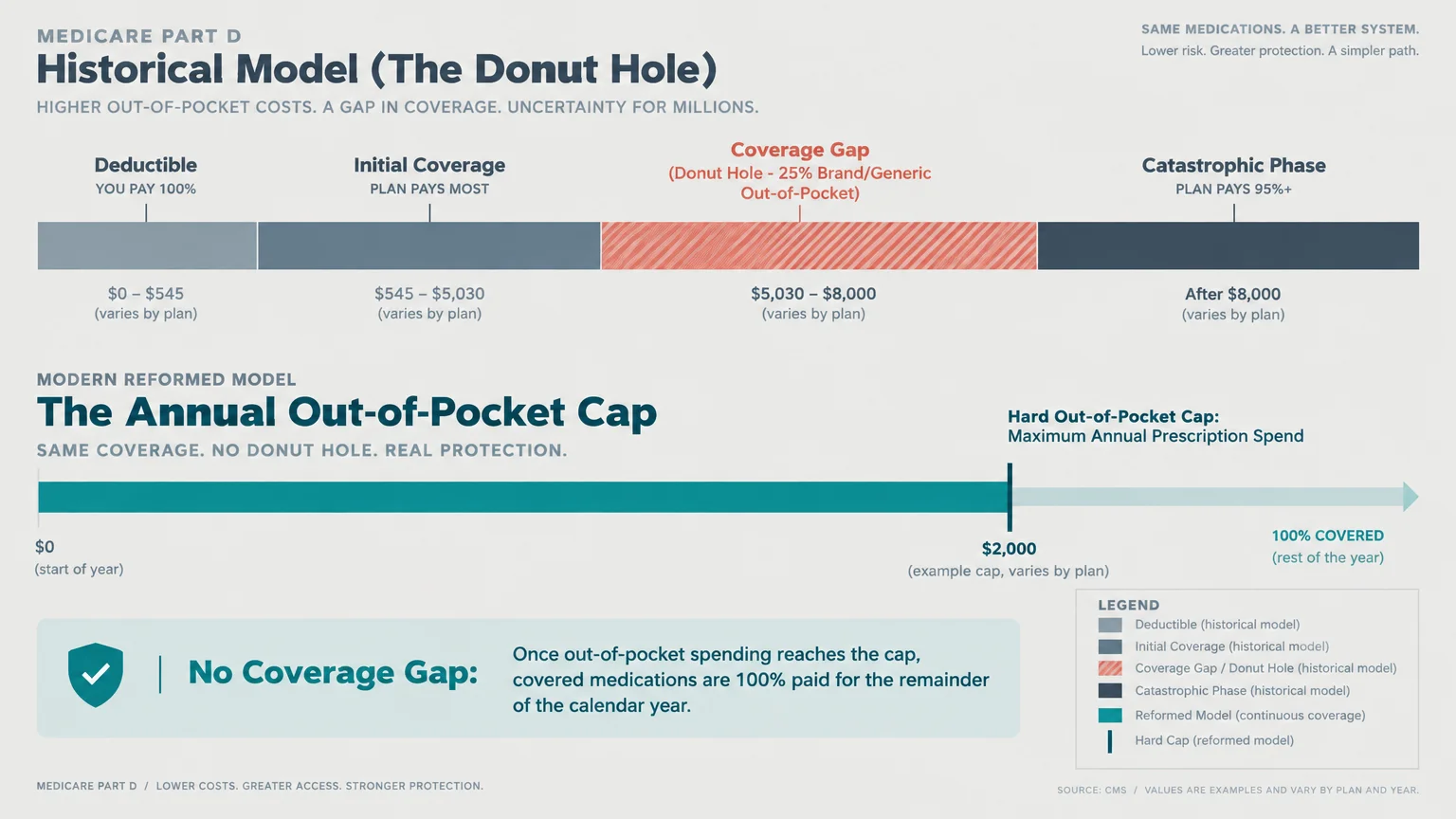
6. The Part D Coverage Gap (“Donut Hole”) vs. The Modern Out-of-Pocket Cap
For nearly twenty years, the Part D coverage gap—popularly called the donut hole—plagued American retirees. Beneficiaries who needed expensive brand-name medications faced temporary spikes in out-of-pocket costs.
Federal legislation permanently eliminated the Part D donut hole beginning in 2025. Medicare prescription drug coverage now features three simple phases: the Deductible Phase, Initial Coverage, and Catastrophic Coverage.
In 2026, no Part D drug plan can charge an annual deductible higher than $615. CMS confirmed this maximum statutory deductible will rise to $700 in 2027.
The average monthly premium for a standalone Part D drug plan is $35.09 in 2026, projected to reach $36.00 in 2027. These predictable premiums help retirees plan their monthly pharmacy budgets with greater precision.
The most important reform is the annual out-of-pocket cap on covered prescription drugs. In 2026, your total out-of-pocket prescription drug spending is capped at $2,100 per calendar year.
CMS has confirmed this out-of-pocket spending limit will increase to $2,400 for 2027. Once you pay that amount for covered medications, you enter Catastrophic Coverage and pay $0 for the rest of the year.
Retirees can also opt into the Medicare Prescription Payment Plan. This program allows you to spread your out-of-pocket medication costs across monthly installments rather than paying massive sums at the pharmacy counter.
Fearing a nonexistent donut hole leads some retirees to ration life-saving prescriptions. Recognizing that the modern out-of-pocket cap shields you from catastrophic drug bills provides immense financial and clinical peace of mind.

7. Standard Premium vs. IRMAA vs. Late Enrollment Penalties
Many retirees assume every American pays the exact same monthly premium for Medicare Part B and Part D. In reality, two separate mechanisms—IRMAA and late penalties—frequently adjust those numbers upward.
The standard Part B premium is $202.90 per month in 2026, paid by the majority of beneficiaries. However, higher-income households must pay the Income-Related Monthly Adjustment Amount, commonly known as IRMAA.
The Social Security Administration calculates IRMAA surcharges based on your tax return from two years prior. Your 2024 Modified Adjusted Gross Income determines your Medicare premiums for the 2026 calendar year.
For 2026, IRMAA surcharges begin if your 2024 MAGI exceeded $109,000 for single tax filers or $218,000 for married couples filing jointly. Higher earners pay tiered surcharges on both Part B and Part D.
Total Part B monthly payments for high earners range from $284.10 up to $689.90 in 2026. You can review appeals processes with the Social Security Administration if your income dropped due to retirement.
Filing Form SSA-44 allows you to appeal an IRMAA surcharge if you experienced a qualifying life-changing event. Common qualifying events include work reduction, retirement, divorce, or the death of a spouse.
Late enrollment penalties represent a completely separate cost adjustment based on missed deadlines rather than income. If you delay Part B without creditable coverage, you pay an extra 10% for every full 12-month period you missed.
For Part D, the late penalty equals 1% of the national base beneficiary premium ($41.33 in 2027) per uncovered month. Unlike IRMAA surcharges, which recalculate annually as income fluctuates, late penalties remain in place for life.

Errors That Cost Families Thousands
Navigating Medicare terminology is not merely an academic exercise. Misinterpreting these core concepts can cause substantial, lasting damage to your retirement savings.
- Dropping employer coverage without verification: Leaving a job without confirming whether your coverage counts as creditable under Part B rules triggers lifetime 10% premium penalties.
- Assuming Original Medicare limits total spending: Original Medicare charges 20% coinsurance indefinitely without an annual out-of-pocket maximum unless you add private supplemental insurance.
- Missing the 6-month Medigap window: Delaying Medigap enrollment subjects your application to medical underwriting, potentially resulting in unaffordable premiums or total coverage denial.
- Ignoring Part A benefit period resets: Treating the Part A hospital deductible as an annual cost leaves you vulnerable to multiple $1,736 deductibles in a single year.
- Overlooking the IRMAA appeal process: Failing to submit Form SSA-44 after retiring causes you to pay high-earner surcharges based on past income you no longer earn.
- Contributing to an HSA after enrolling in Part A: Making Health Savings Account contributions while enrolled in Medicare triggers tax penalties from the Internal Revenue Service.
Financial consumer protection advocates at the Consumer Financial Protection Bureau urge older Americans to verify all benefit paperwork before signing. Checking these details early prevents irreversible administrative errors.
“A budget is telling your money where to go instead of wondering where it went.” — John C. Maxwell
Taking proactive command of your healthcare choices preserves your hard-earned retirement assets for the goals that matter most to your family.

When to Get Expert Help
Medicare rules feature intricate legal nuances that can challenge even the most diligent retirees. Seeking professional assistance ensures you make informed choices tailored to your household budget.
Consult your local State Health Insurance Assistance Program (SHIP) for objective, free benefits counseling. SHIP counselors do not sell insurance or earn commissions, making them an outstanding resource for unbiased guidance.
Engage a fee-only financial planner or certified public accountant if your income hovers near IRMAA thresholds. They can design Roth conversion and asset distribution strategies that keep you below costly surcharge brackets.
Work with an independent health insurance broker when comparing Medicare Advantage and Medigap options in your specific county. Independent brokers represent multiple insurance carriers and can verify whether your doctors and drugs remain covered.
Reach out to an elder law attorney if you anticipate needing long-term nursing home care. They can help navigate Medicaid eligibility spend-down rules without jeopardizing your surviving spouse’s financial security.
Frequently Asked Questions About Medicare Terminology
What is the core difference between Medicare Part A and Part B?
Medicare Part A covers inpatient hospital stays, hospice, and skilled nursing care, carrying a $0 premium for most workers. Part B covers outpatient care, doctor visits, and medical equipment, requiring a monthly premium of $202.90 in 2026.
Part A uses benefit periods with a $1,736 deductible in 2026, while Part B uses an annual deductible of $283 followed by 20% coinsurance. Both parts combine to form traditional Original Medicare.
Can I switch from Medicare Advantage back to Medigap during fall Open Enrollment?
You can drop your Medicare Advantage plan and return to Original Medicare during fall Open Enrollment. However, you generally do not have a guaranteed right to purchase a Medigap policy at that time.
In most states, private insurers will review your medical history and can reject your application or charge higher rates. Only your initial 6-month Medigap window guarantees coverage without underwriting.
How does a benefit period differ from a standard annual deductible?
A standard annual deductible resets on January 1, requiring you to pay it once per calendar year. A Part A benefit period resets only after you have been out of inpatient care for 60 consecutive days.
If you experience multiple hospital admissions separated by more than 60 days, you must pay the $1,736 deductible for each separate benefit period. There is no annual cap on benefit periods.
What is the difference between IRMAA and a Medicare late penalty?
IRMAA is a temporary surcharge added to Part B and Part D premiums for individuals with higher taxable incomes. It is recalculated every year based on tax returns from two years prior.
A late enrollment penalty is a permanent fee added for missing enrollment deadlines without creditable employer coverage. Unlike IRMAA, late penalties generally never go away.
What counts as creditable coverage for Medicare Part B and Part D?
Creditable coverage is health insurance through active employment with a company that employs 20 or more workers. The coverage must pay at least as much as standard Medicare benefits.
COBRA coverage, retiree health plans, and individual marketplace policies do not count as creditable coverage for delaying Part B. Relying on them will result in late enrollment penalties.
Take Control of Your Healthcare Budget
Review your annual coverage notices and health plan documents carefully as open enrollment approaches each year. Understanding these seven critical Medicare terms keeps you in complete control of your medical care and retirement budget.
This article is for informational purposes only and does not constitute financial, legal, or tax advice. Rates, benefit amounts, and tax rules change regularly—verify current details with the relevant agency or a licensed professional.
Last updated: October 2026. Rates, benefit amounts, and tax rules change—always verify current details at official sources.