Free food delivery services for seniors can eliminate grocery expenses and bring hot, nutritious meals straight to your door. Federal programs and community non-profits provide these meal options to help older adults maintain independence at home.
Rising grocery bills put intense pressure on fixed household budgets across the country. Securing free meal delivery protects your retirement savings while ensuring consistent, daily nutrition.
You can tap into federal meal networks, local food bank delivery routes, and specialized grocery subsidies right now. Here is how each program operates and what you must do to qualify.
Meals on Wheels and the Older Americans Act
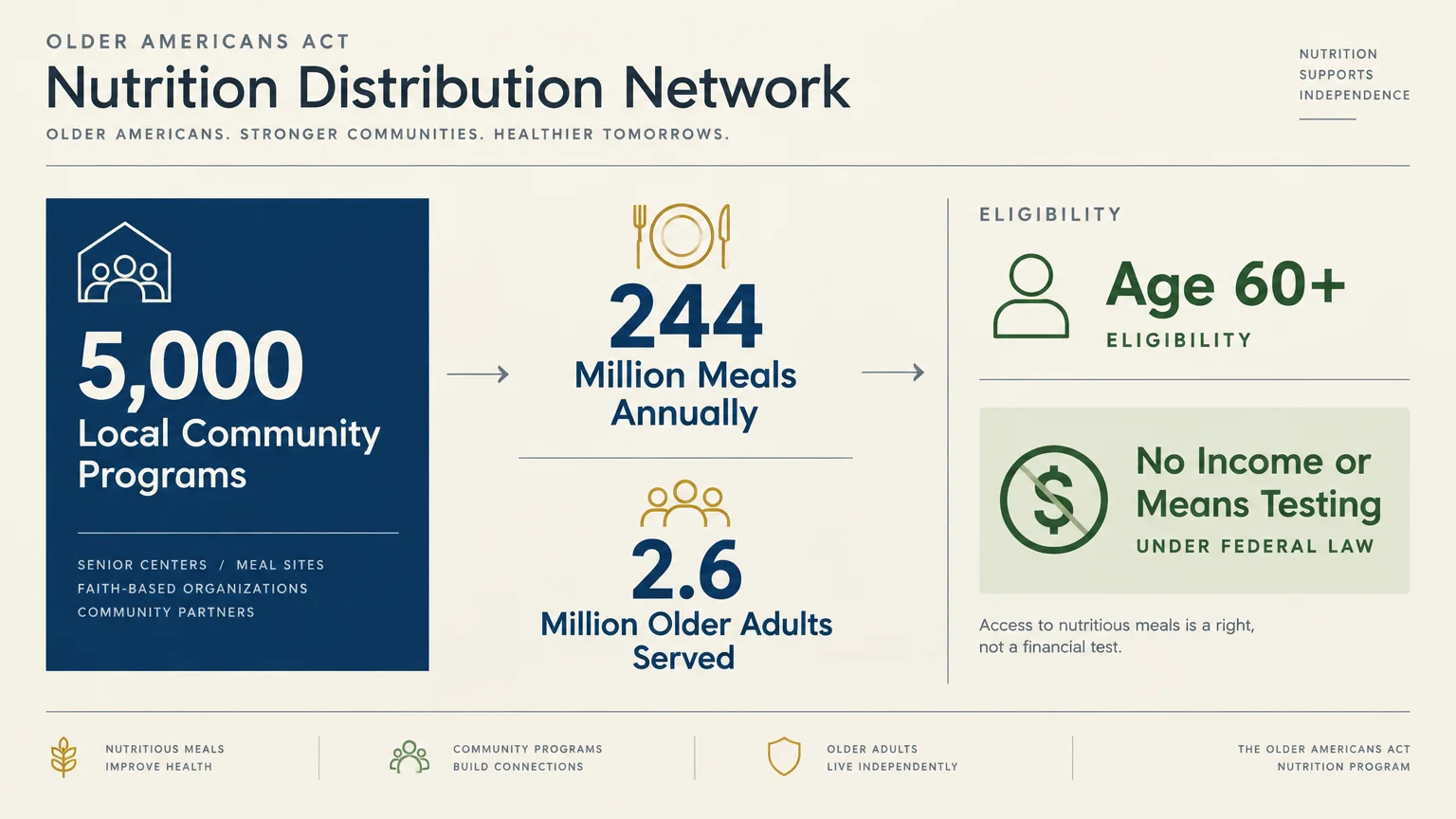
The Older Americans Act funds community nutritional networks nationwide to keep older adults living safely at home. This legislation powers approximately 5,000 local community programs across every state.
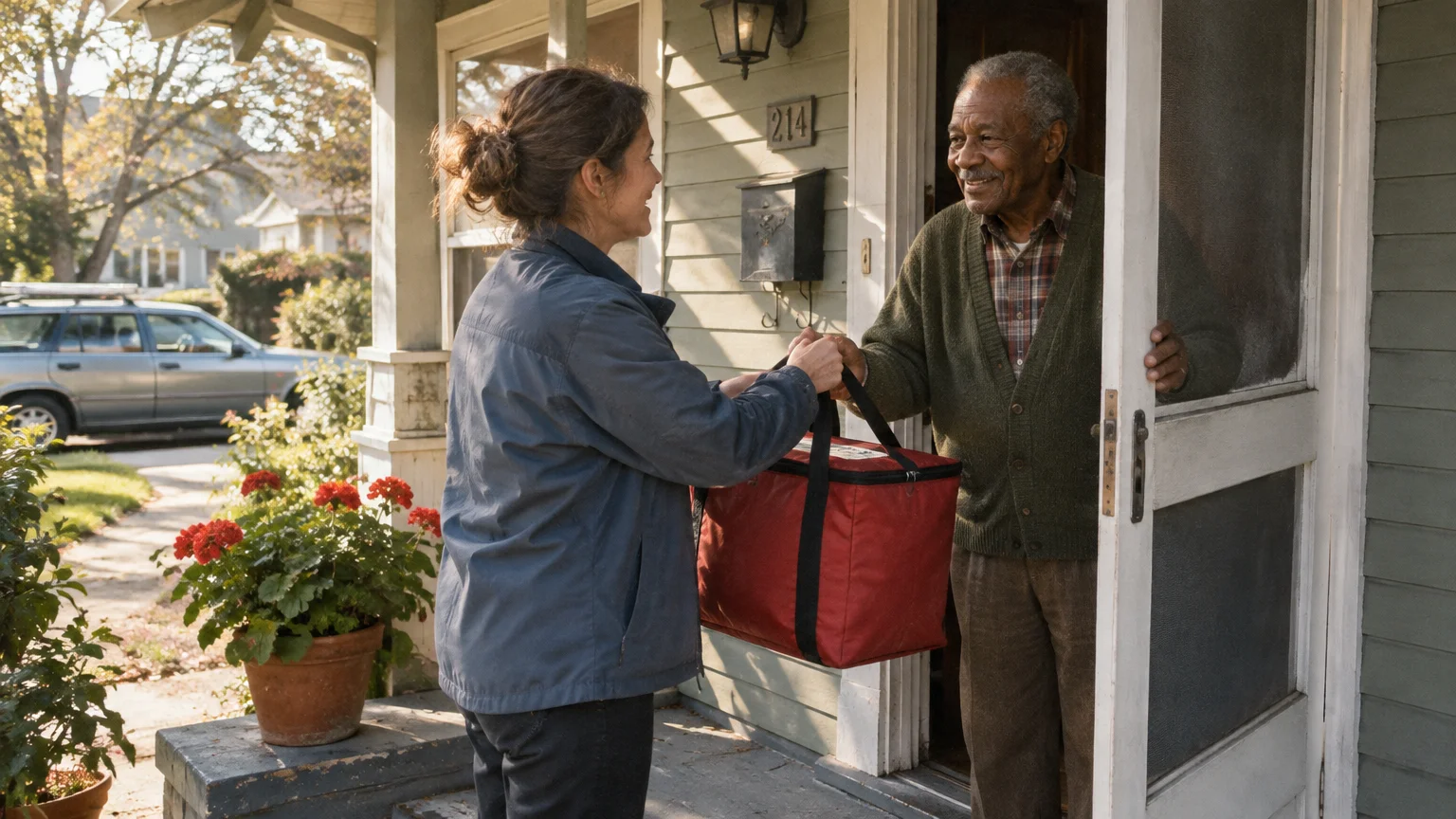
Together, these dedicated local agencies distribute 244 million meals each year to 2.6 million older adults. Volunteer drivers deliver these meals directly to the senior’s front door.
Food insecurity creates severe physical and financial stress for older households living on fixed incomes. Meals on Wheels America reports that nearly 14 million seniors in the United States face food insecurity.
Furthermore, one in two seniors living alone lacks the income needed to pay for basic necessities. Daily meal delivery protects household budgets while eliminating the physical barrier of grocery shopping.
Eligibility Rules Under Federal Law
To qualify for federally funded home-delivered meals under the Older Americans Act, you must be age 60 or older. Federal regulations explicitly prohibit any means or income testing to determine your eligibility.
Programs cannot deny you service based on your savings, Social Security check, or retirement assets. Instead, agencies prioritize individuals with the greatest economic or social need, particularly homebound adults.
Being homebound generally means you experience significant difficulty leaving your residence without assistance. Local case managers evaluate whether mobility limitations, vision loss, or medical conditions prevent you from shopping or cooking.
A representative usually conducts a brief telephone intake followed by an in-home evaluation. They assess your functional capacity to perform daily tasks like walking, preparing food, and standing safely.
Voluntary Contributions and Program Costs
Federal law strictly forbids Older Americans Act nutrition programs from charging mandatory fees for home-delivered meals. You will never receive an invoice or bill for these nutritional services.
Service providers may invite you to make a voluntary, confidential contribution toward program expenses. However, staff members will never withhold or alter your meal delivery if you contribute nothing.
You decide whether to donate based strictly on your personal cash flow. Contributing even two dollars helps sustain community operations, but paying nothing is completely acceptable and common.
The Daily Safety Check and Social Connection
Meals on Wheels delivers more than just nutritious food. The volunteer’s daily visit serves as an indispensable safety wellness check for older adults living alone.
Drivers are trained to look for signs of distress, medical emergencies, or household hazards. If a senior does not answer the door, volunteers trigger an immediate welfare check protocol.
This regular contact brings enormous peace of mind to family caregivers who live in other towns. It provides a reliable human connection that combats isolation and loneliness.
Navigating Waitlists and Funding Gaps
Escalating grocery prices and growing elderly populations have stretched program resources thin. Roughly 2.5 million low-income, food-insecure seniors remain unserved nationwide due to waitlists and funding gaps.
If your local program maintains a waitlist, submit your application immediately to establish your place in line. Coordinators prioritize applicants facing acute medical recovery, recent hospital discharges, or severe isolation.
While waiting for regular routes to open, ask the intake coordinator about emergency shelf-stable food shipments. Many local chapters provide a two-week emergency pantry box to bridge the waiting period.
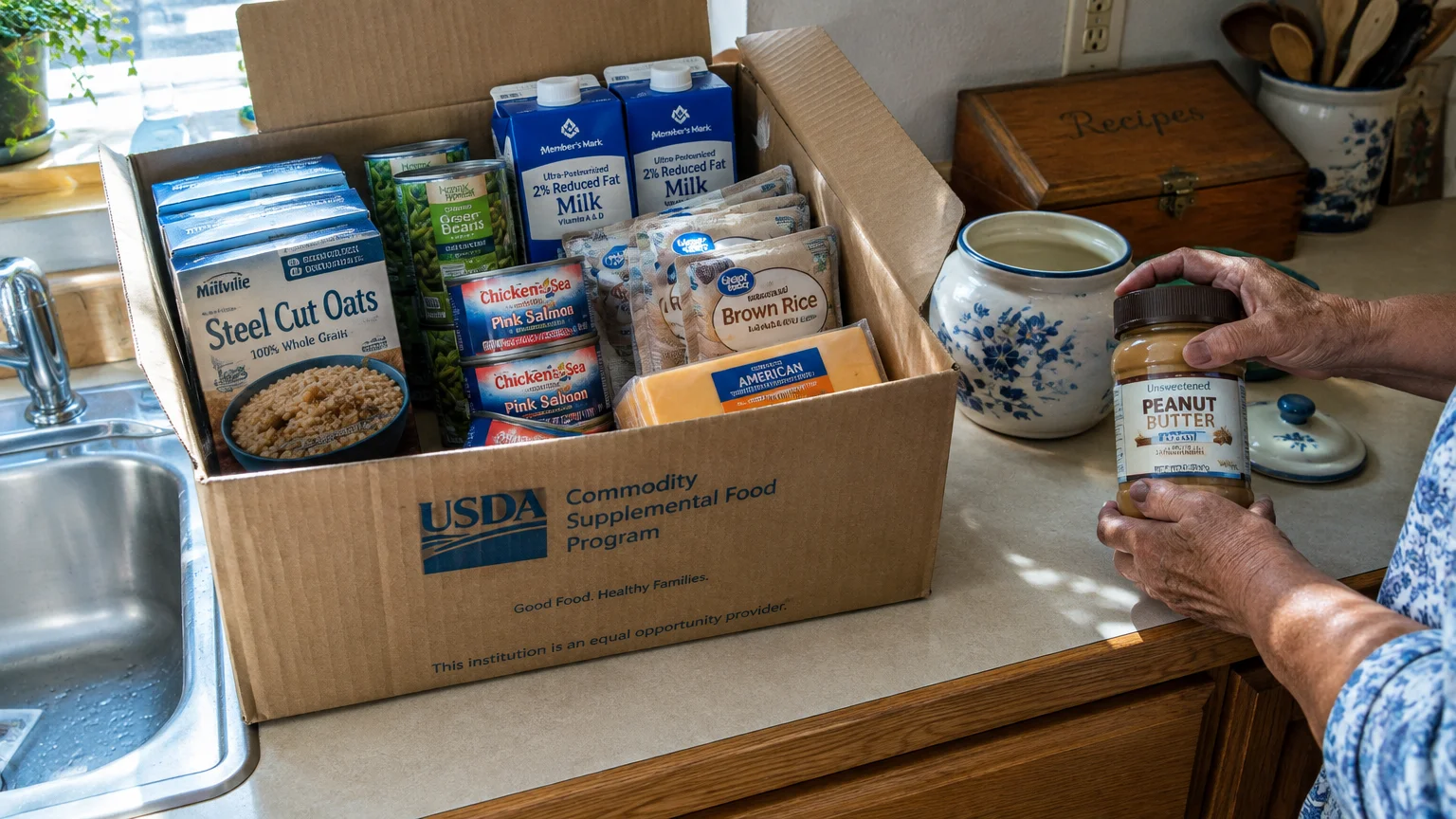
Commodity Supplemental Food Program Senior Boxes
The Commodity Supplemental Food Program is a targeted federal initiative administered by the United States Department of Agriculture. It provides low-income seniors with free, monthly boxes packed with nutritious, shelf-stable groceries.
Regional food banks manage the inventory and partner with community groups to handle packing and distribution. Many food banks now coordinate volunteer delivery networks that bring these heavy packages straight to homebound elders.
Each monthly package delivers roughly 30 to 40 pounds of USDA-inspected commodities. These supplies help bridge the gap when Social Security payments run low at month’s end.
What You Receive in Each Food Package
The contents of each box are designed by nutritional specialists to support healthy aging. The items provide essential calcium, protein, potassium, and fiber without added retail costs.
A standard monthly package contains shelf-stable milk, canned poultry or fish, peanut butter, cheese, cereal, pasta, and 100% fruit juice. You also receive multiple cans of vegetables and low-sugar fruits.
These shelf-stable items store easily in your pantry, allowing you to prepare meals on your schedule. They drastically reduce your weekly spending on expensive center-aisle supermarket staples.
2026 Income Limits and Eligibility Guidelines
To qualify for the Commodity Supplemental Food Program, you must be at least 60 years old. Unlike Meals on Wheels, this program enforces a specific household income ceiling.
Effective February 2026, the maximum gross income limit stands at 150% of the Federal Poverty Guidelines for the 48 contiguous states and Washington, D.C.
For a single individual, the 2026 gross income ceiling is $1,995 per month, or $23,940 per year. For a two-person household, the monthly ceiling is $2,705, which equals $32,460 annually.
Certain states opt for a stricter 130% poverty limit for program enrollment. In those states, gross monthly income cannot exceed $1,729 for individuals or $2,345 for couples.
Applying requires verifying your age and household gross income. You can present your Social Security award letter, pension statement, driver’s license, and utility bills during enrollment.
Arranging Direct Home Delivery for Senior Boxes
Lifting a 35-pound box is impossible for many older adults suffering from arthritis or spinal issues. Recognizing this reality, many food banks now offer free home delivery services.
Non-profit agencies often partner with delivery platforms like DoorDash’s Project DASH to provide free home delivery. A courier picks up the boxed goods from the food bank and drops them off at your door.
If direct delivery is not offered in your county, you can designate an authorized representative. Your chosen proxy can collect the box each month and carry it into your kitchen.
“A budget is telling your money where to go instead of wondering where it went.” — John C. Maxwell
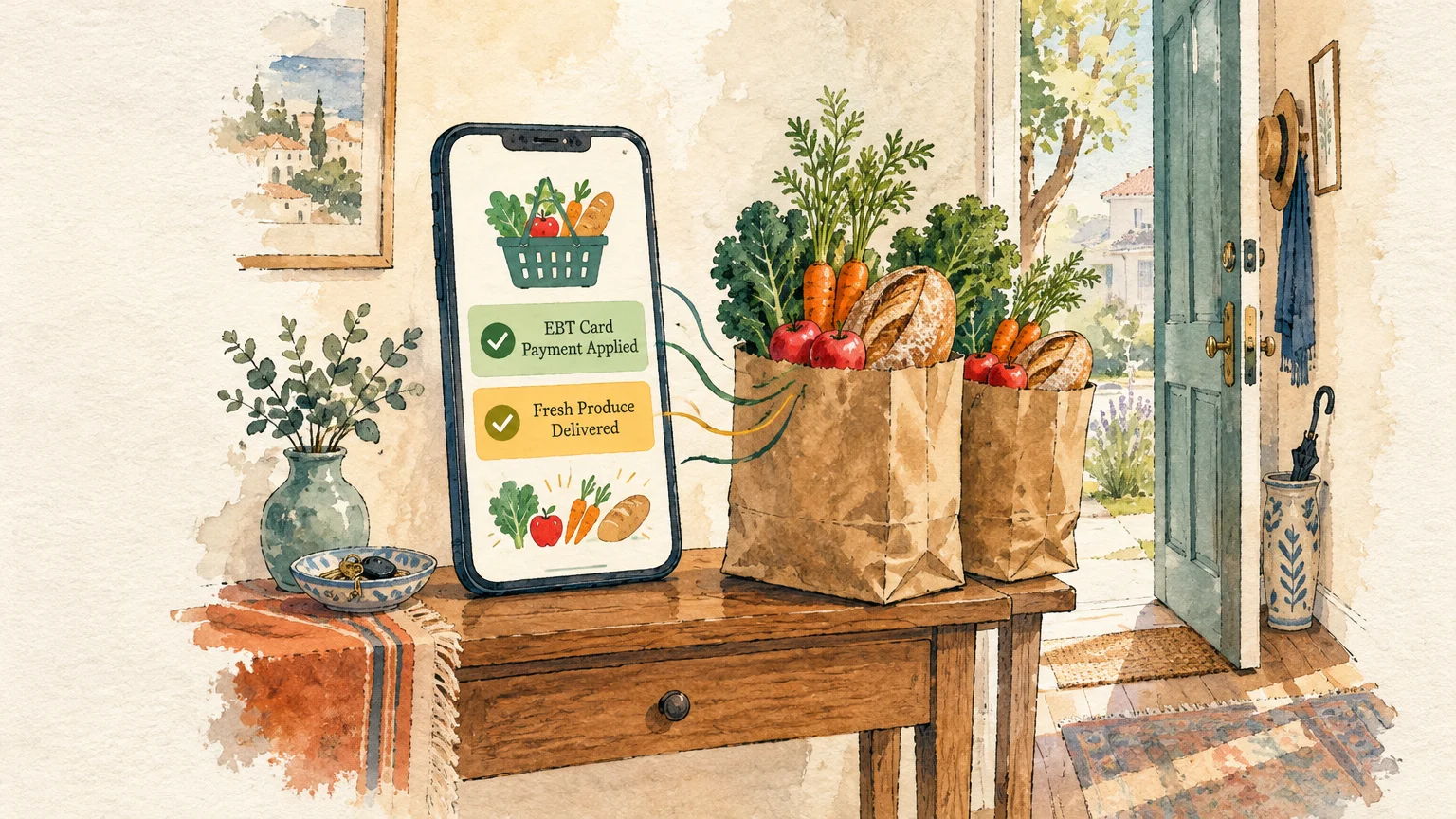
Using SNAP and EBT for Direct Home Grocery Delivery
The Supplemental Nutrition Assistance Program provides monthly electronic benefit funds directly on an EBT card. Seniors can now spend those funds online to order groceries delivered directly to their residences.
A major participation gap exists among older Americans who qualify for food assistance. A 2026 study by the National Council on Aging revealed that roughly three out of five eligible seniors remain unenrolled.
That means approximately 5 million low-income seniors leave valuable nutrition money on the table each month. Understanding the specialized rules for older applicants makes applying far easier than many believe.
Special SNAP Eligibility Rules for Seniors
For SNAP benefits, federal regulations define an elderly individual as anyone aged 60 or older. Households with an elderly or disabled member receive several major procedural advantages during application.
Most importantly, elderly households are generally exempt from the gross income test. You only need to satisfy the net income test after applying all allowable household expense deductions.
For fiscal year 2027, effective October 1, 2026, through September 30, 2027, the net monthly income limit is $1,330 for a single person. For a two-person household, the limit is $1,804.
Elderly households also qualify for a significantly higher resource limit than standard applicants. For fiscal year 2027, your household can hold up to $4,750 in countable assets, compared to $3,000 for standard households.
Your primary home, personal vehicles, and qualified retirement accounts like 401(k) plans never count toward this asset cap. Only cash, checking accounts, and standard savings balances undergo review.
SNAP Benefit Amounts for 2026 and 2027
For fiscal year 2027, the maximum monthly SNAP allotment is $306 for a one-person household. For a two-person household, the maximum benefit reaches $562 per month.
Even if you receive only the minimum monthly allotment of $25, enrolling is well worth your time. That enrollment acts as an automatic gateway to discounted broadband, utility relief, and waived delivery fees.
The Medical Expense Deduction Advantage
One of the most underutilized provisions in the SNAP program is the excess medical expense deduction. Seniors can deduct verified out-of-pocket medical expenses exceeding $35 per month from their gross income.
Qualifying deductions include prescription copays, Medicare Part B and D premiums, dental care, hearing aid supplies, and eyeglasses. They also include transportation expenses incurred traveling to medical appointments.
By subtracting substantial medical bills, your calculated net income drops significantly. This net income drop often shifts your monthly allotment from the $25 minimum up toward the $306 maximum.
Online EBT Ordering and the Delivery Fee Rule
Major supermarket chains across the country allow you to enter your SNAP EBT card for digital grocery orders. Participating stores include Walmart, Kroger, Aldi, Safeway, and Amazon Fresh.
However, you must plan around one important federal restriction: SNAP benefits cannot pay for delivery fees or driver tips. EBT funds can only pay for qualifying food items.
To complete your transaction, you must provide a secondary payment method, such as a debit card. Alternatively, you can use discounted delivery memberships that waive the delivery fee entirely.
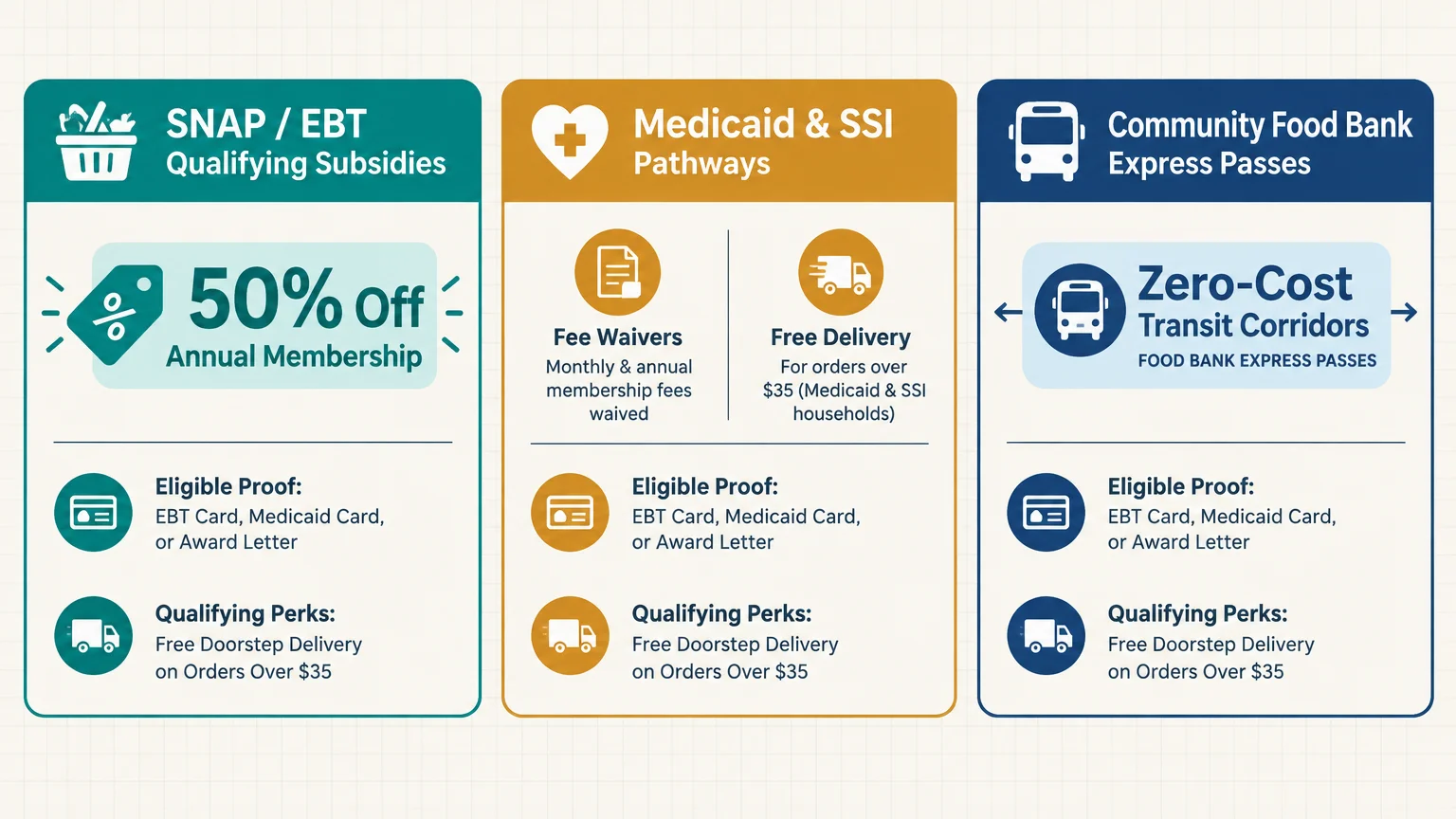
Discounted Grocery Delivery Memberships for Assistance Recipients
Commercial grocery delivery fees often range from $7 to $10 per trip, making delivery unaffordable on a fixed pension. Fortunately, major retail corporations offer half-price delivery memberships for people receiving public assistance.
By pairing your SNAP EBT card with a discounted delivery subscription, you achieve essentially free home delivery. These plans let you order groceries from the comfort of your living room without paying high surcharges.
Walmart+ Assist Program Details
The Walmart+ Assist program provides qualifying customers with a 50% discount on regular subscription fees. You pay $6.47 per month, or $49 annually, compared to standard rates of $12.95 monthly or $98 annually.
This membership provides unlimited free delivery on grocery orders of $35 or more from your local Walmart store. You can purchase fresh fruits, meats, dairy, bread, and household supplies at everyday store prices.
Qualifying is straightforward if you receive SNAP, Medicaid, Supplemental Security Income, or other federal assistance. You simply verify your eligibility through their secure online portal using your official benefit card or award letter.
Amazon Prime Access for Seniors
Amazon Prime Access offers all the benefits of standard Amazon Prime for $6.99 per month. That represents a savings of more than 50% off the standard $14.99 monthly fee.
This subscription includes free grocery delivery from Amazon Fresh and Whole Foods Market on orders meeting local minimums. You can pay for qualifying food items directly with your SNAP EBT card at checkout.
Enrolling requires uploading verification of public assistance, such as an EBT card, Medicaid card, or SSI statement. Once verified, you lock in the reduced rate for up to twelve months before simple recertification.
“Do not save what is left after spending, but spend what is left after saving.” — Warren Buffett

Senior Farmers Market Nutrition Program Delivery Proxies
The Senior Farmers’ Market Nutrition Program provides low-income seniors with direct funds to purchase fresh, locally grown produce. The program supports local agriculture while delivering fresh fruits, vegetables, culinary herbs, and honey to elders.
In most states, agencies distribute these benefits as coupon booklets or digital EBT cards each spring. Annual benefit amounts generally range between $20 and $50 per participant.
To qualify for the 2026 program season, you must be 60 or older with gross income at or below 185% of poverty.
In the 48 contiguous states, 185% of poverty equals $29,526 per year for a single person. For a two-person household, the 2026 income ceiling is $40,034 annually.
You must spend your 2026 vouchers before they expire on November 30, 2026, in most states. Any remaining balance cannot be refunded or carried over into 2027.
Designating a Delivery Proxy
Many frail or homebound seniors cannot navigate uneven grass and crowded paths at outdoor farmers’ markets. Federal rules specifically permit you to designate an authorized proxy to shop for you.
You simply complete an authorized proxy form through your local distributing agency, such as a senior center or food bank. You name a family member, trusted neighbor, or caregiver to act on your behalf.
Your proxy picks up the voucher booklet, visits participating local farm stands, and selects your produce. They then deliver the fresh food directly to your kitchen counter at no cost to you.
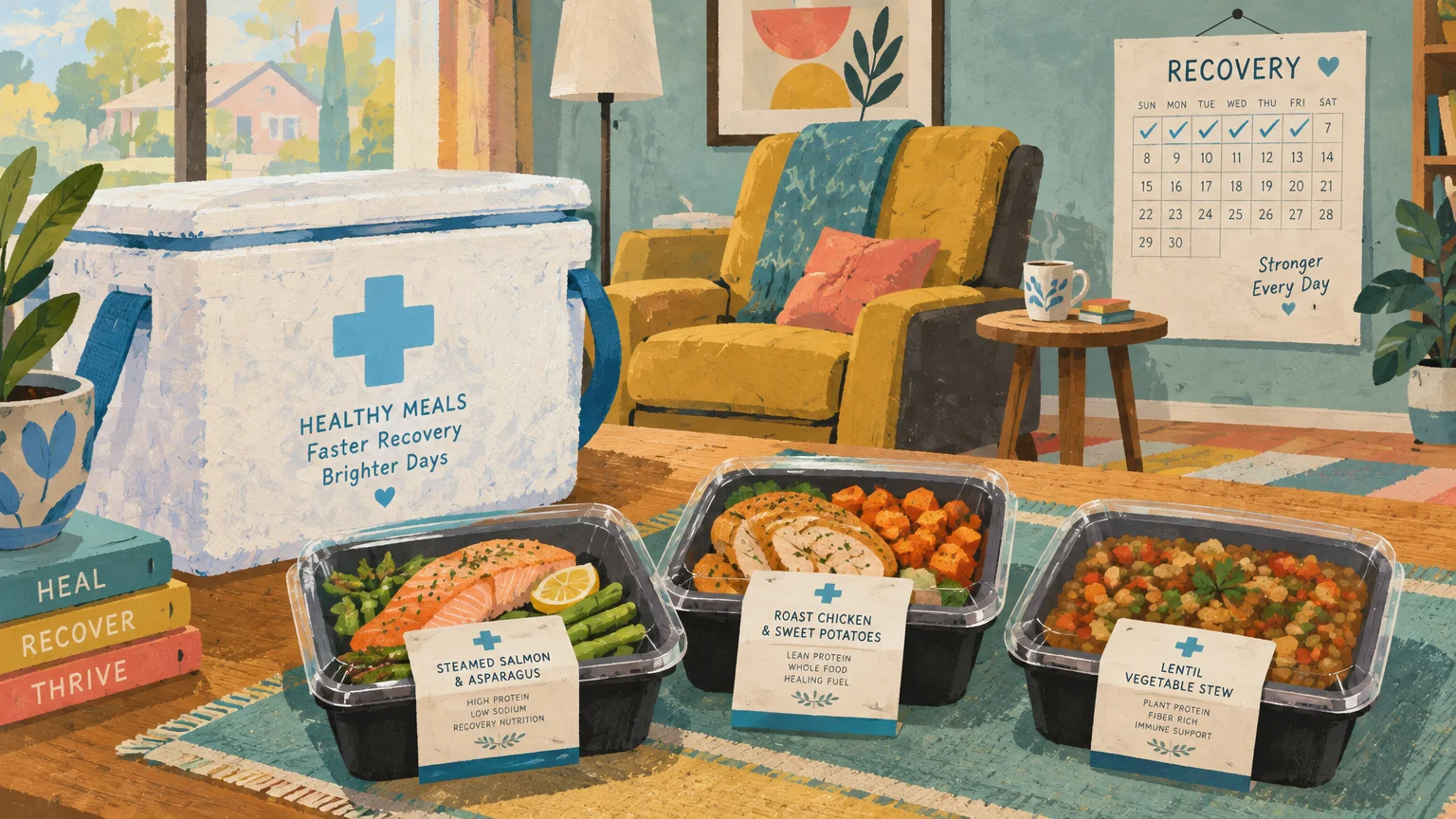
Healthcare Plans Offering Free Home-Delivered Meals
You might already possess health insurance coverage that pays for nutritious meals delivered to your doorstep. Both private Medicare Advantage plans and state Medicaid waivers increasingly fund nutrition as part of preventative care.
Health insurance companies recognize that malnourishment slows recovery and drastically increases hospital readmission rates. Tapping into these medical food benefits can save your household hundreds of dollars following medical procedures.
Medicare Advantage Post-Discharge Meals
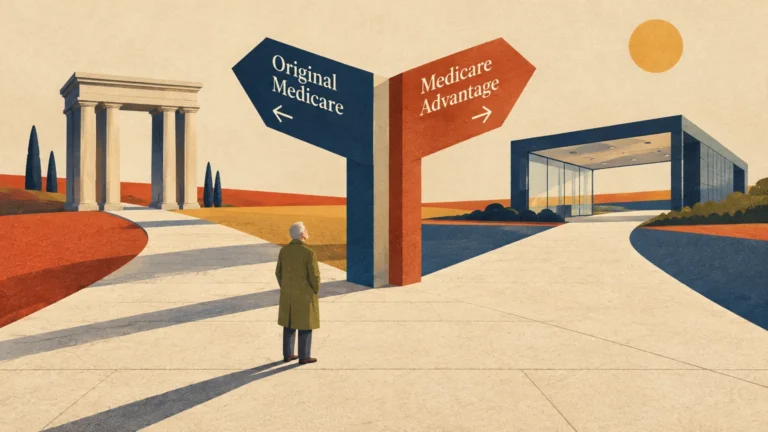
While traditional Medicare excludes routine grocery costs, many Medicare Advantage plans provide short-term meal benefits. You can explore and compare participating plans at Medicare.gov.
These benefits typically trigger when you discharge from an inpatient hospital stay or a skilled nursing facility. Plans usually furnish 10 to 28 precooked, frozen meals delivered in insulated shipping boxes.
The meals arrive fully prepared and simply require heating in an oven or microwave. Meal providers accommodate specialized medical diets, including low-sodium, diabetic, cardiac, and renal-friendly options.
To access this benefit, speak with your hospital social worker or discharge planner before leaving the facility. They will coordinate directly with your Medicare Advantage plan manager to initiate your delivery schedule.
Special Supplemental Benefits for the Chronically Ill
Some Medicare Advantage plans offer extended meal coverage under Special Supplemental Benefits for the Chronically Ill. Enrollees diagnosed with conditions like diabetes, heart failure, or end-stage renal disease may qualify for continuous deliveries.
Under these specialized rules, plans can provide monthly food allowances or scheduled meal boxes even without a hospital stay. Check your plan’s Evidence of Coverage document to verify if your policy includes chronic illness nutrition.
Medicaid Home and Community-Based Services
Low-income seniors who need daily functional assistance often qualify for state Medicaid Home and Community-Based Services waivers. Known as Section 1915(c) waivers, these programs help older adults avoid moving into nursing homes.
HCBS waiver programs routinely cover 100% of the cost of daily or weekly home-delivered meal services. State-contracted vendors deliver either hot midday meals or weekly shipments of flash-frozen dinners.
Qualifying requires meeting state Medicaid income thresholds and demonstrating a clinical need for nursing facility level of care. A designated state caseworker will assess your home environment and coordinate ongoing food deliveries.
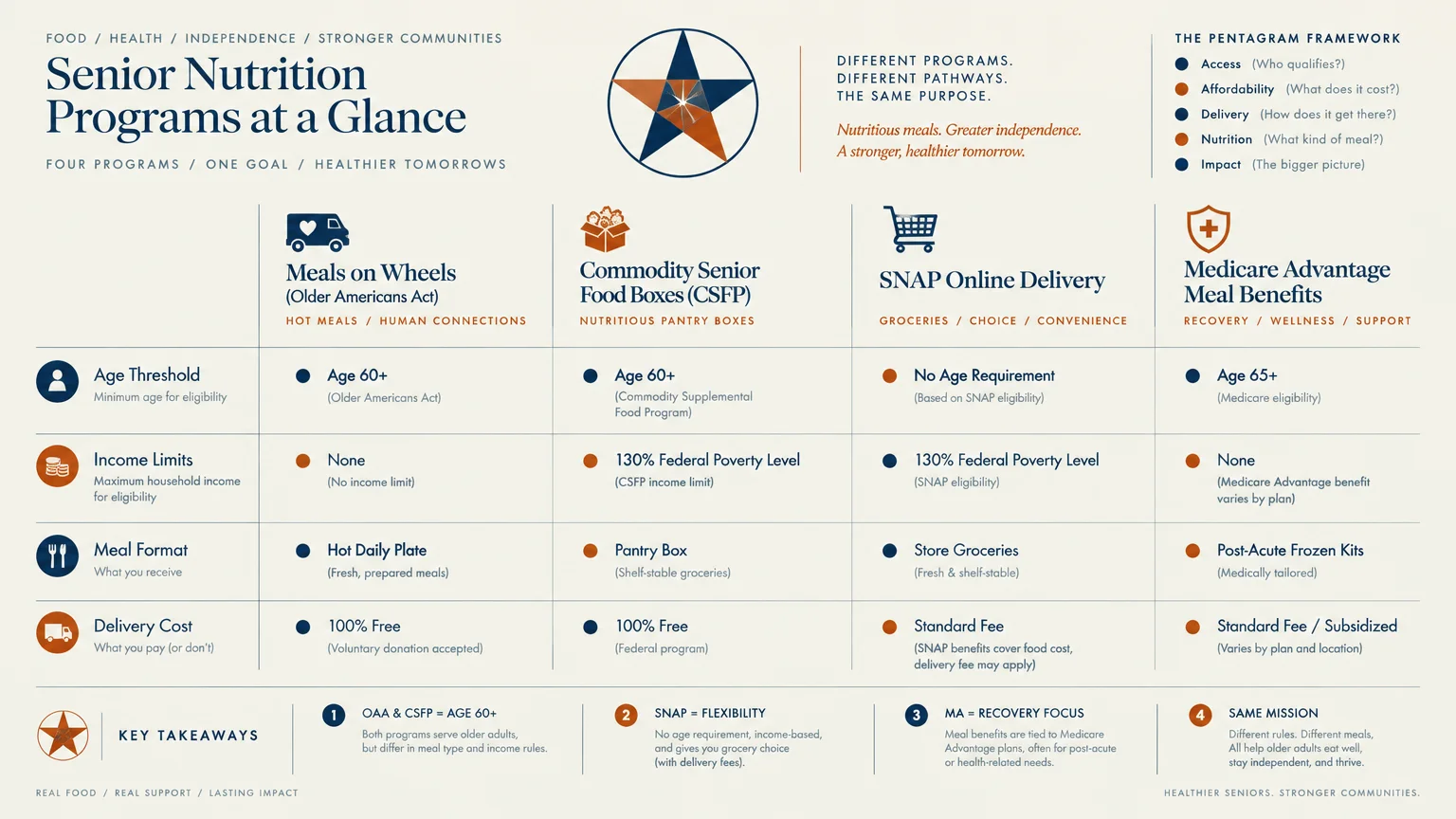
Comparing Senior Food Assistance and Delivery Programs
Selecting the best programs depends on your household income, functional mobility, and dietary requirements. The table below outlines key eligibility criteria, delivery methods, and out-of-pocket costs across major senior nutrition initiatives.
| Program Name | Minimum Age | 2026/2027 Income Limit | Delivery Mechanism | Cost to You |
|---|---|---|---|---|
| Meals on Wheels (OAA) | Age 60 | No income limit | Volunteer driver delivery | Free (Voluntary donations accepted) |
| CSFP Senior Food Box | Age 60 | $1,995/mo (1 person) / $2,705/mo (2 person) | Food bank or Project DASH drop-off | $0 (Completely free) |
| SNAP Online Delivery | Age 60 (Elderly rules) | Net: $1,330/mo (1 person) / $1,804/mo (2 person) | Supermarket delivery courier | Food covered; delivery fee applies |
| Walmart+ Assist | Any age on assistance | Enrolled in SNAP, Medicaid, or SSI | Walmart home delivery fleet | $6.47/mo ($49/yr); free delivery on $35+ |
| Amazon Prime Access | Any age on assistance | Enrolled in SNAP, Medicaid, or SSI | Amazon Fresh or Whole Foods driver | $6.99/mo; free delivery on minimum orders |
| SFMNP Farm Vouchers | Age 60 | $29,526/yr (1 person) / $40,034/yr (2 person) | Authorized proxy pickup and delivery | $0 ($20 to $50 seasonal benefit) |
| Medicare Advantage Meals | Varies by plan | Varies by individual policy | Frozen meal commercial shipper | $0 for eligible post-acute care stays |
You do not need to choose just one of these programs. You can combine multiple benefits simultaneously to cover different grocery needs and maximize your monthly cash savings.
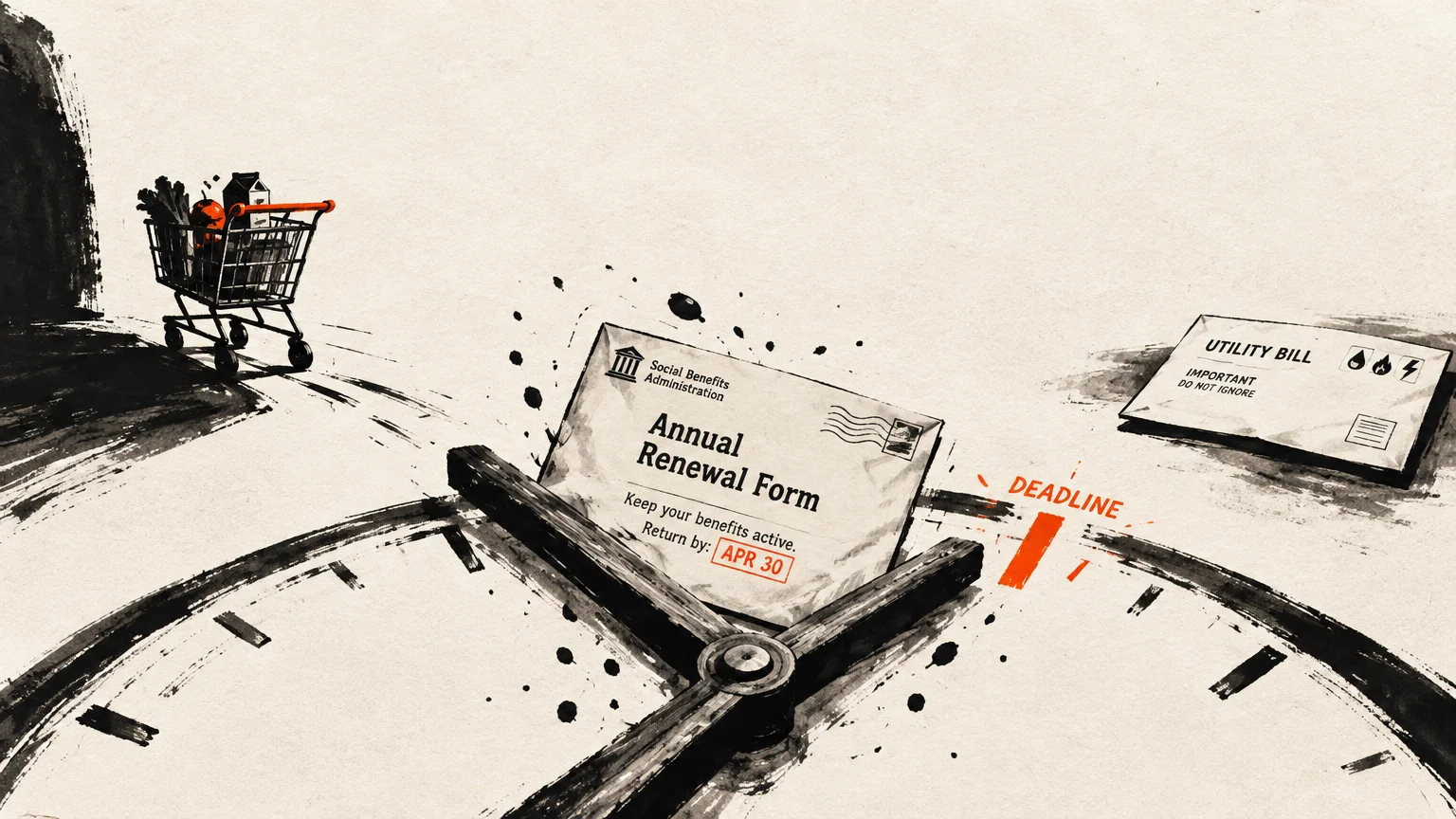
Errors That Cost Families Thousands
Many families leave thousands of dollars in earned nutritional assistance on the table due to common administrative misunderstandings. Avoiding these costly errors protects your household savings and ensures consistent, quality nourishment.
Assuming Social Security Disqualifies You from Meals on Wheels
One of the most widespread errors is assuming your Social Security check disqualifies you from Older Americans Act meal delivery. Seniors often believe that any steady income bars them from community nutrition services.
By federal law, Meals on Wheels programs cannot perform income or asset tests on prospective clients. If physical or cognitive limitations keep you from shopping or cooking safely, you are eligible to receive food.
Paying Full Retail Price for Delivery Subscriptions
Enrolling in retail delivery services at standard market prices costs seniors nearly $100 extra each year. Paying full retail when you receive public assistance needlessly depletes a tight monthly budget.
If you receive Medicaid, SNAP, or SSI, take five minutes to upload your documentation for Walmart+ Assist or Amazon Prime Access. Cutting your subscription costs by 50% immediately preserves your limited cash.
Ignoring SNAP Due to the $25 Minimum Allotment Rumor
Millions of seniors never submit a SNAP application because they have heard they will only receive $25 per month. While $25 is the statutory minimum, older adults routinely qualify for far higher sums.
When you document all out-of-pocket medical bills exceeding $35 monthly, your net countable income plummets. That medical deduction often transforms a modest $25 payment into the full $306 monthly allotment.
Allowing Farmers Market Vouchers to Expire
Tens of thousands of dollars in fresh produce assistance goes unspent every autumn because recipients overlook the seasonal deadline. SFMNP coupons cannot be carried over into subsequent program years.
Mark November 30, 2026, on your calendar to ensure all vouchers are redeemed before expiration. If you cannot attend a market yourself, designate a proxy immediately so fresh produce reaches your table.
Overlooking Post-Hospital Meal Coverage
Hospital discharge planners manage complex medical charts and often forget to mention voluntary insurance perks. Patients frequently return home from surgery without realizing their Medicare Advantage plan offers free post-acute meals.
Always ask your hospital care coordinator whether your insurance includes home-delivered convalescent meals before you leave. Activating this benefit provides up to four weeks of free, chef-prepared nutrition while you heal.

When to Get Expert Help
Navigating multiple social service applications, income guidelines, and medical waiver forms can be daunting for seniors and family caregivers. Seeking professional assistance helps you unlock every eligible dollar without unnecessary frustration.
Your local Area Agency on Aging is your best starting point for personalized, objective support. Their staff can evaluate your situation and connect you with local meal routes, food boxes, and home care.
You can contact the Eldercare Locator directory to identify the specific public aging agency serving your county. Their certified information specialists provide free, confidential referrals to senior food programs and caregiver resources.
For broader financial protection, explore consumer budgeting and debt tools at the Consumer Financial Protection Bureau. Their practical resources help older adults guard their retirement funds against fraud and high fees.
If you need comprehensive guidance regarding federal benefits, taxes, and family assistance programs, consult USA.gov Money and Taxes. State Health Insurance Assistance Program counselors can also help you evaluate Medicare Advantage meal benefits.
Frequently Asked Questions About Senior Food Delivery
Can I receive Meals on Wheels if I still drive a car?
You may still qualify for Meals on Wheels if you can drive, provided you face other significant limitations. Programs evaluate your overall physical ability to lift heavy groceries, stand over a hot stove, and prepare meals safely.
If you can drive to medical appointments but cannot safely cook daily meals, explain your exact circumstances during intake. Assessors look at your complete daily routine to determine your nutritional vulnerability.
Can someone pick up my senior food box if I am bedridden?
Yes, you can designate an authorized proxy to pick up your Commodity Supplemental Food Program box. You simply complete a brief proxy form designating a family member, neighbor, or caregiver to act on your behalf.
Your designated proxy presents their identification along with your paperwork at the distribution site. They will collect the heavy commodity box and deliver it directly into your kitchen.
How long do Medicare Advantage post-hospital meals last?
Most Medicare Advantage plans furnish post-discharge meals for a period ranging from two to four weeks. Enrollees typically receive between 10 and 28 fully prepared, frozen meals following an eligible facility discharge.
Once your covered insurance benefit period ends, you can transition smoothly to community programs like Meals on Wheels. Your plan case manager can assist you in coordinating that administrative handover.
Does my adult child living with me disqualify me from senior meals?
An adult child living in your home does not automatically disqualify you from receiving home-delivered meals through the Older Americans Act. Program coordinators evaluate whether that adult is physically and schedule-wise capable of preparing daily nutrition.
If your adult child works full-time outside the home or experiences health challenges, you remain eligible. The focus remains on whether you have consistent access to warm, nutritious meals during the day.
What foods are prohibited from purchase with online SNAP delivery?
Federal regulations prohibit using SNAP EBT benefits to buy hot prepared foods, alcohol, tobacco, vitamins, medicines, or pet food. You also cannot use SNAP funds to pay retailer delivery fees or driver tips.
You can use your SNAP EBT card for produce, meats, poultry, fish, dairy products, breads, cereals, and snacks. These allowable groceries cover the vast majority of your weekly nutritional needs.
Taking Your Next Steps
Contact your regional Area Agency on Aging or dial 211 today to begin your home-delivered meal application. Securing reliable meal delivery safeguards your physical health, eases daily stress, and keeps your household budget firmly on track.
This article is for informational purposes only and does not constitute financial, legal, or tax advice. Rates, benefit amounts, and tax rules change regularly—verify current details with the relevant agency or a licensed professional.
Last updated: October 2026. Rates, benefit amounts, and tax rules change—always verify current details at official sources.