
An unexpected spike in your retirement income can quietly trigger hundreds of dollars in extra healthcare costs each month. This extra charge is the Medicare surcharge, officially known as the Income-Related Monthly Adjustment Amount (IRMAA).
A single dollar over the federal threshold forces you into higher Medicare premiums for both Part B and Part D. Because Social Security relies on a two-year lookback period, your financial moves today directly dictate what you pay later.
Learning how the government calculates this surcharge helps you protect your retirement savings. Strategic planning lets you legally manage your modified adjusted gross income and avoid costly surcharges during your post-work years.
Understanding the Medicare Income-Related Adjustment
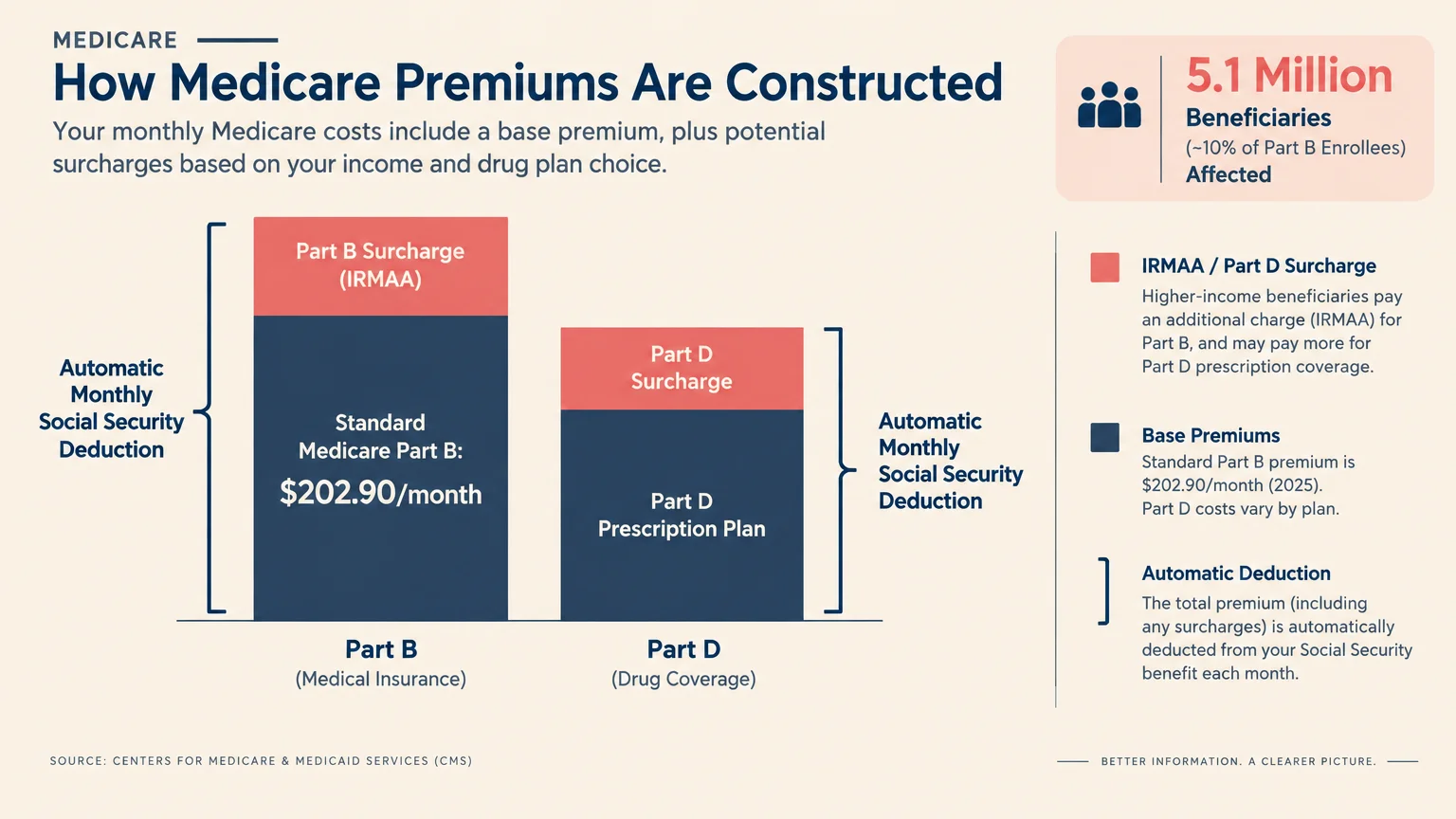
The Medicare income-related adjustment adds an extra fee to your monthly healthcare premiums if your earnings exceed federal limits. The government adds this surcharge directly to Medicare Part B medical insurance and Medicare Part D prescription drug plans.
Roughly 5.1 million Medicare beneficiaries pay these extra surcharges each month. This group represents nearly 10 percent of all Part B enrollees nationwide.
Many retirees believe they can bypass the surcharge by enrolling in private coverage. Enrolling in a Medicare Advantage plan does not protect you from the surcharge, because private insurers still collect the mandatory Part B adjustment.
You pay this surcharge on top of standard plan premiums. The Social Security Administration automatically deducts these charges from your monthly benefit checks whenever possible.
If you delay taking Social Security, the Centers for Medicare & Medicaid Services will bill you quarterly. Failing to pay these premium surcharges can result in the loss of your healthcare coverage.

The Two-Year Lookback Rule: Why Timing Dictates Your Premiums
The Social Security Administration determines your eligibility for surcharges using federal tax data from two years prior. Your 2026 Medicare premiums depend entirely on the tax return you filed for the 2024 tax year.
This statutory delay often catches new retirees completely off guard. A lucrative final year in the workforce can artificially elevate your healthcare costs two years after you stop working.
For example, decisions you make during 2025 determine whether you pay surcharges in 2027. Actions you take throughout 2026 will establish your healthcare premiums for 2028.
This timing creates a severe cash-flow mismatch for households that fail to anticipate it. You might face executive-level healthcare premiums while living on a modest, fixed retirement income.
You must monitor your income trajectory years before you claim benefits. Proactive planning softens the blow of this mandatory federal lookback window.
Official 2026 Medicare Surcharge Brackets and Cost Cliffs
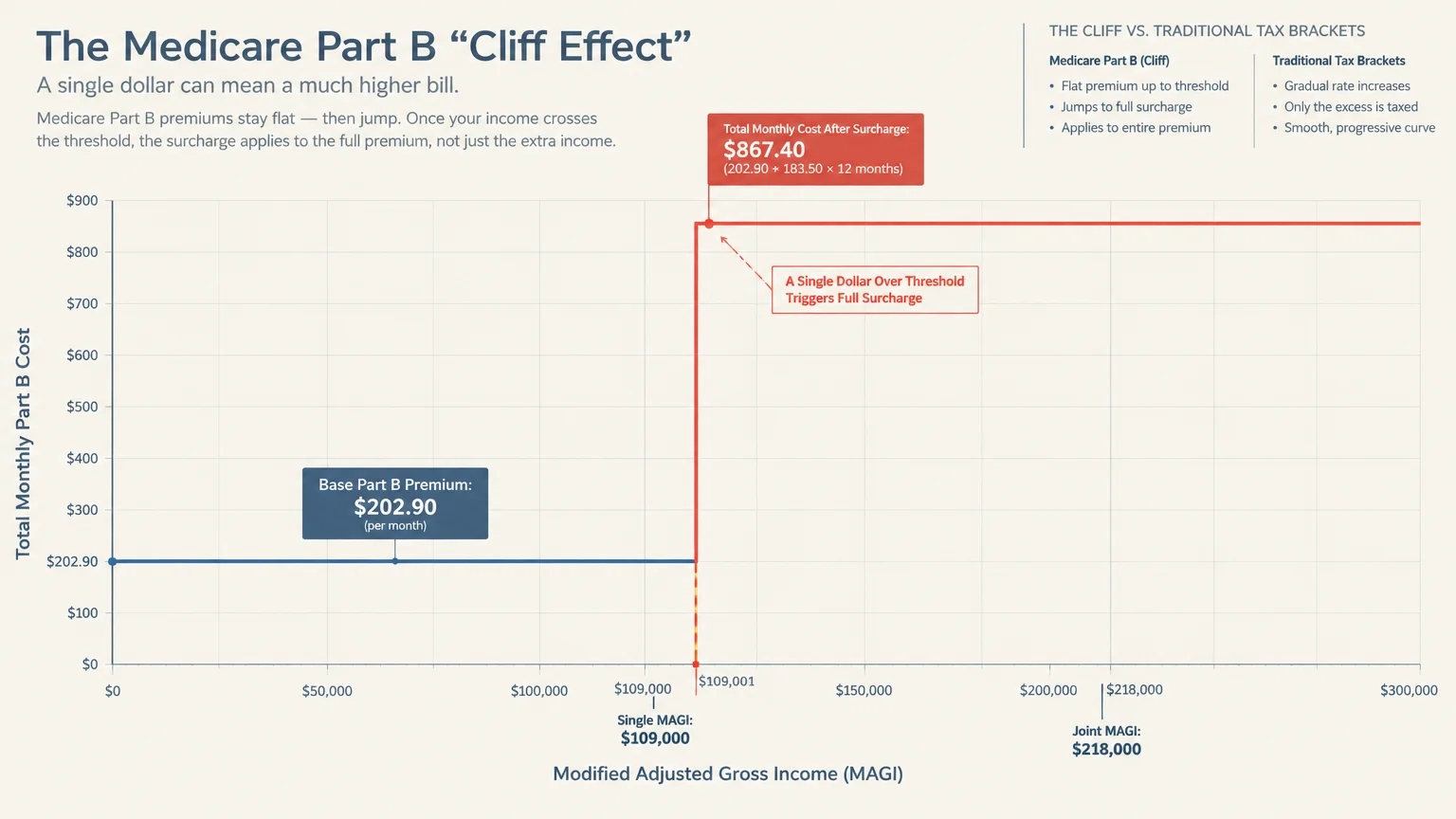
For 2026, the standard Medicare Part B monthly premium is $202.90 with an annual medical deductible of $283. Beneficiaries whose income exceeds specific limits pay substantial adjustments on top of that base amount.
Unlike standard marginal tax brackets, Medicare surcharges operate as rigid financial cliffs. Earning just one dollar over a threshold triggers the full monthly penalty across the entire calendar year.
Under the Bipartisan Budget Act, the top income bracket remains completely frozen through at least 2028. This freeze exposes more retirees to maximum surcharges as general economic inflation pushes nominal income upward.
| Tier | Single MAGI (2024 Return) | Joint MAGI (2024 Return) | Part B Surcharge | Total Monthly Part B | Part D Surcharge |
|---|---|---|---|---|---|
| Tier 0 (Standard) | $109,000 or less | $218,000 or less | $0.00 | $202.90 | $0.00 |
| Tier 1 | $109,001 – $137,000 | $218,001 – $274,000 | +$81.20 | $284.10 | +$14.50 |
| Tier 2 | $137,001 – $171,000 | $274,001 – $342,000 | +$202.90 | $405.80 | +$37.50 |
| Tier 3 | $171,001 – $205,000 | $342,001 – $410,000 | +$324.60 | $527.50 | +$60.40 |
| Tier 4 | $205,001 – $499,999 | $410,001 – $749,999 | +$446.30 | $649.20 | +$83.30 |
| Tier 5 | $500,000 or more | $750,000 or more | +$487.00 | $689.90 | +$91.00 |
Crossing from Tier 0 to Tier 1 costs an individual an extra $1,148.40 annually across Parts B and D. For a married couple, that single extra dollar can siphon over $2,290 per year from household savings.
“It’s not how much money you make, but how much money you keep, how hard it works for you, and how many generations you keep it for.” — Robert Kiyosaki

IRMAA 2027 Projections: What to Anticipate for Next Year
Federal officials release finalized Part B rates and surcharge tiers each November. Beneficiaries receive individualized determination notices in December, right as Medicare Open Enrollment closes on December 7.
The Medicare Trustees Report projects that standard Part B premiums will rise to approximately $209.50 monthly in 2027. This upward baseline pushes all corresponding adjustment tiers higher as well.
Inflation calculations indicate that the entry threshold for IRMAA 2027 will increase to roughly $112,000 for single filers. Married couples filing jointly will face an entry threshold near $224,000.
Projected 2027 Part B surcharges range from roughly $83.80 monthly in Tier 1 to over $502.60 in Tier 5. These figures place total projected monthly Part B costs between $293.30 and $712.10 per enrollee.
Prescription drug surcharges will also increase across every tier. Projected monthly additions for Part D range from $15.40 in Tier 1 up to $96.40 in Tier 5.
How Medicare Calculates Your Income: The MAGI Surprise
The calculation that determines your surcharge is not your regular taxable income. The federal government uses a specific version of Modified Adjusted Gross Income (MAGI) designed exclusively for Medicare.
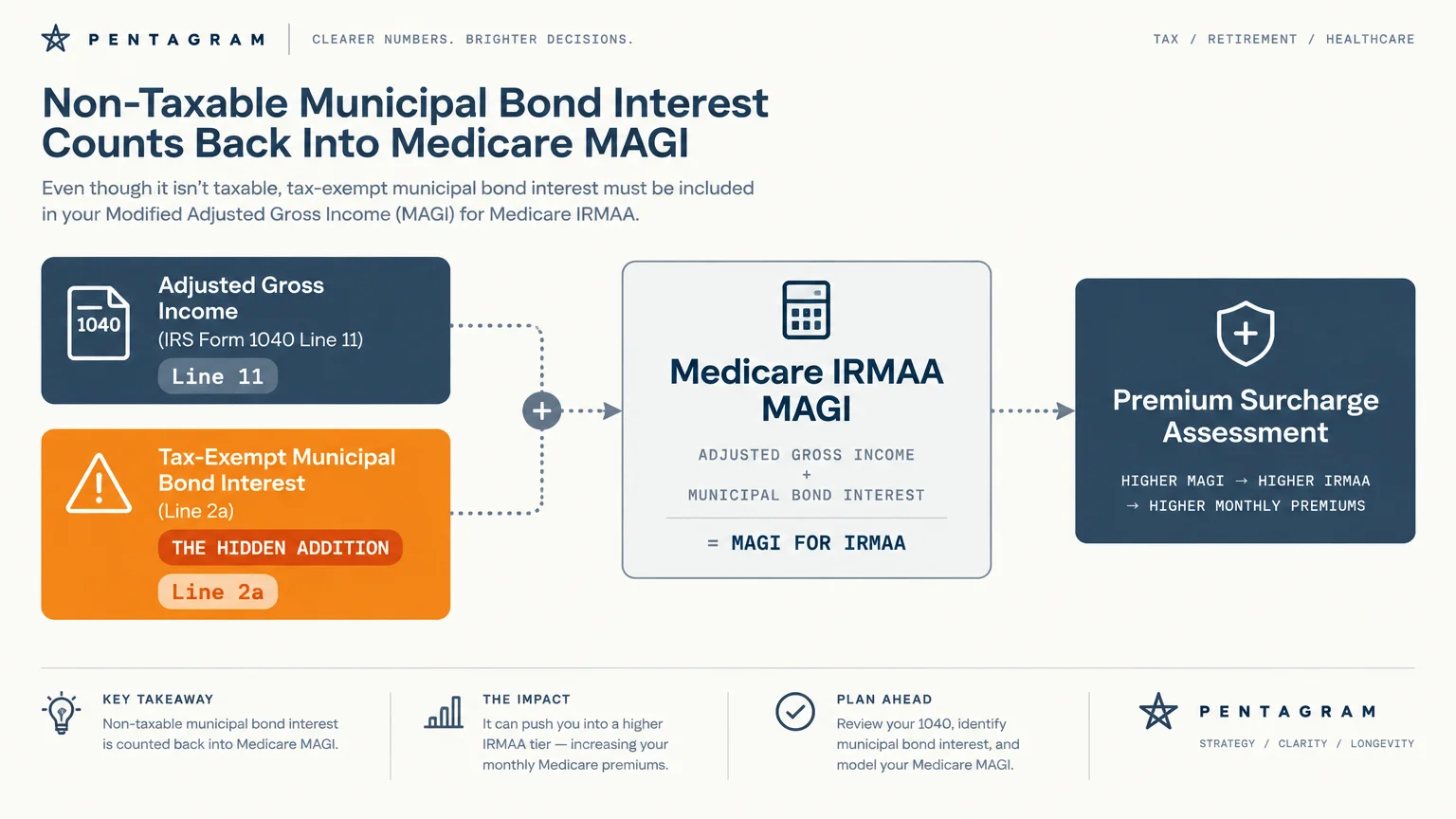
Medicare MAGI takes your regular Adjusted Gross Income from your tax return and adds back tax-exempt interest income. It also includes specific untaxed foreign earned income.
Retirees frequently invest in municipal bonds under the assumption that the income remains completely tax-free. While municipal bond interest avoids federal income tax, Medicare explicitly includes it when determining your surcharge bracket.
A portfolio heavy in municipal debt can easily push you over an income threshold. That tax-exempt yield could end up triggering thousands of dollars in higher Medicare premiums.
You must review line items for tax-exempt interest on IRS Form 1040 before making assumptions about your tier. Even minor tax-exempt earnings can trigger an unwelcome surcharge notice.

The Per-Person Multiplier: How Couples Absorb a Double Hit
The Social Security Administration assesses Medicare surcharges individually for every enrolled beneficiary. If you and your spouse both enroll in Medicare, your household pays double the surcharge amount.
Joint tax filers share the higher income threshold brackets, but each individual pays the assessed monthly penalty. A joint income of $275,000 in 2024 puts both spouses into 2026 Tier 2.
In Tier 2, each spouse pays an extra $202.90 for Part B and $37.50 for Part D every month. Together, the couple loses $480.80 per month to surcharges alone.
That penalty extracts $5,769.60 in household cash flow across twelve months. Many couples fail to model this compounding effect when structuring their annual retirement distributions.
The per-person penalty makes proactive tax management twice as critical for married couples. Protecting a threshold preserves purchasing power for both partners simultaneously.

The 2026 Rebate Exclusion and Hidden Costs
Higher monthly premiums are not the only financial penalty tied to surcharge brackets. In October 2026, roughly 20.8 million Original Medicare Part B enrollees received a one-time $90 rebate payment from the Medicare Improvement Fund.
Federal rules explicitly barred all beneficiaries paying income-related surcharges from receiving that relief payment. Breaching a threshold cost retirees both their monthly cash and eligibility for federal consumer rebates.
Exclusions like this highlight an expanding pattern in federal benefit administration. High-income designations increasingly strip away supplemental benefits and consumer protections across federal programs.
These secondary penalties magnify the overall damage of crossing an income threshold. Staying beneath the surcharge cutoff preserves your eligibility for unexpected federal credits and program rebates.
Common Money Traps That Trigger Higher Medicare Premiums
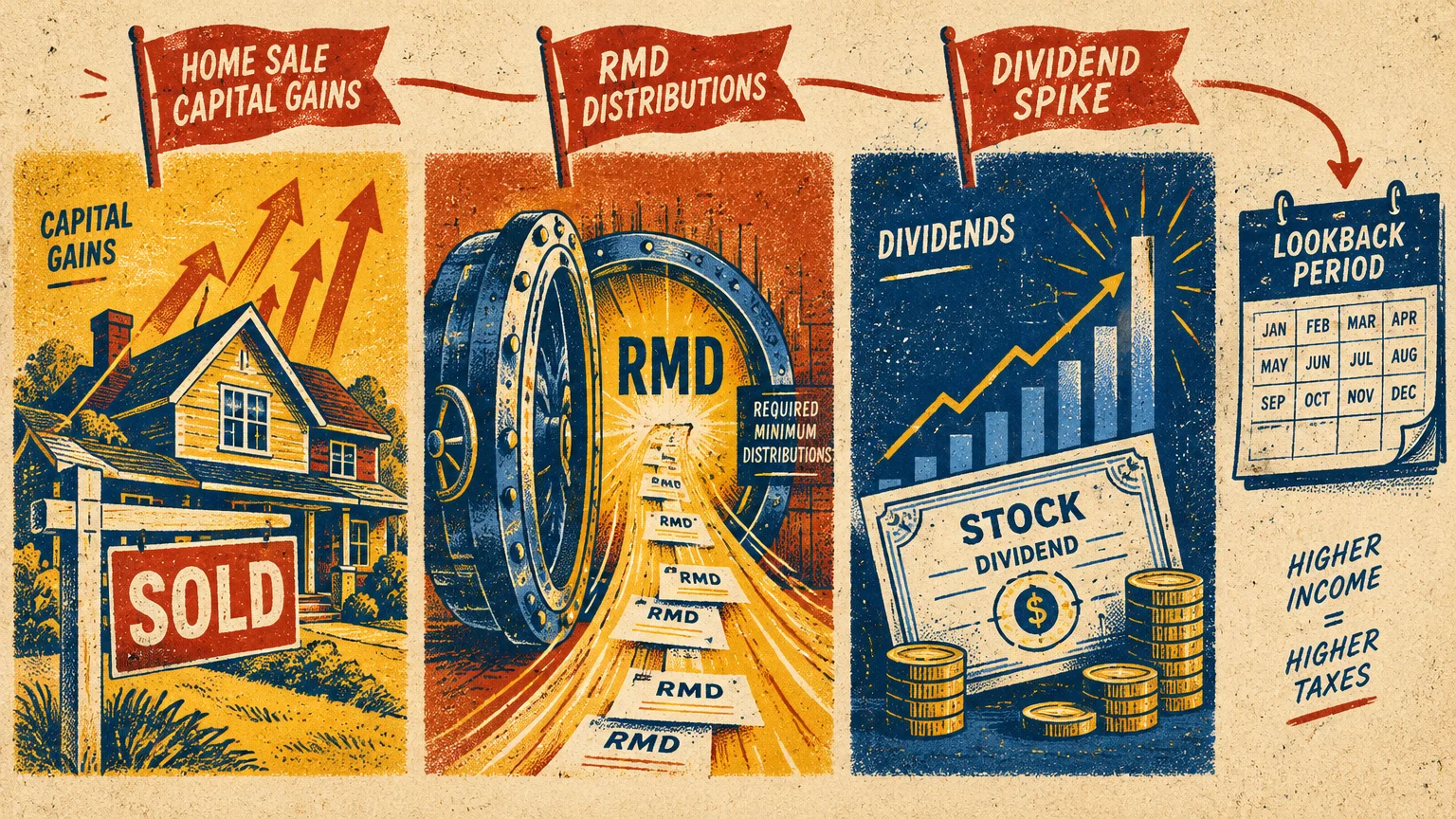
Many retirees accidentally cross income thresholds due to routine financial transactions rather than massive salaries. Understanding these standard financial triggers allows you to safeguard your income brackets in advance.
- Unplanned Roth IRA Conversions: Moving traditional retirement assets to a Roth account creates immediate taxable income. Converting large balances after age 63 directly triggers higher surcharges two years later.
- Downsizing or Selling Real Estate: Capital gains from selling a vacation home, rental property, or primary residence inflate your adjusted gross income. Exceeding primary residence gain exclusions pushes your MAGI into upper surcharge tiers.
- Realizing Substantial Capital Gains: Rebalancing a non-retirement brokerage portfolio can generate sudden, massive capital gains distributions. Selling highly appreciated stock in a single calendar year frequently triggers top-tier surcharges.
- Reaching Age 73 Mandatory Distributions: Under current federal law, Required Minimum Distributions (RMDs) begin at age 73. Large pre-tax balances force mandatory withdrawals that can push you over the initial $109,000 or $218,000 thresholds.
- Ignoring Tax-Exempt Yields: Concentrating cash into municipal bond funds to generate sheltered income often backfires under Medicare rules. Every dollar of municipal bond interest counts directly toward your surcharge calculation.
Each of these traps creates a spike in earnings that catches retirees by surprise. Recognizing these potential pitfalls gives you time to implement preventative distribution strategies.
Legitimate Strategies to Avoid IRMAA
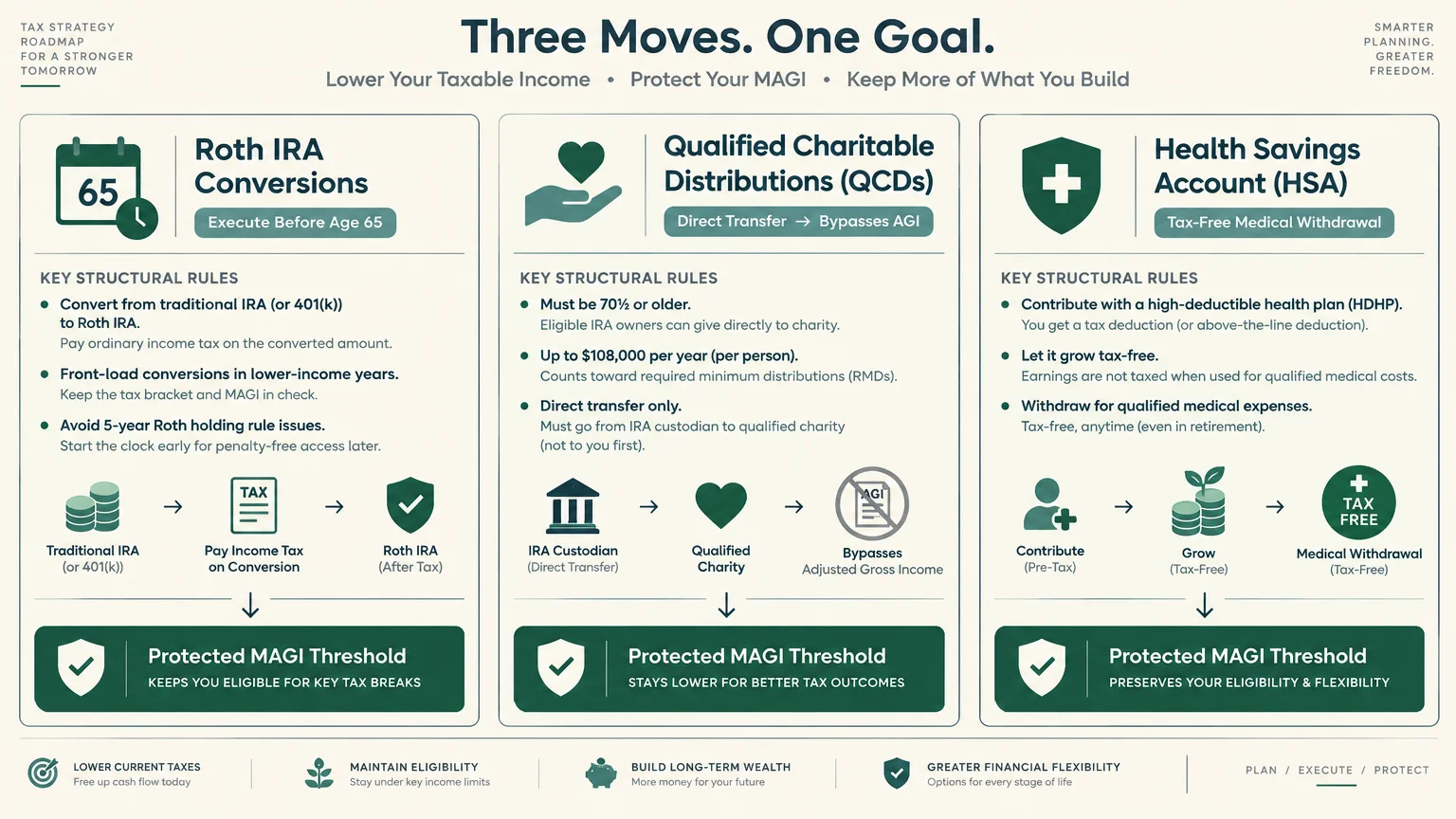
You can use legal tax-planning strategies to reduce your modified adjusted gross income and avoid IRMAA entirely. Managing how and when you pull money from retirement accounts prevents painful threshold violations.
1. Complete Roth Conversions Before Age 63
The two-year lookback clock starts running at age 63 for enrollees entering Medicare at age 65. If you convert traditional retirement funds to a Roth account before age 63, the income will not impact your Medicare costs.
Executing systematic conversions in your early sixties removes taxable funds from future distribution requirements. Once inside the Roth account, future withdrawals do not count toward your Medicare income calculation.
2. Direct Funds Through Qualified Charitable Distributions
If you are age 70½ or older, you can utilize Qualified Charitable Distributions (QCDs) through your traditional IRA. For 2026, the IRS retirement rules allow you to donate up to $111,000 directly from your IRA to eligible charities.
Married couples can donate up to $222,000 if both spouses maintain individual qualifying accounts. These charitable transfers satisfy your mandatory RMD obligations without increasing your adjusted gross income by a single dollar.
3. Pull From Tax-Free Accounts
Distributions from Roth IRAs, Roth 401(k)s, and Health Savings Accounts (HSAs) do not count toward your Medicare MAGI. Using an HSA for qualified medical expenses delivers completely tax-free distributions that Social Security ignores.
Blending your monthly income between taxable accounts and tax-free Roth reserves keeps your reported income below critical surcharge boundaries. This diversified distribution strategy grants you complete control over your annual taxable footprint.
4. Spread Capital Gains Across Multiple Tax Years
If you plan to sell appreciated real estate or stock, structure the transaction across multiple calendar years whenever possible. Using installment sales for property transactions spreads your capital gain recognition over several tax periods.
Staggering your gains keeps your income from spiking violently in a single tax filing. This smooth distribution pattern protects your household from crossing steep multi-tier surcharge cliffs.
“A budget is telling your money where to go instead of wondering where it went.” — John C. Maxwell

How to Appeal an IRMAA Surcharge Using Form SSA-44
If your current income dropped significantly compared to your tax return from two years ago, you do not have to accept the surcharge. You can request a formal adjustment by submitting Form SSA-44 directly to the Social Security Administration.
The federal government will only recalculate your Medicare premiums if your income loss stems from an approved life-changing event. The government recognizes exactly eight qualifying life-changing events for an appeal:
- Work stoppage (complete retirement)
- Work reduction (transitioning from full-time to part-time employment)
- Marriage
- Divorce or legal annulment
- Death of a spouse
- Loss of income-producing property due to a natural disaster, fraud, or civil emergency
- Loss of employer pension income due to plan termination or corporate reorganization
- Receipt of an employer settlement payment caused by company bankruptcy or closure
You cannot appeal a surcharge simply because you experienced a one-time capital gain, sold a home, or converted an IRA to a Roth account. The Social Security Administration rejects appeals based on normal investment activity or discretionary tax maneuvers.
When you file Form SSA-44, you must include supporting documentation proving both the event and your current estimated income. A signed retirement letter from your employer alongside a recent tax return provides the required proof.
Submit your appeal promptly after receiving your initial determination notice from Social Security. Once approved, the agency will adjust your monthly premiums and reimburse any surcharges you overpaid earlier in the year.

When to Consult a Professional
Managing the intersection of retirement distributions, federal taxes, and Medicare rules requires careful technical coordination. Navigating these overlapping rules alone often leads to costly, irreversible tax traps.
A licensed Certified Public Accountant (CPA) can model multi-year tax scenarios before you take large capital distributions. They will calculate your precise distance from surcharge thresholds before you execute asset sales or Roth conversions.
Fee-only fiduciary financial planners help structure sustainable retirement drawdowns that preserve wealth without generating unnecessary penalties. They can align your portfolio income with official brackets to keep your monthly healthcare costs predictable.
If you need assistance navigating Medicare enrollment options or filing appeals, seek guidance from a State Health Insurance Assistance Program (SHIP) counselor. SHIP counselors provide free, unbiased assistance to help you resolve complex administrative disputes with Medicare.
Frequently Asked Questions About Medicare Surcharges
Can I opt out of Part B or Part D to avoid IRMAA?
You can decline Medicare Part B or Part D coverage, but doing so leaves you without outpatient and prescription drug protection. If you drop coverage without creditable employer insurance, you will face lifetime late-enrollment penalties when you sign up later.
How long does an IRMAA surcharge last?
Medicare surcharges apply for one calendar year at a time. The Social Security Administration re-evaluates your income annually based on updated IRS data, meaning your surcharge will disappear if your income drops in future years.
Does municipal bond interest really count toward the Medicare surcharge?
Yes, municipal bond interest counts toward your Medicare Modified Adjusted Gross Income. Even though municipal interest remains exempt from regular federal income taxes, federal law mandates its inclusion for all Medicare surcharge calculations.
How soon after retiring should I submit Form SSA-44?
You should submit Form SSA-44 as soon as Social Security issues your initial surcharge determination notice. Filing immediately prevents excessive monthly deductions from your Social Security checks and accelerates your premium refund.
Can married couples file taxes separately to avoid higher Medicare premiums?
Filing separately rarely helps and usually makes the surcharge worse. The income threshold for married individuals filing separately who lived together drops to just $109,000 for Tier 4 and $391,000 for Tier 5 in 2026, triggering maximum surcharges at much lower incomes.
Protect Your Retirement Budget
Managing your Medicare premiums requires ongoing vigilance and proactive tax coordination throughout your retirement years. Review your modified adjusted gross income annually at Medicare.gov and verify your standing against current threshold limits before completing large financial transactions.
Take charge of your portfolio drawdowns today to keep your hard-earned wealth where it belongs. This article is for informational purposes only and does not constitute financial, legal, or tax advice. Rates, benefit amounts, and tax rules change regularly—verify current details with the relevant agency or a licensed professional.
Last updated: October 2026. Rates, benefit amounts, and tax rules change—always verify current details at official sources.