
A Roth IRA conversion can shield your retirement growth from future tax increases, but a single tactical misstep can trigger a massive, irreversible tax penalty. Moving pre-tax retirement dollars into a Roth account requires navigating rigid IRS rules and strict income thresholds.
Many savers accidentally push themselves into higher tax brackets, spike their Medicare premiums, or forfeit healthcare subsidies. Understanding how conversion taxes interact with your broader retirement tax planning is vital before moving a single dollar.
By avoiding the most severe Roth conversion mistakes, you protect your hard-earned assets and maximize your lifetime tax savings.
Error 1: Paying Conversion Taxes from Your IRA Balance
When you convert a traditional IRA to a Roth IRA, you owe ordinary income tax on the converted pre-tax balance. Many account holders mistakenly elect to have their financial custodian withhold those taxes directly from the retirement distribution.
Withholding taxes directly from your conversion balance drains the power of compound growth. When you reduce the amount that reaches the Roth account, you leave fewer dollars behind to generate tax-free earnings.
The consequences become far more severe if you execute a Roth IRA conversion before reaching age 59½. The IRS treats the money withheld for taxes as an early distribution rather than a completed rollover.
You must pay ordinary income tax on the withheld amount plus a 10% early withdrawal penalty. That extra penalty creates an unnecessary friction cost that destroys the conversion’s financial benefit.
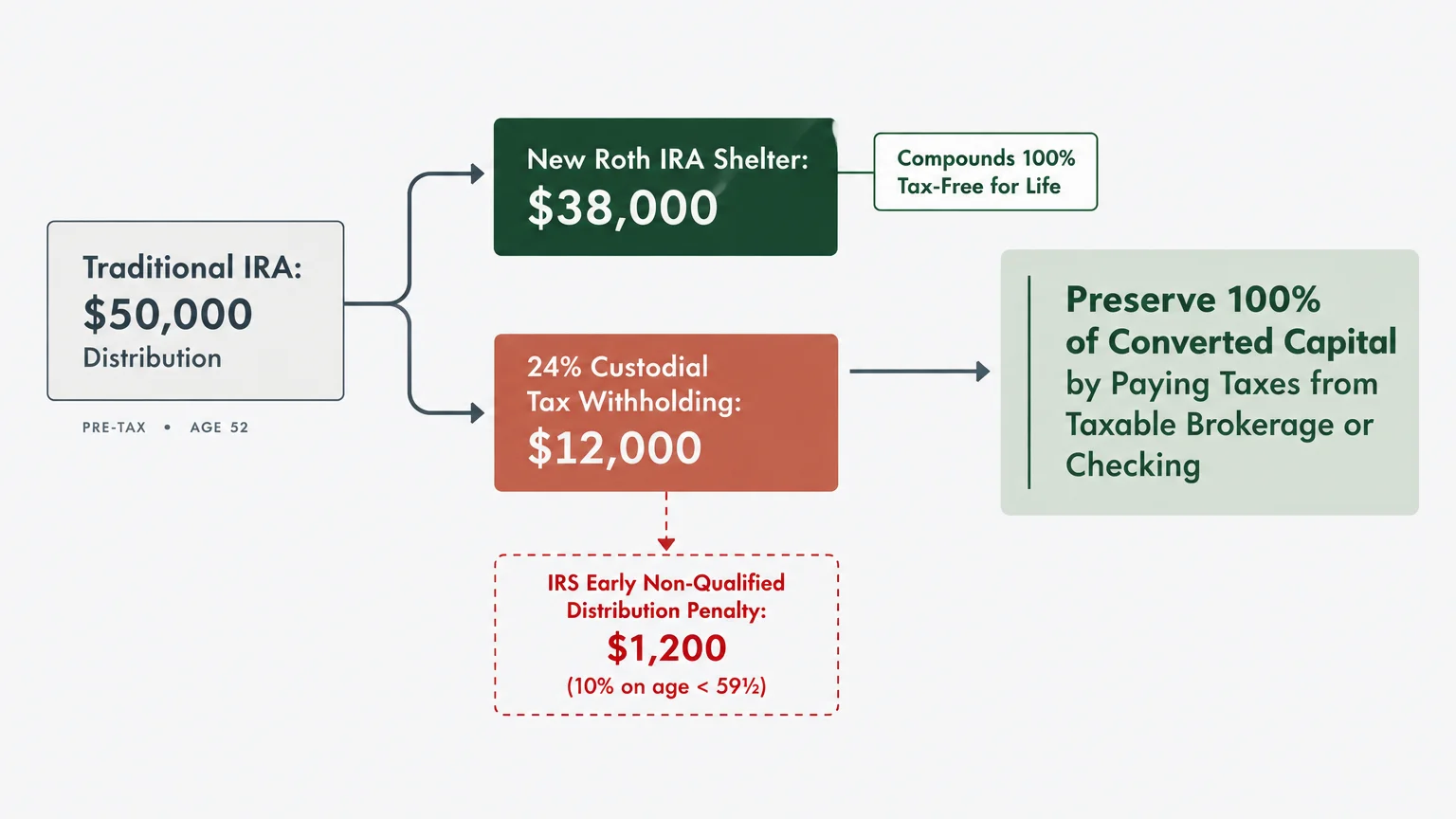
Suppose you convert $50,000 at age 52 and ask the custodian to withhold 24% ($12,000) for federal income taxes. Only $38,000 lands inside your new Roth IRA account.
The IRS treats that $12,000 tax withholding as a non-qualified cash distribution taken before age 59½. You will owe an immediate $1,200 penalty on your next tax filing.
Always pay your conversion taxes from separate, non-retirement savings such as a checking, savings, or taxable brokerage account. This practice preserves the entire converted sum inside the Roth shelter, where it compounds tax-free for life.
Error 2: Ignoring the IRS Pro-Rata and Aggregation Rules
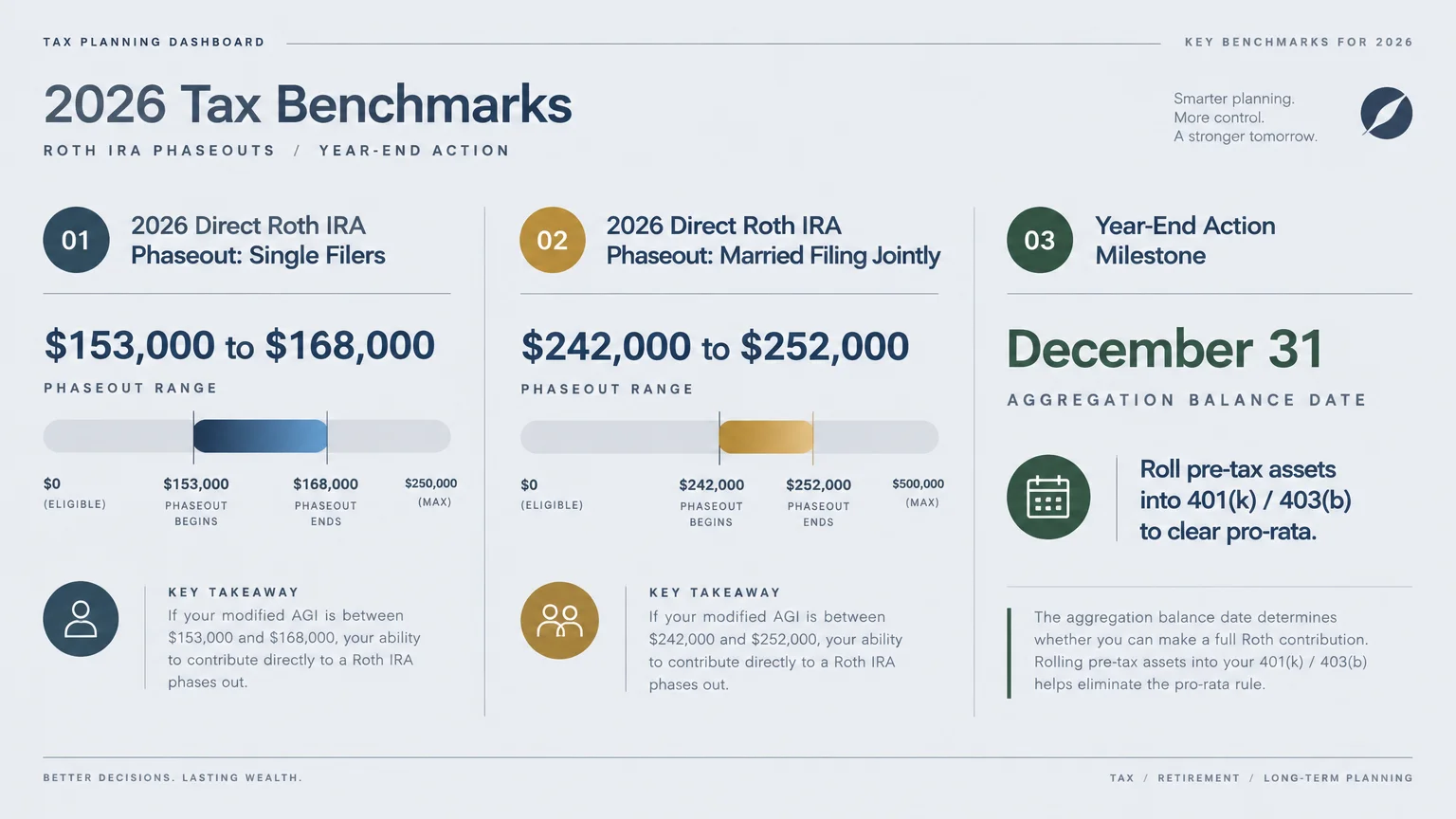
High-earning individuals often execute a backdoor Roth conversion strategy because their income exceeds the direct Roth contribution thresholds. For 2026, direct contribution eligibility phases out between $153,000 and $168,000 for single filers and $242,000 to $252,000 for joint filers.
To bypass these caps, investors contribute post-tax dollars to a traditional IRA and convert the balance shortly after. However, the IRS does not allow you to pick and choose which dollars you convert.
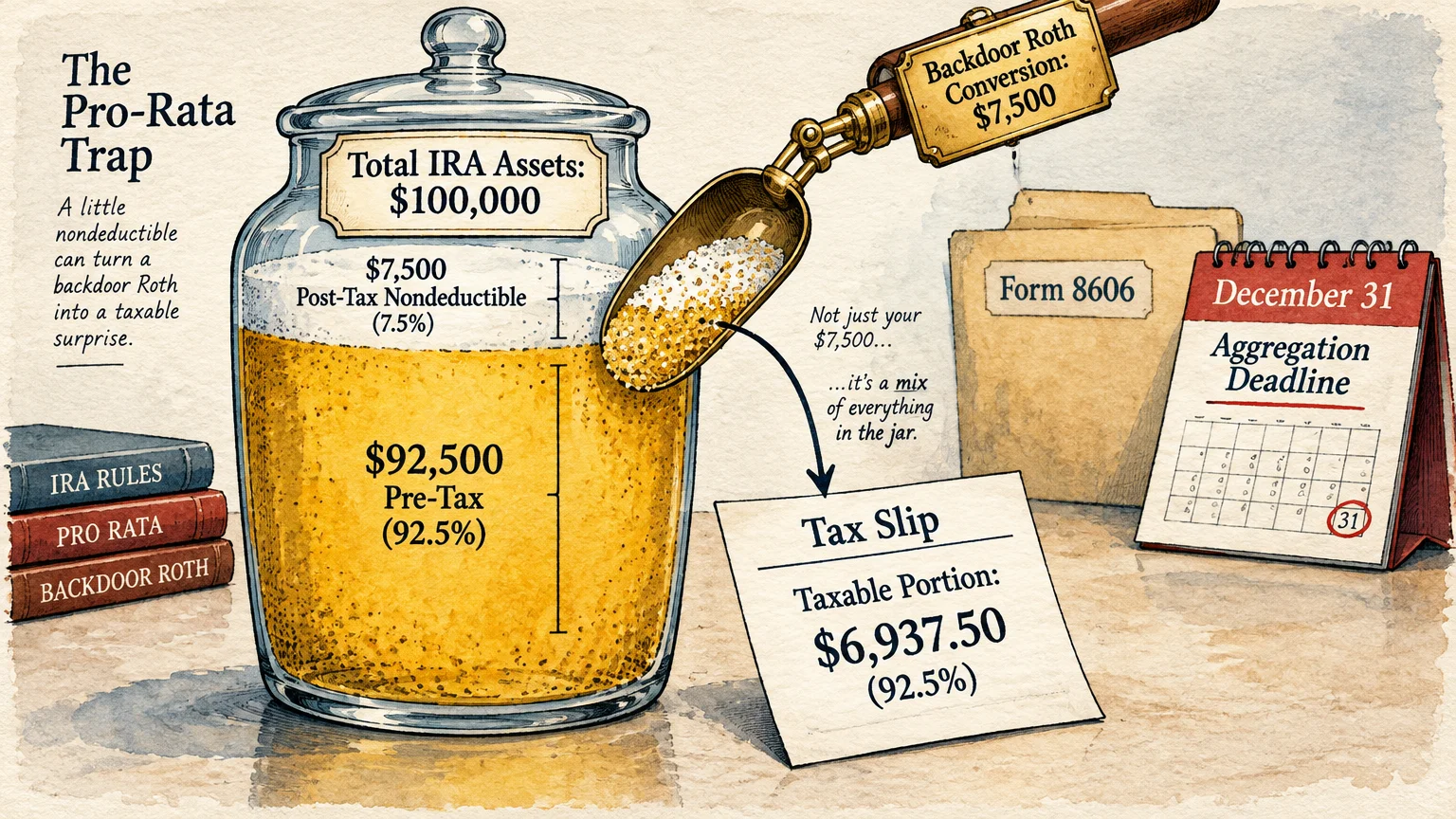
Under the IRS pro-rata rule, the agency looks at the collective balance of all traditional, SEP, and SIMPLE IRAs you own. You cannot isolate your after-tax contribution from your existing pre-tax nest egg.
The IRS requires you to file Form 8606 to compute the taxable portion of your conversion. The agency determines taxability based on your account balances on December 31 of the calendar year you execute the conversion.
Consider an investor who holds $92,500 of pre-tax assets across two rollover IRAs and makes a $7,500 nondeductible contribution in 2026. Their total traditional IRA balance equals $100,000, with 92.5% pre-tax dollars and 7.5% post-tax dollars.
If that investor converts $7,500 thinking the transaction is tax-free, the pro-rata rule dictates otherwise. Exactly 92.5% ($6,937.50) of the converted amount is treated as ordinary income subject to immediate taxation.
To avoid the pro-rata trap, roll your pre-tax IRA balances into an active employer 401(k) or 403(b) plan before December 31. Employer-sponsored qualified plans do not count toward the IRS aggregation calculation.
Review rollover rules at the IRS Retirement Plans portal before shifting funds between institutional plans.
Error 3: Forcing Conversions into a Higher Tax Bracket
The One Big Beautiful Bill Act made individual tax cuts permanent, keeping federal income brackets at 10%, 12%, 22%, 24%, 32%, 35%, and 37%. Despite these stable rates, converting an excessively large balance in a single year triggers severe bracket creep.
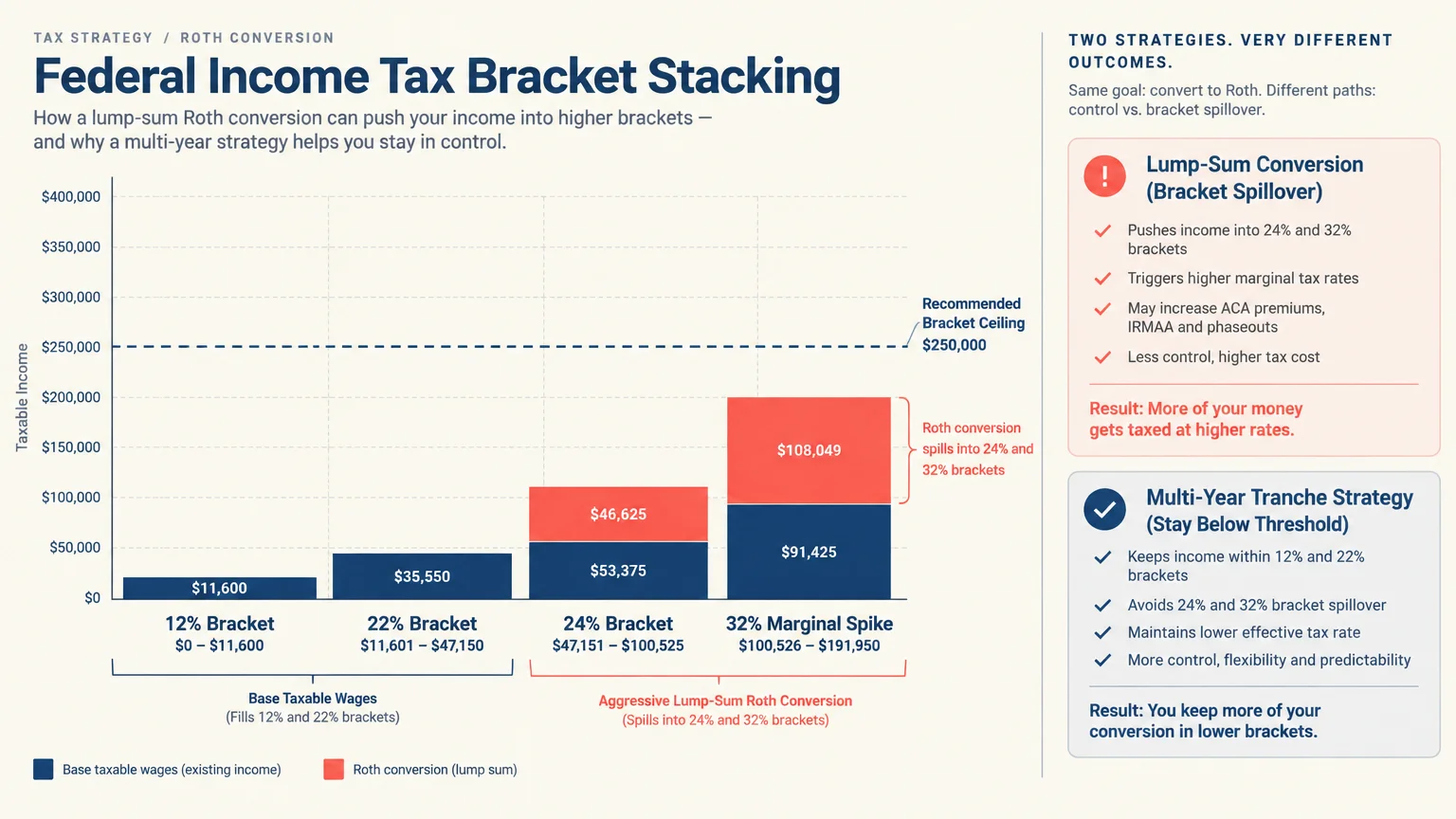
A Roth conversion adds directly to your adjusted gross income (AGI) for the year. A large conversion can easily thrust your marginal dollars into a substantially higher tax bracket.
For the 2026 tax year, the 12% income bracket ends at $50,400 for single taxpayers and $100,800 for married couples filing jointly. The 2026 standard deduction is $16,100 for singles and $32,200 for joint filers.
Every dollar of taxable income beyond that 12% threshold faces a 22% rate—an immediate 10-percentage-point spike. Converting too much at once means prepaying taxes at rates higher than your expected future retirement bracket.
Assume a retired married couple has $70,000 in taxable income during 2026 and converts $80,000 from an IRA. Their taxable income rises to $150,000, pushing $49,200 of the conversion into the 22% bracket.
If that same couple spread the conversion across multiple tax years, they could convert their balance entirely within the 12% bracket. Spreading conversions preserves cash and minimizes aggregate tax payments over time.
For 2027, the 12% bracket ceiling rises to $52,025 for singles and $104,050 for joint filers, offering even more conversion room. Thoughtful retirement tax planning requires filling your current bracket to its ceiling without spilling over into the next tier.
Error 4: Triggering the Medicare IRMAA Surcharge Trap
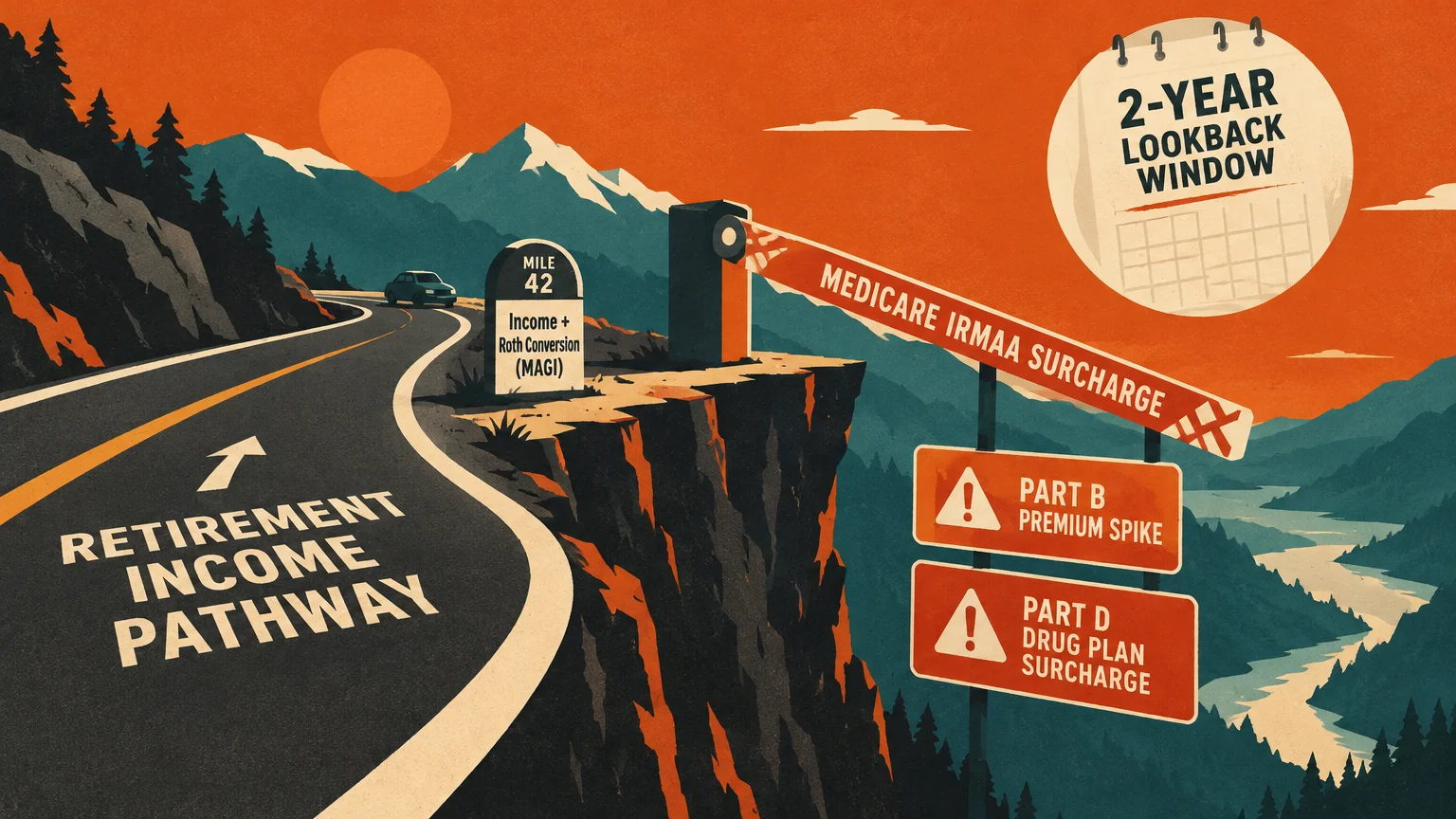
Retirees age 65 and older often overlook how conversion taxes impact their Medicare premiums. High income levels trigger the Income-Related Monthly Adjustment Amount (IRMAA), which adds surcharges to Medicare Part B and Part D coverage.
The federal government calculates IRMAA surcharges using a strict two-year lookback period. A Roth IRA conversion executed in 2026 directly dictates your Medicare premiums for the entire 2028 coverage year.
For 2026, the standard Medicare Part B monthly premium is $202.90, with an annual deductible of $283. If your modified adjusted gross income (MAGI) crosses established tier lines, your premiums jump significantly.
The first IRMAA threshold begins at $109,000 for single filers and $218,000 for married couples filing jointly. Crossing this threshold by a single dollar adds $81.20 per month to Part B and $14.50 per month to Part D.
For a married couple, an extra dollar of conversion income costs an additional $2,296.80 in combined annual healthcare expenses. If a conversion pushes you into Tier 2 ($137,001 to $171,000 Single / $274,001 to $342,000 MFJ), Part B jumps to $405.80 monthly.
The highest IRMAA tier, starting at $500,000 for singles and $750,000 for couples, raises Part B premiums to $689.90 monthly. Add the top-tier $91.00 monthly Part D surcharge, and high conversions quickly erode retirement cash reserves.
Review official premium schedules directly on Medicare.gov before finalizing your year-end conversion dollar amounts.
Error 5: Falling Off the Pre-Medicare ACA Subsidy Cliff
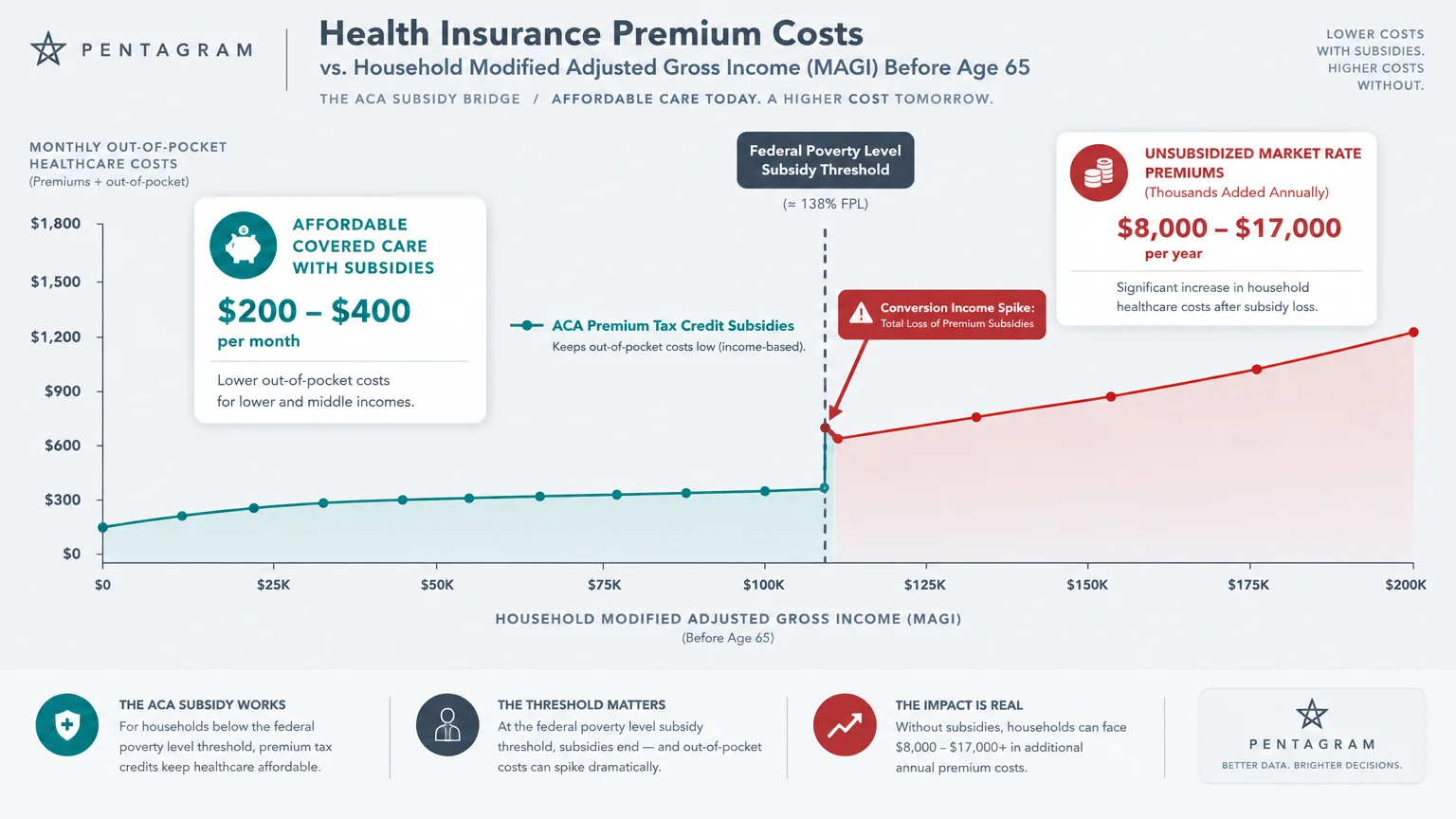
Pre-retirees who leave the workforce before age 65 frequently rely on Affordable Care Act (ACA) health insurance marketplaces. These households often fund early retirement using cash savings while keeping reportable taxable income low to qualify for premium tax credits.
The temporary enhanced ACA subsidies expired at the end of 2025. Starting in 2026, the strict 400% Federal Poverty Level (FPL) subsidy cliff has returned.
Under current rules, earning even $1 over 400% of the FPL eliminates 100% of your premium tax credits. A Roth conversion counts dollar-for-dollar toward ACA household income calculations.
For 2026 coverage, the 400% FPL cutoff is $62,600 for an individual and $84,600 for a two-person household in the contiguous United States. Exceeding those cutoffs forces you to repay all marketplace subsidies when filing your federal tax return.
Imagine an early retired couple in their early sixties living comfortably on an income of $75,000 while receiving $14,000 in annual health subsidies. They decide to convert $15,000 of traditional IRA funds to a Roth account before year-end.
That $15,000 conversion pushes their household MAGI to $90,000, passing the $84,600 eligibility ceiling. They must repay the full $14,000 subsidy to the IRS on tax day, producing an astronomical effective tax rate on that conversion.

Error 6: Attempting to Convert Required Minimum Distributions
Under the SECURE 2.0 Act, the starting age for Required Minimum Distributions (RMDs) is 73 for individuals born between 1951 and 1959. Savers born in 1960 or later must begin taking their required annual distributions at age 75.
Federal tax law strictly prohibits converting required minimum distributions into a Roth IRA. The IRS mandates that you withdraw your full RMD for the calendar year before executing any Roth conversion.
The IRS treats the first dollars distributed from a traditional IRA during an RMD year as fulfilling that required distribution. You cannot designate those initial withdrawals as a Roth rollover.
If you mistakenly deposit RMD money into a Roth IRA, the IRS classifies the transfer as an excess contribution. Excess contributions face an ongoing 6% excise penalty each year until you properly remove the funds.
To execute a legal Roth conversion in an RMD year, first take your full mandatory distribution and deposit it into a taxable account. You pay ordinary income tax on that required withdrawal.
Once your RMD is satisfied, you may convert any remaining traditional IRA balance to your Roth IRA. Plan conversions early in your retirement window before RMD requirements limit your tax flexibility.
Error 7: Confusing the Two Distinct Five-Year Rules
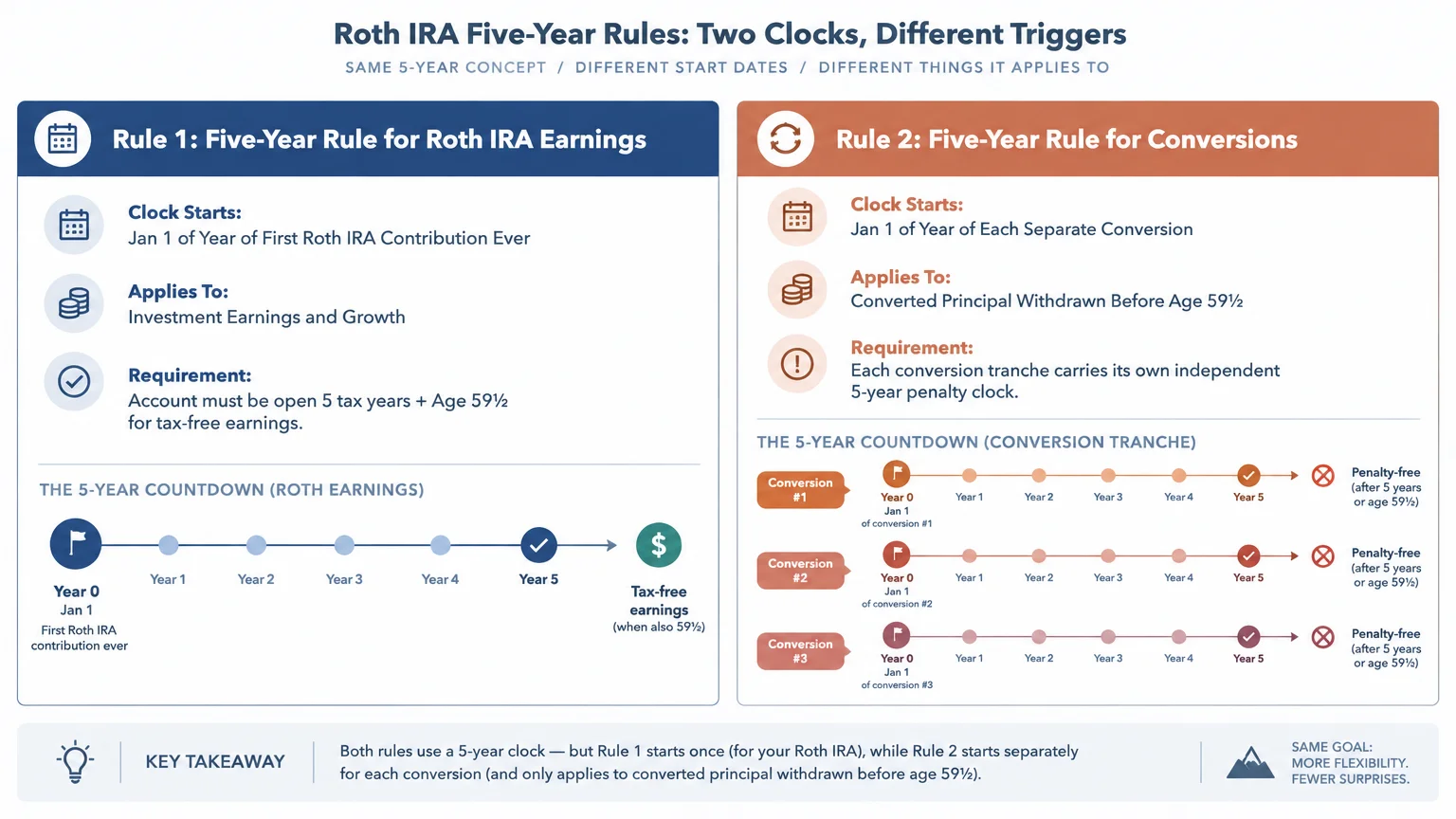
Roth IRAs carry a reputation for complete tax-free liquidity, but complex distribution rules govern converted assets. Investors frequently conflate the two separate five-year rules enforced by the IRS.
The first rule governs converted principal. Each individual Roth conversion carries its own five-year waiting period, which begins on January 1 of the tax year the conversion occurs.
If you are under age 59½ and withdraw converted principal before that specific five-year clock expires, the IRS imposes a 10% early withdrawal penalty. This rule prevents taxpayers from using conversions to dodge early distribution penalties.
The second rule governs investment earnings across all your Roth accounts. To withdraw accumulated investment earnings tax-free and penalty-free, you must meet two concurrent conditions.
You must reach age 59½, and at least five tax years must have elapsed since your very first contribution to any Roth IRA. Unlike the conversion clock, this account-level clock begins once and never resets.
Withdrawing earnings before satisfying both conditions subjects those gains to ordinary income tax and potential penalties. Track each conversion year carefully to prevent accidental distribution penalties.
“It’s not how much money you make, but how much money you keep, how hard it works for you, and how many generations you keep it for.” — Robert Kiyosaki
Errors That Cost Families Thousands
Beyond the primary execution mistakes, secondary tax traps can silently undermine your household balance sheet. These ancillary costs often catch retirees by surprise during tax season.
A primary trap is the Social Security “tax torpedo.” Adding conversion income to your tax return increases your provisional income, accelerating the taxation of your federal benefits.
Provisional income thresholds have remained frozen for decades without indexing for inflation. If provisional income exceeds $25,000 for singles or $32,000 for joint filers, up to 50% of your benefits face taxation.
Crossing $34,000 for singles or $44,000 for married couples makes up to 85% of Social Security benefits taxable. You can view current benefit taxation guidelines through the Social Security Administration.
Another costly pitfall involves the Net Investment Income Tax (NIIT). Conversions can push your modified adjusted gross income past $200,000 for singles or $250,000 for joint filers.
While the conversion amount itself is not subject to the 3.8% NIIT, the extra income exposes your dividends and capital gains to the surcharge. This unexpected tax bump reduces the net return on your taxable portfolio.
Missing the annual calendar deadline also ruins conversion plans. Unlike direct IRA contributions, which can occur up to April 15, Roth conversions must settle by December 31 of the applicable tax year.
Finally, remember that Roth conversions are completely permanent. Tax law eliminated recharacterizations, meaning you cannot undo a conversion if the market declines or your tax bill arrives higher than expected.
Key 2026 Thresholds: Planning Your Roth Conversion Strategy
Executing an effective Roth conversion strategy requires balancing bracket limits against benefit thresholds. The table below outlines key federal income boundaries to track during the 2026 tax year.
| Income Metric / Surcharge Rule | Single Filer Threshold (2026) | Married Filing Jointly (2026) | Financial Impact of Crossing Boundary |
|---|---|---|---|
| 12% Federal Tax Bracket Ceiling | $50,400 taxable income | $100,800 taxable income | Marginal tax rate jumps from 12% directly to 22% |
| 22% Federal Tax Bracket Ceiling | $105,700 taxable income | $211,400 taxable income | Marginal tax rate increases from 22% to 24% |
| 24% Federal Tax Bracket Ceiling | $201,775 taxable income | $403,550 taxable income | Marginal tax rate jumps from 24% directly to 32% |
| ACA Health Subsidy Cliff (400% FPL) | $62,600 MAGI | $84,600 MAGI (2-person) | 100% loss of marketplace health insurance premium credits |
| Medicare IRMAA Tier 1 Entry | $109,000 MAGI | $218,000 MAGI | Part B premium jumps to $284.10/mo plus $14.50/mo Part D surcharge |
| Net Investment Income Tax (NIIT) | $200,000 MAGI | $250,000 MAGI | 3.8% surtax applies to investment income, interest, and dividends |
| Social Security 85% Taxable Tier | $34,000 provisional | $44,000 provisional | Up to 85% of Social Security retirement benefits subject to income tax |
Monitoring these thresholds ensures your conversion dollars generate positive after-tax value. Precise income tracking prevents small distribution errors from generating massive, unintended tax bills.
Always incorporate standard deductions ($16,100 Single / $32,200 MFJ in 2026) when calculating how much IRA money fits inside your target bracket. Review IRS publications at the official IRS portal before executing transfers.

When to Get Expert Help
Roth conversions involve multi-year modeling and irreversible tax consequences. Working with certified professionals ensures you avoid expensive traps and optimize lifetime wealth preservation.
A Certified Public Accountant (CPA) or Enrolled Agent (EA) can run multi-year tax projections. They model the exact impact of conversions on state tax obligations, itemized deductions, and credit phaseouts.
A fee-only Certified Financial Planner (CFP) can assess how Roth conversions fit into your long-term estate and income plan. Fiduciary planners coordinate conversions with Social Security start dates, pension distributions, and legacy goals.
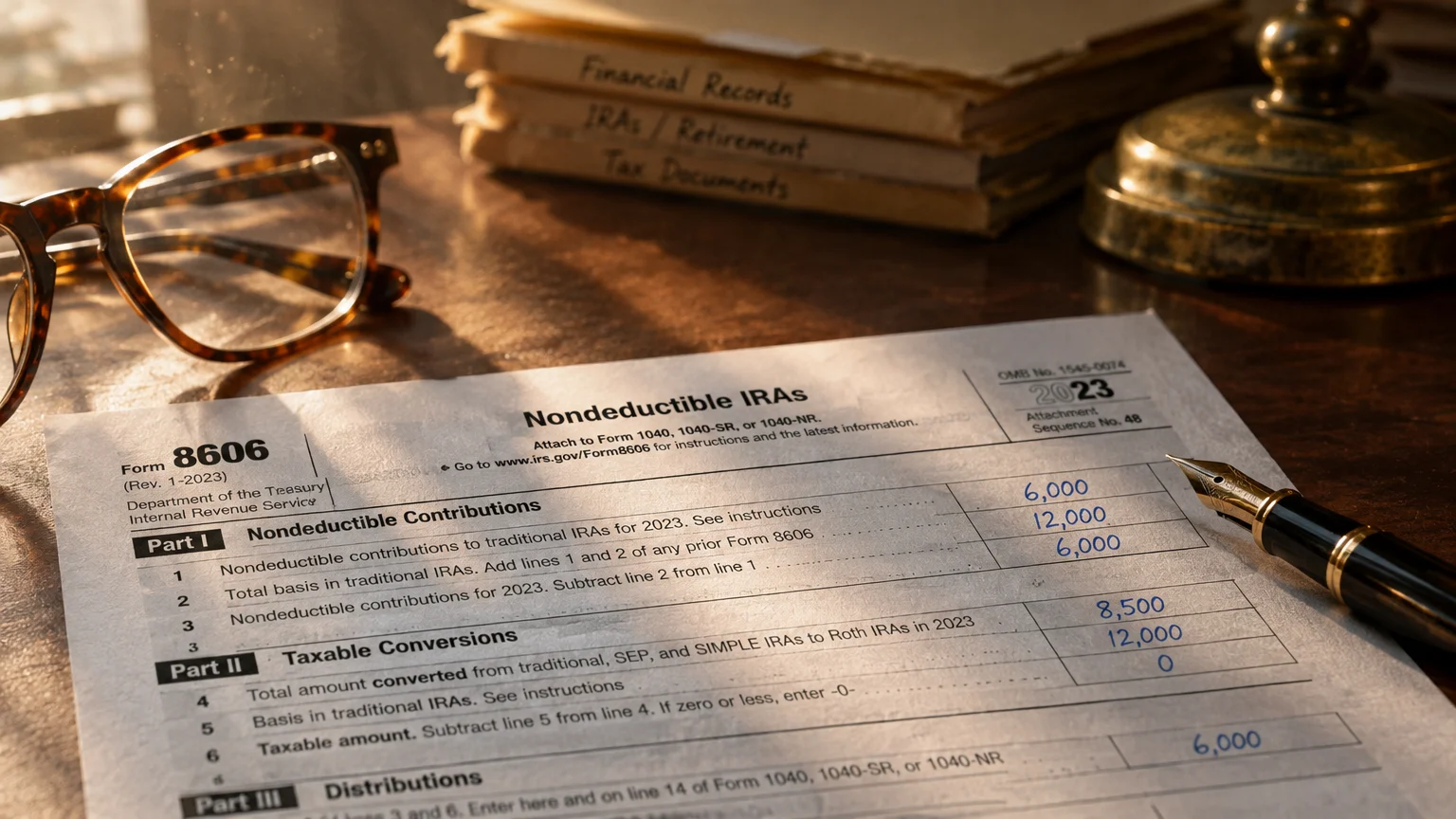
Seek specialized advice if you own complex traditional IRAs containing nondeductible contributions. A tax professional ensures proper compliance with IRS Form 8606 reporting requirements.
Professional guidance is equally critical if you rely on ACA health coverage between ages 60 and 64. A single conversion miscalculation can wipe out thousands of dollars in vital premium subsidies.
Frequently Asked Questions About Roth Conversions
What is the annual deadline to complete a Roth IRA conversion?
You must complete a Roth conversion by December 31 of the calendar year in which you want the income taxed. Unlike regular IRA contributions, there is no April 15 extension for conversions.
Can I undo a Roth conversion if the stock market drops?
No. Federal tax law permanently eliminated the ability to recharacterize or reverse a Roth IRA conversion. Once the conversion transaction settles, your tax liability is locked in permanently.
Do Roth IRA conversions count as earned income for IRA contribution limits?
No, the IRS treats Roth conversion amounts as unearned taxable income. You cannot use conversion proceeds to establish eligibility for making annual IRA or Roth IRA contributions.
How does a Roth conversion affect my state income taxes?
Most states treat converted IRA balances as ordinary taxable income, mirroring federal tax treatment. Savers living in states with steep income taxes face an additional state tax bill on conversion balances.
Take time to review your total projected income, healthcare subsidies, and tax brackets before moving assets into a Roth account. A strategic, multi-year conversion schedule will protect your balance sheet while building substantial tax-free wealth.
This article is for informational purposes only and does not constitute financial, legal, or tax advice. Rates, benefit amounts, and tax rules change regularly—verify current details with the relevant agency or a licensed professional.
Last updated: November 2026. Rates, benefit amounts, and tax rules change—always verify current details at official sources.