
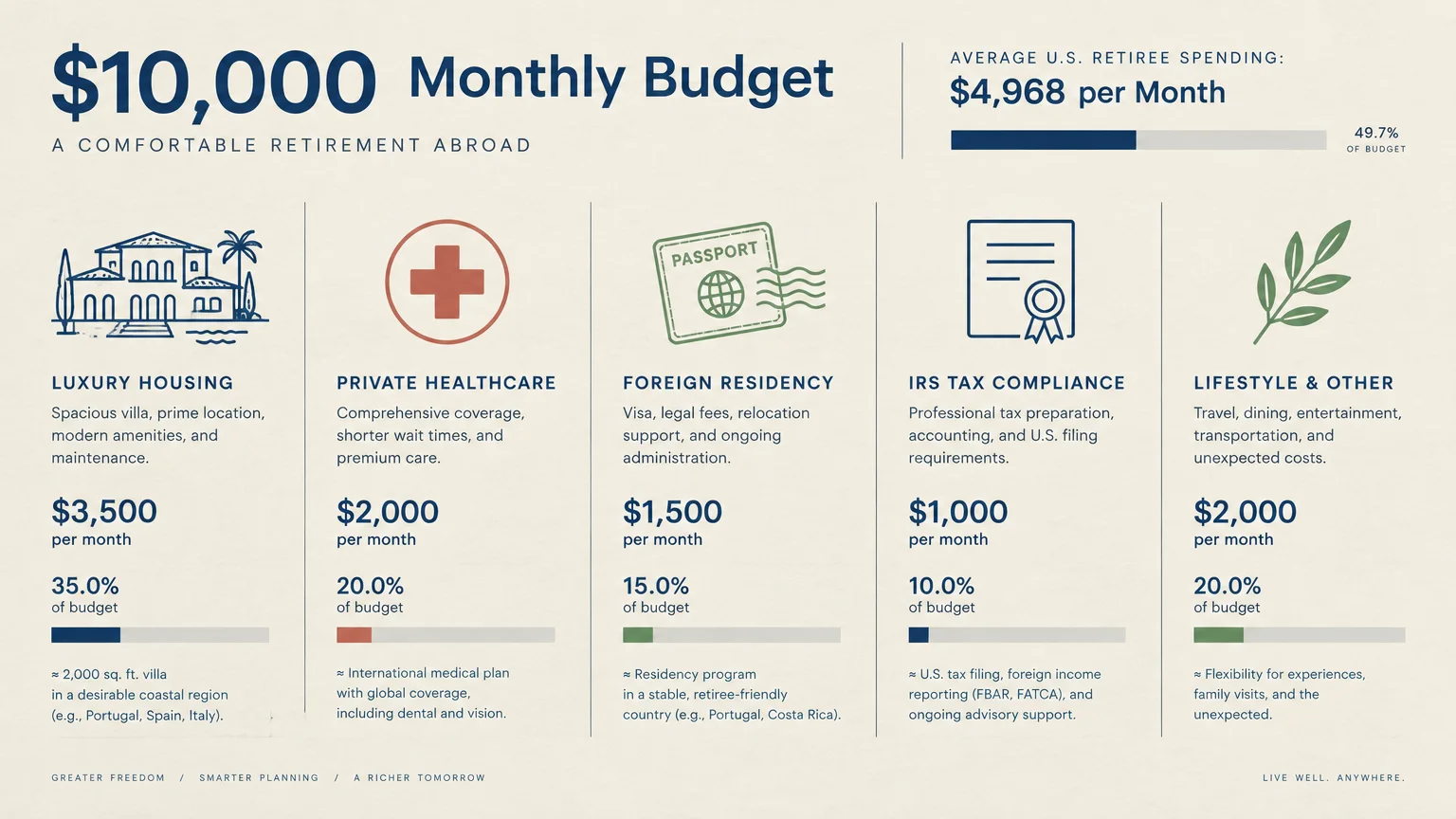
Retiring with a budget of $10,000 per month puts you in an enviable financial position. That annual income of $120,000 represents roughly double what the typical American retiree household spends each year.
While ten thousand dollars provides a comfortable life in the United States, taking those funds overseas transforms your lifestyle entirely. You can transition from tracking ordinary living costs to enjoying an authentic luxury retirement.
Understanding how far your money stretches across popular places to retire requires looking closely at visas, housing, and healthcare. Five standout countries show the dramatic lifestyle upgrade your purchasing power creates abroad.
What You Need to Know
- A $10,000 monthly budget provides more than double the average U.S. retiree household expenditure of $4,968 per month.
- You can easily meet the strict residency income minimums in top expat hubs across Europe, Latin America, and Southeast Asia.
- In destinations like Thailand and Mexico, this income level funds full-time domestic household staff, luxury housing, and private medical care.
- European destinations like Spain and Portugal offer high cultural immersion and world-class infrastructure while leaving thousands in monthly savings.
- American citizens must continue filing federal taxes, requiring proactive planning around foreign bank reporting and healthcare coverage.
The Purchasing Power of a $10,000 a Month Retirement
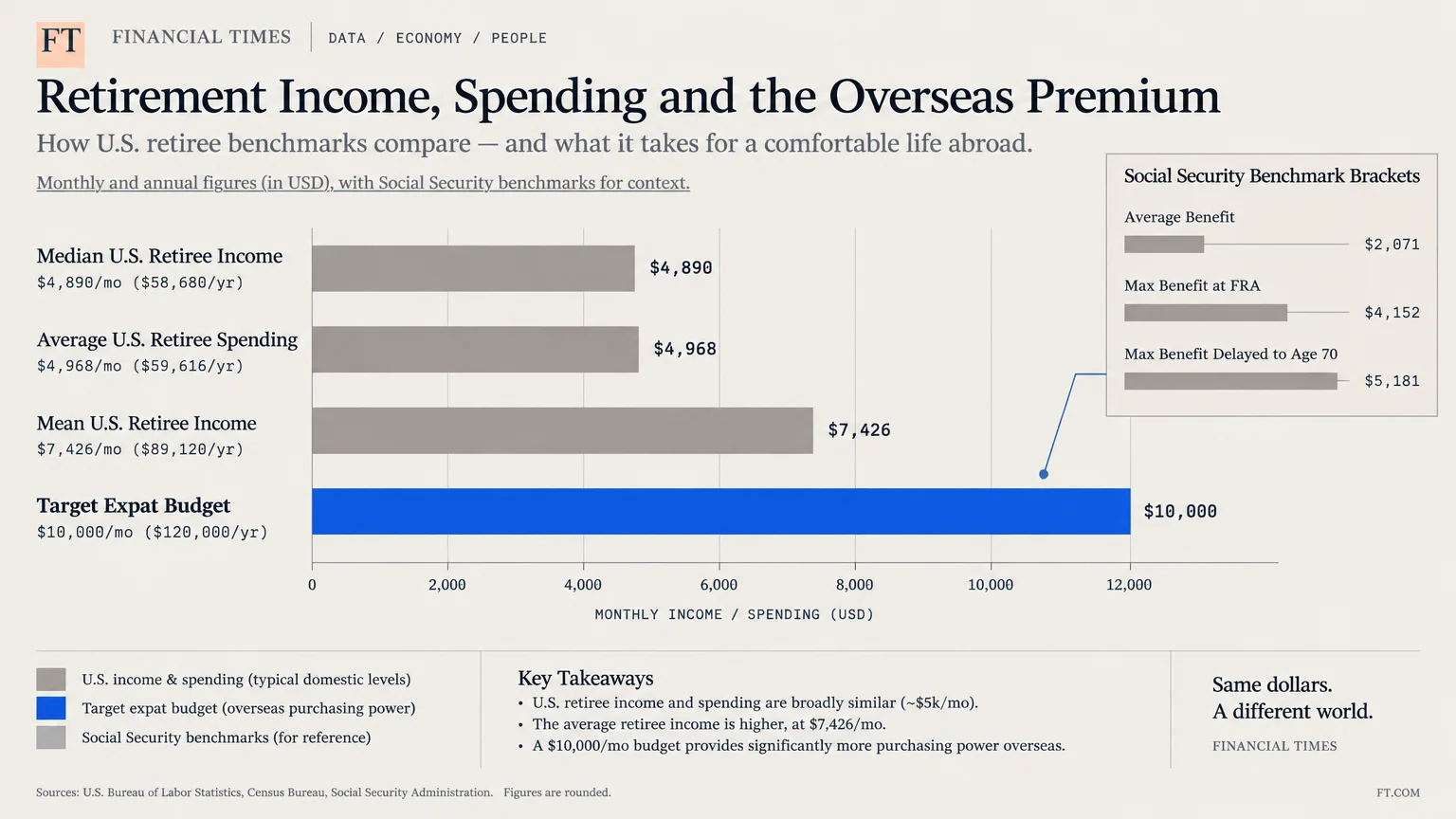
To grasp the strength of a $10,000 monthly income, look at national benchmarks back home. You are operating with significant financial muscle compared to standard retirement profiles.
According to data from the Bureau of Labor Statistics, average U.S. retiree household spending reached $59,616 per year in 2025. That equates to $4,968 per month across all basic living categories.
Income figures tell an identical story. For households aged 65 and older, median annual retirement income sits at $58,680, or $4,890 each month.
Mean retirement income reaches $89,120 annually, which equals $7,426 per month. A monthly cash flow of $10,000 surpasses both numbers by wide margins.
Social Security checks contribute meaningfully toward that target. Following a 2.8% cost-of-living adjustment, the average retired worker benefit stands at $2,071 per month.
High earners collect even more substantial support from the Social Security Administration. The maximum benefit reaches $4,152 per month at full retirement age for workers born in 1960 or later.
Those who delay claiming until age 70 receive up to $5,181 per month. An upcoming 3.6% COLA increase taking effect in January 2027 will lift these thresholds further.
When you combine pensions, investment portfolios, and Social Security to produce $10,000 monthly, you hold massive leverage. In many foreign markets, this income lets you live like royalty.
“It’s not how much money you make, but how much money you keep, how hard it works for you, and how many generations you keep it for.” — Robert Kiyosaki

Mexico: High-End Living Close to Home
Mexico remains one of the most popular places to retire for North Americans. Close geographic proximity, established expat enclaves, and familiar retail options make the transition seamless.
In July 2025, Mexican immigration authorities modernized their solvency rules. Economic solvency requirements now tie directly to the Unidad de Medida y Actualización (UMA), valued at MXN $117.31 per day.
Temporary Residency demands 680 times the daily UMA in monthly income, translating to roughly $4,430 to $4,630 USD monthly. Permanent Residency requires 1,140 times the daily UMA, or approximately $7,430 USD per month.
With a $10,000 monthly budget, you bypass temporary status entirely. You qualify immediately for permanent residency on your initial consulate visit.
In premier communities like San Miguel de Allende, Lake Chapala, or Puerto Vallarta, housing takes top priority. You can rent a fully furnished, three-bedroom luxury villa with a private swimming pool for $2,500 to $3,500 monthly.
Domestic staffing is remarkably accessible throughout Mexico. Retaining a full-time housekeeper, dedicated gardener, and part-time private cook costs between $700 and $1,100 per month.
Private healthcare services in Mexico rival top American hospital networks at a fraction of the cost. Major medical insurance with international coverage runs roughly $350 to $500 monthly for retirees in their sixties.
Dining out daily at upscale bistros, booking coastal weekend trips, and hosting private events requires about $1,800 monthly. Even after living extravagantly, you will bank $3,000 or more every month.
Sample $10,000 Monthly Budget in Puerto Vallarta
- Luxury 3-bedroom oceanview condo: $3,200
- Utilities, fiber internet, and climate control: $350
- Full-time housekeeper and private cook: $900
- Comprehensive private health insurance: $450
- Groceries and premium imported goods: $600
- Fine dining, marina entertainment, and social clubs: $1,400
- Private transportation and vehicle upkeep: $400
- Surplus savings or international travel: $2,700

Portugal: European Charm and Coastal Elegance
Portugal stands out as a premier destination for retirees pursuing European culture, historic architecture, and Atlantic views. The sunny Algarve and affluent Cascais corridor outside Lisbon attract discerning retirees worldwide.
The standard immigration path for self-funded retirees is the D7 Passive Income Visa. This visa requires proof of recurring passive income equal to 100% of the Portuguese minimum wage.
Following recent statutory wage increases, a primary applicant must prove €920 per month, or €11,040 annually. Sponsoring a spouse adds 50%, or €460 per month.
You must also deposit 12 months worth of qualifying funds into a local Portuguese bank account. Your $10,000 monthly budget clears these baseline financial hurdles many times over.
Keep immigration timelines in mind as you map your long-term residency. Under Lei Orgânica 1/2026, enacted in May 2026, the residency period required for non-EU citizens to seek citizenship increased from 5 to 10 years.
A $10,000 monthly income funds an upscale lifestyle in coastal Portugal. In the central Algarve, you can secure a modern three-bedroom townhouse with ocean views for €2,800 to €3,600 per month.
Grocery shopping in Portugal is both affordable and high quality. Stocking your pantry with fresh regional produce, local seafood, artisanal cheeses, and award-winning wines costs around €600 monthly.
Comprehensive private health insurance from top European carriers costs €250 to €450 monthly per couple. This coverage grants direct access to state-of-the-art private hospitals like CUF and Hospital da Luz.
Even with frequent dining at Michelin-starred venues and regional travel across Europe, your total monthly spending rarely exceeds €6,500. You maintain a wide monthly cash cushion.
Sample $10,000 Monthly Budget in the Algarve
- Furnished seaside villa or modern townhouse: $3,400 (€3,100)
- Utilities, heating, and high-speed internet: $350 (€320)
- Bi-weekly housekeeping and garden maintenance: $450 (€410)
- Private European health insurance: $400 (€365)
- Gourmet groceries, fresh fish, and local markets: $650 (€590)
- Fine dining, regional wines, and golf memberships: $1,600 (€1,460)
- Rental car lease and fuel: $550 (€500)
- Discretionary savings and European exploration: $2,600 (€2,370)

Costa Rica: Tropical Serenity and Sustainable Comfort
Costa Rica appeals to retirees seeking biodiverse landscapes, pristine Pacific beaches, and a relaxed pace of life. Known for its stable democracy, the country provides reliable legal frameworks for foreign residents.
The government offers two distinct pathways for retirees. The Pensionado visa requires a guaranteed lifetime pension of at least $1,000 per month, easily satisfied by Social Security.
If you rely on distributions from investment portfolios, the Rentista visa serves as the appropriate channel. This option requires proving $2,500 monthly in unearned income guaranteed for at least two years.
Every foreign resident must enroll in and pay monthly sliding-scale dues to the Caja Costarricense de Seguro Social (CCSS). Temporary residents become eligible to apply for permanent residency status after three continuous years.
Ten thousand dollars each month delivers an elevated lifestyle along the Gold Coast of Guanacaste or in the Central Valley hills. You can lease an executive estate inside a gated community for $2,700 to $3,800 monthly.
Imported vehicles face steep local tariffs, so budgeting for a reliable four-wheel-drive SUV is essential. Leasing or operating a premium vehicle runs roughly $700 monthly including insurance.
Private clinics like CIMA Hospital in San José deliver medical care that matches American standards. Maintaining supplemental private international coverage alongside mandatory Caja contributions costs around $400 monthly.
Employing a full-time gardener and daily housekeeper costs roughly $800 per month. Living costs leave you with ample discretionary funds to explore rain forests, volcanic hot springs, and coastal resorts.
Sample $10,000 Monthly Budget in Guanacaste
- Executive gated-community home with private pool: $3,500
- Electric utilities, air conditioning, and internet: $450
- Full-time housekeeper and groundskeeper: $850
- Mandatory Caja fee plus private global health insurance: $600
- Fresh local groceries, organic produce, and meats: $700
- Dining out, beach club access, and outdoor activities: $1,300
- Vehicle lease, fuel, and registration: $750
- Surplus discretionary reserve: $1,850

Spain: Mediterranean Culture and Rich History
Spain combines historic architecture, vibrant urban centers, and relaxed Mediterranean coastal enclaves. Retirees gravitate to areas like the Costa del Sol, Alicante, and Valencia for reliable sunshine and exceptional food.
The Non-Lucrative Visa (NLV) serves as the primary gateway for foreign retirees. This residence authorization strictly prohibits all employment and remote professional work.
Spain calculates financial solvency using the IPREM benchmark index, currently set at €600 per month. The primary applicant must demonstrate 400% of the IPREM, which equals €2,400 monthly or €28,800 annually.
Each dependent family member requires an additional 100% of the IPREM, or €600 monthly (€7,200 annually). Your $10,000 monthly income satisfies Spanish government thresholds without difficulty.
Housing on the Costa del Sol or in historic Valencia offers exceptional value compared to domestic coastal cities. A luxury penthouse overlooking the Mediterranean rents for €2,600 to €3,500 per month.
Spain boasts one of the most efficient high-speed rail networks in the world. You can travel from coastal towns to Madrid or Barcelona in a few hours without keeping a personal automobile.
Spanish visa rules require non-EU applicants to secure comprehensive private health insurance with zero copayments from an authorized domestic provider. A policy for an older couple typically costs €300 to €500 per month.
Dining at traditional tapas bars, buying local wines, and attending cultural festivals costs about €1,500 monthly. A $10,000 monthly cash flow lets you enjoy Spanish culture without monitoring daily expenditures.
Sample $10,000 Monthly Budget on the Costa del Sol
- Luxury beachfront apartment or Marbella villa: $3,300 (€3,000)
- Utilities, air conditioning, water, and fiber internet: $320 (€290)
- Weekly deep cleaning and household assistance: $400 (€365)
- Zero-copay private health insurance policy: $450 (€410)
- Groceries, Mediterranean produce, and wines: $600 (€550)
- Dining out, cultural events, and social clubs: $1,500 (€1,365)
- High-speed rail travel and regional transit: $350 (€320)
- Discretionary savings and lifestyle surplus: $3,080 (€2,800)

Thailand: Unmatched Five-Star Value in Southeast Asia
Thailand delivers the most dramatic purchasing power expansion of any major retirement hub. Areas like Chiang Mai, Phuket, and Hua Hin combine modern urban conveniences with Southeast Asian hospitality.
Affluent retirees should target Thailand’s Long-Term Resident (LTR) Visa under the Wealthy Pensioner category. This visa grants a renewable 10-year residency permit for individuals aged 50 and older.
The Wealthy Pensioner track requires at least $80,000 per year ($6,667 per month) in regular passive or pension income. Your $10,000 monthly income easily surpasses this threshold.
The LTR visa requires health insurance with minimum coverage of $50,000 or a $100,000 cash deposit. It carries a one-time application fee of 50,000 THB (roughly $1,400 USD).
Most importantly, the LTR visa provides complete exemption from Thai personal income tax on foreign-sourced earnings brought into the country. That single provision saves you substantial tax friction.
Living on $10,000 per month in Thailand places you in the upper tier of luxury retirement. In Phuket or Hua Hin, you can lease a private four-bedroom villa with a landscaped garden and pool for $2,500 to $3,500 monthly.
Household assistance is accessible at rates unseen in Western countries. Employing a live-in housekeeper, full-time cook, and private driver costs between $1,200 and $1,800 monthly combined.
Medical infrastructure in Thailand is famous for medical tourism excellence. Internationally accredited facilities like Bumrungrad Hospital in Bangkok deliver immediate, world-class medical attention.
Even with daily massage therapy, yacht charters, and dinners at luxury resort restaurants, spending $10,000 monthly is a challenge. Most retirees bank at least $3,500 each month without trying.
Sample $10,000 Monthly Budget in Phuket
- Private pool villa near the coast: $2,800
- Electricity, air conditioning, water, and gigabit internet: $400
- Full-time housekeeper, private cook, and chauffeur: $1,400
- Comprehensive global medical insurance: $450
- Imported groceries and premium local markets: $550
- Resort dining, daily wellness spas, and boat outings: $1,200
- Vehicle maintenance, fuel, and upkeep: $300
- Unspent liquid surplus: $2,900
“A budget is telling your money where to go instead of wondering where it went.” — John C. Maxwell
Cost of Living and Visa Comparison Across Destinations
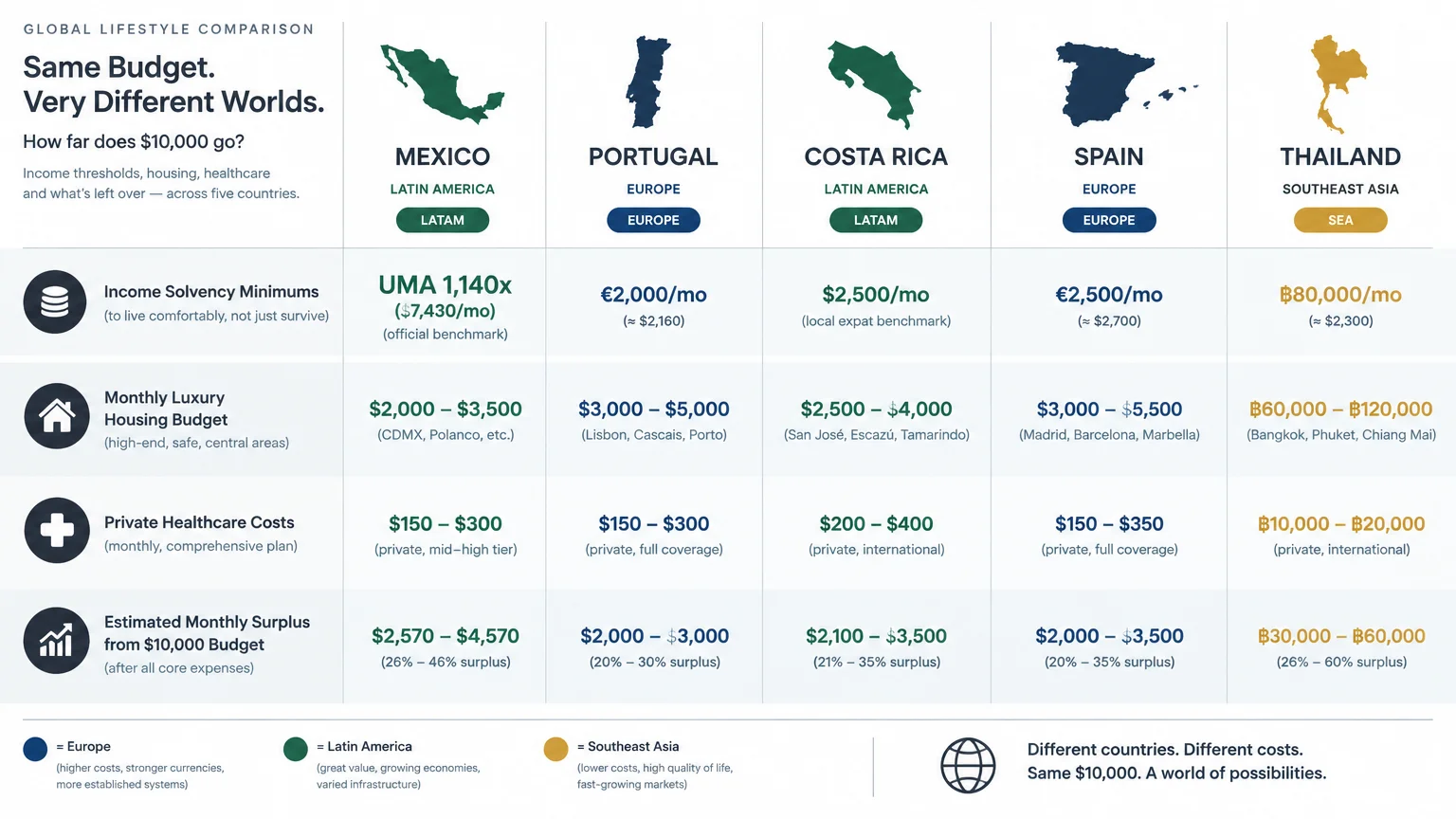
Evaluating popular retirement destinations side by side helps clarify how each country handles immigration hurdles, housing markets, and lifestyle costs. Your purchasing power shifts based on regional economic dynamics.
The table below outlines the core financial requirements, typical high-end expenses, and lifestyle upgrades available under a $10,000 monthly budget.
| Destination | Visa Minimum Income | Luxury Housing (Monthly) | Healthcare (Monthly) | Domestic Staffing | Lifestyle Character |
|---|---|---|---|---|---|
| Mexico | $7,430 (Permanent) | $2,500 – $3,500 | $350 – $500 | Full-time ($700–$1,100) | Vibrant, close to U.S., relaxed |
| Portugal | €920 single / €1,380 couple | €2,800 – €3,600 | €250 – €450 | Part-time (€400–€600) | Old-world European, coastal, secure |
| Costa Rica | $1,000 (Pension) / $2,500 (Rent) | $2,700 – $3,800 | $400 – $600 | Full-time ($700–$900) | Eco-focused, tropical, active |
| Spain | €2,400 single + €600 dep. | €2,600 – €3,500 | €300 – €500 | Part-time (€350–€550) | Cosmopolitan, culinary, walkable |
| Thailand | $6,667 ($80k/yr LTR) | $2,200 – $3,200 | $350 – $500 | Full-time team ($1,200–$1,800) | Five-star resort living, tropical |

Expat Healthcare Realities and Medicare Limitations
Managing healthcare represents one of the most critical adjustments for Americans retiring abroad. Many retirees mistakenly believe their domestic health benefits travel with them across international borders.
As detailed by Medicare.gov, standard Medicare provides virtually zero coverage for medical services rendered outside the United States. Foreign medical providers cannot submit claims to Medicare.
Retirees living overseas must decide whether to retain Medicare Part B. Maintaining Part B requires paying ongoing monthly premiums while receiving no care abroad.
If you drop Part B and later return to reside permanently in the United States, you will incur permanent lifetime late-enrollment penalties. Most expat advisors recommend keeping Part B if you visit the U.S. regularly.
To bridge the care gap abroad, expat retirees rely on private International Private Medical Insurance (IPMI). These comprehensive policies cover emergency hospitalizations, routine specialist consultations, and emergency medical evacuations.
Because healthcare in places like Spain, Mexico, and Thailand costs a fraction of American rates, paying out-of-pocket for routine prescriptions and dentist visits is often trivial. High-deductible international catastrophic policies keep total insurance costs manageable.

Managing Expat Taxes and IRS Reporting Requirements
Relocating overseas does not release you from American tax filing responsibilities. The United States is one of only two countries that taxes citizens based on citizenship rather than geographic residency.
You must file an annual federal tax return with the Internal Revenue Service regardless of where you make your home. Guidance from IRS Retirement Plans outlines how distributions from IRAs, 401(k) accounts, and pensions remain taxable.
Moving abroad triggers additional information filings. The Report of Foreign Bank and Financial Accounts (FBAR) requires filing FinCEN Form 114 if your aggregate foreign account balances exceed $10,000 at any point during the calendar year.
The Foreign Account Tax Compliance Act (FATCA) mandates submitting Form 8938 with your annual tax return once your foreign financial assets surpass specific reporting thresholds. Failing to submit these disclosure documents triggers severe civil penalties.
Double-taxation treaties between the United States and host nations help mitigate overlapping tax burdens. Using the Foreign Tax Credit (FTC) often offsets local income taxes paid against your domestic federal tax bill.

Common Money Traps for Overseas Retirees
Transitioning into a luxury retirement overseas requires navigating practical money hurdles. Avoiding unforced financial errors protects your monthly cash flow from unnecessary erosion.
Purchasing residential property immediately upon arrival is a common trap. Renting for at least 12 months lets you experience regional weather, neighborhood quirks, and local infrastructure before locking up capital.
Failing to plan for foreign currency fluctuations creates unexpected budget friction. If the U.S. dollar softens against the Euro, your fixed-dollar income converts into fewer Euros each month.
Holding several months of living expenses in local currency within host-country accounts shields you from daily exchange volatility. You can time currency conversions when rates favor the dollar.
Overlooking state-level tax domicile rules creates another financial pitfall. States like California, New York, and Virginia may continue asserting taxing authority over your income unless you cleanly sever residency ties before moving.

When to Consult a Professional
Moving abroad with an upper-tier retirement income involves overlapping legal and financial frameworks. Assembling an experienced advisory team before departure saves thousands of dollars and prevents administrative delays.
Work with a fee-only fiduciary financial planner who specializes in cross-border wealth management. They can structure retirement account withdrawals to minimize tax drag across both jurisdictions.
Engage a Certified Public Accountant (CPA) or Enrolled Agent experienced in expatriate taxation. They will manage FBAR, FATCA, and state tax exit requirements accurately.
Hire a licensed immigration attorney based inside your target country. Local attorneys navigate consulate quirks, document legalization, and residency appointments far faster than individuals attempting to self-file.
Frequently Asked Questions
Can I collect my Social Security benefits while living abroad?
Yes. The Social Security Administration deposits monthly retirement payments directly into foreign bank accounts in most countries worldwide, including Mexico, Portugal, Spain, Costa Rica, and Thailand.
Do I have to pay taxes in both the U.S. and my new home country?
You must file tax returns in both jurisdictions. However, bilateral tax treaties and mechanisms like the Foreign Tax Credit prevent double taxation on the same income streams in most cases.
Should I keep my U.S. bank accounts open after moving overseas?
Yes. Retaining primary U.S. checking accounts, credit cards, and investment brokerages is vital for collecting Social Security, receiving retirement disbursements, and funding international currency transfers.
How does inflation affect a $10,000 monthly retirement budget overseas?
While local prices fluctuate, a $10,000 monthly income provides a wide buffer. Even in elevated inflationary cycles, high-tier budgets absorb price increases without sacrificing living standards.
Moving abroad with a $10,000 monthly budget provides rare financial freedom and unmatched lifestyle quality. Begin by selecting your preferred destination, securing professional tax counsel, and planning an extended rental visit to test the lifestyle firsthand.
Information in this article reflects rules and figures current as of the publication date and may change. Always confirm details directly with your bank, the IRS, the Social Security Administration, or other official sources before making decisions.
Last updated: November 2026. Rates, benefit amounts, and tax rules change—always verify current details at official sources.