
A sudden surge in your retirement earnings can trigger an unwelcome surprise on your monthly healthcare bills. Earning just one dollar over federal thresholds can force you to pay hundreds of dollars more each month for Medicare.
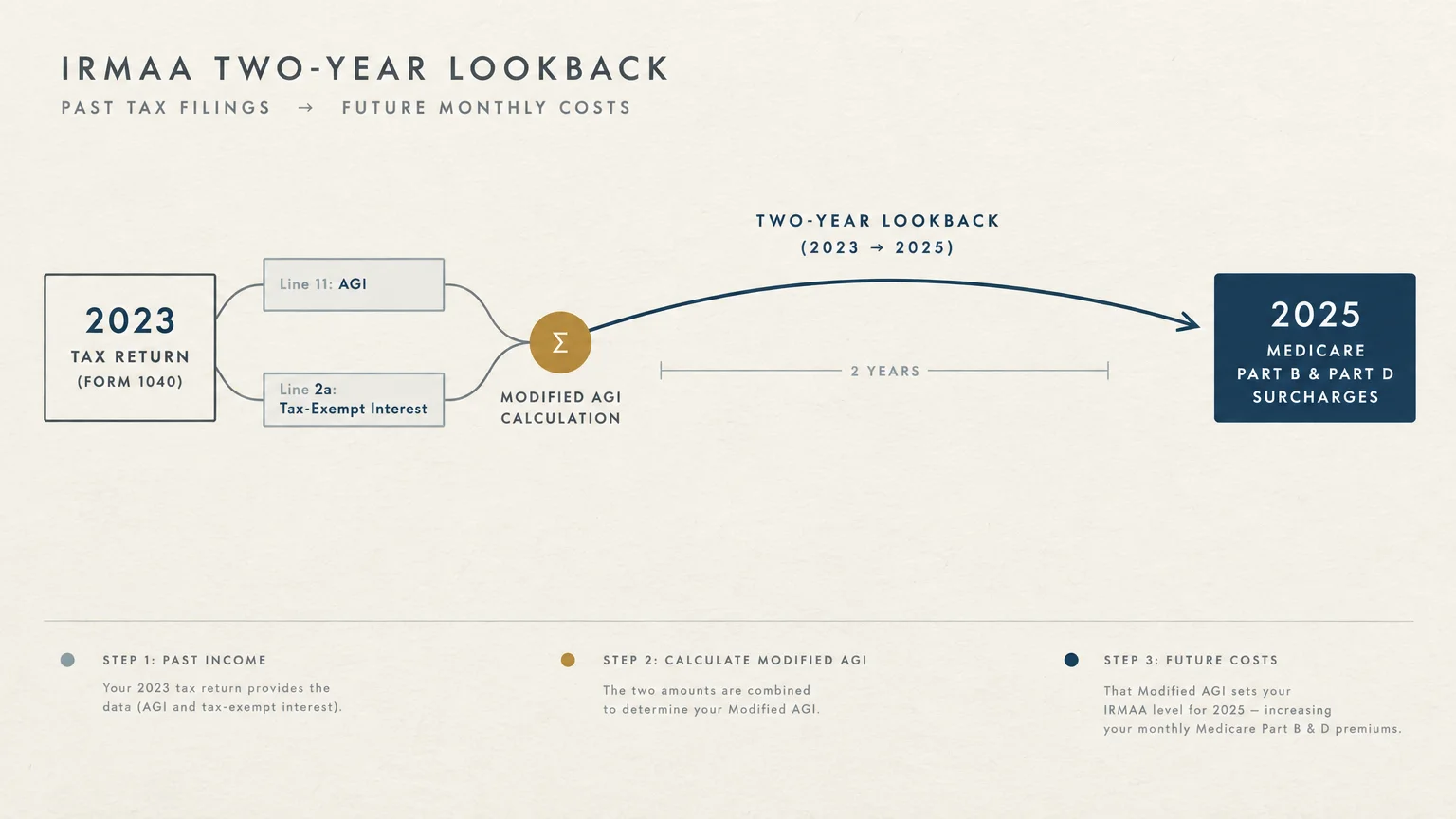
This hidden surcharge—known as the Income-Related Monthly Adjustment Amount, or IRMAA—penalizes higher earners across both Part B and Part D plans. The government determines these rate hikes by scrutinizing your tax returns from two years prior.
Knowing which revenue streams trigger these surcharges allows you to shield your wealth and protect your cash flow. Here are the eight income types that push your premiums into costly territory.
What You Need to Know About IRMAA and Medicare Surcharges
Medicare Part B covers outpatient medical services, while Part D provides prescription drug coverage. Most beneficiaries pay standard monthly rates for these programs.
However, federal law requires higher-income beneficiaries to pay an extra charge on top of standard premiums. Congress established this rule to shift more program costs onto households with higher financial resources.
The Social Security Administration calculates your extra fee using your modified adjusted gross income. They pull this data directly from your federal income tax return from two years prior.
For example, your 2025 Medicare premiums depend entirely on the tax return you filed for the 2023 tax year. Similarly, your 2026 premiums hinge on your 2024 earnings.
Unlike ordinary federal tax brackets, IRMAA does not operate marginally. If your income passes a tier threshold by a single dollar, you owe the full monthly surcharge for that entire bracket.
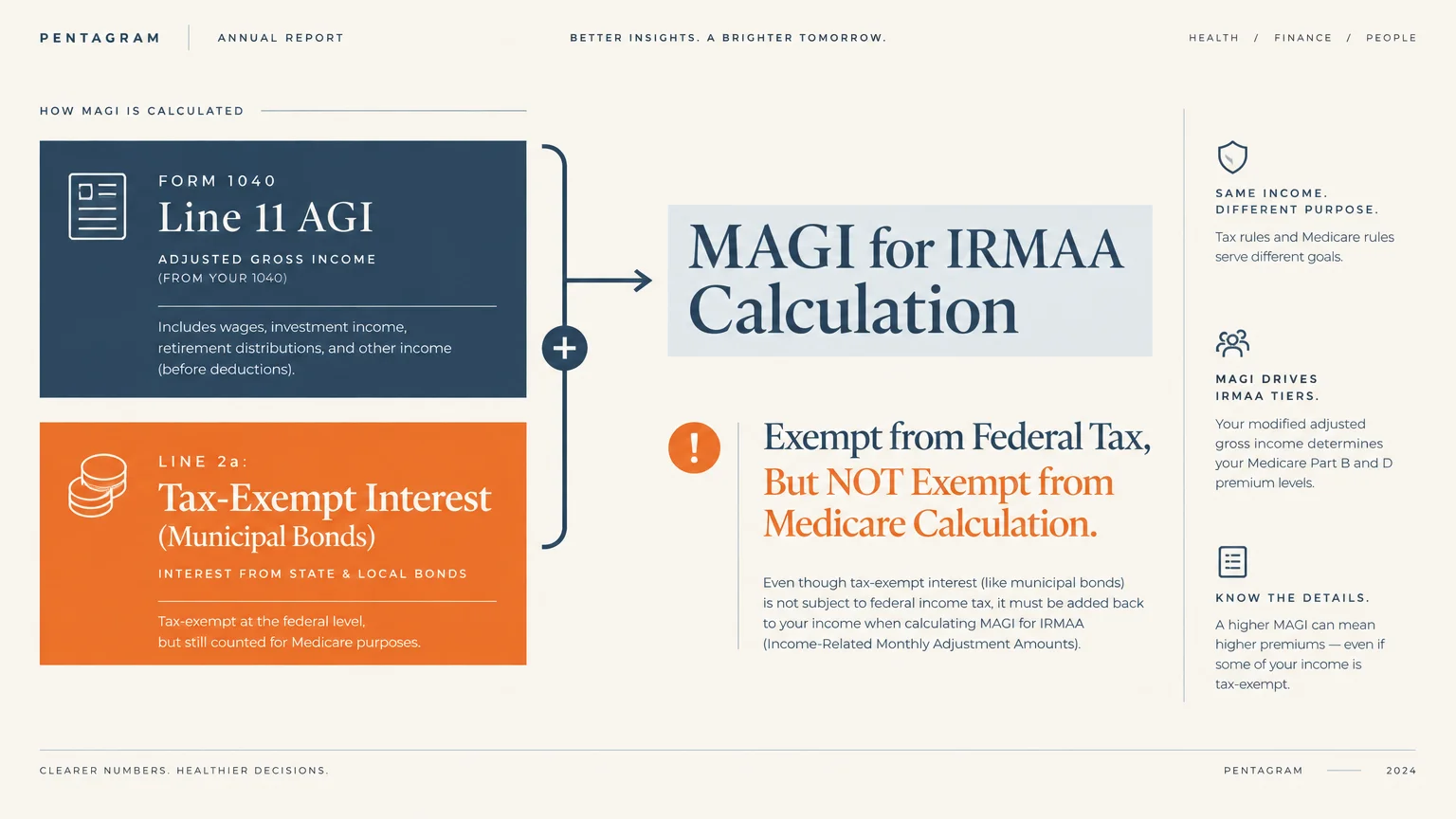
To determine if you owe a surcharge, the government uses a specific formula for modified adjusted gross income. You calculate this figure by taking your adjusted gross income from Form 1040 line 11 and adding back any tax-exempt interest income from line 2a.
Approximately 7% to 8% of all Medicare beneficiaries trigger these surcharges each year. Understanding the exact brackets prevents costly financial blind spots.
2025–2026 Medicare Premium Brackets and Surcharge Tiers
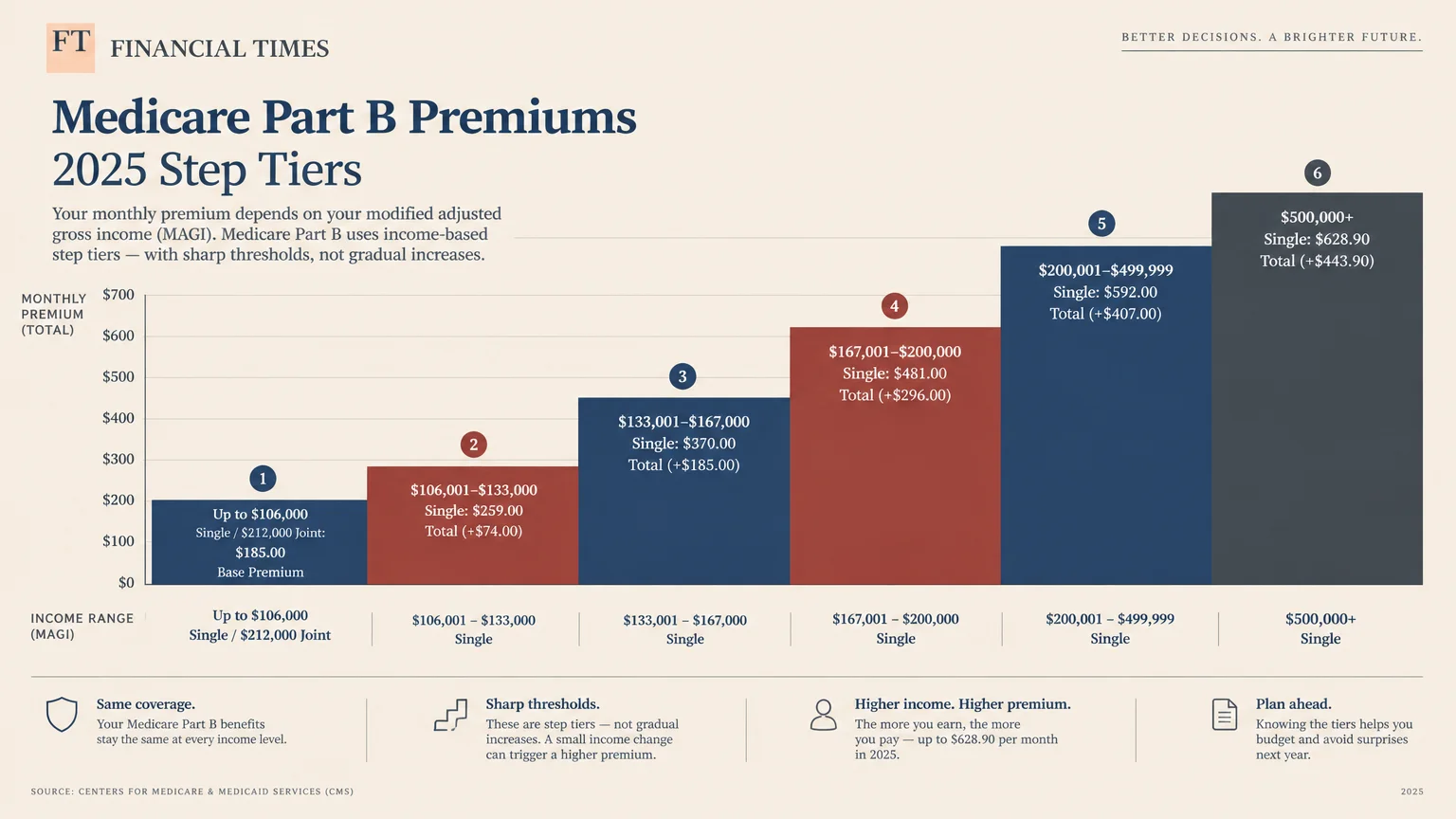
For 2025, the standard Medicare Part B monthly premium is $185.00, while the annual deductible sits at $257.00. Beneficiaries below the initial income thresholds pay this baseline amount.
Single tax filers face surcharges when their modified adjusted gross income exceeds $106,000. Married couples filing jointly trigger surcharges when combined income exceeds $212,000.
Married individuals who file separately face the strictest rules. If you lived with your spouse at any time during the year, surcharges begin as soon as your income exceeds $106,000.
Review the five income tiers below to see how different revenue levels impact your Part B and Part D costs.
| Single Filer Income (2025) | Joint Filer Income (2025) | Part B Surcharge | Total Part B Premium | Part D Extra Surcharge |
|---|---|---|---|---|
| $106,000 or less | $212,000 or less | $0.00 | $185.00 | $0.00 |
| $106,001 – $133,000 | $212,001 – $266,000 | +$74.00 | $259.00 | +$13.70 |
| $133,001 – $167,000 | $266,001 – $334,000 | +$185.00 | $370.00 | +$35.30 |
| $167,001 – $200,000 | $334,001 – $400,000 | +$296.00 | $481.00 | +$56.80 |
| $200,001 – $499,999 | $400,001 – $749,999 | +$407.00 | $592.00 | +$78.40 |
| $500,000 or more | $750,000 or more | +$443.90 | $628.90 | +$85.80 |
Part D surcharges are billed in addition to whatever private plan premium you already pay. If you fail to budget for these brackets, routine financial moves can create expensive surprises.
“It’s not how much money you make, but how much money you keep, how hard it works for you, and how many generations you keep it for.” — Robert Kiyosaki
1. Required Minimum Distributions and Pretax Withdrawals
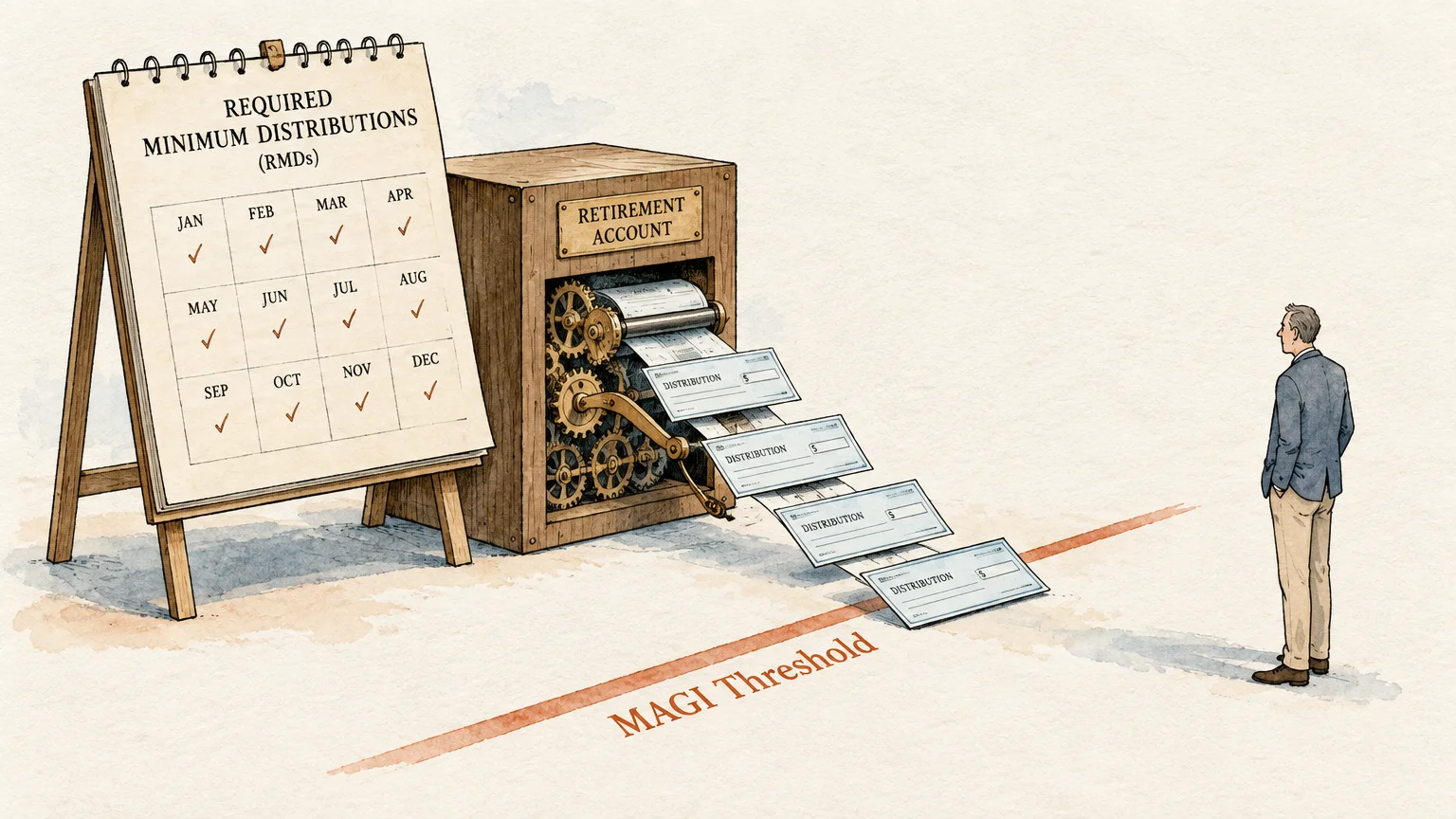
When you withdraw money from a traditional 401(k), 403(b), or traditional IRA, every dollar counts as ordinary income. These distributions flow directly onto your tax return and raise your adjusted gross income.
Under the SECURE 2.0 Act, required minimum distributions begin at age 73 for current retirees. By 2033, this starting age shifts to 75.
Because you cannot decline an RMD, large account balances force substantial taxable withdrawals into your tax year. These mandatory distributions frequently push retirees across the initial $106,000 or $212,000 income thresholds.
Even voluntary withdrawals taken before age 73 inflate your adjusted gross income dollar for dollar. Carefully mapping out withdrawals before reaching age 73 helps prevent this automatic escalation.

2. Roth IRA Conversions
Converting pretax retirement funds into a Roth IRA provides tax-free growth and tax-free withdrawals for life. Many retirees pursue conversions to eliminate future required minimum distributions.
However, the full amount converted counts as taxable ordinary income in the calendar year you execute the transfer. If you convert $80,000 from a traditional IRA to a Roth account, your adjusted gross income increases by $80,000.
Due to the two-year lookback rule, a major Roth conversion completed in 2024 will inflate your Medicare premiums throughout 2026. Many retirees overlook this delayed penalty when executing aggressive conversions.
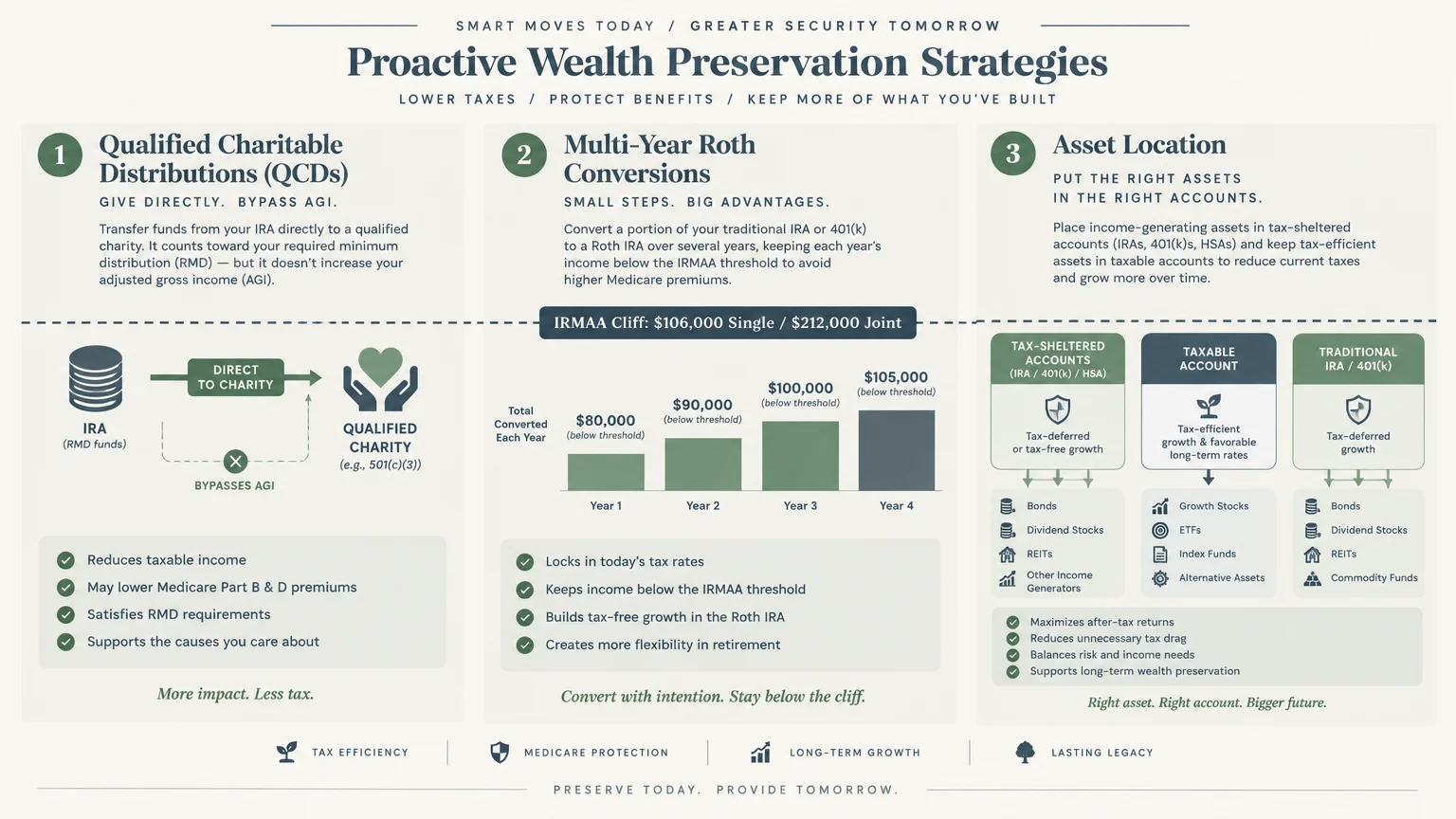
You can manage this risk by breaking large conversions into smaller, multi-year installments. Keeping your total income just below the nearest Medicare premium brackets preserves your healthcare savings.

3. Capital Gains from Stocks, Crypto, and Real Estate
Selling appreciated investments in a taxable brokerage account creates net capital gains. Both short-term gains and long-term capital gains land directly on IRS Schedule D.
Long-term capital gains receive preferential tax rates, often topping out at 15% or 20%. However, preferential tax treatment does not shield this money from your modified adjusted gross income.
Every dollar of taxable gain flows into your adjusted gross income on line 11 of Form 1040. Liquidating an equity portfolio, trading cryptocurrencies, or selling a rental property can trigger an immediate jump in your Medicare Part B surcharge.
If you rebalance your investment portfolio, consider harvesting tax losses to offset your gains. Timing these transactions across multiple tax years prevents sudden single-year spikes.

4. Home Sales Exceeding Section 121 Exclusion Limits
Downsizing your primary residence is a standard retirement milestone. Under Section 121 of the Internal Revenue Code, married couples can exclude up to $500,000 of home sale gain from income, while singles can exclude $250,000.
Home values in many American markets have surged over recent decades. Long-time homeowners often generate profits that substantially exceed these statutory exclusion caps.
Any capital gain above the exclusion limit is treated as taxable capital gain and increases your adjusted gross income. A married couple realizing a $650,000 profit must add $150,000 directly to their gross income.
This excess gain routinely pushes retirees into the highest surcharge tiers two years later. Documenting capital improvements made to your home helps raise your tax basis and lower your reportable gain.
5. Tax-Exempt Municipal Bond Interest
Municipal bonds are popular among retirees because their coupon payments are exempt from federal income taxes. Many investors assume this income remains entirely invisible to federal agencies.
Unfortunately, the statutory definition of modified adjusted gross income under the Social Security Act includes a specific trap. The government requires you to add all tax-exempt interest back into your adjusted gross income.
You report this interest on line 2a of Form 1040. Social Security combines line 11 and line 2a when determining your surcharge liability.
Holding substantial municipal bond positions can easily push you over an IRMAA cliff. Reviewing your bond yields ensures your tax-free interest does not trigger an expensive Medicare Part B surcharge.

6. Taxable Social Security Benefits
Social Security benefits are not automatically tax-free. If your provisional income exceeds modest thresholds, a significant portion of your monthly check becomes subject to income taxes.
For single filers with provisional income over $34,000, up to 85% of Social Security benefits become taxable. Married couples filing jointly face this 85% taxable threshold when provisional income passes $44,000.
The taxable portion of your monthly benefit lands on line 6b of Form 1040. Once listed there, it becomes part of your adjusted gross income.
This creates a compounding effect where Social Security payments push other income sources into higher surcharge brackets. Coordinating the timing of your initial benefits claim helps minimize this exposure.

7. Pensions, Severance, and Non-Qualified Annuities
Traditional defined-benefit pensions deliver reliable monthly income throughout retirement. However, the IRS treats these payouts as taxable ordinary income.
If you receive a lump-sum severance or early-retirement buyout package near age 65, that payment increases your gross earnings. Corporate buyouts often trigger elevated Medicare premiums during your first years in the program.
Non-qualified annuities present a similar risk. While contributions to a non-qualified annuity use after-tax dollars, the earnings portion of each withdrawal is taxed as ordinary income.
Taking large withdrawals from an annuity can push your adjusted gross income well past the initial surcharge boundary. Structuring annuity payouts through annuitization spreads this taxable gain evenly across your lifetime.

8. Earned Income and Portfolio Yields
Remaining active in the workforce through part-time work or consulting adds valuable cash flow. Yet W-2 wages and 1099 self-employment earnings add directly to your taxable income total.
Consulting income earned at age 63 will directly impact the premiums you pay when you enroll in Medicare at 65. Even modest side ventures can push a household into higher premium tiers.
Portfolio yields also count toward this calculation. Ordinary stock dividends, mutual fund distributions, and interest from high-yield savings accounts all land directly in your adjusted gross income.
In high-interest environments, cash yields from certificates of deposit can generate substantial taxable income. Monitoring your annual bank yields prevents an accidental crossing of the surcharge boundary.

Don’t Make These Common IRMAA Mistakes
Many retirees lose thousands of dollars each year by making preventable administrative mistakes. Understanding how the program enforces these rules protects your budget.
- Ignoring the cliff effect: Earning just one dollar over a threshold triggers an entire year of surcharges. Monitor your income carefully as year-end approaches.
- Failing to account for the two-year lag: Decisions made at age 63 determine your costs at age 65. Start planning your income two years before applying for benefits.
- Assuming capital gains are appealable: Selling stock or a second home is not considered an appealable life event. The government will not waive surcharges caused by investment sales.
- Filing taxes separately without checking the penalty: Married couples filing separately trigger surcharges at just $106,000 of income. This filing status often multiplies healthcare costs.
Careful end-of-year tax planning helps you avoid these expensive traps. Reviewing your numbers with a professional ensures you stay beneath critical thresholds.
How to Appeal an Unfair Surcharge Using Form SSA-44
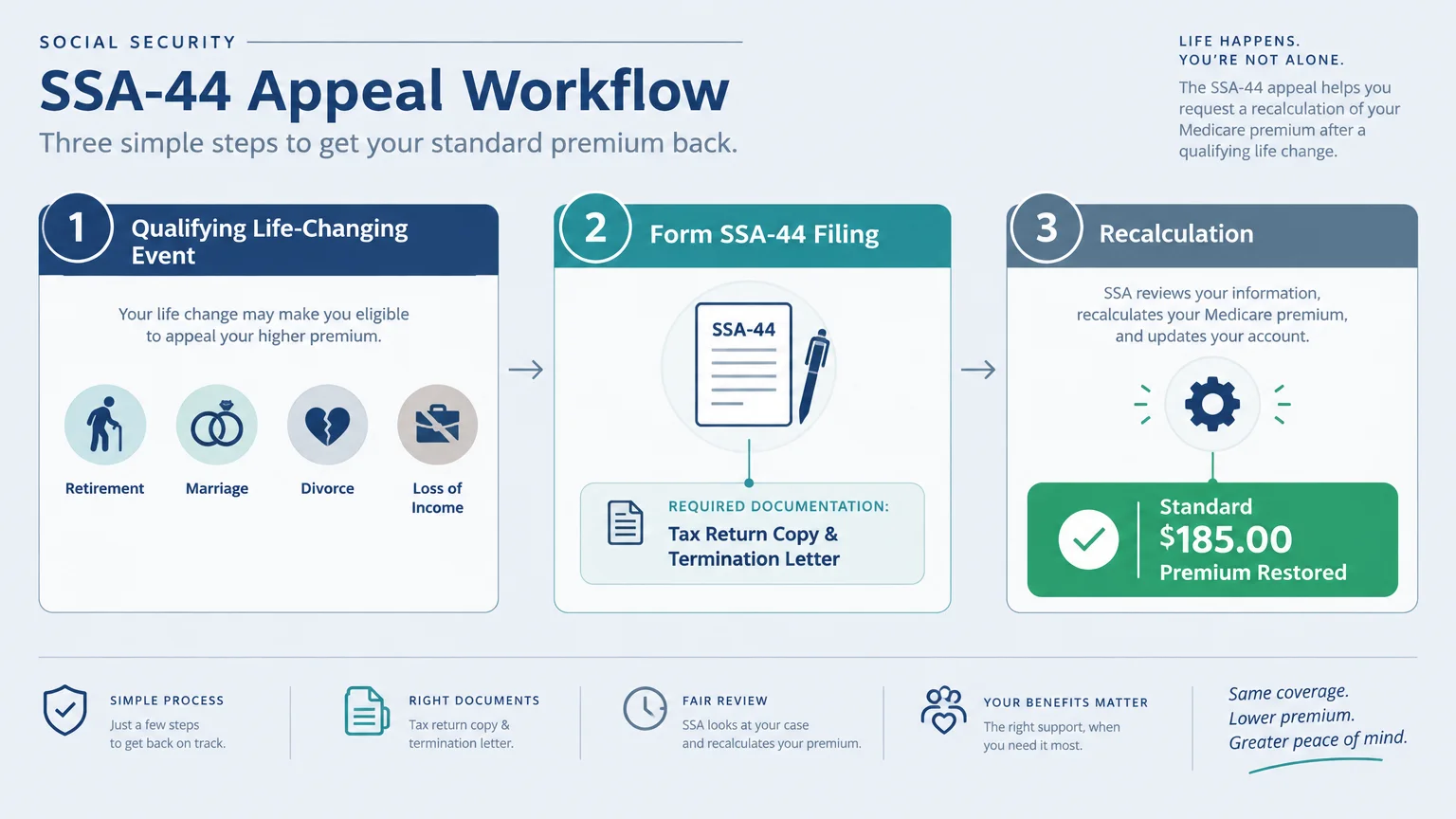
If your income drops significantly due to a major life change, you do not have to accept the two-year lookback calculation. You can ask Social Security to recalculate your premiums using your current earnings.
To request a reduction, you must submit Form SSA-44 to the Social Security Administration. However, the agency only grants relief for eight specific life-changing events.
Qualifying events include work stoppage through retirement, work reduction, the death of a spouse, or marriage. You may also qualify due to divorce, loss of income-producing property from disaster, loss of pension income, or employer settlement payouts.
You must provide documentation of the event, such as a retirement letter or death certificate, alongside proof of your reduced income. If approved, your premiums adjust immediately to match your current financial situation.
Keep in mind that Social Security strictly rejects appeals based on one-time market gains or voluntary Roth conversions. You must fit one of the eight statutory categories to receive relief.
Proactive Strategies to Keep Your Income Below the Cliff
Strategic financial planning helps you keep your modified adjusted gross income below the surcharge thresholds. Implementing these tools protects your long-term wealth.
If you are age 70½ or older, you can utilize Qualified Charitable Distributions. You can transfer up to $105,000 per year directly from a traditional IRA to a qualified charity.
Qualified Charitable Distributions count toward your required minimum distribution without adding a single dollar to your adjusted gross income. Learn more about distribution rules through the IRS retirement plans division.
You can also draw tax-free income from Health Savings Accounts to pay for qualified medical costs. Because HSA withdrawals are completely tax-free, they do not appear on your tax return or increase your premiums.
Finally, consider completing your Roth conversions between retirement and age 63. Doing so allows you to absorb taxable income before the two-year Medicare lookback window opens.
“The best time to plan for a financial goal was 20 years ago. The second best time is today.”

When Professional Advice Is Worth It
Navigating Medicare surcharges alongside complex tax rules can quickly become overwhelming. Working with a qualified professional ensures you make informed decisions.
A certified public accountant can model multi-year tax projections to identify when you approach critical surcharge tiers. They help you time deductions and asset sales to preserve your brackets.
A fee-only financial planner helps you coordinate retirement account distributions alongside Social Security claims. They evaluate your complete asset picture to minimize unnecessary Medicare Part B surcharge assessments.
For official rules on coverage and billing, consult Medicare.gov or review tax provisions directly through the Internal Revenue Service.
Frequently Asked Questions About Medicare Premiums and Income
How long does an IRMAA surcharge last?
An IRMAA surcharge lasts for one calendar year. Social Security re-evaluates your income annually using updated federal tax data.
Does an inheritance count toward Medicare premium calculations?
Inheritances are generally not subject to federal income tax and do not increase adjusted gross income. However, withdrawals from inherited traditional retirement accounts count as taxable income.
Can I appeal a surcharge caused by selling my home?
No, Social Security does not consider selling a home to be a qualifying life-changing event. You must pay the surcharge for that single year.
Do Health Savings Account withdrawals raise my Medicare premiums?
No, withdrawals from a Health Savings Account used for qualified medical expenses are completely tax-free. They do not appear on your tax return or affect your IRMAA calculation.
Take Control of Your Retirement Healthcare Costs
Protecting your retirement budget requires ongoing vigilance over how different revenue sources affect your Medicare costs. Review your tax returns annually to spot potential surcharge triggers before the two-year lookback takes effect.
Take time this month to evaluate your required distributions, investment sales, and banking interest. Proactive planning keeps your healthcare expenses predictable and leaves more money in your pocket.
This article is for informational purposes only and does not constitute financial, legal, or tax advice. Rates, benefit amounts, and tax rules change regularly—verify current details with the relevant agency or a licensed professional.
Last updated: February 2026. Rates, benefit amounts, and tax rules change—always verify current details at official sources.