
Unexpected expenses can strain your monthly budget, but the cash you need might already belong to you. Millions of retirees sit on overlooked funds that never appear in standard bank balances.
Finding hidden money in retirement often begins by tracking down past earnings and rethinking traditional assets. Unclaimed accounts, dormant insurance policies, and forgotten government bonds hold tens of billions of dollars.
Reclaiming these funds delivers instant liquidity without forcing you to sell invested stocks at a market loss. Here are the primary unused assets for retirement income you should examine today.
Tracking Down Stranded 401(k) Accounts and Safe-Harbor IRAs
Changing employers throughout your career frequently leads to fragmented retirement savings. Over time, old paperwork disappears and former employers merge or change corporate names.
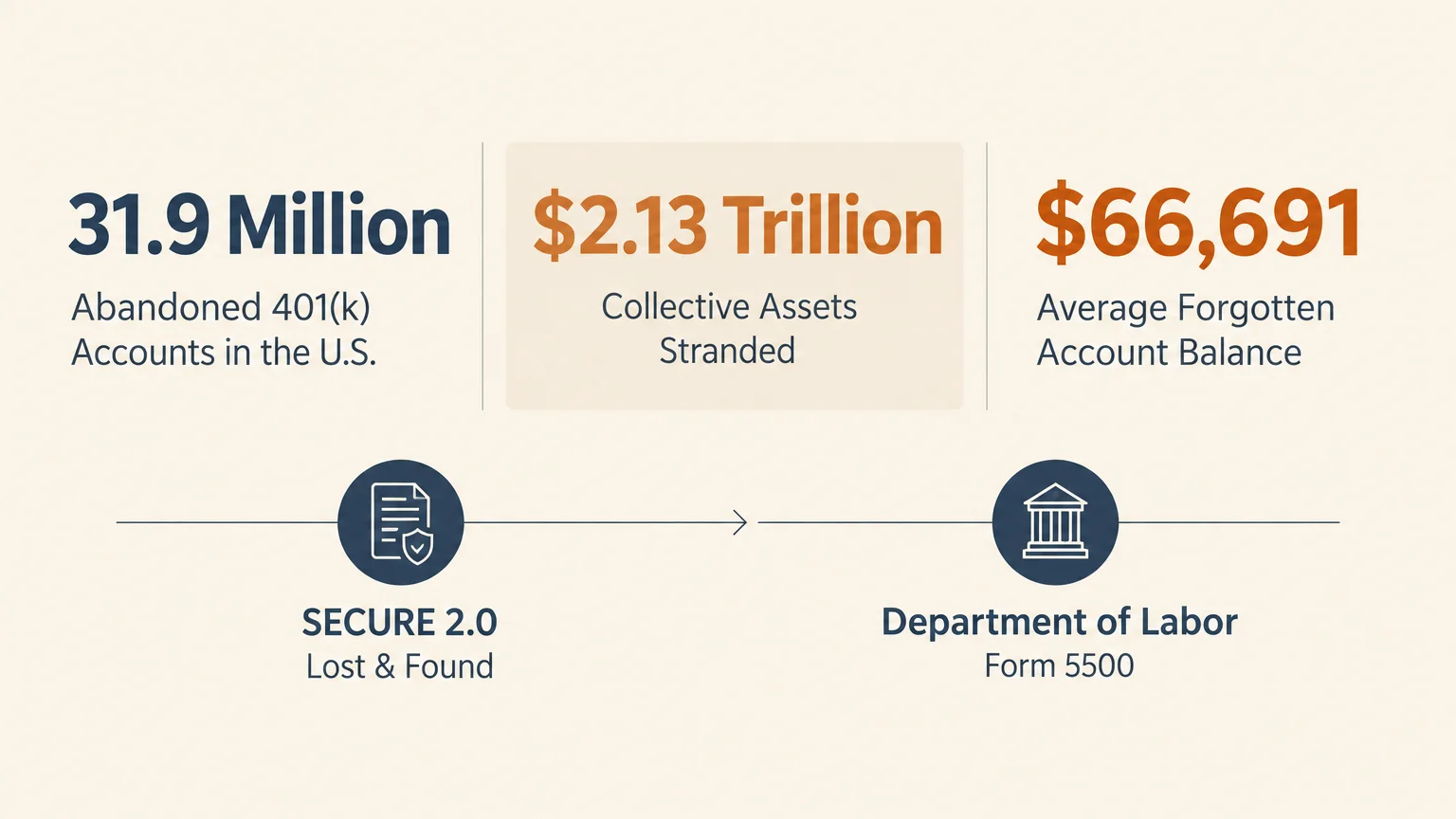
Capitalize and the Center for Retirement Research estimate that 31.9 million 401(k) accounts remain abandoned across the United States. These stranded plans hold roughly $2.13 trillion in collective assets.
The average forgotten account holds approximately $66,691. Leaving that capital behind deprives you of significant purchasing power when unexpected expenses arise.
Under current rules, employers can automatically force out small balances between $1,000 and $7,000 into safe-harbor individual retirement accounts. These accounts often sit quietly in conservative default funds that barely keep up with inflation.
You can locate these funds using the Retirement Savings Lost and Found database mandated by the SECURE 2.0 Act. The Department of Labor Employee Benefits Security Administration maintains this centralized search directory.
If federal databases do not show your old plan, review historical records through FreeERISA. You can track down the plan’s current trustee by searching your former employer’s annual Form 5500 tax filings.

Recovering Forgotten Defined-Benefit Pensions
Defined-benefit corporate pensions represent another major source of overlooked income for older Americans. Many workers assume their earned pension vanished if their previous employer declared bankruptcy or shut its doors.
The federal government protects private defined-benefit pensions through the Pension Benefit Guaranty Corporation. When private companies terminate their pension obligations, the agency often takes over the administration and payment processing.
The PBGC manages an active missing participants program to reconnect retirees with unpaid benefits. You can search their national database using your Social Security number and legal name.
Even if an old employer remains in business, human resources records may contain outdated mailing addresses. Contacting former plan administrators directly can restore monthly payments you earned decades ago.

Reclaiming Billions Held in State Treasuries and Escrow Balances
State treasuries currently hold approximately $70 billion in unclaimed property, according to the National Association of Unclaimed Property Administrators. About one in seven Americans has unclaimed money waiting to be collected.
The average payout across all approved state property claims reaches roughly $2,000. These windfalls come from inactive checking accounts, uncashed dividend checks, utility deposits, and safe-deposit box contents.
Financial institutions must surrender dormant customer accounts to state treasuries through legal escheatment processes. You can search records across multiple participating states for free through MissingMoney.com.
Make sure to check state registries under your maiden name, common misspellings of your surname, and previous home addresses. You should also search on behalf of deceased parents whose estates you legally settled.
Mortgage escrow accounts are another frequent source of uncollected property. If you refinanced your mortgage or paid off your home loan, your previous servicer might still hold excess escrow funds.

Redeeming Matured and Forgotten U.S. Savings Bonds
The U.S. Department of the Treasury holds roughly $32 billion in matured, uncashed savings bonds. Many retirees bought paper bonds decades ago or received them as gifts from relatives.
Series E, Series EE, and Series I savings bonds stop earning interest completely after 30 years. Keeping matured bonds in a drawer produces zero growth and exposes your money to loss or theft.
You can locate uncashed bonds through the Treasury Hunt portal hosted on TreasuryDirect.gov. The system matches your Social Security number against records of bonds issued since 1974.
If you hold damaged paper bonds or inherited certificates without clear records, you can submit Treasury Form FS 1522. The Bureau of the Fiscal Service will research the serial numbers and reissue payment directly.

Unlocking Liquid Cash From Existing Life Insurance Policies
Many seniors continue paying steep monthly premiums on permanent life insurance policies they bought decades ago. If your mortgage is paid off and your adult children are self-sufficient, that death benefit may no longer be necessary.
Most individuals simply let unneeded coverage lapse or surrender the policy back to the insurer for modest cash value. Doing so leaves thousands of dollars in equity on the table.
Retirees age 65 and older holding policies with face values of $100,000 or more can explore life settlements. In a life settlement, an institutional investor purchases your existing life insurance contract.
The purchasing company takes over all future premium obligations and collects the death benefit when you pass away. In exchange, they hand you an upfront cash payout.
Life settlements typically generate between 10% and 25% of the policy’s death benefit, and sometimes significantly more. That payout routinely equals four to eight times your contract’s base cash surrender value.
“It’s not how much money you make, but how much money you keep, how hard it works for you, and how many generations you keep it for.” — Robert Kiyosaki
If you prefer keeping your policy active for heirs, review your contract for an accelerated death benefit rider. Many insurers let you access up to 80% of your death benefit tax-free if you face chronic medical conditions.
You can also take out a low-interest loan directly against your policy’s accumulated cash value. Policy loans bypass credit checks and require no mandatory monthly payments, though unpaid interest reduces the ultimate death benefit.

Repurposing Health Savings Accounts for Everyday Income
Health Savings Accounts offer triple tax advantages while you build career savings. What many retirees do not realize is how HSA withdrawal rules transform once you turn 65.
Before age 65, spending HSA money on ordinary non-medical expenses triggers income tax plus a severe 20% penalty. That 20% penalty disappears entirely on your 65th birthday.
Individuals age 65 and older can withdraw HSA funds for ordinary living expenses completely penalty-free. Official guidelines on IRS retirement plans and tax accounts explain these distribution thresholds in detail.
Non-medical withdrawals are taxed as regular income, functioning just like traditional IRA distributions. This flexibility lets you treat your old health account as an auxiliary emergency reserve.
You preserve completely tax-free treatment whenever you direct HSA money toward qualified medical expenses. You can use tax-free distributions to cover Medicare Part B premiums, Part D prescription coverage, and Medicare Advantage payments.
Take advantage of the receipt shoebox strategy if you saved healthcare receipts from earlier years. You can reimburse yourself today tax-free for qualifying medical costs paid years ago, provided the HSA existed when the expense occurred.

Strategic Home Equity Solutions Beyond Traditional Downsizing
Home equity constitutes the largest portion of net worth for the majority of American retirees. Tapping into housing wealth does not always require listing your home for sale or moving into a smaller property.
Home Equity Conversion Mortgages allow homeowners age 62 and older to borrow against accumulated housing equity without making monthly mortgage payments. Borrowers retain legal ownership of their home throughout the loan duration.
The Federal Housing Administration sets annual limits on the equity you can tap through government-backed reverse mortgages. The maximum claim amount reached $1,209,750 for 2025 and rises to $1,249,125 for 2026.
Borrowers can receive funds as a lump sum, regular monthly distributions, or a flexible credit line. The unused portion of a reverse mortgage credit line actually grows over time, independent of your home’s market value.
Homeowners must continue covering property taxes, homeowners insurance, and necessary structural maintenance. Failing to meet these homeowner responsibilities can cause the lender to accelerate the loan balance.
Seniors struggling with property taxes should also examine municipal tax deferral programs through their local county assessor. Many jurisdictions allow older residents to defer local property taxes until the house transfers ownership.

Monetizing Idle Vehicles and Tangible Personal Property
Maintaining a second vehicle or recreational camper often costs retirees thousands of dollars annually in insurance, registration, and upkeep. Selling an underutilized vehicle provides an immediate cash infusion while permanently trimming your recurring monthly expenses.
Vintage musical instruments, high-end watches, and fine jewelry represent another common form of stagnant household wealth. Certified appraisers and reputable online consignment platforms allow you to turn unwanted physical items into liquid savings without accepting pawnshop discounts.
If you own vacant land or an unneeded timeshare, explore disposition options to eliminate ongoing maintenance fees and local property taxes. Even selling unused parcels at a modest price frees up monthly cash flow and eliminates liability risks.
Comparing Your Liquidity Options
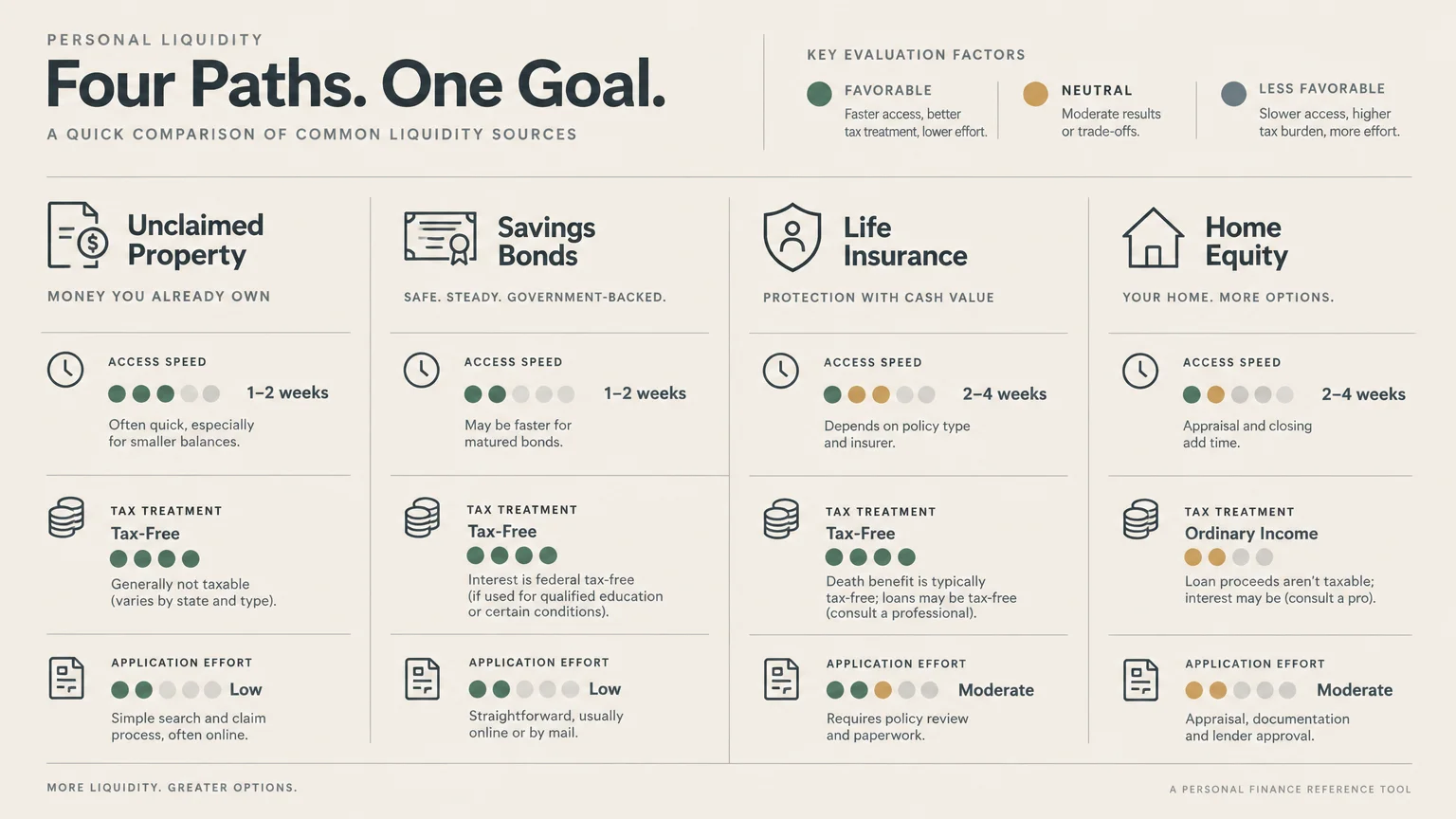
Selecting the right asset strategy depends on your immediate cash needs, timeline, and tax circumstances. Comparing your alternatives side-by-side clarifies which source delivers liquidity with minimal tax friction.
| Asset Strategy | Typical Access Timeline | Tax Treatment | Best Used For |
|---|---|---|---|
| Stranded 401(k) or Pension | 30 to 90 days | Tax-deferred if rolled over; ordinary income if liquidated | Long-term income stabilization |
| State Unclaimed Property | 2 to 12 weeks | Tax-free return of your own capital | Immediate small cash emergencies |
| Matured U.S. Savings Bonds | 1 to 3 weeks | Federal income tax due on accrued interest | One-time unexpected household repairs |
| Life Insurance Settlement | 60 to 120 days | Basis is tax-free; excess is capital gain or ordinary income | Significant lump-sum capital needs |
| Post-65 HSA Withdrawals | Immediate (1 to 3 days) | Tax-free for medical; ordinary income for general living | Monthly budget gaps and healthcare |
| FHA Reverse Mortgage (HECM) | 45 to 60 days | Tax-free loan proceeds | Aging in place without monthly payments |
Combining multiple low-tax sources often proves far more effective than liquidating a single large account. Spreading distributions across different vehicles protects you from entering higher tax brackets.
“The best time to plan for a financial goal was 20 years ago. The second best time is today.”

Errors That Cost Families Thousands
Liquidating overlooked assets without checking rules can trigger steep administrative fees and tax surprises. Taking time to verify transaction terms shields your household from avoidable wealth destruction.
Watch out for these costly mistakes when pursuing hidden assets retirees overlook:
- Paying commercial asset locators: Private locator companies often charge fees exceeding 20% to claim money you can collect for free from state treasuries and federal registries.
- Surrendering life insurance prematurely: Accepting a nominal cash surrender value from your carrier forfeits the much higher payouts available on the secondary life settlement market.
- Mishandling 401(k) rollover transfers: Choosing an indirect rollover check rather than a direct trustee-to-trustee transfer triggers automatic 20% federal tax withholding.
- Triggering Medicare premium surcharges: Large, taxable lump-sum withdrawals can unexpectedly elevate your modified adjusted gross income, triggering Income-Related Monthly Adjustment Amounts (IRMAA) on Medicare Part B and Part D.
- Neglecting reverse mortgage tax obligations: Failing to budget for mandatory property taxes, flood insurance, and homeowners insurance can cause the lender to initiate foreclosure on a reverse mortgage.
Reviewing beneficiary designations and liquidation rules prevents permanent financial loss. Always confirm tax consequences with a qualified professional before cashing out any forgotten asset.

When to Get Expert Help
Navigating insurance buyouts, pension claims, and housing equity decisions requires careful financial balancing. Getting advice from unconflicted professionals ensures you protect both your income and your legacy.
Work with a Certified Public Accountant or fee-only fiduciary financial planner before selling life policies or cashing out stranded pensions. Fiduciary professionals never take commissions on the financial products they recommend.
Before entering into a reverse mortgage, you must complete mandatory counseling with an independent specialist. You can locate certified counselors through HUD housing counseling services.
If you suspect abusive sales tactics or unauthorized account fees, submit a formal complaint through the Consumer Financial Protection Bureau. Federal oversight helps safeguard older consumers against deceptive financial practices.
Frequently Asked Questions About Overlooked Retirement Assets
How do I know if I have an abandoned 401(k) from an old job?
Check the Department of Labor online Retirement Savings Lost and Found registry or search FreeERISA using your past employer name. You can also contact your former company human resources department directly to confirm plan records.
Are life settlement proceeds considered taxable income?
Settlement proceeds up to your cumulative paid premiums are received tax-free as a return of basis. Proceeds exceeding your basis up to the cash surrender value are taxed as ordinary income, while remaining gains qualify for capital gains rates.
What happens to unclaimed state property if I never file a claim?
State treasuries hold unclaimed funds indefinitely in custodial trust until the rightful owner or their legal heirs step forward. Your money does not expire or forfeit to the state government over time.
Can I draw money from my HSA if I am enrolled in Medicare?
Yes, you can freely spend existing HSA balances on qualified medical costs or non-medical expenses at any time. However, federal rules prohibit making new contributions to an HSA once Medicare enrollment begins.
Moving Forward With Your Financial Inventory
Finding hidden money in retirement starts by conducting an intentional review of your career history and existing policies. A few hours spent checking public databases can yield thousands of dollars in accessible funds.
Unlocking unused assets for retirement income gives you immediate financial flexibility without forcing you to sell invested assets at a loss. Take control of your balance sheet today and claim the money you earned.
This article is for informational purposes only and does not constitute financial, legal, or tax advice. Rates, benefit amounts, and tax rules change regularly—verify current details with the relevant agency or a licensed professional.
Last updated: February 2026. Rates, benefit amounts, and tax rules change—always verify current details at official sources.