
Entering the top 1% of income earners in your 70s requires an annual individual income between $369,420 and $628,223, depending on your age. At the household level, that cutoff exceeds $1.29 million.
While average retirees rely on Social Security and modest pensions, top-tier older adults draw substantial cash flow from private businesses, investment portfolios, and required minimum distributions.
Reaching this elite tier transforms how you handle multi-generational transfers, family trusts, and wealth preservation. Here is what current federal data reveals about the highest-earning retirees in the United States.
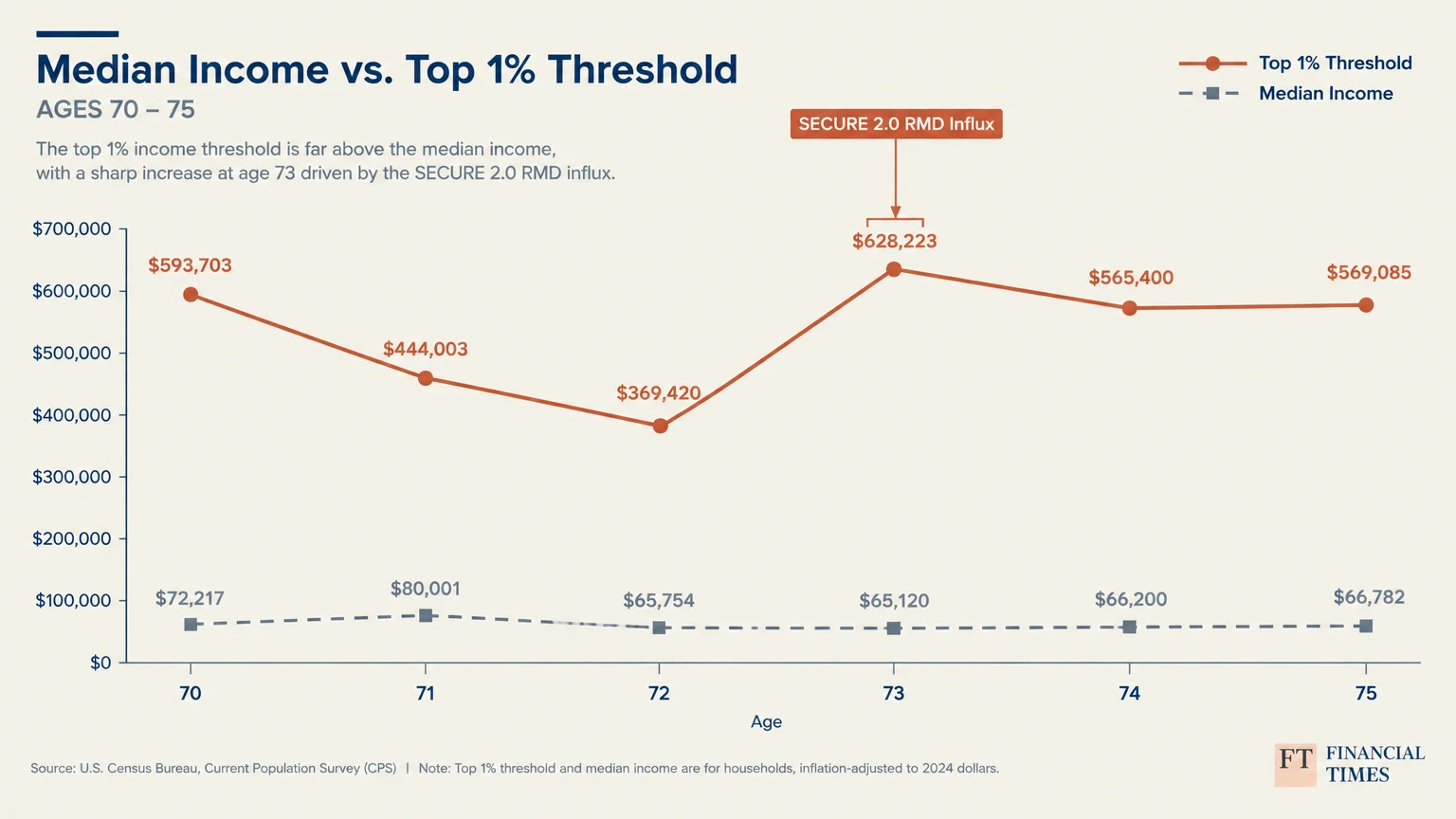
Individual Income Benchmarks Across Your 70s
Individual income undergoes dramatic shifts after career retirement. Annual earnings no longer reflect a steady corporate salary; instead, they reflect investment performance, business liquidations, and statutory withdrawal rules.
According to U.S. Census Bureau Current Population Survey data, individual earnings percentiles vary considerably from year to year during this decade of life.
At age 70, the median individual income is $72,217, while the average sits at $112,994. Reaching the top 10% requires $206,005, but joining the top 1% demands an impressive $593,703.
By age 71, the threshold changes. The median individual income rises to $80,001, while entering the top 10% takes $215,816. The top 1% cutoff settles at $444,003.
At age 72, the median drops to $65,754, and the average income is $94,682. The 90th percentile threshold is $206,414, while the top 1% requires $369,420.
A noticeable shift occurs at age 73. While the median income is $65,120, the top 1% threshold spikes sharply to $628,223.
This spike aligns directly with federal tax rules. Under the SECURE 2.0 Act, age 73 marks the start of required minimum distributions for many account holders, forcing large taxable retirement withdrawals into annual income.
At age 74, individual median income is $66,200, with an average of $100,716. Crossing into the top 10% takes $237,273, while the top 1% threshold is $565,400.
By age 75, the median stands at $66,782, and the average reaches $102,096. You need $255,450 to enter the top 10%, while the top 1% demands $569,085.
| Age | Median Income | Average Income | Top 10% (90th) | Top 1% (99th) |
|---|---|---|---|---|
| 70 | $72,217 | $112,994 | $206,005 | $593,703 |
| 71 | $80,001 | $105,471 | $215,816 | $444,003 |
| 72 | $65,754 | $94,682 | $206,414 | $369,420 |
| 73 | $65,120 | $100,514 | $185,002 | $628,223 |
| 74 | $66,200 | $100,716 | $237,273 | $565,400 |
| 75 | $66,782 | $102,096 | $255,450 | $569,085 |
Survey data at single-year advanced ages contains natural volatility due to sample sizes and reporting caps. However, an individual generally needs between $370,000 and $630,000+ annually to rank among the top 1% in their 70s.
Household Income: Why Federal Reserve Data Tells a Different Story
Measuring individual income tells only part of the story. Most Americans in their 70s manage finances as a joint household, pooling retirement benefits, investment portfolios, and real estate income.
Data from the Federal Reserve Survey of Consumer Finances reveals significantly higher numbers for household earners than individual Census surveys indicate.
The Federal Reserve intentionally oversamples high-wealth families to capture realized capital gains, private equity dividends, and partnership payouts that standard surveys often miss.
In the Federal Reserve survey data, families headed by someone aged 75 or older experienced a 24% surge in median income, reaching $66,800. Their mean household income rose to $125,100.
When you evaluate the top 1% of households in this demographic, the numbers rise steeply. For households aged 70 to 74, entering the top 1% requires an income of roughly $1,294,608.
For households aged 75 to 80, the top 1% threshold is approximately $811,765. Both figures outpace the broad national benchmark across all age groups, which stands at $704,999 for households.
Broader Census figures show that the median household income for all Americans aged 65 and older is $59,680, or about $4,973 per month. The mean income is $92,350.
Marital status creates a massive divide in senior living standards. Married couples aged 65 and older report a median household income of $93,890.
In contrast, single men aged 65 and older report a median income of $35,590. Single women in the same age group live on a median income of just $31,540.
These comparisons highlight the immense financial gap between typical retirees and the top 1%, who earn more in a single month than median households earn all year.

Income Versus Wealth: Why Net Worth Defines the Retirement Elite
In your 70s, annual income ceases to be the best measure of financial strength. True financial security depends on accumulated balance sheets rather than active cash flow.
Many wealthy retirees intentionally keep their taxable income low to minimize taxes and Medicare surcharges, even while sitting on tens of millions in liquid assets.
“It’s not how much money you make, but how much money you keep, how hard it works for you, and how many generations you keep it for.” — Robert Kiyosaki
Data from the Federal Reserve shows that older Americans control record levels of accumulated wealth. Households headed by someone aged 75 or older hold a median net worth of $504,900 and an average net worth of $1.96 million.
To rank in the top 1% of wealth in your early 70s, ordinary retirement savings will not suffice. For ages 70 to 74, the net worth benchmarks reflect extraordinary asset accumulation.
- 50th Percentile (Median): $424,000
- 75th Percentile: $1,320,000
- Top 10% (90th Percentile): $3,798,000
- Top 5% (95th Percentile): $8,639,000
- Top 1% (99th Percentile): $20,117,000
The wealth requirements climb even higher for households aged 75 to 79. In this cohort, maintaining a top-tier financial profile requires more than $22 million.
- 50th Percentile (Median): $415,000
- 75th Percentile: $1,345,000
- Top 10% (90th Percentile): $4,137,000
- Top 5% (95th Percentile): $6,869,000
- Top 1% (99th Percentile): $22,055,000
For context, Fidelity Investments reports that the average 401(k) balance for participants aged 70 and older is $264,500. While substantial, that average balance represents just over 1% of the net worth held by the top 1%.
The Components of Top-Tier Retirement Cash Flow
How do people in their 70s generate $400,000 to over $1 million in annual revenue without working standard jobs? The answer lies in diversified income engines.
Government benefits play only a minor role for the top 1%. According to the Social Security Administration (SSA), the maximum monthly benefit for a high earner claiming at age 70 is $5,181, which equals $62,172 per year.
By contrast, the average monthly Social Security benefit for retired workers is $2,071, reflecting recent cost-of-living adjustments. The maximum benefit at Full Retirement Age is $4,152 monthly.
Even if two spouses both receive the absolute maximum age-70 Social Security benefit, their combined $124,344 covers only a fraction of the top 1% income requirement.
The vast majority of top-tier retirement cash flow comes from taxable investment portfolios, private company distributions, commercial real estate rents, and statutory retirement accounts.
Under IRS regulations, individuals must begin taking required minimum distributions (RMDs) from traditional 401(k)s and IRAs at age 73. Rules governing these withdrawals are detailed through IRS Retirement Plans resources.
A retiree with $10 million in traditional pre-tax retirement accounts faces an RMD factor that forces hundreds of thousands of dollars onto their tax return in a single year.
These mandatory withdrawals instantly propel retirees into the highest income percentiles, whether they need the cash for daily living expenses or not.

Multi-Generational Wealth Transfers and Family Finance Strategies
When household income reaches top-tier thresholds, financial planning shifts from personal consumption to family wealth management. High-earning seniors often act as the financial anchor for multiple generations.
Sandwich-generation adults and wealthy grandparents frequently leverage cascading 529 education plans. By opening accounts for grandchildren, you can shelter investment growth from capital gains taxes.
Many states offer state income tax deductions for 529 contributions. Grandparents can also take advantage of five-year front-loading provisions to move significant capital out of their taxable estates quickly.
Under SECURE 2.0 rules, beneficiaries can roll over up to $35,000 of unused 529 funds into a Roth IRA over their lifetime, providing grandchildren with a tax-free retirement head start.
Annual gifting represents another critical tool. You can gift up to the federal annual exclusion limit per recipient each year without filing a gift tax return or reducing your lifetime exemption.
A married couple can double this amount by electing gift splitting. This strategy allows grandparents to distribute significant cash to children and grandchildren systematically.
Eldercare logistics also require proactive budgeting. High-net-worth families often choose private-duty in-home nursing or luxury assisted living communities, where care expenses regularly exceed $100,000 annually.
Without proper legal mechanisms, such as healthcare directives, revocable living trusts, and durable powers of attorney, sudden health crises can lock up household liquidity.
Establishing formal family caregiver agreements ensures that adult children who leave careers to provide eldercare receive legal, tax-compliant compensation that protects family dynamics.
Costly Mistakes to Avoid
Managing top-tier income in your 70s introduces severe tax traps and administrative penalties. One missed deadline or overlooked threshold can cost tens of thousands of dollars.
- Missing Required Minimum Distributions: Failing to take an RMD on time triggers a 25% IRS excise tax on the undistributed amount. While the penalty drops to 10% if corrected within two years, proactive planning prevents the penalty entirely.
- Triggering Medicare IRMAA Surcharges: High taxable incomes trigger Income-Related Monthly Adjustment Amounts (IRMAA). These federal surcharges dramatically raise your Medicare Part B and Part D premiums. You can review official premium tables directly at Medicare.gov.
- Ignoring State Estate Tax Thresholds: Federal estate tax exemptions are generous, but many states impose estate or inheritance taxes at much lower asset levels. Failing to account for state statutes can expose your heirs to unexpected tax bills.
- Holding Excess Cash in Taxable Accounts: Leaving large cash balances in standard savings accounts creates unnecessary ordinary income tax. High earners benefit from holding cash reserves in tax-exempt municipal money market funds or short-term Treasuries.
- Neglecting Beneficiary Designations: Outdated primary or contingent beneficiaries on IRAs, 401(k)s, and life insurance policies override instructions in your will. This oversight can accidentally disinherit grandchildren or pass wealth to ex-spouses.

Don’t DIY These Decisions
Operating in the top income tier requires professional execution. Attempting to manage complex tax filings, corporate drawdowns, and estate vehicles alone routinely leads to costly errors.
You should work with a fee-only, fiduciary Certified Financial Planner (CFP) who does not sell commissioned insurance products. A fiduciary aligns investment risk with your family distribution objectives.
Pair your financial planner with a Certified Public Accountant (CPA) who specializes in high-net-worth retirement taxation. Your CPA can model RMDs, harvest capital losses, and optimize charitable giving strategies.
Charitable options like Qualified Charitable Distributions (QCDs) allow seniors aged 70½ and older to transfer up to $105,000 annually directly from an IRA to charity, satisfying RMDs without adding to taxable income.
Finally, retain an experienced estate planning and elder law attorney. They establish irrevocable trusts, structure generation-skipping transfer exemptions, and draft airtight medical directives to protect your household legacy.
Frequently Asked Questions About Top 1% Retirement Income
What is the difference between individual and household top 1% income in retirement?
Individual income measures earnings generated by one person, which ranges between $369,420 and $628,223 in your 70s. Household income includes joint marital filings and corporate revenues, pushing the top 1% cutoff beyond $1.29 million.
Why does top 1% individual income spike at age 73?
Federal tax law requires retirees to begin taking required minimum distributions from pre-tax retirement accounts at age 73. High-net-worth seniors must withdraw substantial sums, which are taxed as ordinary income and recorded on Census data.
Can Social Security alone put you into the top 10% of retirees?
No. The absolute maximum Social Security benefit at age 70 is $5,181 per month, or $62,172 annually. Entering the top 10% in your 70s requires an individual income exceeding $185,000 to $255,000.
What net worth is required to support a top 1% lifestyle in your 70s?
According to Federal Reserve data, entering the top 1% of net worth requires $20,117,000 for ages 70 to 74. For ages 75 to 79, the top 1% net worth threshold increases to $22,055,000.
Securing Your Household Legacy
Reaching or approaching the top 1% of income in your 70s is a testament to disciplined saving, savvy investing, and diligent career building. However, maintaining that status requires constant vigilance.
Audit your distribution schedule today to minimize unnecessary income spikes that drive up Medicare premiums. Coordinate with your tax advisor to convert traditional balances, gift assets to family, or fund educational trusts.
Financial outcomes vary based on individual income, credit history, and circumstances. This article provides general guidance only. Consult a qualified financial planner, CPA, or consumer attorney for advice specific to your situation.
Last updated: November 2026. Rates, benefit amounts, and tax rules change—always verify current details at official sources.