Buying a dependable vehicle without draining your savings account feels harder than ever. You can protect your household budget by targeting vetted, reliable used cars that minimize long-term operational costs.
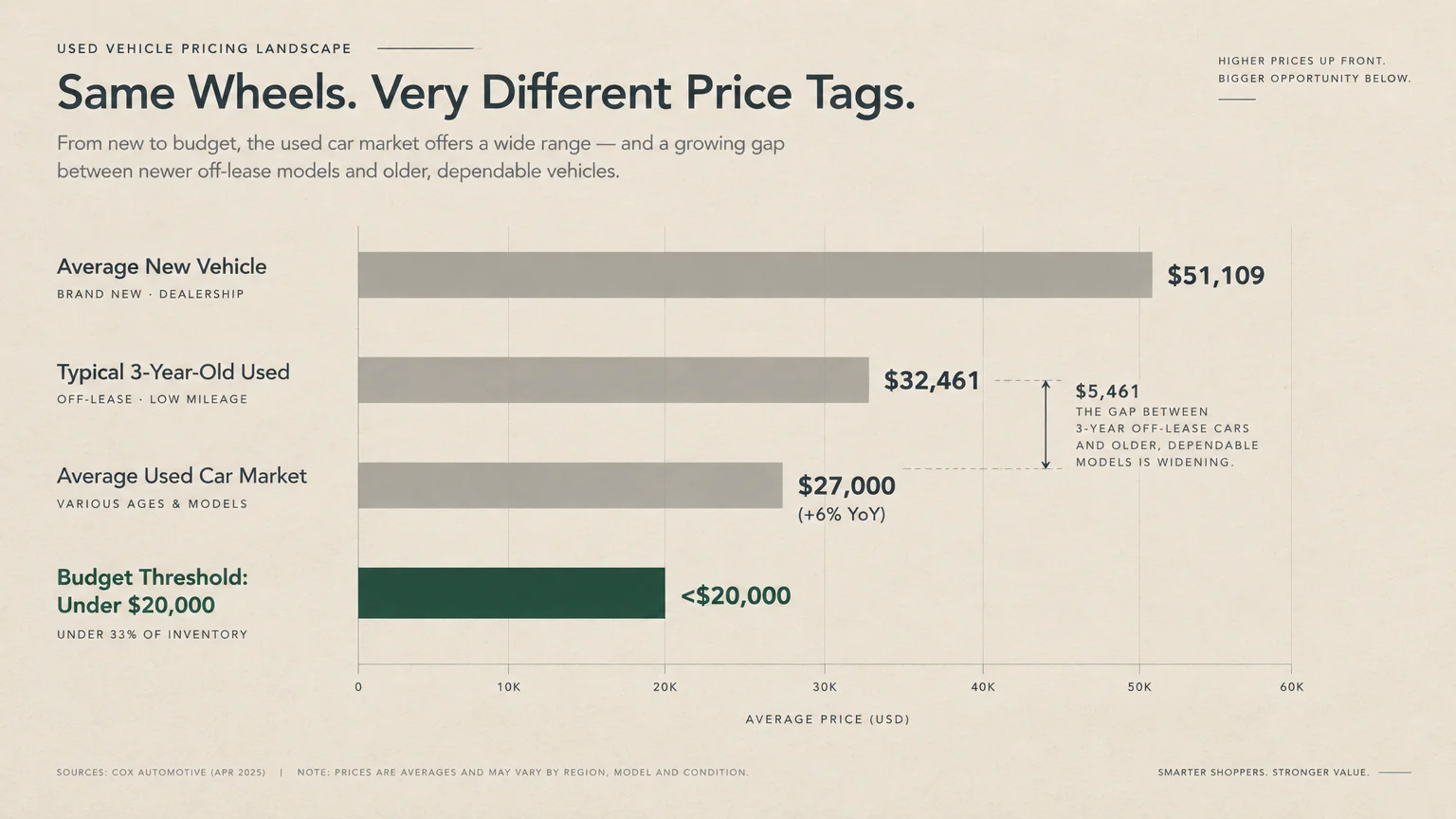
New vehicle transaction prices hit an all-time high of $51,109, while average used car prices climbed to $27,000. Fortunately, disciplined shoppers can still secure exceptional transportation for less than $20,000.
Financial professionals prioritize the total cost of ownership over showroom appeal. Here are the seven best used cars under 20000 that deliver lasting reliability, modest repair bills, and superior fuel economy.
The Reality of the Used Car Market in 2026
Navigating the pre-owned market requires a clear understanding of current pricing dynamics. Data from Cox Automotive reveals the average used vehicle price sits near $27,000, reflecting a 6% increase year-over-year.
Finding affordable used cars under the $20,000 threshold requires extra diligence. According to Edmunds, vehicles priced below $20,000 now represent less than one-third of all used car transactions.
Lightly used inventory commands a steep premium in today’s market. A typical three-year-old vehicle averages $32,461, even as three-year residual values dropped to a five-year low of 66% of original MSRP.
This pricing squeeze forces budget-conscious families to look beyond off-lease inventory. You must examine five-to-ten-year-old vehicles with proven mechanical track records to maximize your purchasing power.
According to the Bureau of Labor Statistics Consumer Expenditure Survey, transportation represents the second-largest household expense category after housing. Controlling your vehicle acquisition costs directly strengthens your monthly cash flow.
How Financial Pros Evaluate Used Vehicles
Financial planners look far beyond the sticker price displayed on the windshield. A cheap purchase price quickly turns toxic if recurring repairs drain your emergency fund.
True vehicle affordability rests on four primary cost pillars. You must calculate purchase price, fuel efficiency, insurance premiums, and scheduled maintenance costs together.
- Depreciation curve: Older models have already absorbed their steepest valuation drops.
- Mechanical simplicity: Naturally aspirated engines and traditional automatic transmissions cost less to repair.
- Parts availability: High-volume mass-market models enjoy cheap, readily available replacement components.
- Fuel expenditure: High-efficiency engines safeguard your monthly cash reserves against fluctuating gas prices.
Consumer Reports’ brand reliability research tracks five-to-ten-year-old vehicles over millions of cumulative miles. Their findings consistently place Lexus, Toyota, and Mazda in the top three reliability spots, followed closely by Acura and Honda.
“Do not save what is left after spending, but spend what is left after saving.” — Warren Buffett
Targeting vehicles from these dependable manufacturers protects your liquid capital. Every dollar saved on unexpected garage visits can compound inside your retirement or high-yield savings accounts.
1. 2019 Toyota Corolla: The Practical Cash-Flow Protector
The 2019 Toyota Corolla remains the gold standard for low-risk, predictable transportation. Retail prices for clean models generally range between $13,325 and $16,600 depending on mileage and trim.
This model year represents the final iteration of the battle-tested eleventh generation. Toyota ironed out every potential mechanical defect before launching the subsequent redesign.
Under the hood sits a durable 1.8-liter four-cylinder engine. This powertrain avoids direct-injection carbon buildup and complicated turbochargers, ensuring lower servicing expenses over time.
The Corolla delivers an EPA-rated 32 MPG in combined driving. That efficiency keeps monthly fuel outlays predictable whether you commute daily or run suburban errands.
Insurance carriers view the Corolla favorably due to standard active safety features. Lower premiums leave extra breathing room in your monthly cash-flow allocation.
2. 2020 Honda Fit: Maximum Utility on a Modest Budget
The 2020 Honda Fit offers unmatched interior packaging within a compact footprint. Pristine late-model examples trade well under $20,000 across national dealership inventories.
Honda discontinued the Fit in North America after 2020, making this model the ultimate version. It features Honda’s clever Magic Seat system, offering cargo capacity that rivals small crossover SUVs.
The 1.5-liter engine pairs with a responsive continuously variable transmission. Drivers regularly achieve 33 MPG combined, reducing annual fuel costs compared to larger compact sedans.
Higher trims include the Honda Sensing safety suite as standard equipment. You gain adaptive cruise control, lane-keeping assistance, and automated emergency braking without paying modern luxury prices.
The Fit uses standard 15-inch or 16-inch tire sizes. Replacing wearable parts like tires and brakes costs hundreds less than servicing oversized crossover utility wheels.

3. 2018 Mazda CX-5: Premium Quality Without the Luxury Price
Shoppers needing elevated seating and all-weather capability should prioritize the 2018 Mazda CX-5. Market values typically range from $12,950 to $16,125 for well-maintained examples.
Mazda earned a top-three reliability ranking from Consumer Reports through mechanical discipline. The company resisted troublesome continuously variable transmissions, relying instead on a proven six-speed torque-converter automatic.
The 2.5-liter Skyactiv-G engine delivers punchy performance without compromising long-term durability. It avoids the complex oil-dilution issues that plagued certain turbocharged competitors from the same era.
Front-wheel-drive models return 28 MPG combined, while all-wheel-drive variants achieve a respectable 26 MPG. This balance gives growing families utility without painful fuel bills.
The CX-5 interior punches far above its price point with premium acoustic insulation. You enjoy a refined driving experience while spending roughly half the cost of an average new vehicle.
4. 2019 Toyota Camry Hybrid: The Commuter’s Fuel Hedge
If you face a demanding daily highway commute, fuel consumption dictates your real operating costs. The 2019 Toyota Camry Hybrid commands prices between $16,700 and $21,000.
Base LE trims achieve an astonishing 52 MPG in combined driving cycles. That extraordinary efficiency shields your household budget from sudden spikes in retail gasoline prices.
Toyota’s hybrid synergy drive system uses a planetary gear set rather than traditional clutches or drive belts. This design eliminates common mechanical wear points, dramatically extending powertrain lifespan.
The hybrid battery pack sits underneath the rear passenger seat without encroaching on trunk capacity. Fleet data confirms these nickel-metal hydride and lithium-ion packs routinely surpass 200,000 miles without incident.
Brake pads on hybrid vehicles frequently last beyond 80,000 miles thanks to regenerative braking. That reduced component wear translates directly into lower lifetime maintenance costs.
5. 2016 Mazda6: The Ultra-Budget Midsize Champion
The 2016 Mazda6 stands out as an unbeatable option for buyers working with tight liquidity. Current market pricing spans from $8,450 to $11,450 for clean, road-ready vehicles.
Choosing this midsize sedan leaves thousands of dollars in your bank account compared to your $20,000 budget cap. You can divert the leftover cash into an emergency fund or retirement investments.
The 2.5-liter Skyactiv powertrain delivers excellent real-world efficiency, averaging approximately 32 MPG on the open highway. It provides midsize family comfort without midsize family fuel bills.
The 2016 refresh received an upgraded center console, improved cabin soundproofing, and updated dashboard electronics. It looks and feels like a modern sedan despite costing less than half the national average used car price.
Standard replacement parts remain inexpensive and widely available from independent repair shops. Avoiding captive dealership service bays protects your family cash flow over the ownership cycle.
6. 2018 Toyota RAV4 Hybrid: Reliable Family Utility
Compact crossover SUVs remain America’s favorite family haulers, but finding good values requires careful research. The 2018 Toyota RAV4 Hybrid typically sells between $16,200 and $21,025.
The 2018 model represents the final year of the beloved fourth-generation RAV4. It avoids the early software glitches and teething problems occasionally found on first-year 2019 redesigns.
Standard electronic on-demand all-wheel drive utilizes a dedicated electric motor on the rear axle. You receive dependable traction in snow and rain without the parasitic drag of mechanical driveshafts.
The RAV4 Hybrid averages 32 MPG in combined city and highway driving. Standard gas-only compact SUVs of similar age struggle to achieve 25 MPG in everyday suburban stop-and-go driving.
Toyota equipped every 2018 RAV4 with Toyota Safety Sense-P as standard equipment. You gain pre-collision braking and dynamic radar cruise control without paying for extra option packages.

7. 2021 Kia Sportage: Modern Tech at an Accessible Price
Buyers who prioritize modern connectivity and newer manufacturing dates should examine the 2021 Kia Sportage. Retail prices currently sit between $15,925 and $20,625.
Selecting a 2021 model secures a vehicle that is several years younger than competing Toyota or Honda crossovers. That age difference often translates to lower overall chassis mileage and fresher suspension components.
The 2.4-liter naturally aspirated engine pairs with a conventional six-speed automatic transmission. This mechanical combination provides straightforward reliability when serviced with regular oil changes.
Front-wheel-drive configurations deliver an EPA-estimated 25 MPG combined. While slightly thirstier than hybrid competitors, the lower entry price offsets fuel differences for low-mileage drivers.
Standard Apple CarPlay and Android Auto integration keep you connected seamlessly on the road. You get contemporary cabin technology without taking on a crippling multi-year auto loan.
Head-to-Head Comparison: Costs, Efficiency, and Value
Comparing key vehicle specifications side by side clarifies your financial decision. Use this reference table to match vehicle attributes against your daily commuting requirements and household budget.
| Model & Year | Typical Price Range | Combined Fuel Economy | Vehicle Class | Primary Financial Advantage |
|---|---|---|---|---|
| 2019 Toyota Corolla | $13,325 – $16,600 | 32 MPG | Compact Sedan | Rock-bottom maintenance and ownership costs |
| 2020 Honda Fit | $14,000 – $18,500 | 33 MPG | Subcompact Hatchback | Maximum cargo versatility with tiny fuel bills |
| 2018 Mazda CX-5 | $12,950 – $16,125 | 26 – 28 MPG | Compact SUV | Upscale interior with dependable non-CVT drivetrain |
| 2019 Toyota Camry Hybrid | $16,700 – $21,000 | 52 MPG (LE Trim) | Midsize Hybrid Sedan | Superior fuel savings for high-mileage commuters |
| 2016 Mazda6 | $8,450 – $11,450 | 32 MPG (Hwy) | Midsize Sedan | Lowest purchase cost preserves liquid emergency funds |
| 2018 Toyota RAV4 Hybrid | $16,200 – $21,025 | 32 MPG | Compact Hybrid SUV | All-wheel drive capability with strong resale value |
| 2021 Kia Sportage | $15,925 – $20,625 | 25 MPG | Compact SUV | Newer model year with modern infotainment systems |
Every vehicle listed above keeps your initial investment well below current market averages. Prioritizing these reliable used cars protects you against the aggressive depreciation that damages new car buyers.
Financing Mechanics: Navigating 2026 Auto Loan Rates
How you finance a used car matters just as much as the vehicle you pick. Experian data shows the average used vehicle loan APR sits at an elevated 11.19%, compared to 6.35% for new vehicles.
The average used car loan repayment term has stretched to 67.86 months. Stretching loan durations lowers your monthly payment on paper, but it vastly inflates your total interest paid.
Your credit profile determines the true cost of borrowing in today’s lending environment. Review how VantageScore 4.0 tiers shape borrowing costs based on Experian data:
- Super Prime (781–850): 6.29% APR ($534 average monthly payment)
- Prime (661–780): 8.81% APR ($528 average monthly payment)
- Near Prime (601–660): 13.93% APR ($555 average monthly payment)
- Subprime (501–600): 19.10% APR ($567 average monthly payment)
- Deep Subprime (300–500): 21.62% APR ($570 average monthly payment)
A subprime borrower pays hundreds more each month in finance charges rather than principal paydown. Financing a $16,000 used car at 19.10% over 60 months generates more than $9,000 in pure interest charges.
Before stepping into a dealership, secure loan pre-approval through an independent credit union or local bank. The Consumer Financial Protection Bureau provides detailed comparison worksheets to help you shop auto financing options effectively.
“A budget is telling your money where to go instead of wondering where it went.” — John C. Maxwell
Follow the conservative 20/4/10 budgeting guideline whenever you finance vehicle purchases. Put down 20%, finance for no longer than 48 months, and keep total transportation costs below 10% of gross income.

2026 Tax Rules: What Used Car Shoppers Must Know
Many consumers hold outdated assumptions regarding tax deductions and credits for pre-owned vehicles. Tax regulations changed dramatically following recent federal legislative updates.
The federal Previously-Owned Clean Vehicle Credit under IRS Section 25E expired on September 30, 2025. That program previously delivered up to $4,000 in tax credits on qualifying used electric vehicles priced under $25,000.
If you purchase a used EV or plug-in hybrid today, you cannot claim a federal tax rebate. While certain state-level or utility rebates still exist, federal subsidies for used electrified vehicles have ended.
Tax deductions for auto loan interest also exclude pre-owned purchases. The One Big Beautiful Bill Act created an auto loan interest deduction of up to $10,000 per year for tax years 2025 through 2028.
Crucially, that deduction applies exclusively to brand-new vehicles that undergo final assembly inside the United States. Used car buyers cannot deduct auto loan interest on their personal federal tax returns.
Because federal tax subsidies no longer offset used car purchases, mechanical dependability must drive your choice. You cannot rely on tax write-offs to soften the impact of an overpriced vehicle purchase.
Essential Pre-Purchase Checklist: Protecting Your Cash Flow
Securing cheap reliable cars requires thorough verification before you sign binding sales contracts. Skipping basic due diligence invites catastrophic financial exposure into your household budget.
- Obtain your credit report: Check your credit history at AnnualCreditReport.com to ensure scoring accuracy before applying for auto loans.
- Pull an independent vehicle history report: Verify clean title status and inspect previous maintenance intervals using Carfax or AutoCheck.
- Check for outstanding safety recalls: Enter the 17-digit Vehicle Identification Number into the NHTSA recall database to ensure free safety repairs were completed.
- Review the FTC Buyers Guide: Review the mandatory window sticker required by the Federal Trade Commission to verify warranty coverage or as-is status.
- Commission a pre-purchase mechanical inspection: Hire an independent ASE-certified technician to perform an objective evaluation before finalizing the transaction.
A comprehensive pre-purchase inspection costs between $150 and $250 at a reputable independent repair facility. That modest fee represents the best financial insurance policy you can buy.
Technicians inspect subframe components, suspension bushings, brake line integrity, and electronic diagnostic codes. Discovering worn components beforehand gives you powerful leverage to negotiate purchase prices downward.
Common Money Traps
Dealership finance offices employ structured sales strategies designed to separate buyers from their hard-earned cash. Being aware of these tactics protects your household savings.
The most dangerous trap involves rolling negative equity from your previous vehicle into a new loan. Financing past debt alongside your next car guarantees an underwater financial position for years.
Beware of inflated finance office add-ons like extended service contracts, paint sealants, and tire warranties. These packages frequently carry markups exceeding 100% while offering limited real-world claim coverage.
Dealers often push gap insurance policies priced at $800 to $1,200 inside your auto financing contract. You can typically secure identical gap coverage through your existing auto insurer for a few dollars monthly.
Watch out for dealership document processing fees that exceed state limits or standard administrative costs. Always demand an itemized, out-the-door price quote in writing before discussing financing or monthly payments.
Never discuss monthly payment targets during initial price negotiations on dealership lots. Salespeople adjust loan durations and interest rates to hit monthly targets while secretly increasing your total vehicle acquisition cost.
Creating a Vehicle Maintenance Sinking Fund
Even the most reliable used cars require routine component replacements as mileage accumulates over time. Smart money management incorporates these inevitable expenses directly into your monthly cash-flow budget.
Establish a dedicated vehicle maintenance sinking fund inside an accessible high-yield savings account. Automate a monthly transfer of $75 to $100 per household vehicle immediately after payday.
This automated habit prevents common maintenance needs from escalating into high-interest credit card debt. Routine wear items like brake rotors, tires, and 60,000-mile fluid flushes become pre-funded expenses.
Consistently following the manufacturer’s maintenance schedule preserves engine efficiency and prolongs component life. Routine oil changes costing $60 prevent engine failures that demand thousands in emergency repairs.
Proactive vehicle maintenance also protects your asset’s eventual resale value when you decide to upgrade. A documented maintenance folder demonstrates responsible ownership and commands top dollar from private buyers.

When to Consult a Professional
Most used car purchases represent straightforward consumer transactions that require basic financial discipline. However, complex personal financial scenarios warrant outside professional advice.
If you carry heavy credit card balances or existing upside-down auto loans, consult an accredited non-profit credit counselor. Legitimate counselors help restructure debt without pushing costly consolidation schemes.
Consult a fee-only financial planner if you are deciding whether to pull cash from investments versus financing transportation. They evaluate opportunity costs without earning product sales commissions.
If you encounter dealership fraud, altered odometers, or undisclosed salvage titles, contact a consumer protection attorney. Federal and state consumer protection statutes provide formal legal remedies against predatory sales practices.
Frequently Asked Questions
What is considered good mileage for a used car under $20,000?
Aim for vehicles with 60,000 to 100,000 miles when shopping within this price range. For trusted brands like Toyota and Honda, well-maintained engines easily surpass 200,000 reliable miles.
Is it better to buy from a private party or an established dealer?
Private party purchases often offer lower purchase prices because sellers lack retail dealership overhead. However, franchised dealerships provide streamlined financing options and state-mandated consumer disclosure protections.
Can I negotiate the price of a used vehicle in today’s market?
Yes, used car inventory levels have stabilized compared to previous pandemic highs. Use documented mechanical inspection results and regional market comparisons to negotiate realistic purchase discounts.
How much should I allocate for initial repairs on a used vehicle?
Set aside $500 to $1,000 in your cash-flow plan immediately following any used car purchase. This buffer comfortably covers fresh fluids, new filters, wiper blades, or minor diagnostic adjustments.
Take Control of Your Transportation Budget
Choosing an affordable, mechanically sound used vehicle is one of the most effective ways to accelerate your financial goals. By focusing on verified reliability over cosmetic prestige, you insulate your family from crushing monthly loan payments.
Review your personal balance sheet, secure financing pre-approval, and schedule an independent mechanical inspection before signing paperwork. Committing to a disciplined purchase under $20,000 preserves your hard-earned cash for building genuine, long-term wealth.
This article is for informational purposes only and does not constitute financial, legal, or tax advice. Rates, benefit amounts, and tax rules change regularly—verify current details with the relevant agency or a licensed professional.
Last updated: November 2026. Rates, benefit amounts, and tax rules change—always verify current details at official sources.