You can legally bypass the heavy income taxes attached to your mandatory retirement withdrawals. Strategic planning allows you to delay distributions, defer taxable income, or eliminate the annual tax burden entirely.
Required minimum distributions often push retirees into elevated income brackets and trigger substantial Medicare premium surcharges. Fortunately, current federal tax laws offer clear avenues to keep your hard-earned savings sheltered from automatic taxation.
By using three proven strategies, you maintain authority over your assets while keeping more wealth in your family accounts. Here is how you can reduce RMD taxes starting this year.
Understanding the RMD Tax Burden and Deadlines
The IRS requires you to start withdrawing money from traditional tax-deferred accounts once you reach a specific age. Congress created these rules so the federal government could finally collect income taxes on untaxed balances.
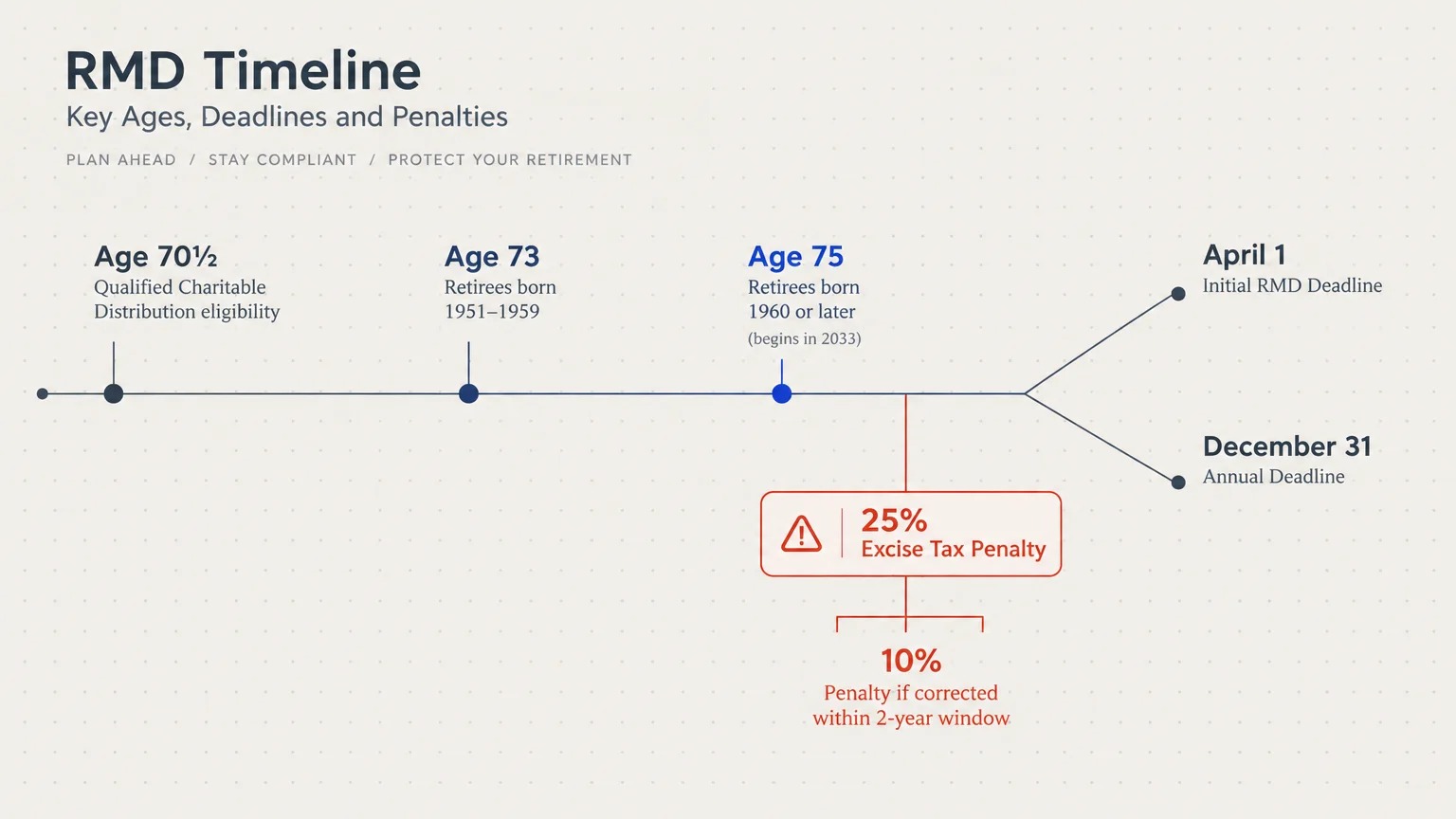
Under current law, your starting age for required minimum distributions is 73 if you were born between 1951 and 1959. That threshold increases to age 75 beginning in 2033 for anyone born in 1960 or later.
Every dollar you pull from a traditional IRA or 401(k) counts as ordinary income. Unlike capital gains, which enjoy lower preferential rates, retirement withdrawals face your top marginal income tax rate.
These withdrawals do more than simply raise your regular income tax bill. They increase your adjusted gross income, which can trigger unexpected secondary tax penalties across your household budget.
A higher income often subjects your Social Security benefits to taxation, capturing up to 85 percent of your monthly checks. Surging income also activates Income-Related Monthly Adjustment Amount surcharges on your Medicare premiums.
You can verify current Medicare premium brackets directly through Medicare.gov to see where these thresholds begin. Crossing a bracket by a single dollar increases both your Part B and Part D expenses.
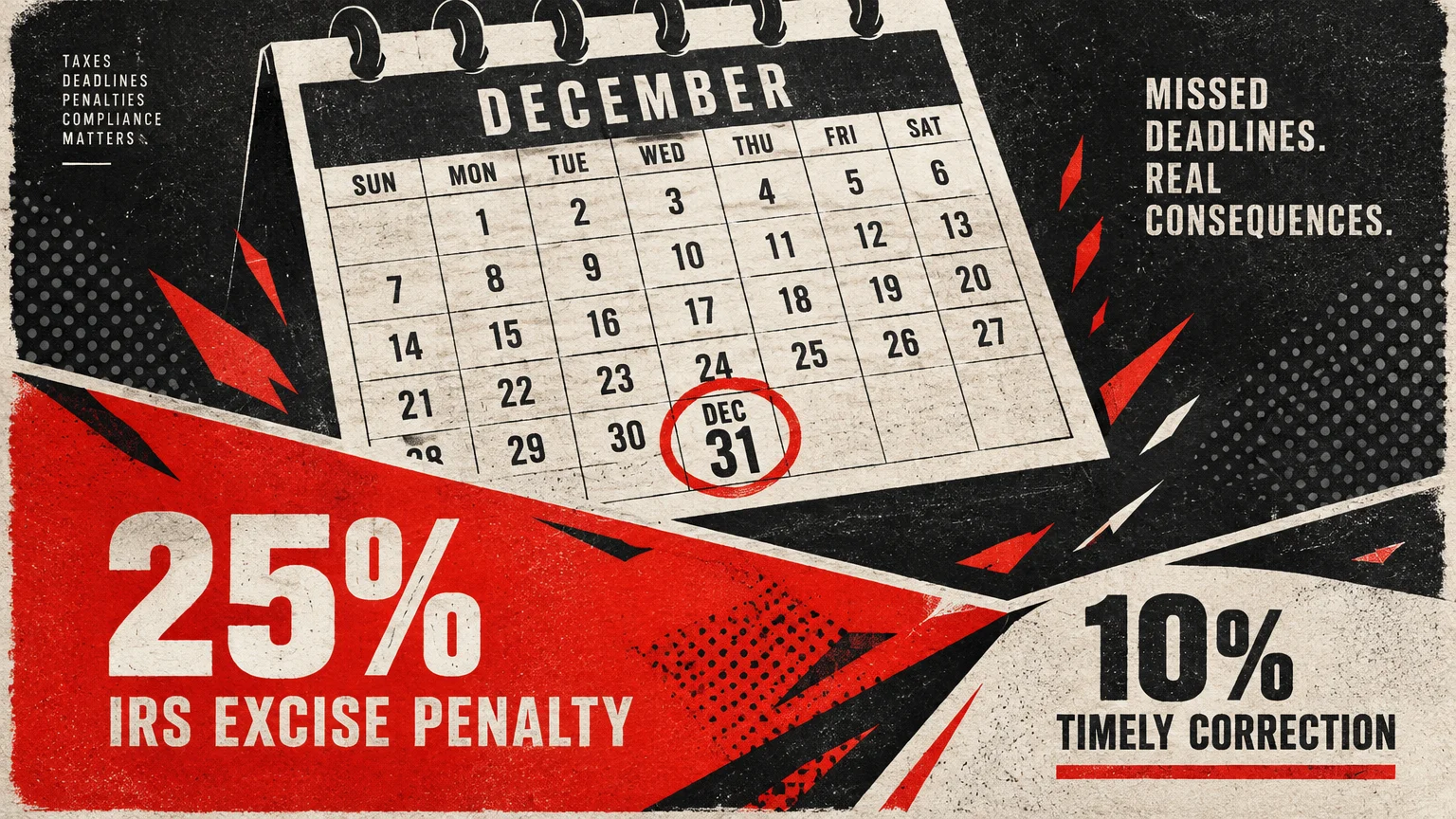
Retirees face an initial deadline of April 1 in the calendar year following the year they turn 73. Every distribution after that first year must occur by December 31.
If you fail to withdraw the correct distribution amount on time, the IRS imposes an excise tax penalty of 25 percent. You can reduce that penalty to 10 percent if you correct the error within a two-year window.
“It’s not how much money you make, but how much money you keep, how hard it works for you, and how many generations you keep it for.” — Robert Kiyosaki

Strategy 1: Use Qualified Charitable Distributions to Wipe Out RMD Taxes
A qualified charitable distribution offers the most direct way to eliminate taxes on your mandatory withdrawals. This strategy allows you to transfer funds directly from your traditional IRA to a qualified charity.
Instead of taking money into your personal bank account and claiming a deduction, the money bypasses your tax return entirely. The distributed amount never enters your adjusted gross income.
By excluding this withdrawal from your gross income, you protect yourself from secondary tax triggers. You keep your overall tax bracket lower while preserving standard deduction benefits.
You become eligible to execute a qualified charitable distribution at age 70½. This age requirement is based on the exact calendar date you reach that milestone, not merely the tax year.
Because eligibility begins at 70½, you can start removing taxable money before mandatory distributions begin at age 73. Doing so shrinks your overall account balance, which reduces future required withdrawals.
For the 2026 tax year, the annual individual cap on qualified charitable distributions is $111,000. If you are married and file jointly, your spouse can also donate up to $111,000 from their separate IRA.
Together, a married couple can transfer up to $222,000 tax-free to qualified organizations in 2026. This transfer fully satisfies your required minimum distribution up to the total donated amount.
Federal tax rules also permit a one-time split-interest gift option under the SECURE 2.0 framework. In 2026, you can transfer up to $55,000 from your IRA into a Charitable Gift Annuity or Charitable Remainder Trust.
This split-interest transfer counts toward your annual charitable distribution limit and produces a lifetime income stream for you or your spouse. Official regulatory guidelines are detailed through IRS Retirement Plans resources.
Step-by-Step Rules for Executing a QCD
You must follow strict procedural steps to ensure the IRS recognizes your transaction as a tax-free gift. A simple administrative error can convert your intended charitable donation into a fully taxable distribution.
- Order a direct custodian-to-charity transfer using your IRA administrator’s official distribution paperwork.
- Never withdraw the funds to your personal checking account first, as this invalidates the tax exclusion.
- Direct your distribution exclusively to a 501(c)(3) public charity rather than a private foundation or donor-advised fund.
- Obtain a contemporaneous written acknowledgment from the charity stating that you received no goods or services in exchange.
- Notify your tax preparer that the distribution shown on Form 1099-R was a non-taxable charitable transfer.
Maintaining strict written records protects you during an IRS audit. Keep copies of the transfer request and the charity’s receipt alongside your annual tax filing.
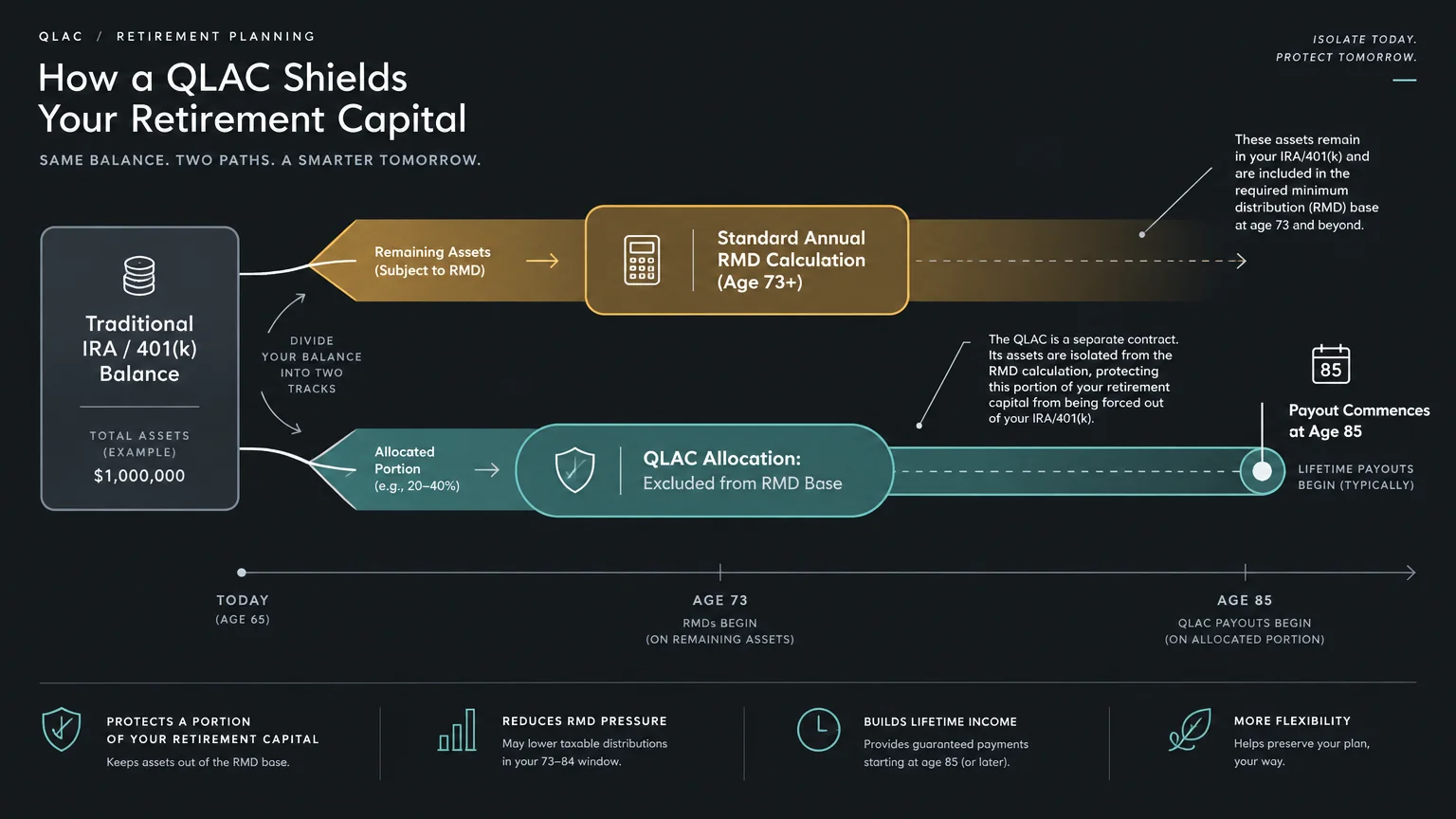
Strategy 2: Defer Taxes to Age 85 with a Qualified Longevity Annuity Contract (QLAC)
If you do not want to give your money to charity, a Qualified Longevity Annuity Contract lets you keep your capital while pushing taxes into the future. A QLAC is a specialized deferred income annuity purchased inside your retirement account.
When you allocate funds to a QLAC, the IRS removes those dollars from your year-end balance calculation. Because your distribution amounts depend directly on that December 31 balance, your mandatory withdrawals drop immediately.
You can purchase a QLAC using assets from traditional IRAs, 401(k) plans, or 403(b) accounts. The contract allows you to postpone receiving annuity income until you turn age 85.
Specifically, your annuity payouts must start no later than the first day of the month following your 85th birthday. You pay no income taxes on the sheltered money until those regular annuity payments actually begin.
For the 2026 tax year, the lifetime limit for QLAC funding is $210,000 per person. A married couple can invest up to $420,000 combined, provided each spouse funds their annuity from their own individual retirement accounts.
Previous regulations limited QLAC purchases to 25 percent of your total account balance. Congress permanently repealed that percentage restriction, meaning you can use the entire $210,000 cap regardless of your total portfolio size.
How a QLAC Changes Your Distribution Math
To understand the savings, consider a 73-year-old retiree with an account balance of $800,000 on December 31. Under standard IRS life expectancy tables, the distribution divisor is 26.5.
Without any planning, the retiree must withdraw approximately $30,189 in taxable income for the year. That withdrawal sits on top of any pension payments or Social Security checks.
If that retiree moves the maximum $210,000 into a QLAC before year-end, their calculated account balance drops to $590,000. Dividing $590,000 by 26.5 produces an adjusted distribution of only $22,264.
The retiree immediately reduces their taxable income by nearly $8,000 for that single calendar year. That tax relief compounds annually until annuity payouts commence at age 85.
Consumers can review consumer protections and annuity disclosures through the Consumer Financial Protection Bureau before committing capital to long-term insurance contracts. Ensure your contract includes a cash-refund feature so your beneficiaries recover any remaining balance if you pass away early.

Strategy 3: Delay Taxes with the “Still-Working” Employer Plan Exception
Many Americans continue working well beyond age 73, whether by choice or financial design. If you fall into this group, you can take advantage of the still-working exception to pause required distributions.
The federal government permits active employees to delay mandatory withdrawals from their current employer-sponsored retirement plan. You can postpone both the distributions and the accompanying income taxes until after you formally retire.
Under this exception, your initial distribution deadline shifts to April 1 of the year following the year you retire. If you work until age 76, your first distribution from that plan occurs at age 77.
Two strict legal conditions govern this exception. First, your employer’s plan document must explicitly allow the deferral, which most major corporate plans do.
Second, you cannot own more than 5 percent of the business sponsoring the retirement plan. If you own more than 5 percent of the company, the IRS treats you as a business owner and enforces mandatory distributions at 73.
This exception applies strictly to your active employer’s 401(k) or 403(b) account. It does not apply to traditional IRAs, SEP IRAs, SIMPLE IRAs, or accounts from previous employers.
The “Reverse Rollover” Strategy for Active Workers
You can expand this tax shield by utilizing a tactic known as a reverse rollover. If your current employer plan permits incoming transfers, you can roll balances from traditional IRAs into your active 401(k).
By moving individual retirement account money into your active company plan, you shield those assets from required distributions. The entire transferred balance qualifies for the still-working exception.
You must execute this transfer before December 31 of the year prior to turning 73. Once the money enters the qualified employer plan, mandatory withdrawals halt until you submit your retirement notice.
Confirm with your plan administrator that your company plan accepts roll-ins of pre-tax IRA funds. Never attempt to roll after-tax non-deductible IRA contributions into an employer plan, as federal rules prohibit that specific movement.

Strategic Bonus: Roth Conversions and SECURE 2.0 Protections
Proactive retirees often eliminate future distribution taxes years before mandatory withdrawals begin. Converting pre-tax balances into Roth accounts removes those assets from required minimum distribution calculations permanently.
A Roth IRA has never required distributions during the original account owner’s lifetime. You pay income tax on the converted amount in the year of the transfer, after which your money grows tax-free.
The SECURE 2.0 Act expanded this benefit to employer-sponsored plans. Starting in 2024, lifetime mandatory distributions were permanently eliminated for Roth 401(k), Roth 403(b), and Roth 457(b) accounts.
You can execute annual partial Roth conversions during the planning window between retirement and age 73. Targeting low-income transition years allows you to absorb the tax hit at lower marginal tax brackets.
However, you cannot use a Roth conversion to avoid a distribution in the current year once you reach age 73. The IRS requires you to satisfy your full annual distribution before converting any remaining pre-tax funds.
“The best time to plan for a financial goal was 20 years ago. The second best time is today.”
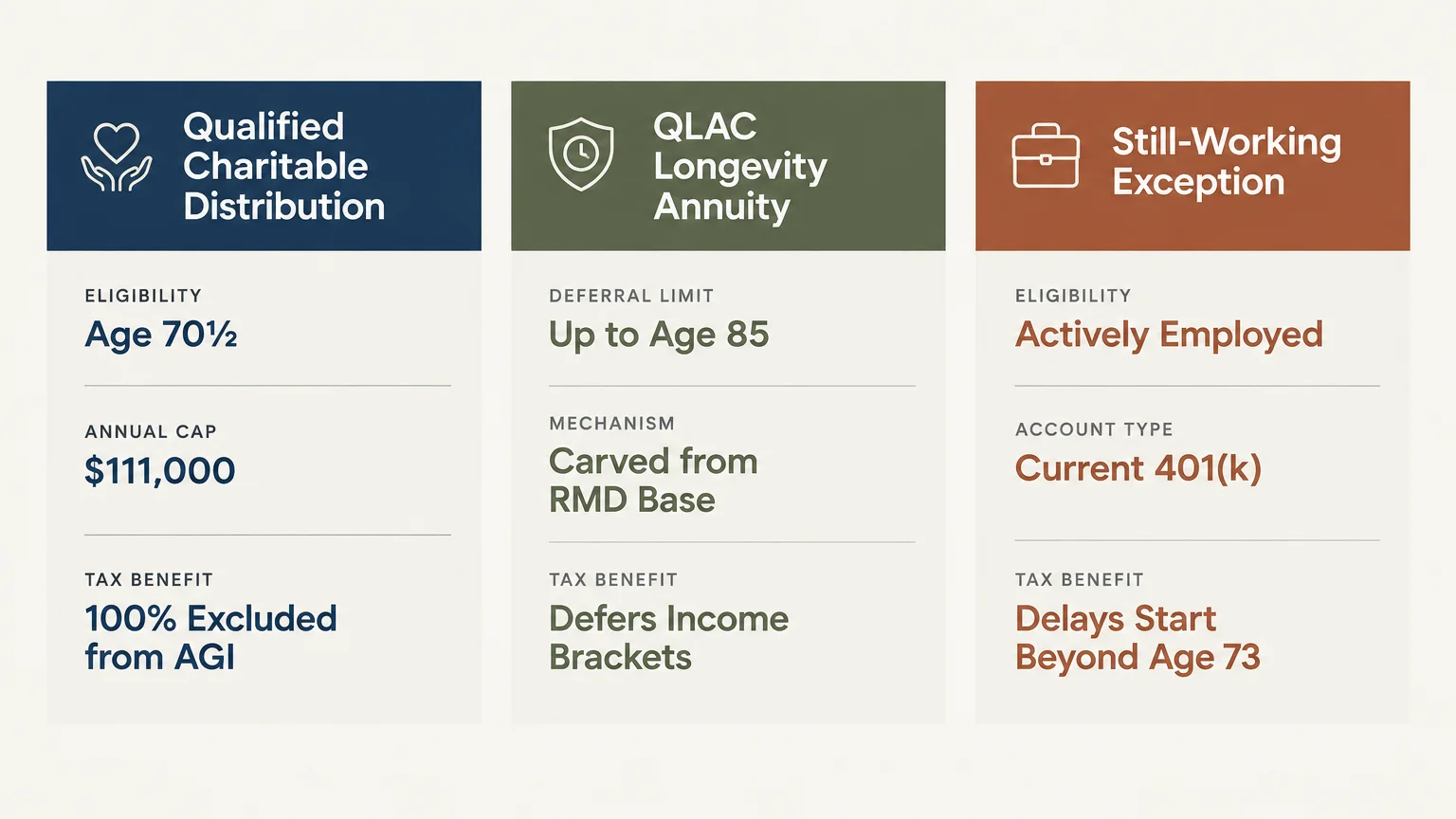
Comparing Your RMD Deferral and Tax Reduction Options
Selecting the right approach depends on your cash flow needs, employment status, and long-term estate goals. Each strategy provides different trade-offs between liquidity, lifetime control, and tax savings.
| Strategy | Primary Tax Benefit | 2026 Limit | Eligibility Age | Key Trade-Off |
|---|---|---|---|---|
| Qualified Charitable Distribution (QCD) | Excludes withdrawal from adjusted gross income entirely | $111,000 per individual ($222,000 married couple) | Age 70½ exactly | Funds leave your household permanently to charity |
| Qualified Longevity Annuity Contract (QLAC) | Defers taxes on principal and payouts until age 85 | $210,000 lifetime cap per individual | Any retirement account owner | Illiquid contract that locks up assets until payout date |
| Still-Working Plan Exception | Delays plan distributions until April 1 post-retirement | Entire balance of current employer plan | Age 73 or older | Must stay actively employed and own 5% or less of company |
| Systematic Roth Conversion | Eliminates all future lifetime mandatory distributions | No statutory annual limit | Any age (ideal ages 60–72) | Requires paying upfront ordinary income taxes on converted sums |
You can also combine several of these strategies concurrently to maximize your tax savings. A working senior could utilize the employer plan exception while simultaneously directing personal IRA assets into charitable gifts.
Errors That Cost Families Thousands
Navigating distribution rules requires precision because simple procedural mistakes trigger harsh financial penalties. Knowing the most frequent errors helps you keep your capital intact.
The first common mistake involves delaying your very first distribution until April 1 of the following year. Taking your first withdrawal in April forces you to take your second withdrawal by December 31 of that same year.
Stacking two required distributions into one calendar tax year can push you into a significantly higher tax bracket. In most cases, taking your first withdrawal by December 31 of your 73rd year produces a better tax outcome.
A second costly error occurs when retirees write personal checks to charities expecting a charitable distribution exclusion. The IRS strictly disallows this practice and treats the withdrawal as ordinary taxable income.
Your IRA custodian must issue the check directly to the eligible non-profit organization. If the distribution check is made payable to you personally, the tax shelter evaporates immediately.
A third error involves assuming the still-working exception shields old retirement accounts from previous employers. It does not protect older accounts left behind at prior jobs.
You must take mandatory withdrawals from those old 401(k) accounts unless you consolidated them into your current active plan. Neglecting an old plan results in missed distribution penalties.
Retirees also make the mistake of aggregating distributions across the wrong types of accounts. While you can aggregate distributions across multiple traditional IRAs, you cannot satisfy an IRA distribution by taking money from a 401(k).
Each 401(k) and 403(b) account generally requires its own separate distribution calculation and withdrawal. Treating these distinct account structures as a single pool violates IRS rules and sparks penalty notices.

When to Get Expert Help
Retirement tax rules intersect with complex federal regulations, making professional advice worthwhile for many families. Managing multi-year distribution schedules often requires technical expertise beyond everyday tax software.
You should consult a certified public accountant or enrolled agent when calculating the multi-year impact of qualified distributions. A tax professional can model your Medicare premium thresholds and help you avoid expensive surcharges.
Work with a fee-only fiduciary financial planner if you are considering purchasing a longevity annuity contract. An independent fiduciary can review fee schedules and verify contract terms without earning product commissions.
Professional guidance is especially critical if you own a stake in a family business while utilizing the still-working exception. Complex IRS family attribution rules can cause you to exceed the 5 percent ownership ceiling unexpectedly.
If you discover that you missed a distribution deadline, seek expert tax help immediately. An advisor can file IRS Form 5329 alongside a formal letter requesting a penalty waiver due to reasonable cause.
Frequently Asked Questions
Can I roll my required minimum distribution into a Roth IRA?
No, the IRS strictly prohibits rolling over any required distribution amount into a Roth IRA. You must satisfy your full mandatory withdrawal for the year before converting any remaining account funds.
What happens if I turn 73 and do not need the money?
You must withdraw the funds regardless of your personal financial need or pay a 25 percent penalty. To avoid the tax impact, use a qualified charitable distribution or fund a longevity annuity.
Do I have to take distributions from my Roth 401(k)?
No, the SECURE 2.0 Act eliminated mandatory lifetime distributions for employer-sponsored Roth accounts beginning in 2024. Your Roth 401(k) balances can remain inside the account to grow tax-free indefinitely.
Can I donate my distribution to a donor-advised fund?
No, donor-advised funds and private grant-making foundations do not qualify for charitable distribution treatment under IRS rules. You must direct distributions to standard 501(c)(3) public charities to receive the tax exclusion.
Take Action to Protect Your Retirement Income
You do not have to surrender a large portion of your retirement savings to preventable income taxes. Take time today to review your retirement account balances and calculate your projected distributions.
Evaluate whether a qualified charitable gift, a longevity annuity contract, or the still-working exception aligns with your household budget. Taking proactive steps now ensures you maintain control over your hard-earned wealth.
Information in this article reflects rules and figures current as of the publication date and may change. Always confirm details directly with your bank, the IRS, the Social Security Administration, or other official sources before making decisions.
Last updated: October 2026. Rates, benefit amounts, and tax rules change—always verify current details at official sources.