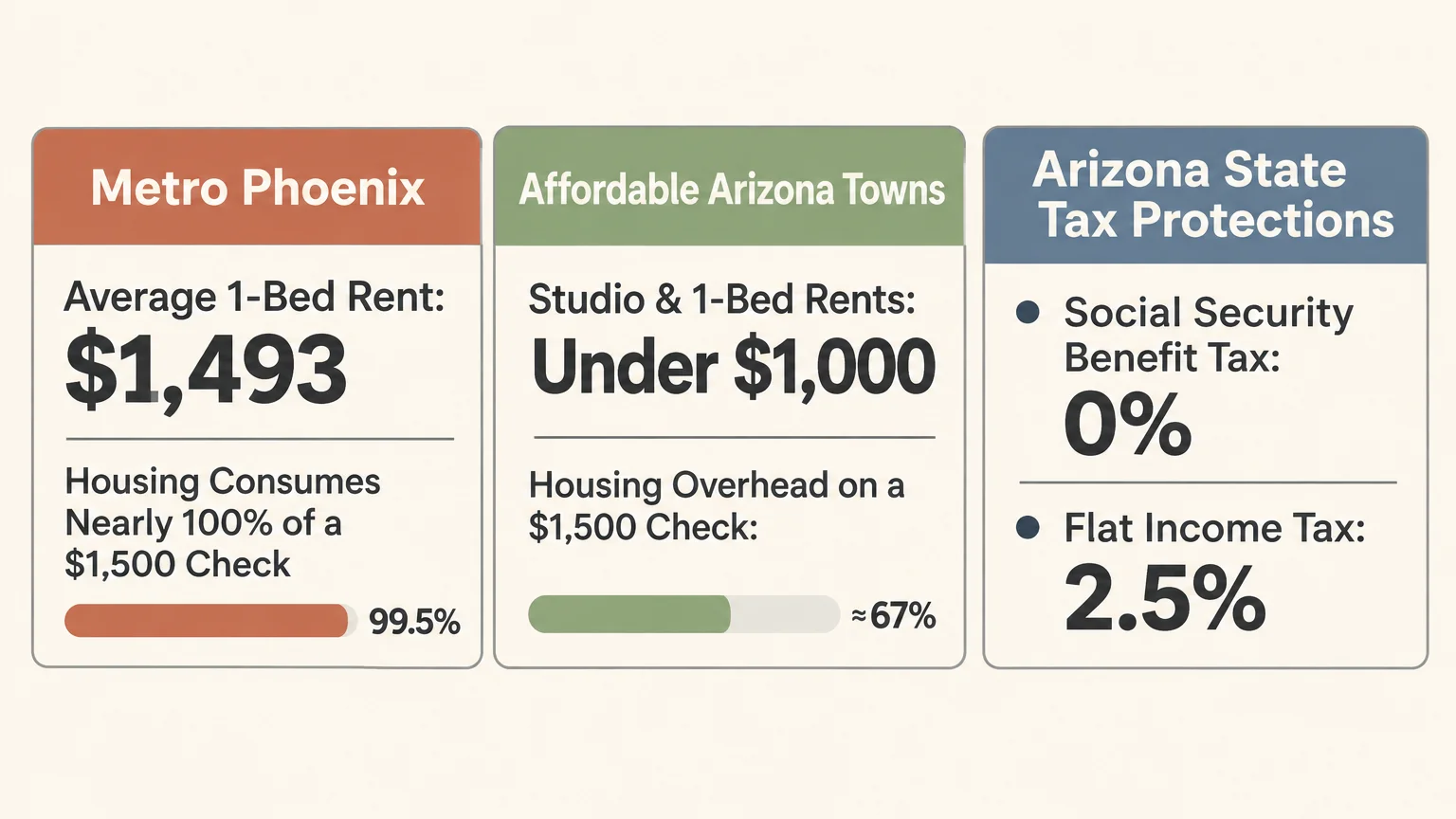
Stretching a $1,500 monthly Social Security check in Phoenix is nearly impossible when a modest one-bedroom apartment averages $1,493. Yet several affordable Arizona towns offer studio and one-bedroom rents well under $1,000.
With the right town and Arizona benefit programs, you can cover rent, groceries, and utilities without draining savings. Below are nine cheap places to retire in Arizona where fixed-income math actually works.
The Real Math Behind a $1,500 Social Security Check
Before picking a zip code, you need to calculate what lands in your checking account each month. Gross benefit numbers rarely match spendable cash.
A $1,500 monthly benefit sits roughly 28% below the 2026 national average retired worker check of $2,095. For January 2027, the Social Security Administration announced a 3.6% cost-of-living adjustment, lifting the average worker check to $2,170.
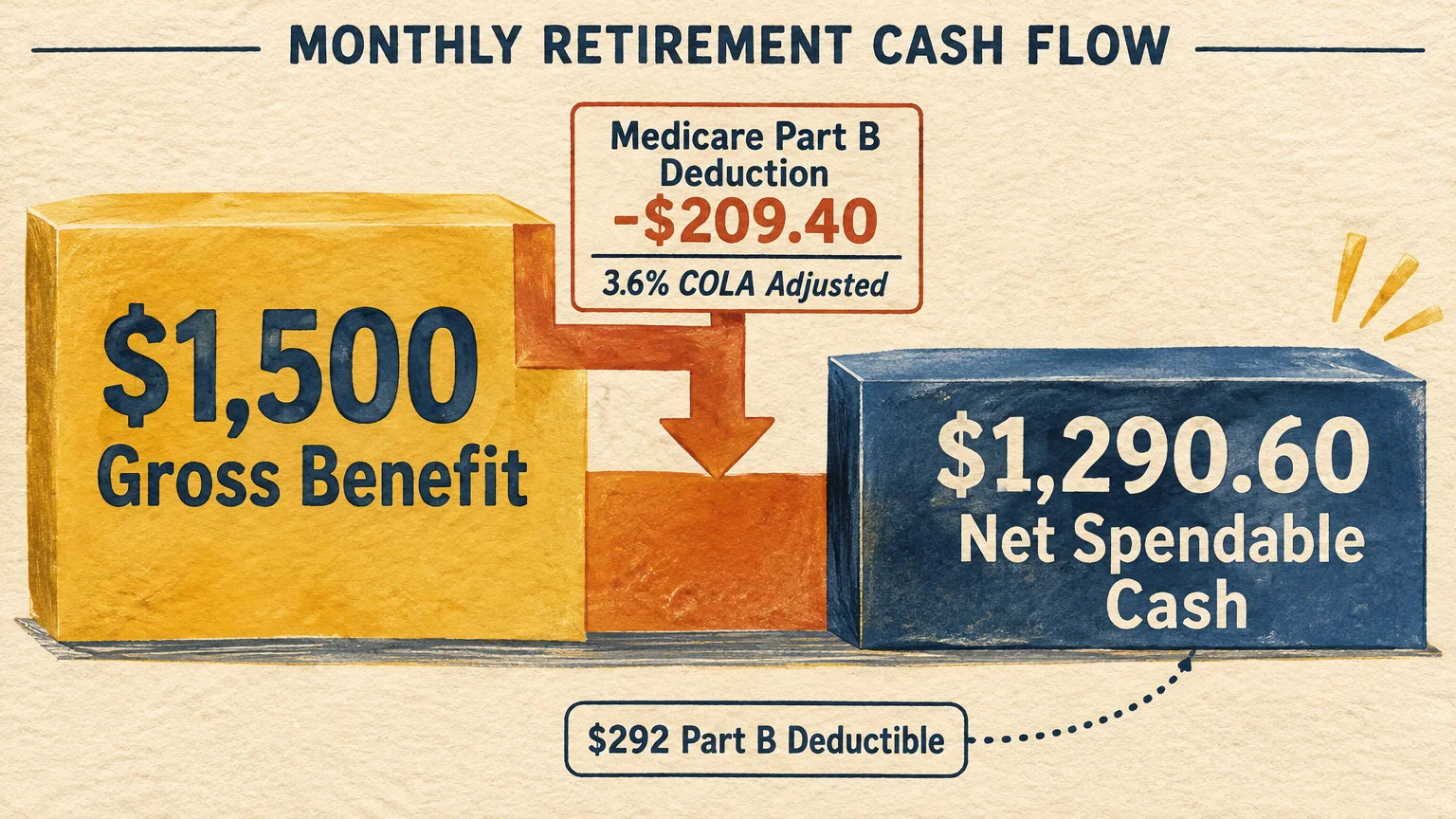
That 3.6% increase adds $54 per month to a $1,500 benefit, bringing your gross payment to $1,554 in 2027. However, Medicare Part B premiums usually come straight out of your deposit.
For 2027, the Centers for Medicare & Medicaid Services set the standard Part B premium at $209.40, up $6.50 from $202.90 in 2026. Without premium assistance, a $1,500 gross check nets just $1,290.60 after the 2027 deduction.
Out-of-pocket medical limits also shift in 2027. The Part B annual deductible moves from $283 to $292, the Part A hospital deductible rises from $1,736 to $1,776, and the Part D prescription cap stands at $2,400.
True financial security on a fixed income comes from matching your housing costs to your net deposit first, then automating every recurring bill around what remains.
Fortunately, nearly 99% of Medicare beneficiaries pay $0 for Part A hospital premiums. You can review your exact deduction schedule anytime through your account on the Social Security Administration website.
How Arizona Taxes and Benefit Programs Stretch Your Cash
Many retirees assume high Arizona housing prices make the whole state unaffordable. Statewide averages sit 5% to 6% above the U.S. norm, driven largely by Phoenix and luxury resort markets.
Outside metro Phoenix, state tax rules and assistance programs dramatically improve social security budget living. Several key protections apply directly to retirees earning around $1,500 per month:
- Zero state tax on Social Security: Arizona levies a flat 2.5% individual income tax rate with no local income taxes, and it completely exempts Social Security benefits from state taxation.
- Expanded federal senior deduction: From 2025 through 2028, adults aged 65 and older receive an extra $6,000 federal deduction—or $12,000 for qualifying couples—sheltering modest IRA or pension withdrawals.
- Grocery tax relief under Proposition 316: State sales tax excludes home groceries, and voters approved Proposition 316 in November 2026 to cap local municipal grocery taxes at 2%.
- Medicare Savings Program relief: Arizona imposes no asset limit on its Medicare Savings Programs; a single retiree earning $1,500 monthly qualifies for the Specified Low-Income Medicare Beneficiary program, which pays the full $209.40 Part B premium.
- Senior SNAP nutrition support: Households with an adult aged 60 or older face no asset limit in Arizona and only need to meet the net income test of $1,330 monthly for one person after housing and medical deductions.
- Refundable Form 140PTC credit: Full-year residents aged 65 or older who pay rent or property taxes can claim up to $502 back if countable income—excluding Social Security—is under $3,751 single or $5,501 with others.
Homeowners get extra protection, too. Arizona carries the third-lowest average effective property tax rate in the nation at 0.48% of assessed home value.
If you are 65 or older and live in your home for two years, the Senior Property Valuation Protection Option freezes your assessed valuation for three-year renewable terms. Income limits for 2026 sit at $47,712 for one owner or $59,640 for two or more owners.
Checking eligibility for Part B premium coverage and prescription savings takes only a few minutes at Medicare.gov. Every dollar you reclaim through benefits goes straight back into your monthly cash flow.
Side-by-Side Comparison of 9 Affordable Arizona Cities
To evaluate affordable Arizona towns fairly, this table pairs local cost-of-living indexes with U.S. Department of Housing and Urban Development Fair Market Rents for fiscal year 2027. Fair Market Rents represent the 40th-percentile gross rent, including basic utilities.
| Arizona City | County | Cost of Living vs. U.S. Avg | FY 2027 Studio / 1BR Rent (FMR) | Median Home Price / Market Note |
|---|---|---|---|---|
| Douglas | Cochise | 15.2% below | $836 / $1,000 | $166,000–$170,000 |
| Sierra Vista | Cochise | 8% below | $836 / $1,000 | ~$262,000 |
| Bisbee | Cochise | 8% below | $836 / $1,000 | $1,375 avg market rent |
| Yuma | Yuma | N/A | $942 / $948 | ~$1,021 avg market rent; $286,500 home |
| Bullhead City | Mohave | 5% below | $953 / $959 | $260,000–$296,000; bills 7% below U.S. |
| Kingman | Mohave | N/A | $953 / $959 | $260,000–$296,000 |
| Winslow | Navajo | 2.1% below | $892 / $966 | $179,061 |
| Globe | Gila | 7.6% below | $1,048 / $1,055 | $232,978 |
| Tucson | Pima | 0% (U.S. avg) | $978 / $1,092 | ~$1,000 avg rent; $320,000–$330,000 home |
Every city on this list beats the Phoenix-Mesa-Chandler metro area by hundreds of dollars per month. Phoenix studio rents average $1,390 and one-bedrooms reach $1,493 under FY 2027 benchmarks.
9 Arizona Cities for Retirees on $1,500 a Month
Each of these communities stretches a modest retirement check in a different way. Pay close attention to elevation, summer cooling bills, and proximity to medical care before choosing your target town.
1. Douglas (Cochise County)
Sitting along the southern border in Cochise County, Douglas posts a cost of living 15.2% below the national average. It is one of the strongest cheap places to retire if you prioritize low everyday overhead.
Median home prices sit between $166,000 and $170,000, making outright cash purchases realistic if you bring equity from another state. Renters benefit from county Fair Market Rents of $836 for a studio and $1,000 for a one-bedroom.
Keep healthcare travel in mind when budgeting for gas. Specialized hospital appointments often require a drive north to Sierra Vista or Tucson.
2. Sierra Vista (Cochise County)
Sierra Vista combines small-city retail convenience with a cost of living 8% below the U.S. average and 12% below the Arizona average. At roughly 4,600 feet in elevation, summers stay noticeably milder than in low-desert Phoenix.
Modest rental benchmarks stand at $836 for a studio and $1,000 for a one-bedroom, while median home prices hover around $262,000. Lower cooling loads help keep electric bills manageable during peak summer months.
Sierra Vista also serves as Cochise County’s medical and shopping hub. You get grocery competition, pharmacies, and clinics without big-city traffic or metro rent markups.
3. Bisbee (Cochise County)
Just southeast of Sierra Vista, historic Bisbee is home to roughly 4,977 residents and posts a cost of living 8% below the U.S. average. Its walkable downtown and arts community appeal to retirees who want character without resort pricing.
County-wide HUD studio rents benchmark at $836, though tight historic housing inventory pushes Bisbee’s broader average market rent closer to $1,375. To retire on 1500 a month here, focus on smaller apartments, casitas, or shared housing.
Steep hillside streets make car condition and mobility worth evaluating early. Verify parking access and heating costs before signing a winter lease.
4. Yuma (Yuma County)
Yuma delivers warm desert winters and one of Arizona’s lowest verified rental markets. Average market rents sit near $1,021 per month, while FY 2027 Fair Market Rents dropped 10% to $942 for a studio and $948 for a one-bedroom.
Median home sale prices run around $286,500, and seasonal produce grown locally helps trim grocery bills. Yuma also offers established senior clinics and major retail chains.
Summer heat is the main budget wildcard here. Plan to run air conditioning heavily from May through September and budget extra cash for summer electricity.
5. Bullhead City (Mohave County)
Located along the Colorado River across from Laughlin, Nevada, Bullhead City sits 5% below the national cost of living. Household bills here run 7% below the U.S. average and 14% below Arizona’s statewide average.
Mohave County’s FY 2027 Fair Market Rents fell 10% to $953 for a studio and $959 for a one-bedroom. Median home values stay in the $260,000 to $296,000 range.
Like Yuma, Bullhead City sees intense summer temperatures. Setting up equal-payment utility billing prevents July and August electric spikes from wrecking your budget.
6. Kingman (Mohave County)
Kingman sits roughly 3,300 feet high along Interstate 40, giving it cooler nights than the river valley while sharing Mohave County’s affordable rent structure. Studio Fair Market Rents sit at $953 and one-bedrooms at $959, with median homes between $260,000 and $296,000.
A critical warning applies to Mohave County shoppers: skip nearby Lake Havasu City on a tight check. Lake Havasu City carries a cost of living 22% above the U.S. average and $1,900 average rents.
Kingman gives you access to major grocery stores and regional medical care at a fraction of Lake Havasu’s cost. You stay within driving distance of Las Vegas specialists without paying resort prices.
7. Winslow (Navajo County)
Along historic Route 66 in northern Arizona, Winslow keeps housing remarkably accessible. Its cost of living sits 2.1% below the national average, and median home prices sit near $179,061.
Navajo County Fair Market Rents benchmark at $892 for a studio and $966 for a one-bedroom. Two-bedroom units run $1,264 if you want space for visiting family or a roommate to split costs.
Sitting on the high desert plateau brings chilly winter nights alongside mild summers. Balance your utility reserve to cover both winter heating and light summer cooling.
8. Globe (Gila County)
Nestled in the Pinal Mountains roughly 90 minutes east of Phoenix, Globe posts a cost of living 7.6% below the U.S. average. Median home prices sit around $232,978.
Gila County Fair Market Rents stand at $1,048 for a studio and $1,055 for a one-bedroom, which requires careful budgeting on $1,500 alone. Look for senior-income apartments or subsidized complexes to keep shelter under 50% of your check.
Avoid drifting north to Payson inside the same county if money is tight. Payson’s cost of living runs 5% above the national average with $1,800 average rents.
9. Tucson (Pima County)
Tucson is the largest city where social security budget living remains feasible without sacrificing major hospital systems. Its overall cost of living matches the U.S. average, while median home prices sit between $320,000 and $330,000.
While Tucson’s FY 2027 Fair Market Rent is $978 for a studio and $1,092 for a one-bedroom, budget neighborhoods and senior complexes regularly offer units near $1,000 per month. Bus routes and walkable pockets can also eliminate car expenses.
Dropping a second vehicle—or living car-free along Tucson’s transit corridors—frees up hundreds of dollars monthly for food, healthcare, and savings. Few other large Arizona cities offer that flexibility.
Bonus Ultra-Low-Cost Rural Pockets
If your budget has zero margin for rent above $800, look toward Arizona’s smaller rural counties. HUD FY 2027 studio and one-bedroom Fair Market Rents drop to $725 and $796 in Santa Cruz County around Nogales, and $786 and $792 in La Paz County around Quartzsite and Parker.
Graham County around Safford averages $807 for studios and $894 for one-bedrooms, while Apache County around St. Johns benchmarks at $746 and $819. Meanwhile, Eloy in Pinal County posts Arizona’s lowest average household bills at $1,403 per month—roughly 66% of the national average.

Building a Sustainable Monthly Cash-Flow System on $1,500
Knowing where to live only solves half the equation. You also need a repeatable cash-flow system that runs smoothly without daily stress or deprivation.
Start by enrolling in Arizona’s Specified Low-Income Medicare Beneficiary program so the state pays your $209.40 Part B premium. That single step protects your full $1,500 check instead of leaving you with $1,290.60.
Next, structure a realistic monthly spending plan for a single retiree renting a studio or modest one-bedroom in a town like Yuma, Bullhead City, or Douglas:
- Housing and basic utilities ($850): Target a studio or income-qualified apartment near $800 to $900, ideally with water and trash included.
- Electric reserve ($150): Summer 2026 broke Arizona’s heat records, pushing regional summer electricity usage to 1,193 kilowatt-hours—roughly $179 per month at 15.1 cents per kilowatt-hour; saving $150 monthly year-round covers summer spikes smoothly.
- Food and household supplies ($225): Pair Proposition 316’s 2% local grocery tax cap with senior SNAP benefits, which can add meaningful monthly grocery purchasing power.
- Transportation and phone ($150): Use low-cost senior mobile plans, consolidate errands into weekly trips, or rely on local transit in cities like Tucson.
- Out-of-pocket medical and buffer ($125): Fund a dedicated high-yield savings account for your $292 Part B deductible, copays, and unexpected car or home repairs.
Treat your savings buffer like a non-negotiable bill that transfers automatically the day your Social Security check clears. Using two separate bank accounts—one for fixed bills and one for groceries and spending—keeps you from accidentally spending rent money.
For practical worksheets on tracking monthly cash flow and comparing bank fees, explore the tools at the Consumer Financial Protection Bureau.

Errors That Cost Families Thousands
Even careful savers lose thousands of dollars a year to avoidable paperwork mistakes and geographic blind spots. Watch out for these costly traps when planning a move:
- Skipping Medicare Savings Programs: Assuming you have too much savings in the bank stops many seniors from applying, even though Arizona has no asset limit for QMB or SLMB; skipping SLMB costs $2,512.80 per year in 2027 Part B premiums.
- Leaving SNAP and Form 140PTC unclaimed: Nationally, only 38% of eligible adults aged 65 and older receive SNAP, and thousands miss Arizona’s $502 refundable property tax and rent credit simply by skipping a tax return.
- Moving to expensive neighboring towns: Choosing Lake Havasu City over Kingman, or Payson over Globe, can add $700 to $900 per month to rent alone—wiping out an entire half-year of savings quickly.
- Ignoring summer cooling costs: Touring a desert rental in mild February masks what August air conditioning costs inside an older, poorly insulated unit; always request 12-month utility history before signing a lease.
- Tapping retirement accounts carelessly: While Arizona exempts Social Security from its 2.5% income tax, withdrawals from traditional 401(k)s and IRAs remain taxable at the state level and can reduce income-tested benefit eligibility.
When to Get Expert Help
Navigating housing waitlists, Medicare assistance, and retirement tax rules at the same time is tricky. Free or low-cost experts can prevent costly errors before you sign a lease or move across state lines.
Reach out to a certified counselor in these situations:
- Evaluating subsidized senior housing or rental assistance: Connect with a specialist through HUD Housing Counseling to locate income-restricted Arizona apartments and verify fair-housing terms.
- Applying for SLMB, QMB, and Medicare Advantage plans: Work with an Arizona State Health Insurance Assistance Program benefits counselor to compare Part D drug formularies and check Medicaid-linked savings eligibility.
- Claiming Form 140PTC or planning IRA withdrawals: Consult a certified public accountant or free Volunteer Income Tax Assistance preparer so small retirement withdrawals do not trigger unnecessary taxes or cut off SNAP support.
- Relocating with home equity or debt: Speak with a fee-only financial planner before buying a home in cash or taking on a new mortgage so you preserve enough liquid reserves for emergencies.
Frequently Asked Questions
Can you really live on $1,500 a month in Arizona?
Yes, provided you choose affordable Arizona towns outside metro Phoenix and use available state benefits. Living comfortably requires keeping rent near or below $950, enrolling in SLMB to cover Part B premiums, and utilizing SNAP or senior tax credits.
What is the cheapest city in Arizona to retire on Social Security?
Douglas offers the lowest overall cost of living among the nine cities at 15.2% below the U.S. average, with homes around $167,000. For ultra-low household bills, Eloy averages $1,403 monthly, while Santa Cruz and La Paz counties offer studio rents under $800.
Does Arizona tax Social Security benefits?
No, Arizona completely exempts Social Security and Railroad Retirement benefits from its 2.5% state income tax. However, withdrawals from 401(k) accounts, traditional IRAs, and private pensions remain subject to Arizona state income tax.
How does a single retiree on $1,500 keep Medicare from shrinking their check?
In Arizona, single individuals earning up to $1,616 per month qualify for the Specified Low-Income Medicare Beneficiary program regardless of savings. Once approved, the state pays your $209.40 monthly Part B premium in 2027, restoring your full benefit deposit.
How much should you budget for summer air conditioning in Arizona?
During the record-hot summer of 2026, regional electricity usage averaged 1,193 kilowatt-hours per month, or roughly $179 at Arizona’s 15.1-cent average rate. Older desert homes or apartments can run higher, so enroll in utility budget billing to smooth seasonal spikes.

Your Next Step Toward an Affordable Arizona Move
Start by checking your eligibility for Arizona’s Medicare Savings Program, SNAP, and local income-restricted senior apartments in two or three cities from the table above. Calling local utility providers for 12-month average electric bills and touring properties during warmer months will confirm whether your $1,500 check leaves comfortable breathing room.
Information in this article reflects rules and figures current as of the publication date and may change. Always confirm details directly with your bank, the IRS, the Social Security Administration, or other official sources before making decisions.
Last updated: November 2026. Rates, benefit amounts, and tax rules change—always verify current details at official sources.