
Waiting past age 62 to file for Social Security does not cost you annual cost-of-living adjustments. The Social Security Administration automatically applies every COLA starting the year you turn 62, even while your benefits sit unclaimed.
Delaying your claim actually multiplies the value of those increases over time. Each annual adjustment raises your baseline benefit first, giving delayed retirement credits a larger base to grow from.
Understanding the exact cutoff dates, calculation formulas, and household tradeoffs helps you choose the right claiming age. You can protect both your future monthly check and your family’s cash flow.
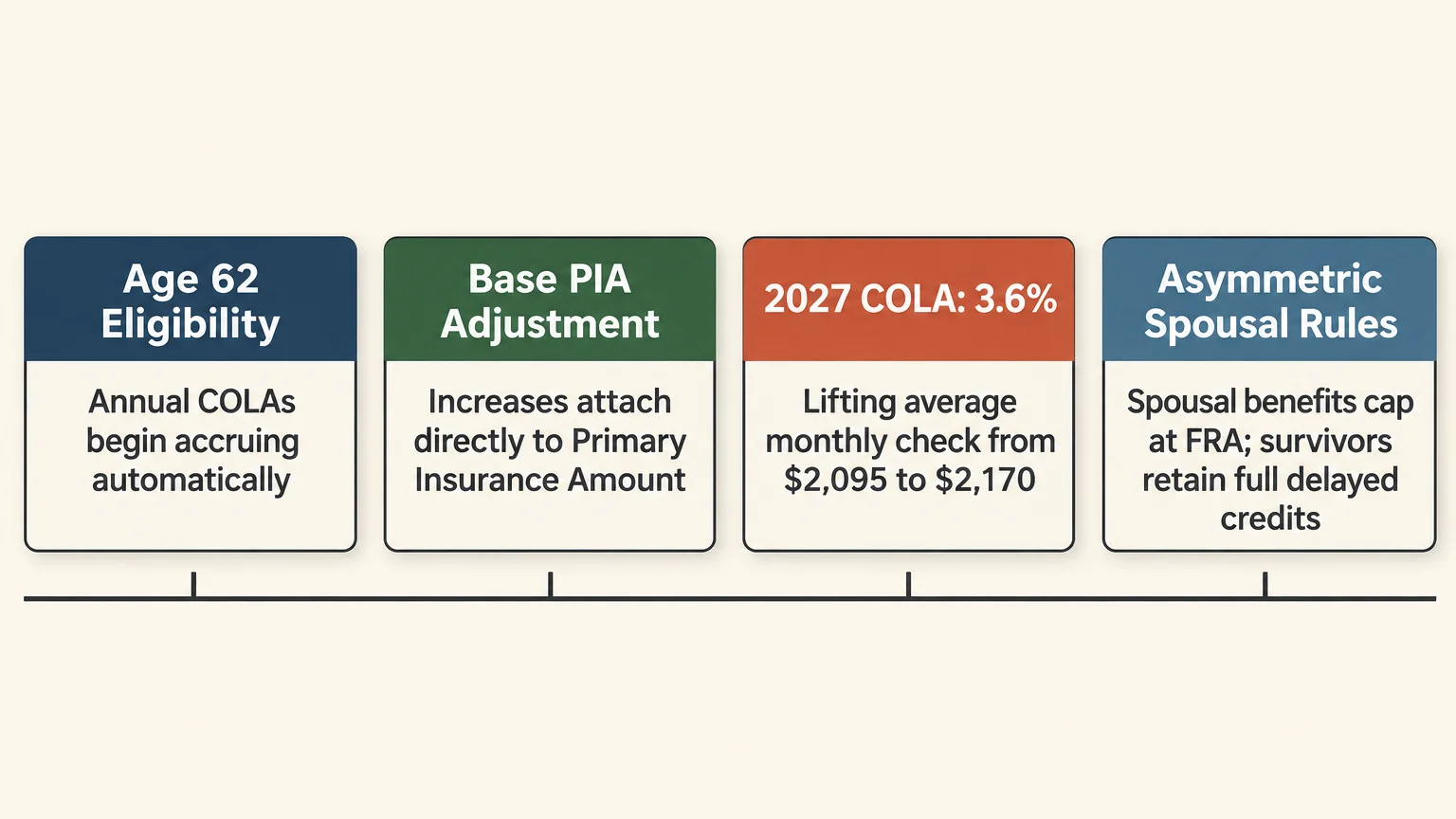
Key Takeaways on Pre-Claiming COLAs
If you are deciding whether to claim now or wait, four core rules govern how benefit increases accumulate behind the scenes.
- Age 62 triggers eligibility: You receive annual COLAs starting with the year you turn 62, regardless of whether you file at 62, Full Retirement Age, or 70.
- Increases attach to your base benefit: Each COLA raises your Primary Insurance Amount first, so early reductions or delayed credits apply to a permanently higher figure.
- The 2027 COLA is 3.6%: Announced in October 2026, this increase raises the estimated average retired-worker check from $2,095 to $2,170 in January 2027.
- Couples face asymmetric rules: Spousal benefits include your age-62-and-older COLAs but earn no delayed credits past Full Retirement Age, while survivor benefits inherit both.
How Social Security COLA Rules Work Before You Claim
Many workers rush to file at 62 because they worry that inflation adjustments only go to people already receiving monthly deposits. That fear leads families to lock in permanent benefit cuts they did not need to accept.
Under Section 215(i) of the Social Security Act, you become eligible for COLAs in the calendar year you turn 62. You do not need to file paperwork or collect a single check to capture those adjustments.
For 2027, the Social Security Administration (SSA) announced a 3.6% COLA on October 14, 2026. That figure reflects the rise in the Consumer Price Index for Urban Wage Earners and Clerical Workers from the third quarter of 2025 through the third quarter of 2026.
The 3.6% adjustment takes effect for December 2026 benefits, with payments arriving in January 2027 for nearly 72 million Social Security beneficiaries. Roughly 7.3 million Supplemental Security Income recipients see their adjustment on December 31, 2026.
Recent years have shown wide swings in inflation adjustments. After 5.9% in 2022 and 8.7% in 2023, annual COLAs moderated to 3.2% in 2024, 2.5% in 2025, and 2.8% in 2026 before climbing to 3.6% for 2027.
Every one of those percentages has already been baked into the future benefit calculation of anyone who turned 62 in 2021 or earlier. If you delay claiming until age 70, you collect the cumulative effect of every increase since your 62nd birth year.
The Birth-Year Cutoff Rule Explained
Eligibility for a specific year’s COLA depends strictly on when you reach age 62. A COLA taking effect for December applies only to workers who attained age 62 in that calendar year or earlier.
If you turn 62 at any point during 2026, the 2027 COLA of 3.6% is automatically added to your future benefit formula. Even if you wait until 2031 or 2034 to claim, that 3.6% bump stays on your record.
If you turn 62 in 2027, however, you do not receive the 2027 COLA. Instead, the SSA calculates your initial benefit using 2027 wage-indexing and formula thresholds, and your first COLA will be the one effective December 2027.
| Milestone | Turning 62 in 2026 (Born 1964) | Turning 62 in 2027 (Born 1965) |
|---|---|---|
| Full Retirement Age (FRA) | 67 (reached in 2031) | 67 (reached in 2032) |
| Receives 2027 COLA (3.6%)? | Yes, even if delaying past 2027 | No; uses 2027 initial PIA formula |
| First COLA Effective Date | December 2026 (payable Jan. 2027) | December 2027 (payable Jan. 2028) |
| Earliest Claiming Month | Birth month if born on 1st or 2nd; otherwise next month | Birth month if born on 1st or 2nd; otherwise next month |
Timing rules around your 62nd birthday also affect your first payment if you decide to claim early. You must be 62 for an entire calendar month to qualify for benefits in that month.
Only people born on the first or second day of a month can claim for their actual birth month. Everyone else must wait until the following month to begin collecting.
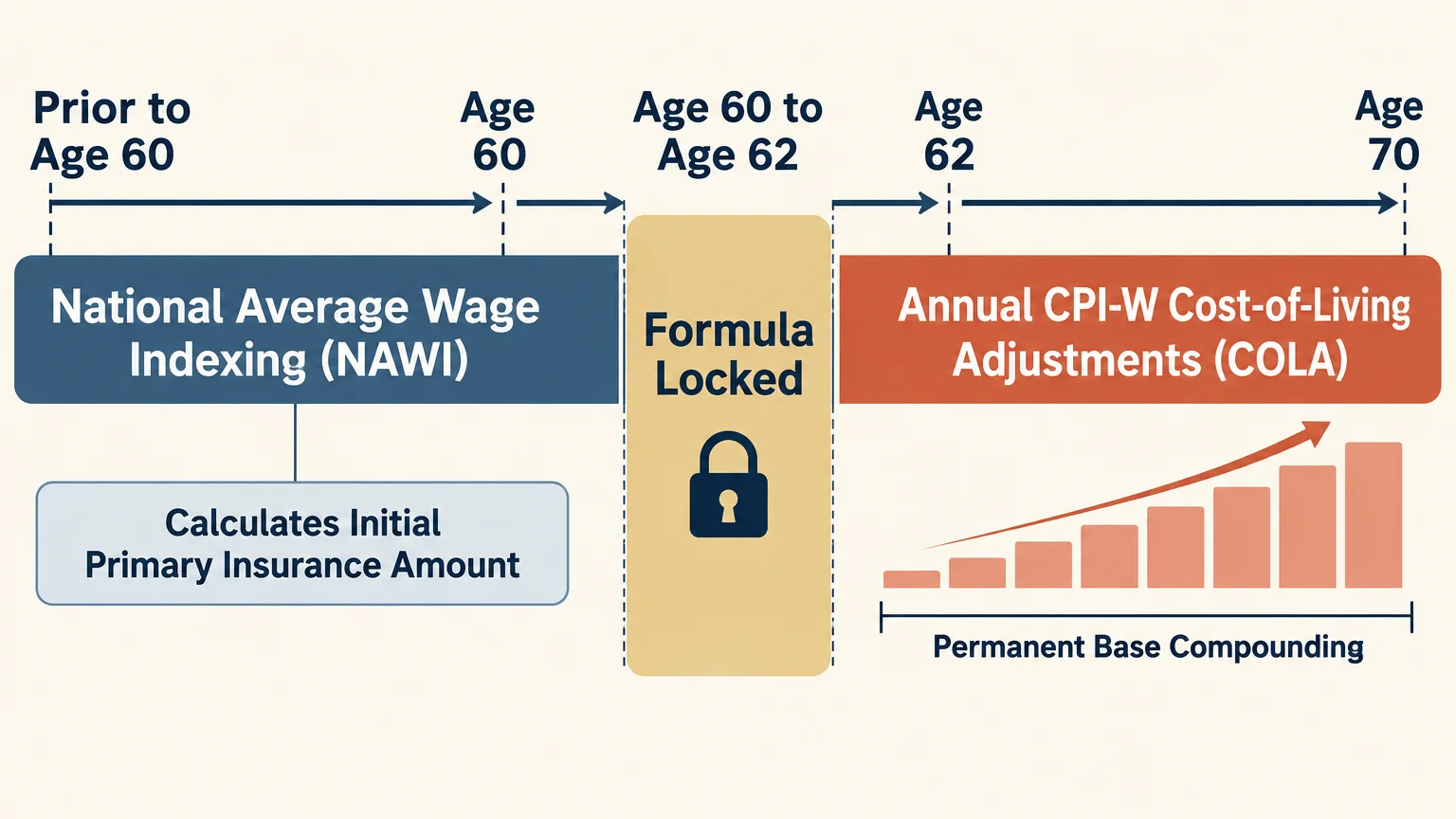
What Happens Between Age 60 and Age 62: Wage Indexing vs. COLAs
Before you turn 62, your future benefit grows through national wage growth rather than price inflation. The SSA builds your record using your highest 35 years of covered earnings.
To put past paychecks on equal footing, the SSA adjusts all earnings earned before age 60 using the National Average Wage Index for the year you turn 60. For workers turning 62 in 2027, that calculation uses the 2025 index figure of $72,800.33.
Any earnings you make at age 60 or older are counted at face value with an indexing factor of 1.0. Because wage indexing stops at age 60 and price-based COLAs start at age 62, your formula bridges a two-year transition window.
The SSA averages those 35 indexed years and divides by 420 months to find your Average Indexed Monthly Earnings (AIME). Next, a three-tier formula turns your AIME into your Primary Insurance Amount (PIA), which is your baseline benefit at Full Retirement Age.
For workers turning 62 in 2027, the PIA formula credits 90% of the first $1,340 of AIME. It adds 32% of AIME between $1,340 and $8,077, plus 15% of any AIME above $8,077.
Once your initial PIA is set at age 62, it never gets recalculated through the bend-point formula again unless you earn higher wages. From age 62 forward, annual COLAs handle the inflation adjustments.
Can Working Past Age 62 Still Boost Your Benefit?
Continuing to work while delaying Social Security can raise your future check in two separate ways. You collect annual COLAs on your existing PIA, and new paychecks can push your base calculation higher.
Because the SSA uses your top 35 earning years, a high-earning year in your mid-60s automatically replaces your lowest-earning year from earlier in your career. That swap raises your AIME and recalculates your PIA upward.
In 2027, the maximum earnings subject to the 6.2% employee Social Security payroll tax rises to $192,300, up from $184,500 in 2026. If you earn near or above that cap while delaying benefits, replacing a lower-paid year from your twenties or thirties yields measurable gains.
Meanwhile, the maximum monthly benefit for a worker retiring at Full Retirement Age increases from $4,152 in 2026 to $4,188 in 2027. Working longer helps higher earners stay near that ceiling while waiting to file.
How Delaying Your Claiming Age Compounds Future Benefit Increases
Understanding the exact order of operations used by the SSA reveals why delaying Social Security creates a compounding effect. Your claiming age does not merely add a flat dollar bonus; it scales every COLA you earn from age 62 onward.
Each December, the SSA multiplies your current PIA by the annual COLA percentage and truncates the result down to the next lower dime. Only after updating your PIA does the SSA apply your claiming-age reduction or delayed retirement credit.
Delayed claiming turns every cost-of-living adjustment from age 62 forward into a permanently larger dollar raise, because your age-70 multiplier scales up the inflation-adjusted base rather than your starting benefit.
For anyone born in 1960 or later, Full Retirement Age is 67; the 1960 birth cohort begins reaching 67 in 2027. Those born in 1959 have a Full Retirement Age of 66 and 10 months.
If you claim early at 62 with a Full Retirement Age of 67, the SSA cuts your PIA by five-ninths of 1% per month for the first 36 months and five-twelfths of 1% for each remaining month. That equals a permanent 30% reduction, leaving you with 70% of your PIA.
If you wait past Full Retirement Age, federal regulations under 20 CFR 404.313 grant delayed retirement credits of two-thirds of 1% per month, or 8% per year, up to age 70. With a Full Retirement Age of 67, waiting until 70 lifts your payout to 124% of your PIA.
After multiplying your COLA-adjusted PIA by your claiming-age factor, the SSA truncates that amount down to the next lower dime. Finally, it subtracts any offsets such as Medicare premiums and truncates the actual payment down to the next lower dollar.
| Claiming Strategy (FRA 67) | Share of PIA | Hypothetical $2,000 PIA After One 3.6% COLA | Dollar Value of That 3.6% COLA Alone |
|---|---|---|---|
| Claim at Age 62 | 70% of PIA | $1,450 per month ($2,072 x 70% = $1,450.40) | $50 per month more than pre-COLA $1,400 |
| Claim at FRA (Age 67) | 100% of PIA | $2,072 per month ($2,072 x 100%) | $72 per month more than pre-COLA $2,000 |
| Claim at Age 70 | 124% of PIA | $2,569 per month ($2,072 x 124% = $2,569.28) | $89 per month more than pre-COLA $2,480 |
Notice what happens in that single-year illustration. A 3.6% COLA on a $2,000 base yields $50 per month for an age-62 claimer, $72 at Full Retirement Age, and $89 for an age-70 claimer—before accounting for seven more years of compounding COLAs.
Over an eight-year delay from 62 to 70, every annual COLA compounds inside the PIA before the 124% factor applies. That combined math explains why delaying serves as powerful inflation protection for households worried about late-life expenses.
Watch for the Mid-Year Credit Lag
If you delay past Full Retirement Age and plan to file before age 70, the exact month you submit your application changes your short-term cash flow. Delayed retirement credits accrue monthly, but the SSA does not always pay them immediately.
When you claim past Full Retirement Age in any month other than January—and before reaching age 70—credits earned during that calendar year are initially held back. Those remaining credits are added to your check the following January.
By contrast, if you wait until the month you turn 70, all accrued delayed retirement credits are included in your very first payment. You can review official monthly payment schedules and administrative timing rules directly in the SSA Payment Schedule publication.
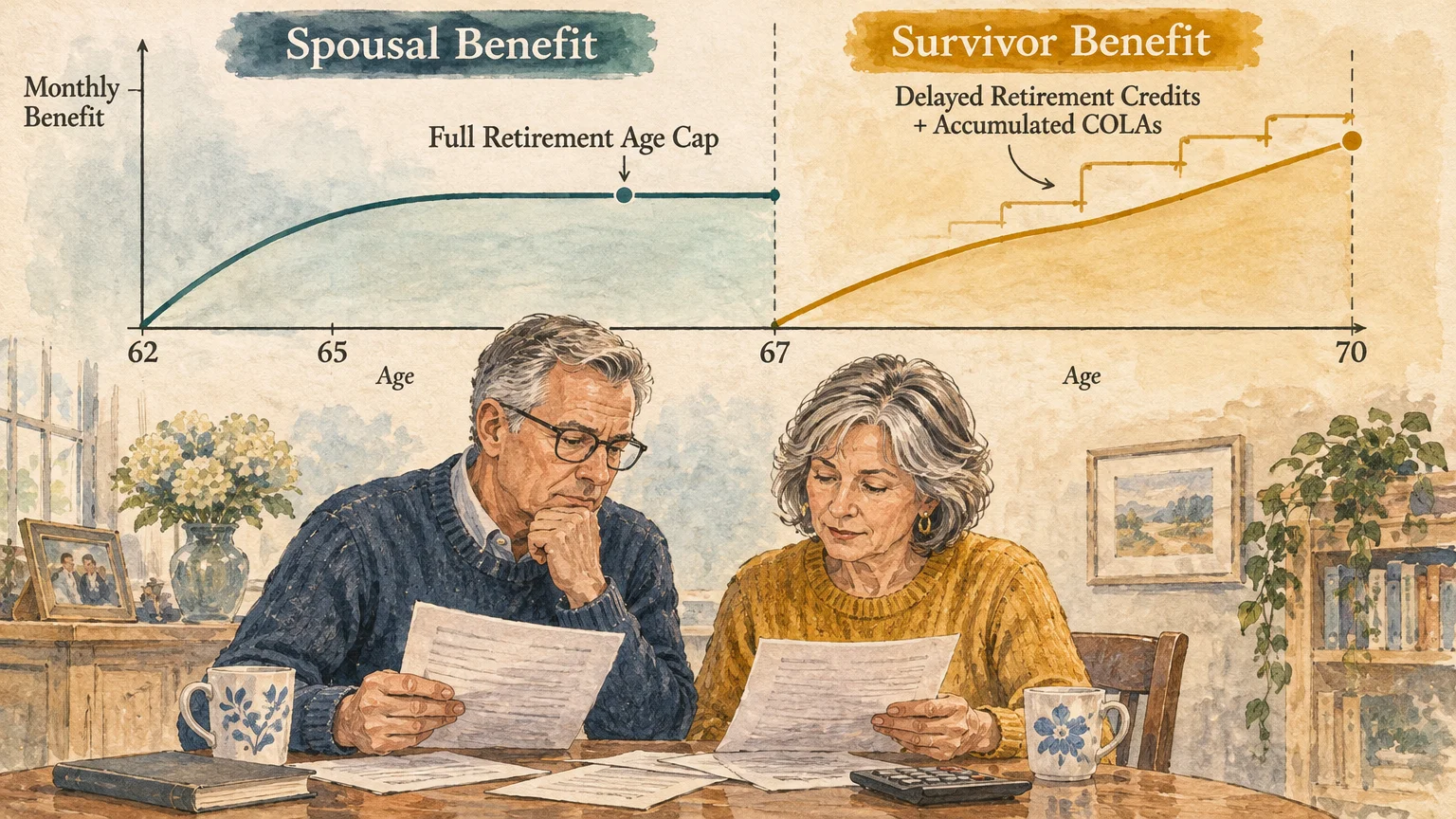
What Delaying Means for Couples, Spousal Benefits, and Survivors
For married couples, delaying Social Security is rarely an individual decision. Your claiming timeline directly controls the lifetime cash flow and survivor protection available to your spouse.
A lower-earning spouse who claims spousal benefits can receive up to 50% of the higher earner’s PIA. Because COLAs increase the worker’s underlying PIA starting at age 62, the maximum spousal base grows with inflation while you wait.
However, spousal benefits do not earn delayed retirement credits if either spouse waits past Full Retirement Age. Waiting until age 70 boosts your own retirement check to 124% of your PIA, yet a spousal benefit still caps at 50% of your PIA.
Survivor benefits follow a completely different rule that heavily favors waiting for the higher earner. If the higher-earning spouse dies, the surviving spouse generally inherits the full benefit the worker was receiving—or had earned—including both accumulated COLAs and delayed retirement credits.
When one spouse is several years older or earns substantially more, delaying the higher earner’s claim until 70 locks in maximum inflation-adjusted income for whichever partner lives longest. That single strategy often prevents sharp drops in household income after a spouse passes away.
Working While Claiming Early Triggers the Earnings Test
Sometimes couples decide that one spouse will claim early to bring cash into the household while the higher earner delays to 70. If that early claimer is still working before Full Retirement Age, the Retirement Earnings Test can temporarily reduce checks.
In 2027, workers under Full Retirement Age all year lose $1 in benefits for every $2 earned above $25,560, up from $24,480 in 2026. In the calendar year you reach Full Retirement Age, $1 is withheld for every $3 earned above $67,920 before your birth-month threshold, up from $65,160 in 2026.
Once you reach your Full Retirement Age month, the earnings limit disappears completely. Any benefits withheld earlier due to excess earnings are not lost forever; the SSA recalculates your monthly benefit upward at Full Retirement Age to credit those missed months.
Still, withheld checks disrupt near-term household budgets if you counted on that income to cover mortgage payments, dependent support, or medical bills. Always check your projected wages before filing early.
Cash-Flow Tradeoffs While You Wait: Medicare Part B and Taxes
Delaying Social Security past age 65 creates two financial ripple effects that households must budget for ahead of time. First, you will pay Medicare premiums directly out of pocket rather than having them deducted from monthly benefit checks.
According to the Centers for Medicare & Medicaid Services, the standard Medicare Part B monthly premium rises by $6.50 to $209.40 in 2027, up from $202.90 in 2026. The annual Part B deductible increases from $283 to $292.
Higher-income households also face Income-Related Monthly Adjustment Amount (IRMAA) surcharges. In 2027, those surcharges begin when modified adjusted gross income from 2025 exceeds $112,000 for single filers or $224,000 for married couples filing jointly.
More importantly, delaying Social Security removes a key safety net known as the hold-harmless provision. Under Social Security Act rules, that rule normally prevents Part B premium hikes from reducing a beneficiary’s net Social Security check from one year to the next.
Enrollees who are not yet receiving Social Security payments—along with anyone paying IRMAA surcharges—are ineligible for hold-harmless protection. You pay the full billed Part B increase out of your savings or checking account via Medicare.gov billing options.
Unindexed Tax Thresholds Can Shrink Net Gains
Larger COLA- and credit-boosted checks also interact with federal income tax rules in ways many families overlook. Under IRS rules, up to 50% or 85% of your Social Security benefits become federally taxable once your combined income passes statutory thresholds.
Unlike tax brackets or Social Security bend points, those benefit taxation thresholds are not indexed for inflation. Every annual COLA and every delayed retirement credit raises your gross benefit while those fixed dollar cutoffs stay frozen.
If you pair a maximized age-70 Social Security benefit with required minimum distributions from traditional retirement accounts, more of your COLA growth can land in the 85% taxable tier. Factoring in federal taxes helps you estimate true spendable income rather than relying on gross benefit projections.
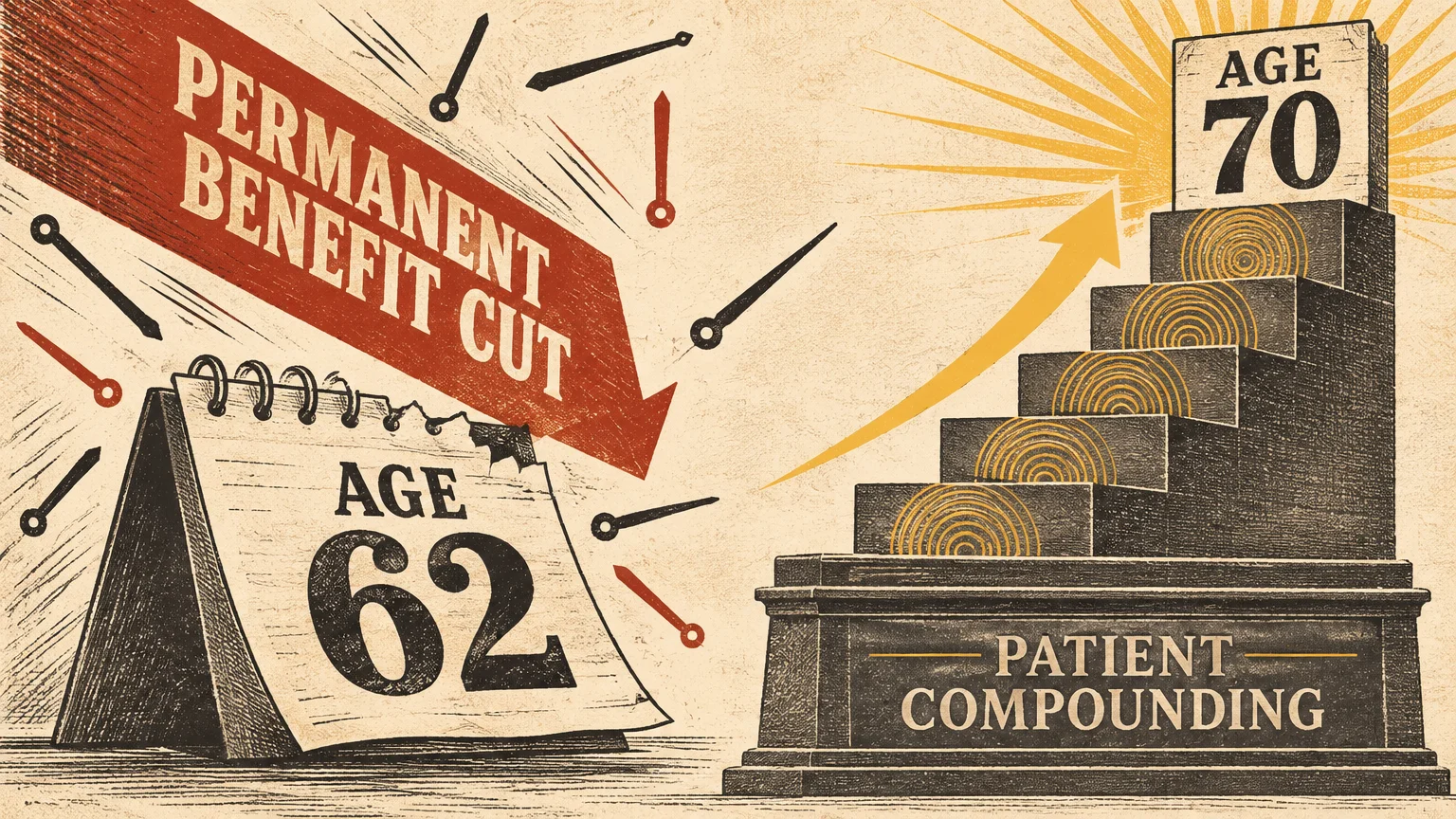
Common Money Traps When Planning Around COLAs
Misunderstanding how pre-claiming adjustments work can push families into costly timing errors. Watch for these four traps as you map out your retirement cash flow.
- Claiming at 62 to grab a high COLA headline: Filing early just because you see a 3.6% or higher COLA announcement locks in a 30% cut relative to age 67, even though waiting would give you that exact same 3.6% increase inside your PIA.
- Expecting the 2027 COLA if born in 1965: People turning 62 in 2027 sometimes budget for the 3.6% raise, but Section 215(i) restricts that adjustment to people who reached 62 in 2026 or earlier.
- Assuming spousal checks earn delayed credits: Waiting until 70 raises your personal check and future survivor benefit, yet a spouse claiming on your record still caps at 50% of your PIA at Full Retirement Age.
- Ignoring mid-year credit lags and direct Medicare bills: Claiming at age 68 and six months leaves part of that year’s delayed credits paused until January, while unpaid Part B premiums require quarterly or monthly direct payments until your checks begin.
When to Consult a Professional
Straightforward single-earner cases often require little more than checking your online statement and comparing your cash reserves against your target claiming age. Complex household situations, however, benefit from specialized advice before you submit an irreversible application.
Consider working with a fee-only financial planner or CPA if you and your spouse have a large age gap or significant earnings differences. Modeling spousal claiming alongside survivor protection requires multi-decade cash-flow projections rather than simple break-even math.
Tax guidance is equally valuable if you plan to live on brokerage withdrawals or Roth conversions during the bridge years between retirement and age 70. A CPA can project how those withdrawals affect your 2025 or 2026 modified adjusted gross income for Medicare IRMAA thresholds and future benefit taxation.
If your family also balances eldercare expenses, disability transitions, or complicated work histories, speaking with a qualified benefits counselor ensures you do not forfeit auxiliary family benefits. Professional guidance helps align Social Security rules with your broader household budget.
Frequently Asked Questions
Do I lose my Social Security COLA if I wait until 70 to claim?
No, you never lose a COLA by delaying your claim past age 62. Every annual cost-of-living adjustment from the year you turn 62 until the year you file automatically increases your Primary Insurance Amount, and your delayed retirement credits multiply against that larger base.
If I turn 62 in 2027, do I get the 2027 COLA?
No, the 3.6% COLA for 2027 applies only to workers who reached age 62 in 2026 or earlier. If you turn 62 in 2027, your initial benefit uses the 2027 wage-indexed formula and bend points, and your first COLA will take effect in December 2027.
Does working after age 62 still increase my benefit if I haven’t claimed?
Yes, working while delaying can raise your benefit if your current earnings exceed one of the lowest years in your top 35-year earnings history. Up to the 2027 taxable wage cap of $192,300, higher paychecks replace older low-wage years and raise your Primary Insurance Amount alongside annual COLAs.
Can my Social Security COLA ever be negative if inflation drops?
No, Social Security benefits cannot decrease when consumer prices fall or remain flat. If the Consumer Price Index for Urban Wage Earners and Clerical Workers shows zero or negative growth over the measurement period, the COLA is simply 0% and benefits stay unchanged.

Your Next Steps
Sign in to your personal account on the official Social Security portal to verify your 35-year earnings history and review your estimated benefits at ages 62, 67, and 70. Compare those projected checks against your household savings, projected Medicare Part B premiums, and spousal survivor needs before choosing a filing date.
Financial outcomes vary based on individual income, credit history, and circumstances. This article provides general guidance only. Consult a qualified financial planner, CPA, or consumer attorney for advice specific to your situation.
Last updated: November 2026. Rates, benefit amounts, and tax rules change—always verify current details at official sources.