
More than 9 million older Americans leave approximately $58 billion in unclaimed senior benefits on the table every year. You might qualify for substantial monthly cash support right now without realizing it.
Rising healthcare expenses and high living costs strain household budgets across the country. Tapping into supplemental payments seniors earn through decades of payroll taxes can immediately restore your financial stability.
State and federal agencies manage multiple senior financial assistance programs designed to offset daily living costs. Here are six major programs that deliver direct financial relief, along with the rules to apply today.
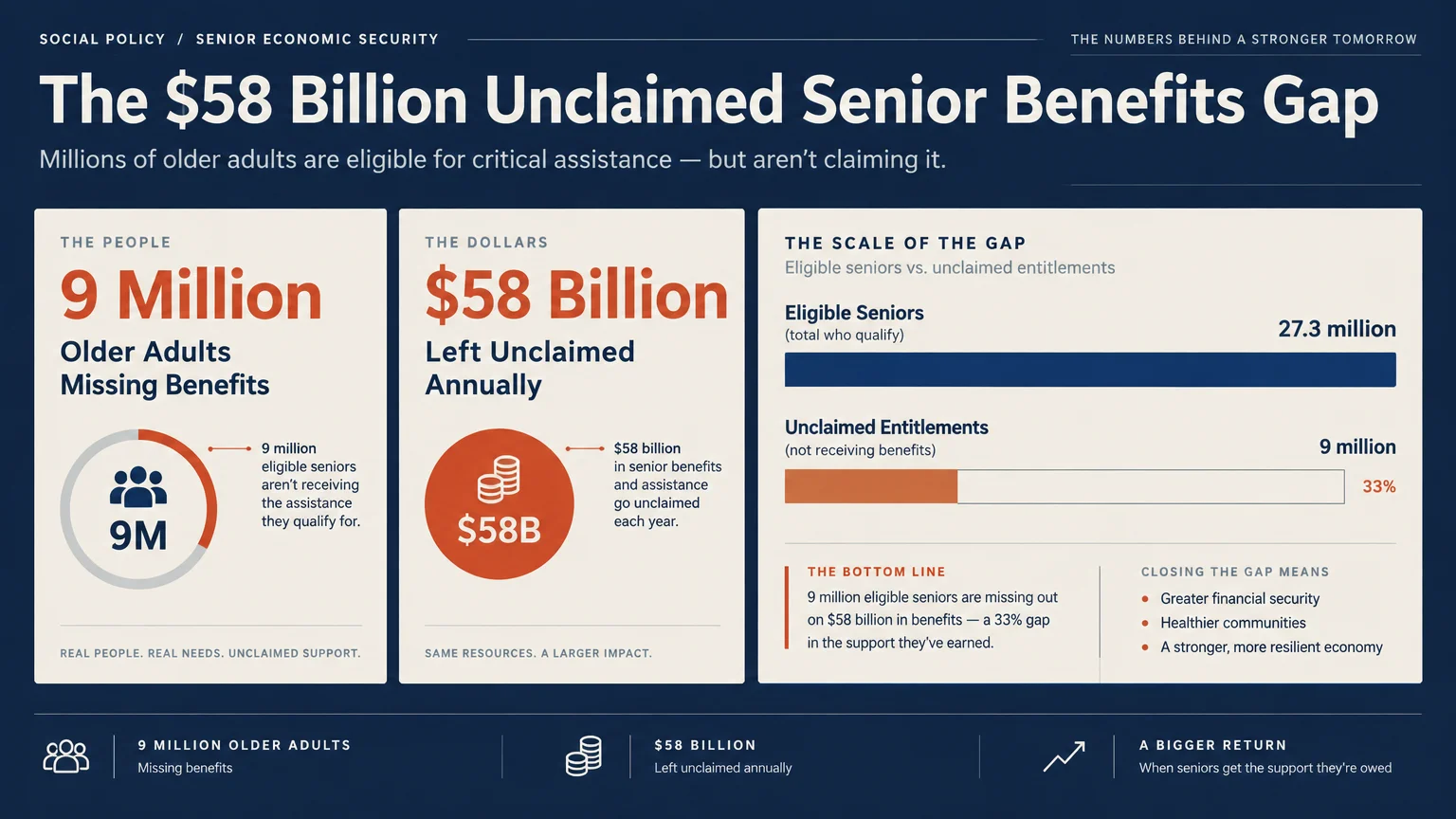
The $58 Billion Benefits Gap Among Older Adults
According to research by the National Council on Aging and the Urban Institute, millions of seniors miss out on vital assistance. Complex paperwork and outdated misconceptions prevent eligible households from seeking help.
Many retirees believe safety-net programs cater exclusively to people living far below the poverty line. In reality, multiple initiatives provide tiered financial assistance to middle-income seniors facing steep medical or housing costs.
You worked hard and contributed to these systems throughout your career. Claiming these funds is not an act of charity; it is an exercise of your legal rights as a taxpayer.
“It’s not how much money you make, but how much money you keep, how hard it works for you, and how many generations you keep it for.” — Robert Kiyosaki
Examining each program reveals that income limits and asset definitions are often far more generous than most seniors expect. Understanding the qualification formulas helps you unlock significant recurring income.
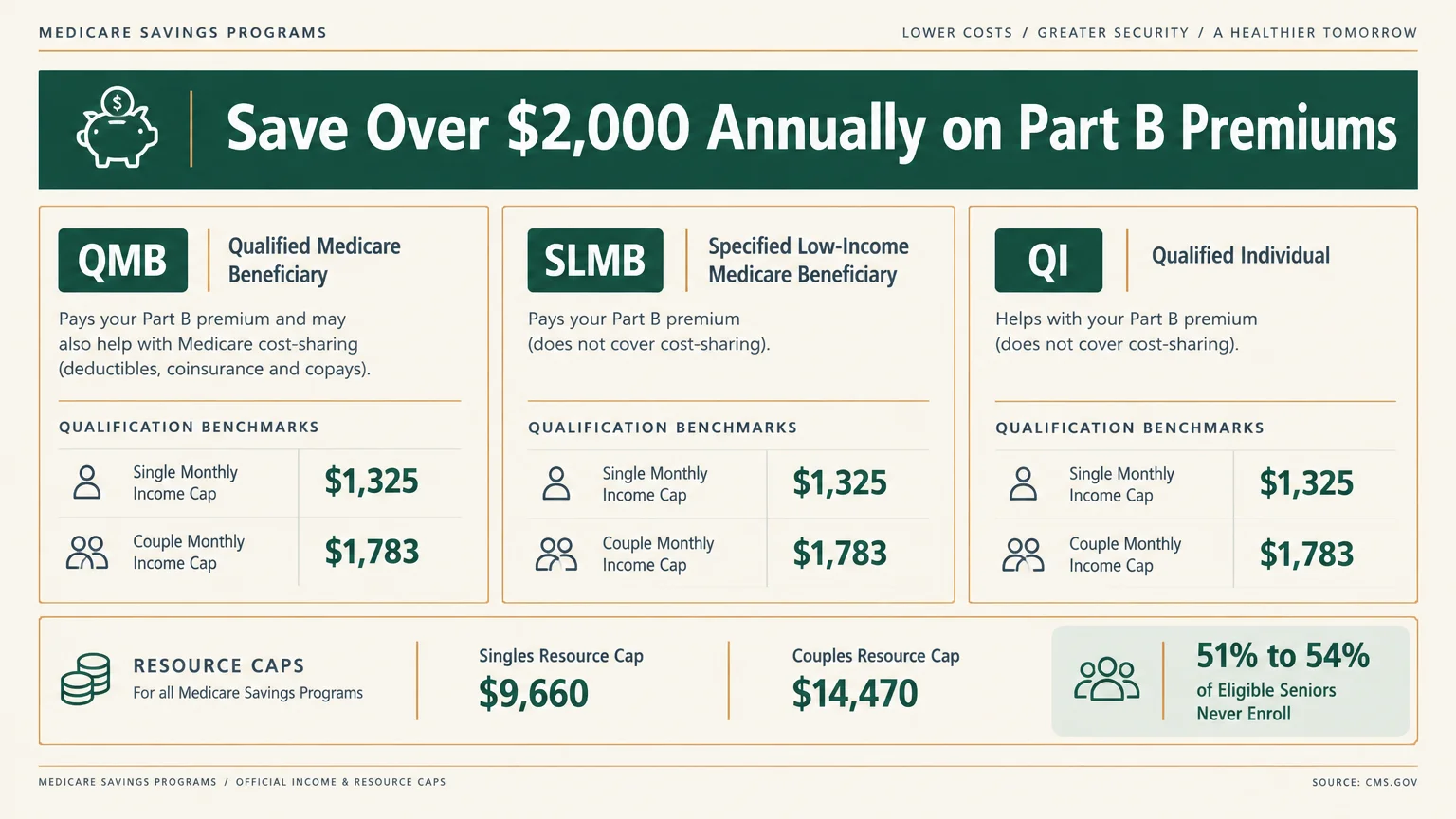
1. Medicare Savings Programs: Recover Over $2,000 Annually
State-administered Medicare Savings Programs help seniors with limited income cover their standard healthcare expenses. These initiatives include the Qualified Medicare Beneficiary, Specified Low-Income Medicare Beneficiary, and Qualifying Individual programs.
Data from advocacy groups indicates that between 51% and 54% of eligible older adults never enroll. This oversight leaves an estimated 6 million people paying premiums that their state government would happily cover.
Securing enrollment eliminates your standard Medicare Part B monthly premium. That single change puts over $2,000 back into your checking account every year.
Under the Qualified Medicare Beneficiary designation, your state also pays your Part A and Part B deductibles, coinsurance, and copayments. You face zero out-of-pocket costs when visiting doctors or receiving hospital treatment.
Federal baseline rules set the monthly income cap at roughly $1,325 for individuals and $1,783 for married couples. Resource caps sit at $9,660 for singles and $14,470 for couples.
Several states, including New York and California, have expanded or completely eliminated these restrictive asset tests. You can review your state-specific rules and start an application through Medicare.gov today.

2. Medicare Part D Extra Help: Lowering Prescription Costs
Prescription medications often represent the largest monthly expense for retirees managing chronic conditions. The Medicare Part D Low-Income Subsidy, commonly known as Extra Help, provides substantial relief for drug costs.
The Social Security Administration estimates the annual value of the Extra Help program at $5,700 to $6,200. The subsidy pays your monthly prescription drug plan premium and eliminates plan deductibles.
Your out-of-pocket medication costs drop significantly once enrolled in this program. Copayments are capped at no more than $5.10 for generic prescriptions and $12.65 for covered brand-name drugs.
To qualify in 2026, an individual can have an annual income up to roughly $23,940. Married couples living together can have an annual income reaching up to $32,400.
Countable resource limits stand at $18,090 for individuals and $36,100 for married couples. The program excludes your primary home, your primary vehicle, personal possessions, and life insurance policies from this asset calculation.
Applying takes only a few minutes through the federal Social Security portal. Qualifying also provides a continuous Special Enrollment Period, letting you switch prescription plans whenever your medication needs change.

3. Supplemental Security Income: Direct Monthly Cash
Supplemental Security Income delivers monthly cash payments to qualifying Americans aged 65 and older. While the Social Security Administration administers the program, SSI draws funding from general tax revenues rather than the Social Security trust fund.
The maximum federal monthly benefit provides up to $994 for an individual and $1,491 for an eligible married couple. Many states add an extra supplemental payment on top of this federal baseline amount.
Federal data shows that between 51% and 60% of eligible older adults never apply for SSI. Many assume that receiving standard Social Security retirement benefits automatically disqualifies them from participation.
In practice, if your standard monthly retirement benefit falls below the SSI threshold, SSI provides a top-up payment. This adjustment brings your total monthly cash flow up to the federal standard.
Applicants must satisfy countable resource limits of $2,000 for an individual and $3,000 for a couple. Like other core benefits, the program excludes your primary house and one everyday automobile.
Securing even one dollar of monthly SSI cash typically grants you automatic enrollment in Medicaid. That secondary benefit eliminates deductibles, vision costs, and dental bills that traditional Medicare fails to cover.

4. VA Aid and Attendance: Enhanced Pension for Veterans
Wartime military veterans and their surviving spouses can access a powerful financial benefit called Aid and Attendance. This special allowance adds tax-free monthly funds directly to your standard Department of Veterans Affairs pension.
A single veteran requiring daily assistance can receive up to $2,424 per month in direct payments. A married veteran with one dependent can receive up to $2,874 each month.
Surviving spouses of wartime veterans can access up to $1,558 per month in supplemental support. These funds reimburse the costs of in-home caregivers, adult day care, memory care, and assisted living facilities.
To establish baseline eligibility, the veteran must have served at least 90 days of active military duty. At least one of those days must have occurred during an officially recognized wartime period.
Combat experience is not required to qualify for this pension expansion. You simply need medical certification confirming that you require daily help with activities like bathing, dressing, or managing medication.
The VA applies an overall net worth limit of $163,699 for pension calculations. This figure combines your annual income and countable assets, while explicitly excluding your primary home and standard furnishings.

5. Social Security Divorced Spousal Benefits
Divorced retirees frequently miss out on extra Social Security payments based on a former partner’s employment history. These auxiliary benefits can significantly increase your retirement income without altering your ex-spouse’s monthly payments.
You can qualify if your past marriage lasted for at least 10 consecutive years. You must also be at least 62 years old and currently unmarried.
The rules permit you to collect up to 50% of your former spouse’s Full Retirement Age benefit rate. The Social Security Administration automatically pays this higher amount if it exceeds your own retirement benefit.
Filing on your ex-spouse’s record requires zero contact with your former partner. The agency processes your application confidentially and never alerts your ex-spouse or affects their current household benefits.
If your former spouse is deceased, you can claim divorced survivor benefits starting at age 60, or age 50 if disabled. Surviving divorced spouses can collect up to 100% of the deceased worker’s monthly payout.
Remarrying after age 60 does not terminate your right to collect divorced survivor payments. This rule allows older adults to build new partnerships without forfeiting crucial survivor income.

6. Senior SNAP Allotments for Healthy Food
The Supplemental Nutrition Assistance Program provides direct monthly financial assistance through an electronic benefits transfer card. Seniors use these dedicated funds to buy fresh produce, meat, and pantry essentials at local stores.
Older adults hold the lowest enrollment rate of any eligible group in the United States. Between 62% and 70% of qualified seniors never claim their monthly grocery support.
The median SNAP payment for households with an adult aged 60 or older is roughly $188 per month. That translates to more than $2,250 every year in grocery savings.
Federal regulations provide simplified qualification criteria for households containing a member aged 60 or older. You can deduct unreimbursed, out-of-pocket medical bills exceeding $35 per month from your countable income.
Allowable medical deductions include prescription copays, medical equipment, dental work, and health insurance premiums. Documenting these costs frequently reduces your net income enough to secure the maximum food allowance.
Senior households can also retain between $4,250 and $4,500 in countable savings without losing eligibility. Learn more about state portals and application procedures at USA.gov Money and Taxes.
“A budget is telling your money where to go instead of wondering where it went.” — John C. Maxwell
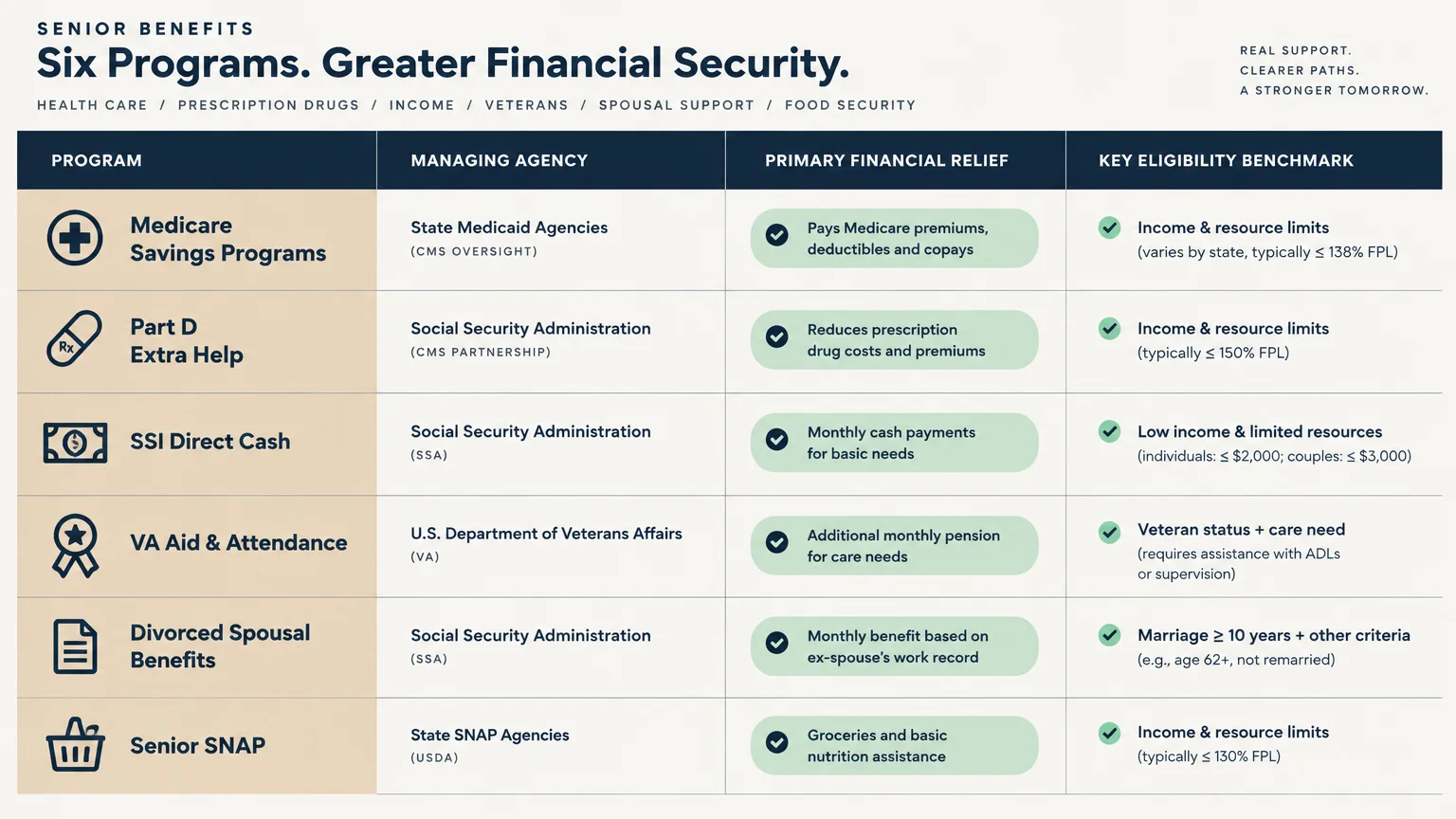
Comparing Senior Financial Assistance Programs
Reviewing these programs side by side clarifies their financial limits and monthly value. The table below details the federal baselines, asset rules, and potential payments available in 2026.
| Program Name | Estimated Monthly Value | Monthly Income Limit (Single) | Asset Limit (Single) | Primary Eligibility Condition |
|---|---|---|---|---|
| Medicare Savings Programs (QMB) | $185 to $350+ (Premium & Care) | ~$1,325 | $9,660 | Enrolled in Medicare Part A; low resources |
| Part D Extra Help | ~$475 to $515 in Drug Subsidies | ~$1,995 | $18,090 | Medicare Part D enrollee; drug cost needs |
| Supplemental Security Income | Up to $994 (Direct Cash) | Varies by earned income | $2,000 | Age 65+ or disabled; limited income |
| VA Aid and Attendance | Up to $2,424 (Direct Cash) | Adjusted by medical costs | $163,699 (Net Worth) | Wartime veteran needing daily personal care |
| Divorced Spousal Benefits | Up to 50% of Ex-Partner’s FRA | No strict cap (Earnings test under FRA) | No asset cap | 10-year marriage; unmarried; age 62+ |
| Senior SNAP Grocery Benefits | ~$188 Median Allotment | 130% to 200% of Poverty Level | $4,250 to $4,500 | Age 60+; low net household income |
Keep in mind that many states increase income caps or drop asset testing entirely for these programs. Always verify local parameters through your state social services office before assuming you make too much money.
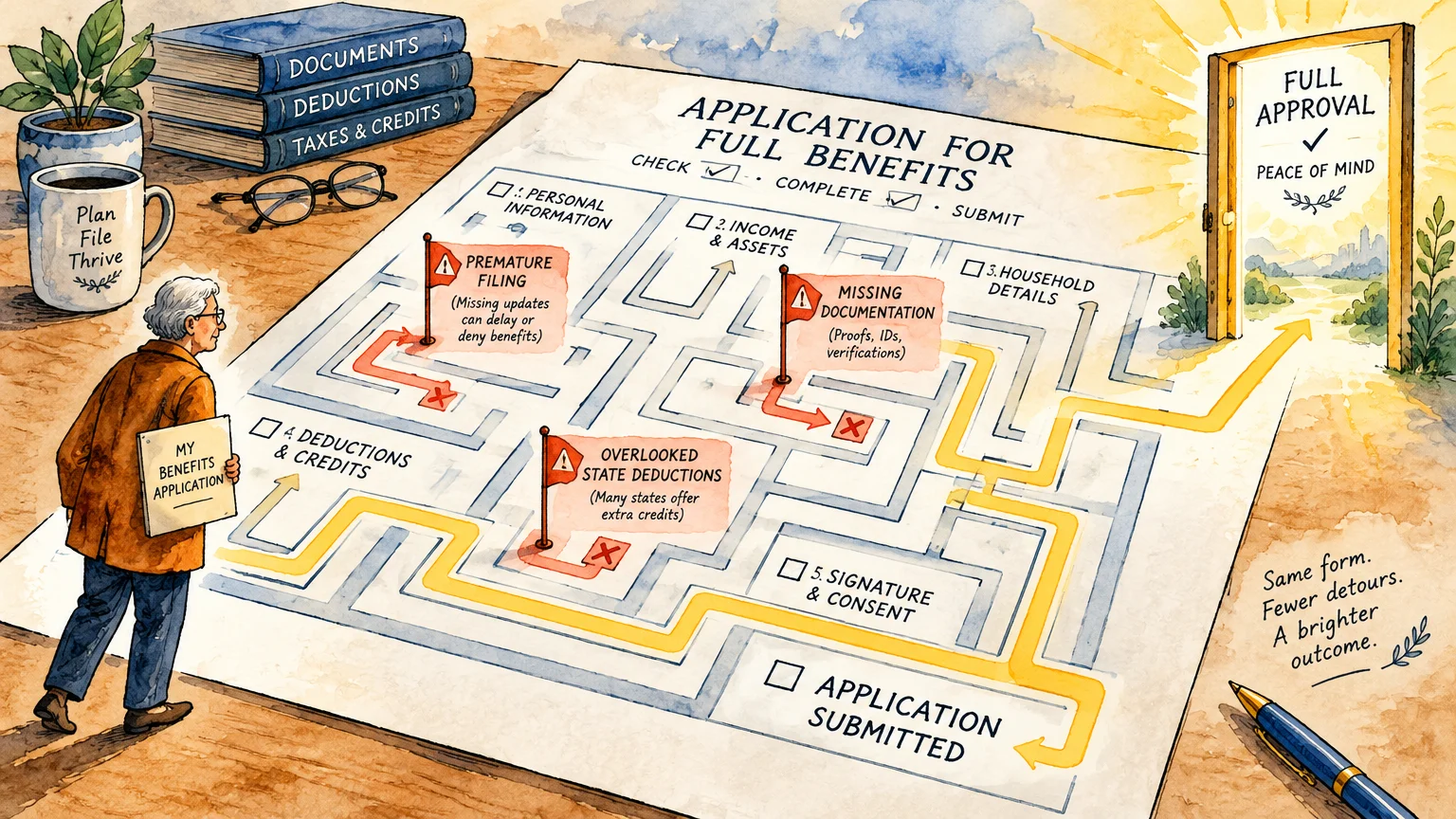
Costly Mistakes to Avoid When Claiming Senior Benefits
Applying for senior benefits requires careful attention to agency rules and documentation. Sidestepping common missteps protects your household income and accelerates application processing.
Assuming Home Ownership Disqualifies You
Many seniors avoid submitting paperwork because they believe owning a home eliminates their eligibility. Nearly every major federal program excludes your primary dwelling and residential land from resource evaluations.
Do not let real estate equity stop you from seeking support. Liquid assets like uninvested cash and non-retirement brokerage accounts receive the vast majority of regulatory scrutiny.
Failing to Deduct Medical Expenses
When applying for SNAP or Medicaid assistance, you must account for every personal healthcare cost you pay. Forgetting to document prescription copays, medical transport, or hearing aid batteries leaves significant money behind.
Deducting valid medical expenses lowers your countable net earnings on official forms. This paperwork adjustment regularly turns an initial program denial into an approved claim.
Missing Retroactive Payment Options
Some assistance programs backdate your initial effective date to the day you submitted your paperwork. Others reimburse out-of-pocket costs incurred during the weeks an agency took to process your file.
Always ask your claims caseworker about retroactive eligibility windows. Requesting back payments ensures you collect every dollar accrued during prolonged administrative reviews.

Don’t DIY These Decisions
Managing government benefit rules can grow complicated when multiple income streams overlap. Engaging qualified professionals ensures you navigate the application maze without making expensive errors.
Before moving money or signing complex benefit documents, seek counsel from experienced specialists:
- Accredited Veterans Service Officers (VSOs): VSOs provide free, accredited support to help wartime veterans file for Aid and Attendance pensions safely.
- State Health Insurance Assistance Programs (SHIP): Local SHIP counselors deliver unbiased, county-specific guidance on Medicare plans and Medicare Savings Programs without charging fees.
- Elder Law Attorneys: Legal specialists understand state-level asset rules, Medicaid lookback periods, and trust structures designed to protect family inheritances.
- HUD-Approved Housing Counselors: These advisors help older homeowners evaluate property tax relief, utility assistance, and reverse mortgage programs securely.
Never pay unaccredited firms that promise instant approvals in exchange for a percentage of your government checks. You can verify consumer protections and financial practices through the Consumer Financial Protection Bureau.
Frequently Asked Questions
Will claiming these extra benefits reduce my regular Social Security check?
No, claiming programs like SNAP, Part D Extra Help, or Medicare Savings Programs will not reduce your base Social Security payments. These initiatives provide supplemental relief without altering your earned retirement check.
Does my ex-spouse find out if I claim divorced spousal benefits?
The Social Security Administration never informs your former partner that you filed on their record. The agency processes your application privately and makes payments directly from federal trust funds.
Can I receive both Medicare Savings Programs and Part D Extra Help?
Yes, enrolling in any Medicare Savings Program automatically qualifies you for the full Part D Extra Help subsidy. This coordinated process eliminates redundant applications and immediately caps your prescription drug costs.
Can I reapply if my benefits application was previously denied?
You can reapply whenever your financial circumstances change or when federal income thresholds rise. Annual cost-of-living adjustments frequently expand qualification limits, allowing previously ineligible seniors to gain full approval.
Taking Action on Your Available Benefits
Take time this week to review your monthly out-of-pocket medical bills, utility statements, and recent tax returns. Contact your local Area Agency on Aging to request an initial benefits assessment.
Financial outcomes vary based on individual income, credit history, and circumstances. This article provides general guidance only. Consult a qualified financial planner, CPA, or consumer attorney for advice specific to your situation.
Last updated: February 2026. Rates, benefit amounts, and tax rules change—always verify current details at official sources.