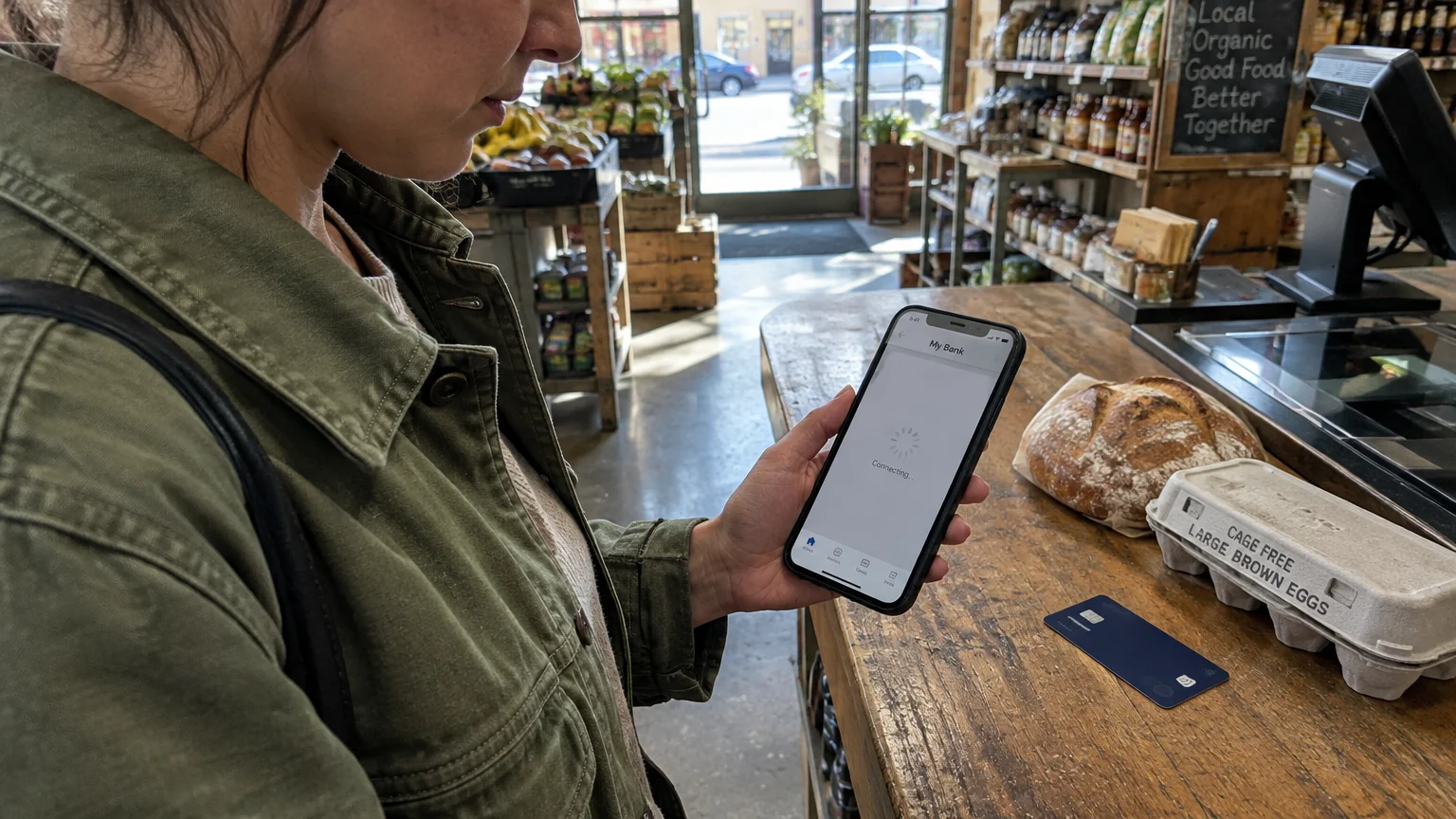
Trying to pay bills or check your balance only to face a bank outage is a stressful start to any morning. Thousands of Americans experienced that exact disruption in mid-November 2026 when major bank portals stalled.
Even brief downtime can delay transfers, stall peer-to-peer payments, and trigger late-fee anxiety for your household budget. Understanding what happened and knowing your federal rights protects your cash when digital access vanishes.
You can take clear steps right now to reach your money, stop cascading fees, and build a resilient backup plan before the next bank app outage hits.
What Happened During the November 2026 Bank Outage
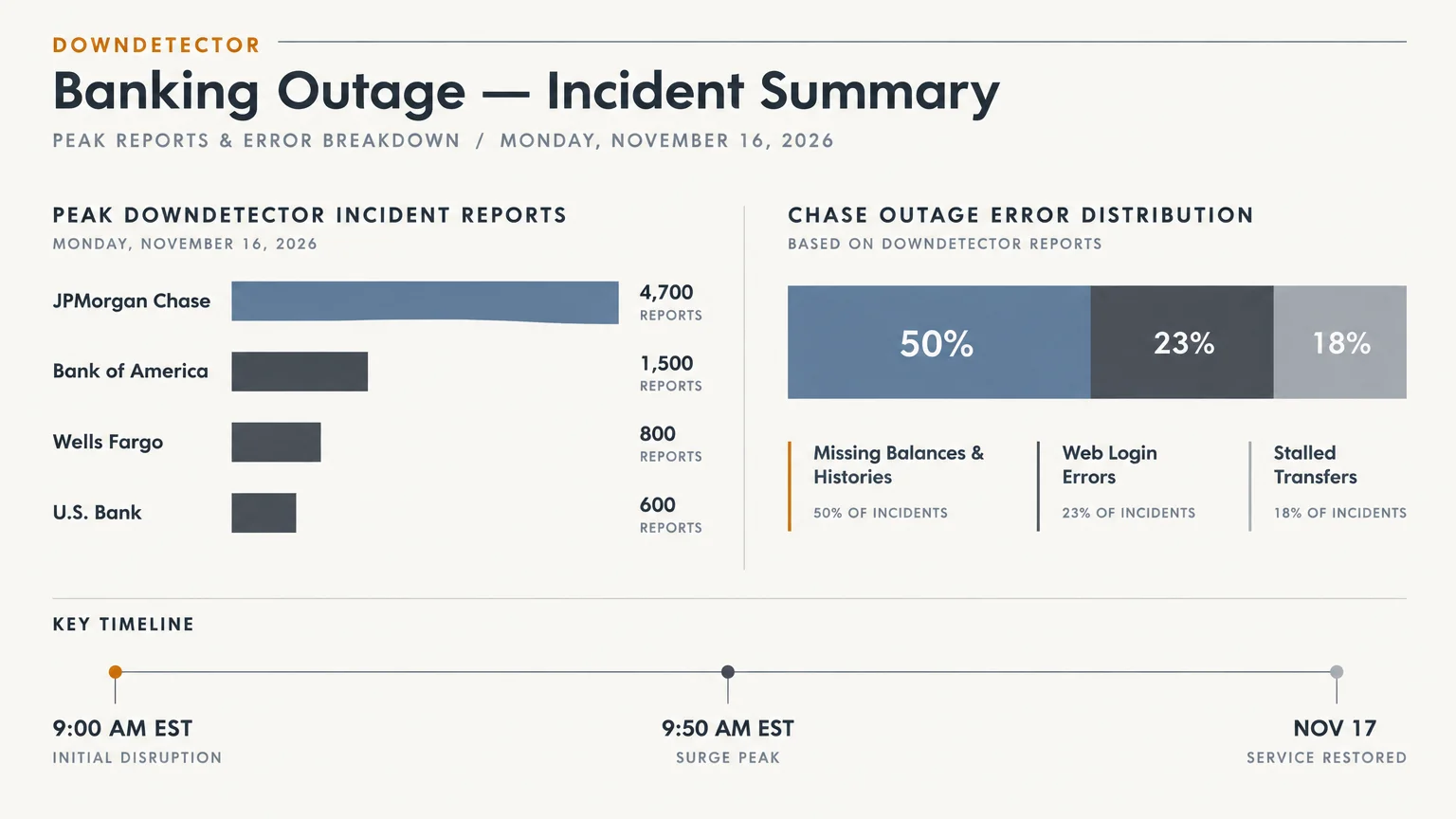
Problems began shortly after 9:00 a.m. EST on Monday, November 16, 2026, and spiked rapidly around 9:50 a.m. ET. Customers across the country reported failed logins, blank balances, and stalled transfers across desktop browsers and mobile apps.
By 2:00 p.m. ET that Monday, outage tracker Downdetector had logged more than 4,700 reports for JPMorgan Chase alone. Total reports for Chase climbed to nearly or over 5,000 before service returned to normal early Tuesday, November 17, 2026.
Half of those Chase reports involved missing account balances and transaction histories. Another 23% centered on web login errors, while 18% involved stalled transfers and wires.
Disruptions spilled well beyond a single institution during the morning surge. Downdetector recorded spikes nearing 1,500 reports for Bank of America, more than 800 for Wells Fargo, and more than 600 for U.S. Bank.
Customers also reported connectivity errors at Capital One, Truist, and Zelle, while data aggregator Plaid experienced disruptions connecting third-party budgeting apps to Chase accounts. Chase, Bank of America, U.S. Bank, and Zelle operator Early Warning Services noted that other banks’ core systems remained up, though transactions involving Chase slowed down.
JPMorgan Chase serves more than 86 million U.S. customers, making even a localized glitch feel widespread. Chase spokesperson Joe Evangelisti attributed the disruption to a “software bug in on-premise hardware systems” following an internal physical system update, confirming it was neither a cyberattack nor a cloud outage.
The banking disruption capped off a turbulent week for major U.S. infrastructure. Days earlier, a global Microsoft Outlook and Teams outage ran from November 12 to November 14, an overloaded FAA router forced a four-hour nationwide flight ground stop on November 13, and a United Airlines system outage lasted 90 minutes on November 16.
Why an Online Banking Outage Hits Household Budgets Harder Today
A decade ago, a stalled website mainly annoyed people balancing checkbooks on Sunday night. Today, mobile banking serves as the financial remote control for millions of working-age and retired households.
According to a Morning Consult survey of 4,402 U.S. adults published in November 2026 by the American Bankers Association (ABA), 44% of bank customers name mobile apps as their top method for managing accounts. That share jumped from 26% in 2017 and has ranked first for seven straight years.
Online banking via laptop or desktop ranks second at 20%, followed by branch visits at 10%, ATMs at 6%, telephone banking at 6%, and mail at 3%. Most households no longer keep paper registers or regular teller routines as a fallback.
Mobile dependence spans multiple generations, though younger earners lean on apps most heavily:
- Gen Z (ages 1997–2012): 54% use mobile apps as their primary banking channel.
- Millennials (1981–1996): 54% manage their money primarily through mobile apps.
- Gen X (1965–1980): 40% rely on mobile apps ahead of other banking methods.
- Baby Boomers (1946–1964): 34% now choose mobile apps as their top access method.
These figures align with the FDIC’s 2023 National Survey of Unbanked and Underbanked Households, where 48.3% of banked households used mobile banking primarily. Online banking followed at 22.8%, while bank tellers accounted for just 8.8%.
In that same FDIC baseline, 95.8% of U.S. households held a bank or credit union account, leaving 4.2%—or 5.6 million households—unbanked. Meanwhile, 95% of ABA survey respondents rated their bank’s digital experience as “excellent,” “very good,” or “good,” and 93% praised overall banking access.
High daily reliability creates a quiet blind spot in household planning. When your phone screen suddenly freezes on payday or rent day, you quickly realize how few offline backup habits you actually have in place.
Immediate Steps to Take When Online Banking Is Down
Panic leads to rushed taps and costly errors when online banking is down. Following a calm sequence protects your transactions and builds a paper trail if fees appear later.
- Verify the outage through safe channels: Call the customer service number printed on the back of your debit card, credit card, or paper statement. You can also visit a local branch or use verified web chat, but never post personal or account details on public social media feeds.
- Switch to offline access methods: Try withdrawing cash at an ATM, paying with a physical debit or credit card, writing a paper check, or calling automated phone banking. IEEE senior member Kayne McGladrey noted to CBS News that branches, ATMs, physical cards, and phone systems frequently keep operating when mobile apps stall.
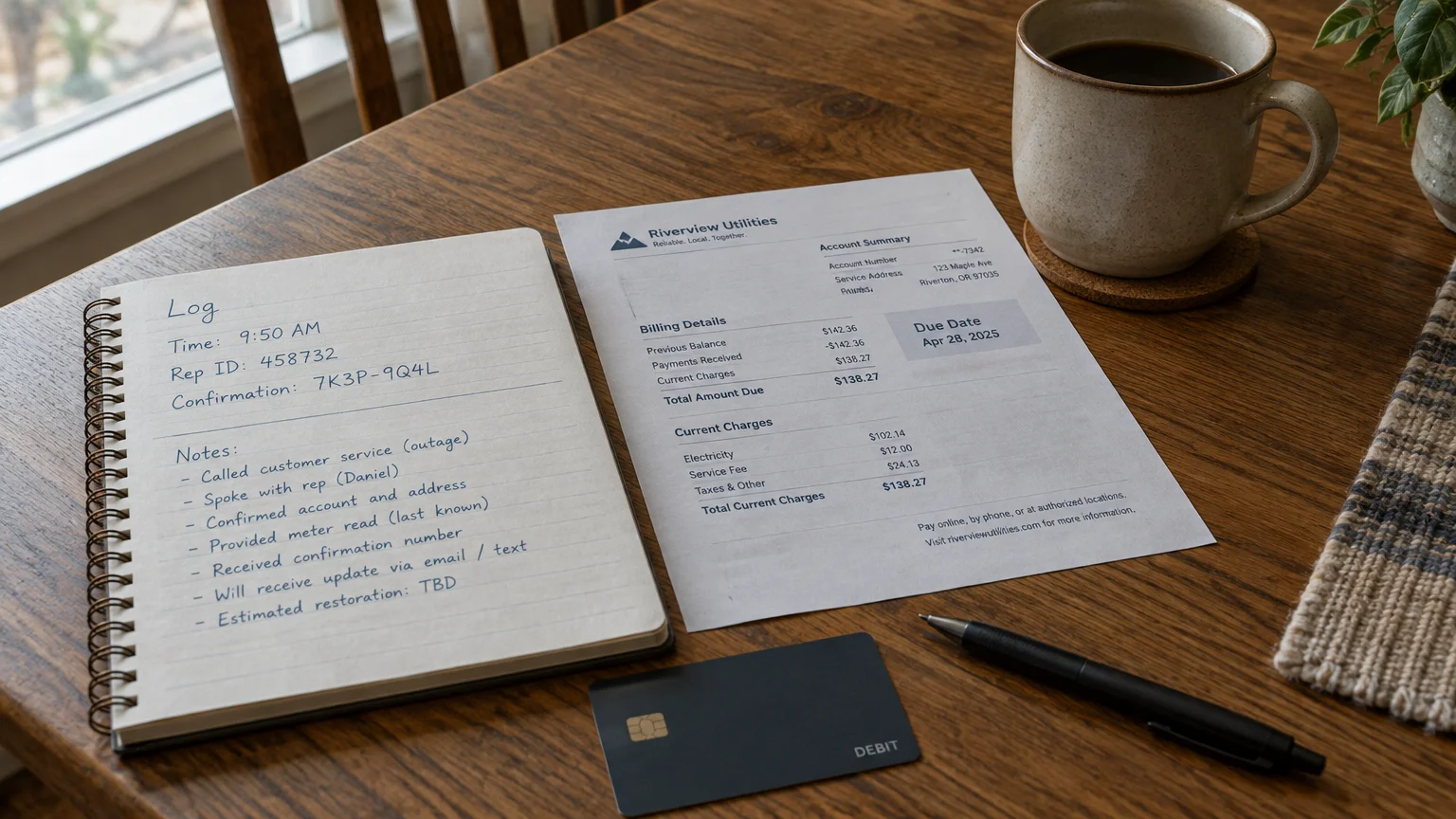
- Document every failed attempt: Take time-stamped screenshots of error screens, missing balances, and pending payment confirmations. McGladrey specifically recommended capturing screenshots of failed or attempted transactions so you have proof if disputes arise.
- Audit your automatic payments: Confirm with your bank whether scheduled recurring bills or direct debits will clear during the disruption. If a utility, car note, or mortgage payment is due that same day, pay it through an alternate card or secondary bank account to avoid late marks.
- Request proactive fee waivers: Ask your bank, credit card issuer, or biller to waive any overdraft, insufficient funds (NSF), or late fees triggered by the system slowdown. Keep the representative’s name, confirmation number, and date of your call in your records.
Building at least two independent ways to reach your cash turns a stressful bank outage into a minor errand rather than a household budget crisis.
Do not assume a stalled screen means your money disappeared or your bill automatically paused. Taking five minutes to verify your payment status and capture evidence gives you strong leverage with customer service once systems recover.
Your Legal Protections and Deposit Safety During Banking Problems
Seeing a zero balance or a blank checking page during a bank outage can trigger immediate alarm about your savings. Federal banking rules draw a clear line between temporary technical downtime and actual financial loss.
First, know what federal law does not guarantee. No U.S. statute requires a bank to pay customers compensation simply because an app or website goes offline, nor does federal law force banks to automatically refund overdraft or late fees caused by an outage.
Fee refunds rely on your bank’s goodwill or your willingness to ask for an adjustment. However, your underlying funds and electronic transfers carry strong federal safeguards backed by regulators like the Consumer Financial Protection Bureau (CFPB).
Deposit Insurance Covers Your Balances Around the Clock
Your money at an FDIC-insured bank or an NCUA-insured credit union remains protected up to $250,000 per depositor, per insured institution, and per ownership category. Ownership categories include single accounts, joint accounts, certain retirement accounts, and revocable trust accounts.
Deposit insurance exists to protect depositors if an institution fails, not to reimburse temporary IT glitches at an open bank. Still, the CFPB emphasizes that your deposited funds stay safe and intact during a software outage even when your screen refuses to display them.
Electronic Fund Transfer Act and Regulation E Timelines
If a bank app outage causes a duplicate debit, a missing ACH transfer, or an unauthorized electronic withdrawal, the Electronic Fund Transfer Act (EFTA) and Regulation E (12 CFR §§ 1005.6, 1005.11) protect your personal, family, and household accounts. Keep in mind that Regulation E does not cover business debit cards.
You have 60 days from the date your bank sends the periodic statement showing an error to report the problem. For a lost or stolen debit card, reporting within two business days caps your liability for unauthorized transfers at $50, whereas waiting longer can raise your exposure up to $500.
Once you report an error, your bank must investigate and determine what happened within 10 business days—or 20 business days for accounts opened within the past 30 days. If the bank needs more time, it can extend the investigation to 45 calendar days, or 90 days for point-of-sale debit transactions, foreign transfers, or new accounts.
To use that extension, the bank must provisionally credit your account within 10 business days—or 20 for new accounts—notify you within two business days, and grant you full use of those funds. It must report final results within three business days of finishing and fix confirmed errors within one business day.
Check Holds, Credit Cards, and Regulator Notification Rules
Other federal rules step in depending on how you tried to pay or deposit money during banking problems. Credit card duplicate charges and billing errors fall under the Fair Credit Billing Act (Regulation Z) rather than Regulation E.
Check deposits and funds availability delays follow the Expedited Funds Availability Act under Regulation CC (12 CFR Part 229). While Regulation CC sets strict schedules for when deposited check funds must become available, Section 229.13 allows temporary hold extensions during genuine emergency conditions, including severe computer or communication failures.
Behind the scenes, banks also answer to strict federal reporting mandates overseen by the OCC, the FDIC, and the Federal Reserve. Under the Computer-Security Incident Notification Rule (12 CFR Part 53), banking organizations must notify their primary federal regulator as soon as possible and no later than 36 hours after identifying a material “notification incident.”
Third-party technology providers face similar pressure under the same rule. Service providers must alert affected banks as soon as possible whenever a disruption lasts—or is likely to last—four or more hours.
| Federal Rule or Protection | What It Covers | Key Consumer Timeline | Important Limits |
|---|---|---|---|
| FDIC / NCUA Deposit Insurance | Checking, savings, money market accounts, and CDs if an institution fails | Up to $250,000 per depositor, per ownership category | Does not pay outage inconvenience claims or cover temporary IT downtime |
| EFTA / Regulation E (12 CFR §§ 1005.6, 1005.11) | Stalled ACH transfers, duplicate debit charges, and unauthorized electronic withdrawals | 60 days to report statement errors; 10 business days to investigate (20 for new accounts) | Applies to consumer household asset accounts only; excludes business debit cards |
| Fair Credit Billing Act (Regulation Z) | Duplicate credit card charges and billing disputes triggered during payment glitches | 60 days from statement date to dispute billing errors in writing | Covers credit cards and open-end credit lines, not checking debit cards |
| Expedited Funds Availability Act (Regulation CC) | Deposit hold timelines for paper checks and electronic credits | Standard next-day or two-day availability schedules depending on deposit type | Section 229.13 allows emergency hold extensions during severe system failures |
| Computer-Security Incident Notification Rule (12 CFR Part 53) | Major operational or service outages at U.S. banking organizations | Banks notify regulators within 36 hours; vendors alert banks at 4+ hours | Regulatory reporting duty only; does not mandate customer fee refunds |
How to Build a Backup Banking Plan Before the Next Outage
Waiting until your primary bank locks up is the hardest time to look for alternatives. Setting up a resilient cash buffer takes less than an hour and keeps your household bills moving smoothly year-round.
Separate Your Primary Checking and Emergency Savings
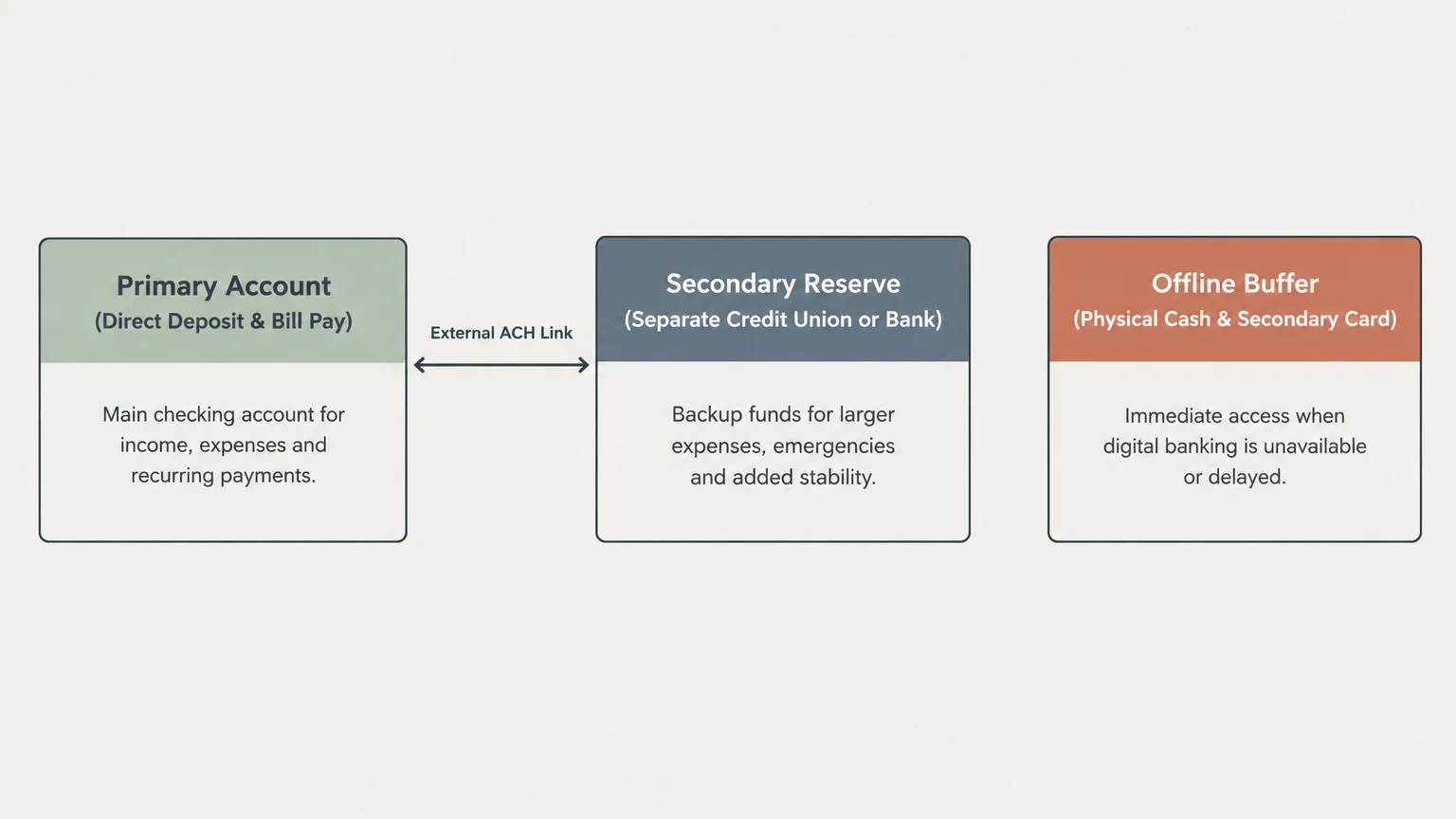
Keep your everyday bill-paying checking account at one institution and your emergency high-yield savings or money market deposit account at an unrelated bank or credit union. If your primary bank suffers a hardware glitch, your backup institution stays completely unaffected.
Link the two accounts via standard ACH transfers before an emergency ever occurs. Verifying micro-deposits ahead of time ensures you can initiate an electronic transfer in seconds when you need extra checking liquidity.
Verify Account Rules, Fees, and Yield Terms
Before opening a secondary checking or savings account, read the full fee schedule and deposit agreement carefully. Look closely at monthly maintenance fee waiver criteria, which often require a minimum daily balance, a specific combined relationship balance, or qualifying recurring direct deposits.
Compare how interest compounds—typically daily or monthly—and check the exact annual percentage yield (APY) tiers before moving idle cash. If an offer advertises an eye-catching APY or a cash sign-up bonus, confirm every qualifying activity threshold and ongoing minimum balance requirement first.
Remember that bank sign-up bonuses are not tax-free windfalls. Financial institutions report cash bonuses as taxable interest income to both you and the IRS on Form 1099-INT.
Keep Liquid Cash Separate from Certificates of Deposit
Certificates of deposit (CDs) can lock in steady yields for planned goals, but they make poor outage backups. Pulling money out of a standard CD early usually triggers an early withdrawal penalty that eats into your earned interest—and sometimes your principal.
Keep three to six months of household reserves in liquid high-yield savings or money market deposit accounts instead. Also check whether your backup credit union or bank participates in shared branching networks or surcharge-free ATM alliances for easy physical access.
Maintain a Small Emergency Cash Reserve at Home
Digital backups still depend on power grids, cellular towers, and card processing networks. Ready.gov recommends keeping small bills on hand at home in case ATMs and point-of-sale card terminals stop working at the same time.
FEMA similarly advises storing enough physical cash to cover multiple days of basic household needs, such as groceries, fuel, and pharmacy copays. Store those bills securely in a fireproof, waterproof home safe alongside a printed list of your banks’ customer service phone numbers.
Costly Mistakes to Avoid During a Bank App Outage
When bank account access stalls, impatient workarounds often create bigger financial headaches than the outage itself. Steering clear of five common traps keeps your balances and identity intact.
- Clicking links in urgent outage texts or emails: The CFPB warns that scammers actively exploit bank outages with fake alerts claiming your account is frozen or compromised. Never share passwords, PINs, or one-time passcodes, and report suspicious messages using FTC Consumer Advice tools.
- Posting account details on social media: Complaining publicly about a stalled transfer is fine, but replying with your phone number, email address, or screenshots showing account numbers invites impersonators. Always move troubleshooting to the verified phone line printed on your physical card.
- Repeatedly tapping submit on stalled transfers: Pressing send three or four times on a lagging Zelle or ACH transfer often queues multiple identical payments. Once servers catch up, those duplicate transfers can drain your checking balance and trigger overdraft fees.
- Skipping due dates without calling billers: Assuming a mortgage servicer, landlord, or utility company will automatically excuse a late payment puts your credit score at risk. Call the biller before the cutoff window or pay from a secondary card until normal access resumes.
- Concentrating 100% of your household cash in one bank: Putting checking, savings, and every debit card under a single login creates a single point of failure. Diversifying across two unrelated institutions gives you instant breathing room when hardware breaks.

Don’t DIY These Decisions
Most minor bank outages resolve within hours, leaving nothing worse than delayed notifications or a quick call to waive a fee. Certain high-stakes situations, however, call for professional assistance rather than solo troubleshooting.
If your bank misses Regulation E’s 10-business-day investigation deadline, withholds provisional credit, or refuses to fix duplicate outage transfers, escalate immediately. File an official complaint with the CFPB online or by calling (855) 411-2372, and consult a consumer attorney if large balances remain frozen.
Missing a major real estate closing wire or commercial escrow deadline due to banking problems also warrants legal review. A real estate or consumer attorney can document bank system failures and help protect earnest money or prevent breach-of-contract penalties.
When a stalled transfer causes you to miss a quarterly or annual tax payment deadline, speak with a certified public accountant (CPA) or enrolled agent. A tax professional can assemble outage documentation and request reasonable-cause penalty relief from the IRS or state tax agency.
Finally, households holding combined balances near or above $250,000 across individual, joint, or trust accounts should verify their deposit insurance structure. Reviewing ownership categories with a fee-only financial planner or qualified branch officer ensures every dollar stays fully insured under FDIC or NCUA rules.
Frequently Asked Questions About Bank Outages
Is my money safe if I cannot log into my bank account?
Yes, a temporary login or app error does not mean your bank failed or lost your deposits. Under FDIC and NCUA coverage, your eligible balances remain insured up to $250,000 per depositor, per institution, and per ownership category throughout a technical outage.
Will my bank automatically refund overdraft or late fees caused by an outage?
No federal law forces banks to automatically refund fees triggered by temporary system downtime. Contact your bank or biller promptly, provide screenshots of your attempted payment, and request a courtesy fee reversal—and escalate to the CFPB if legitimate disputes go unresolved.
How long does a bank have to fix a duplicate transfer or missing ACH payment?
Under Regulation E, you have 60 days from your statement date to report an electronic transfer error. Your bank generally must investigate within 10 business days—or 20 for new accounts—and issue provisional credit within that window if it extends the review to 45 or 90 days.
What should I do if a scammer contacts me during a bank outage?
Hang up immediately or delete the message without clicking any links or sharing verification codes. Call the verified support number on the back of your debit card to check your account, and report impersonation attempts to the FTC and CFPB.
Take 15 minutes this week to write down your banks’ verified phone numbers, audit your autopay due dates, and confirm that your household emergency fund sits at a separate institution from your daily checking. A little preparation now ensures the next software glitch barely slows your budget down.
This article is for informational purposes only and does not constitute financial, legal, or tax advice. Rates, benefit amounts, and tax rules change regularly—verify current details with the relevant agency or a licensed professional.
Last updated: November 2026. Rates, benefit amounts, and tax rules change—always verify current details at official sources.