
Retiring does not automatically erase your financial obligations, yet many households drop coverage the day they stop working. Financial advisors rarely give a blanket yes or no on keeping life insurance after age 65.
Your decision comes down to household cash flow and who still depends on your income, pension, or unpaid caregiving. Keeping an unneeded policy drains retirement savings, while canceling too soon can leave a surviving spouse exposed.
Here is how advisors evaluate retiree policies in 2026, when keeping or converting coverage protects your family, and how to exit expensive policies safely.
When Advisors Say Yes to Life Insurance After 65
Financial advisors evaluate retiree life insurance around one practical question: what financial gap opens the day you die? If your death immediately cuts household income or leaves unpaid obligations behind, keeping coverage makes sense.
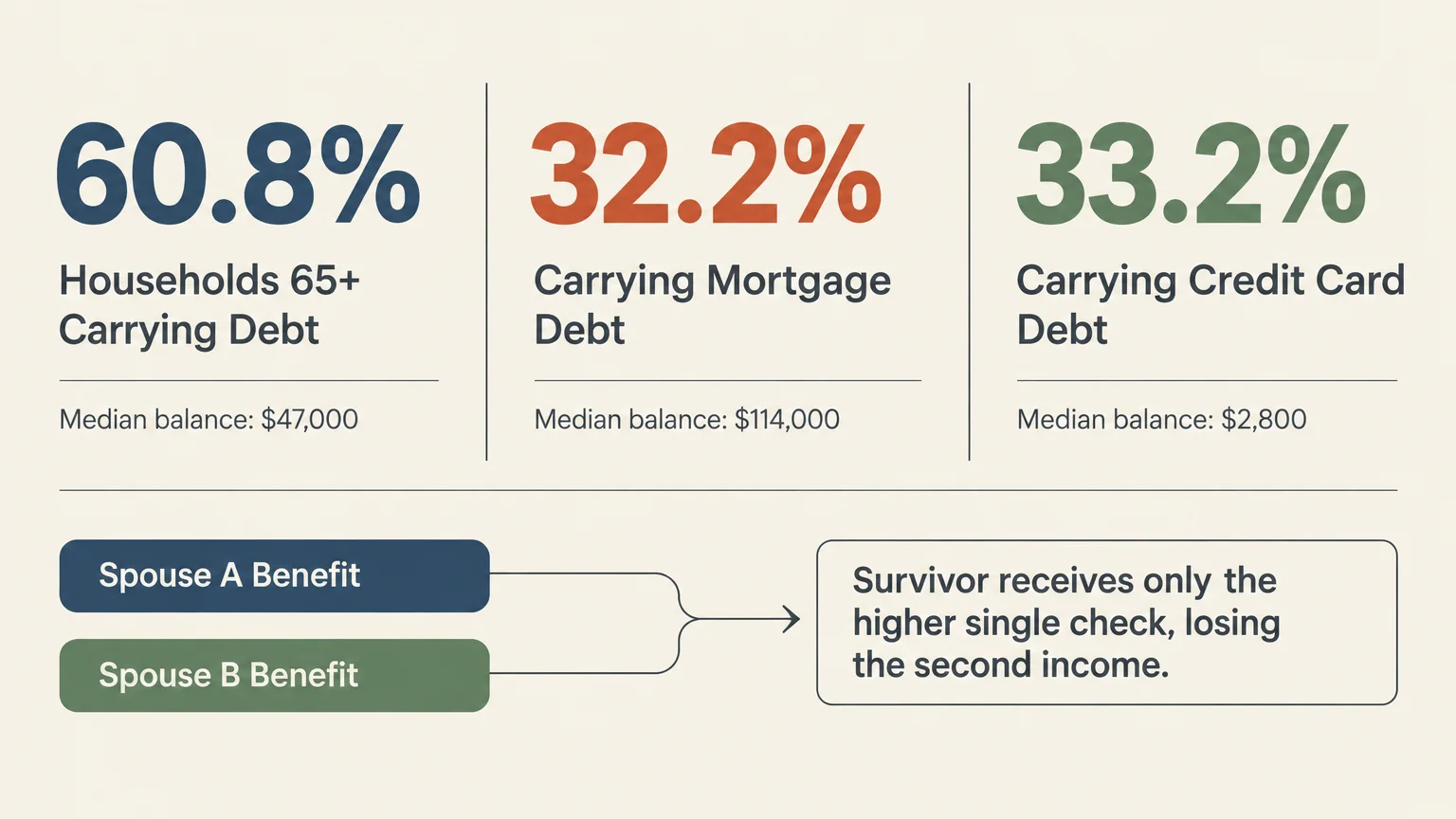
Many households enter retirement carrying more leverage than previous generations did. According to the Federal Reserve’s 2025 Survey of Consumer Finances, 60.8% of U.S. households headed by someone age 65 or older still carried debt, with a median balance of $47,000.
Housing debt drives much of that lingering exposure. The same Federal Reserve report found that 32.2% of households age 65 and older still owed on a home, carrying a median mortgage balance of $114,000.
Among homeowners ages 65 to 79, 43.1% carried a mortgage or home equity line of credit in 2025, up from 41.1% in 2022. Another 33.2% of older households carried credit card balances with a median of $2,800.
Those balances create real strain even before a health crisis hits. In the 2026 EBRI / Greenwald Retirement Confidence Survey, 40% of retirees reported that debt is a problem for their financial situation, and 3 in 10 said debt negatively impacts them.
Social Security rules create a second major income gap when one spouse dies. Under Social Security Administration rules, a surviving spouse who already collects their own retirement benefit cannot keep both monthly checks.
Instead, the survivor receives only the higher of the two benefit amounts. If both spouses relied on two similar checks to pay a $114,000 mortgage and property taxes, losing the smaller check creates an immediate cash-flow shortfall.
Advisors commonly recommend maintaining coverage after 65 when any of these household conditions apply:
- Replacing lost Social Security or pension income: A death benefit helps a surviving spouse pay off a remaining mortgage or replace a pension that lacks a survivor payout option.
- Supporting a dependent with special needs: Parents or grandparents caring for a disabled adult child or dependent grandchild can fund a special needs trust without liquidating retirement accounts.
- Equalizing a complex estate: If one child inherits a family business, farm, or real estate parcel, life insurance delivers tax-free cash to other heirs so nobody has to sell illiquid assets.
- Covering divorce-mandated support: Court decrees sometimes require older spouses to maintain a policy naming an ex-spouse as beneficiary to secure ongoing alimony obligations.
- Paying state-level estate or inheritance taxes: Even when federal estate taxes do not apply, several states tax estates or inheritances at much lower thresholds, and a policy provides quick liquidity.
You can review your household balance sheet using the same framework a fee-only planner uses. Add up your mortgage, credit card balances, and lost survivor income, then subtract liquid assets your spouse can tap without penalty.
If that calculation leaves a clear deficit, keeping an existing term or permanent policy acts as targeted protection. If your assets already cover every expense, you have outgrown the need for insurance.
When Keeping a Policy Wastes Retirement Cash Flow
If your spouse can cover housing, utilities, and healthcare comfortably from Social Security, pensions, and savings, life insurance becomes an unnecessary fixed expense. Every dollar spent on premiums reduces what you can spend or invest elsewhere.
Despite that math, many Americans lose coverage unintentionally at retirement rather than making an active choice. According to the 2026 Insurance Barometer Study by LIMRA and Life Happens, 52% of U.S. adults own life insurance, down among Baby Boomers from 56% in 2025 to 53% in 2026.
That same study shows 27% of insured adults hold coverage solely through an employer, while 20% hold both workplace and individual policies. When you leave a job at 65, group term coverage usually ends or converts at steep individual rates.
Buying a brand-new policy in your late 60s or 70s rarely pencil-checks for middle-income retirees. Insurers price mortality risk aggressively after age 60, and underwriting gets stricter with every birthday.
According to October 2026 quote averages from NerdWallet and LifeStein.com, a preferred healthy 40-year-old male nonsmoker pays $321 per year for a $500,000, 20-year term policy. By age 60, that same $500,000, 20-year term jumps to $2,335 per year for men and $1,640 per year for women.
At age 70, the cost spikes dramatically. Healthy nonsmokers face average quotes of $9,702 per year for men and $7,934 per year for women for that same $500,000, 20-year term policy.
Tobacco use makes late-life coverage even harder to justify mathematically. For smokers age 65 and older, NerdWallet and LifeStein.com data show average $500,000, 20-year term quotes climbing to $13,160 per year for men and $9,809 per year for women.
Life insurance in retirement is not a trophy from your working years; it is a targeted balance-sheet tool that should expire the moment your survivors no longer need the payout.
When premiums reach nearly $10,000 a year, keeping or buying coverage only makes sense if a death is likely soon or an estate tax bill looms. Otherwise, redirecting those premiums into high-yield cash reserves or diversified investments builds guaranteed wealth you control.
You can inspect broader household debt and net worth benchmarks at the Federal Reserve to stress-test whether your savings already cover your spouse’s retirement budget. If your net worth already absorbs the loss of one Social Security check, paying high premiums hurts your retirement lifestyle.

Comparing Your Coverage Options in Retirement
Not all life insurance works the same way after 65, and your existing contract terms often matter more than new quotes. Before dropping or buying a policy, compare how each major policy type behaves in your 60s and 70s.
Insurers also restrict policy lengths as you age. According to Policygenius and Blue Cross underwriting guidelines, many carriers cap new term applications around ages 70 to 75 and limit applicants in their 70s to 10-year or 15-year terms.
If you already hold a term policy from your 40s or 50s, check its conversion rider immediately. NerdWallet notes that term conversion deadlines commonly cut off at age 65, 70, or 75 depending on the insurer.
Converting part of a term policy before that deadline lets you lock in permanent coverage without taking a new medical exam. That option can be a lifeline if you developed a serious health condition and still have a financially dependent spouse.
| Policy Type | Average Cost Benchmark (Age 70) | Medicaid Asset Impact (Most States) | Best Retiree Use Case |
|---|---|---|---|
| Term Life Insurance | $9,974/year ($831/month) across available terms | Does not count as a countable asset | Covering a temporary mortgage or short-term income gap |
| Whole / Permanent Life | $27,522/year ($2,293/month) average for new issue | Cash surrender value counts if combined face value exceeds $1,500 | Special needs trusts or complex estate liquidity needs |
| Final Expense Insurance | $1,172/year ($98/month) average | Cash surrender value counts if combined face value exceeds $1,500 | Covering burial or cremation when liquid savings are absent |
| Self-Insuring (Cash Reserve) | No premiums; earns interest on your own cash | Counts toward $2,000 individual limit unless spent down or protected | Retirees with sufficient savings and no dependent income needs |
The cost gap between policy types at age 70 is stark. Policygenius data show average quotes for 70-year-olds running $9,974 per year for term life, $27,522 per year for whole life, and $1,172 per year for final expense policies.
Notice how permanent coverage magnifies that cost difference even earlier in life. At age 40, a healthy male nonsmoker pays an average of $3,180 per year for whole life compared with $321 per year for term—roughly ten times more.
If you already own an older whole life policy bought decades ago, do not assume its premiums match new-issue quotes. Older permanent policies often carry lower locked-in premiums or dividends that cover annual costs, making them worth a careful in-force illustration review.
Covering End-of-Life Costs Without Overpaying
Many retirees keep small life insurance policies—or buy final expense coverage—purely to avoid burdening children with funeral bills. Understanding exact end-of-life prices helps you decide whether a policy or a dedicated savings account works better.
Social Security provides virtually no meaningful help for funeral expenses. Under 2026 Social Security rules, the one-time lump-sum death benefit remains $255—a figure unchanged since 1954 and never indexed for inflation.
Even that $255 payment applies only to an eligible surviving spouse or minor or disabled child, and survivors must claim it within two years of death. Adult children settling an unmarried parent’s estate receive nothing from Social Security.
Real funeral costs vary widely based on the service your family chooses. According to the National Funeral Directors Association’s 2023 Member General Price List Study, the national median cost of a funeral with viewing and burial is $8,300, rising to $9,995 with a burial vault.
Choosing cremation lowers the median bill, though traditional services still add up. The same NFDA study reports a median cost of $6,280 for a funeral with viewing and cremation.
Those median figures also exclude cemetery plots, grave opening and closing fees, headstones, flowers, and printed obituaries. Families routinely spend an extra $1,000 to $5,000 or more on those cemetery and memorial items.
Direct services without a viewing or formal ceremony cost substantially less. A 2026 analysis of FTC-mandated General Price Lists by WhatDeathCosts found national averages of $2,151 for direct cremation and $2,917 for direct burial.
Preferences are shifting rapidly toward lower-cost arrangements as well. The NFDA’s 2025 Cremation & Burial Report projected the 2025 U.S. cremation rate at 63.4% compared with 31.6% for burial, with cremation projected to hit 82.3% by 2045.
Compare those real-world prices against final expense premiums before buying a policy at 70. Paying $1,172 per year for a small final expense policy means you hand over $9,376 in premiums over eight years—more than the $8,300 median traditional funeral.
If you have $8,000 to $12,000 in liquid savings, placing it in a payable-on-death bank account lets your family access funds immediately without probate delays or insurer underwriting fees. Only retirees with no spare savings who cannot build an emergency reserve benefit from final expense coverage.
Long-Term Care, Medicare Gaps, and Medicaid Rules
Healthcare and custodial care—not funeral bills—pose the largest financial threat to a surviving spouse’s retirement savings. According to the U.S. Administration for Community Living and CareScout, 7 out of 10 people turning 65 will need some form of long-term care.
Most families mistakenly assume federal health benefits cover those expenses. As Medicare.gov clarifies, Medicare does not pay for custodial long-term care, covering only limited skilled nursing or rehabilitation after a qualifying hospital stay.
Paying out of pocket can deplete a modest estate quickly. According to the CareScout and Genworth 2025 Cost of Care Survey released in March 2026, national median long-term care prices now reach steep annual levels:
- Non-medical in-home caregiver: $35 per hour, totaling $80,080 per year for regular full-time support.
- Skilled nursing in the home: $90 per hour for clinical visits.
- Adult day health care: $95 per day for daytime supervision and programming.
- Assisted living community: $6,200 per month, or $74,400 per year.
- Nursing home (semi-private room): $315 per day, totaling $114,975 per year.
- Nursing home (private room): $355 per day, totaling $129,575 per year.
Some older permanent life insurance policies include chronic illness or accelerated death benefit riders that let you tap the death benefit early for care. If your policy lacks those riders, however, its cash value can complicate Medicaid eligibility if you ever need nursing home coverage.
In most states, Medicaid restricts countable assets to $2,000 for an individual long-term care applicant. Term life insurance carries no cash value, so it does not count toward that $2,000 asset limit.
Permanent policies face much stricter rules under Medicaid. In most states, whole or universal life insurance is exempt only if the combined face value of all policies you own is $1,500 or less.
If your permanent policies carry a combined face value above $1,500, Medicaid counts the policy’s entire cash surrender value toward your $2,000 asset limit. Families often have to surrender the policy and spend down that cash before Medicaid begins paying for nursing home care.

Estate Taxes, Income Taxes, and Policy Exits
For decades, wealthy families kept permanent life insurance solely to pay federal estate taxes so heirs would not have to sell family property. Recent federal legislation kept the number of households facing that problem small.
Under the Working Families Tax Cuts Bill, signed into law on July 4, 2025, the federal estate and lifetime gift tax exemption stands at $15,000,000 per individual—or $30,000,000 per married couple with spousal portability—for 2026.
The IRS announced inflation adjustments lifting that exemption in 2027 to $15,480,000 per individual, or $30.96 million per couple. The annual gift tax exclusion is also $19,000 per recipient in 2026 ($38,000 for married couples), rising to $20,000 ($40,000 for couples) in 2027.
Because fewer estates cross $15 million or $30 million, most retirees no longer need life insurance for federal estate tax liquidity. Still, income tax rules on policy payouts and policy exits affect everyday retirees.
Under Internal Revenue Code Section 101(a), life insurance death benefits paid to beneficiaries are generally excluded from federal gross income. However, any interest earned on delayed or installment payouts is taxable, and exceptions apply if a policy was transferred for valuable consideration.
If you own a permanent policy at death, the IRS includes the full death benefit in your gross estate for estate tax calculations. Moving an existing policy into an Irrevocable Life Insurance Trust (ILIT) triggers the IRS three-year clawback rule—if you die within three years of transferring the policy, the full death benefit returns to your taxable estate.
If you decide you no longer need a permanent policy, do not simply stop paying premiums without checking your loan balance and tax basis. Cash value grows tax-deferred, and withdrawals up to your cost basis—the total premiums you paid—are generally tax-free.
However, if a permanent policy lapses or is surrendered while carrying an outstanding policy loan, any loan amount exceeding your cost basis becomes taxable ordinary income in that year. Overfunding a policy beyond the IRS seven-pay test also turns it into a Modified Endowment Contract, which eliminates tax-free-first withdrawal treatment while keeping the death benefit tax-free.
Retirees with unwanted policies often have smarter exits than simple cancellation. Across roughly 134 million individual policies in force, the voluntary surrender rate hovered near 1.3% in 2024, according to the American Council of Life Insurers and Abacus Global Management.
Depending on your contract and health, advisors typically compare four exit paths:
- Request a reduced paid-up option: You stop paying premiums and accept a smaller permanent death benefit that stays active for life without further bills.
- Execute a tax-free 1035 exchange: You roll accumulated cash value directly into a qualified annuity or long-term care policy without triggering immediate income taxes on your gain.
- Explore a life settlement: According to LexisNexis Risk Solutions, third-party buyers generally consider life settlements for policyholders age 65 and older with face values of $100,000 or more, sometimes paying more than the insurer’s cash surrender value.
- Take a clean cash surrender: If you have no outstanding loans and minimal taxable gain above cost basis, taking the cash surrender value frees money immediately for debt payoff or retirement spending.
Comparing those four routes with your insurer’s in-force illustration prevents you from walking away with pennies when a reduced paid-up benefit or 1035 exchange preserves far more value.
Costly Mistakes to Avoid
Retirees rarely lose money because they asked too many questions; they lose money when policies run on autopilot for decades. Avoiding five frequent errors protects both your monthly budget and your heirs.
- Letting a heavily loaned policy lapse: Walking away from a universal or whole life policy with a large unpaid loan triggers phantom taxable ordinary income on any loan balance above your premiums paid.
- Missing a term conversion cutoff: Ignoring the age 65, 70, or 75 conversion deadline closes your last chance to secure permanent coverage without medical underwriting if your health declines.
- Leaving outdated beneficiaries on file: Failing to remove an ex-spouse or name contingent beneficiaries after a spouse dies can send death proceeds through slow probate court instead of directly to your family.
- Assuming employer coverage retires with you: Counting on group workplace coverage without checking portability costs leaves roughly a quarter of insured workers scrambling when group rates expire at retirement.
- Overlooking Medicaid’s $1,500 threshold: Holding permanent policies with face values above $1,500 turns cash surrender value into a countable asset that can delay long-term care Medicaid eligibility.
Check your policy declarations page, beneficiary designations, and annual statement once a year alongside your tax return. Fifteen minutes of review prevents costly surprises for whoever settles your estate.

Don’t DIY These Decisions
Comparing basic term quotes or checking a beneficiary form is straightforward to handle yourself. Once tax rules, trust documents, or six-figure policy exits enter the picture, guessing can cost thousands of dollars.
Work with a CPA, fee-only financial planner, or elder law attorney before making irreversible moves in these situations:
- Surrendering a policy with loans or Modified Endowment Contract status: A CPA can calculate your exact cost basis and taxable ordinary income before you trigger an unexpected IRS bill.
- Negotiating a life settlement on a $100,000+ policy: A fee-only advisor helps evaluate broker offers against reduced paid-up options and warns you about taxes and creditor exposure.
- Setting up or funding an Irrevocable Life Insurance Trust: An estate attorney ensures trust language avoids the IRS three-year clawback rule and aligns with state estate tax thresholds.
- Planning around Medicaid long-term care limits: An elder law attorney advises whether converting, gifting, or spending down permanent cash value fits your state’s Medicaid rules.
Pay for objective hourly or flat-fee advice rather than relying solely on a commissioned agent whose income depends on selling you a replacement policy.
Frequently Asked Questions
Should a 70-year-old buy a new life insurance policy?
For most 70-year-olds with paid-off debts and adequate retirement savings, buying a new policy is rarely cost-effective. Term quotes for healthy 70-year-old nonsmokers average roughly $7,934 to $9,702 per year for $500,000 of coverage, and carriers typically cap terms at 10 to 15 years.
Buying new coverage at 70 usually only makes sense if you still support a dependent with special needs or owe substantial debt your spouse cannot service alone.
What happens to my life insurance when I retire from my job?
Employer-sponsored group life insurance generally ends when your employment ends, leaving the 27% of insured adults who hold only workplace coverage unprotected. Most group plans offer a short window to convert or port coverage to an individual policy, though premiums jump sharply based on your retirement age.
Ask your human resources department for portability rates at least three months before your retirement date so you can compare them against private coverage or self-insuring.
Does life insurance count as an asset for Medicaid long-term care?
Term life insurance has no cash value and does not count toward Medicaid’s $2,000 countable asset limit in most states. Permanent life insurance is exempt in most states only when the combined face value of all policies is $1,500 or less.
If your permanent policies carry a combined face value above $1,500, Medicaid counts the cash surrender value toward your $2,000 limit.
Are life insurance death benefits taxed for my spouse or children?
Under Internal Revenue Code Section 101(a), life insurance death benefits paid directly to named beneficiaries are generally excluded from federal gross income. However, beneficiaries owe income tax on any interest earned if payouts are delayed or taken in installments.
Federal estate taxes also apply only if your total gross estate—including the policy’s death benefit—exceeds the federal exemption of $15,000,000 per individual in 2026 or $15,480,000 in 2027, though state estate taxes can start lower.
Your Next Step Before Canceling or Renewing
Pull every active life insurance declarations page this week, verify your beneficiary listings, and check any term conversion deadline before your next birthday. Run the math on your spouse’s surviving Social Security check and remaining debt so every premium dollar earns its keep.
Information in this article reflects rules and figures current as of the publication date and may change. Always confirm details directly with your bank, the IRS, the Social Security Administration, or other official sources before making decisions.
Last updated: November 2026. Rates, benefit amounts, and tax rules change—always verify current details at official sources.