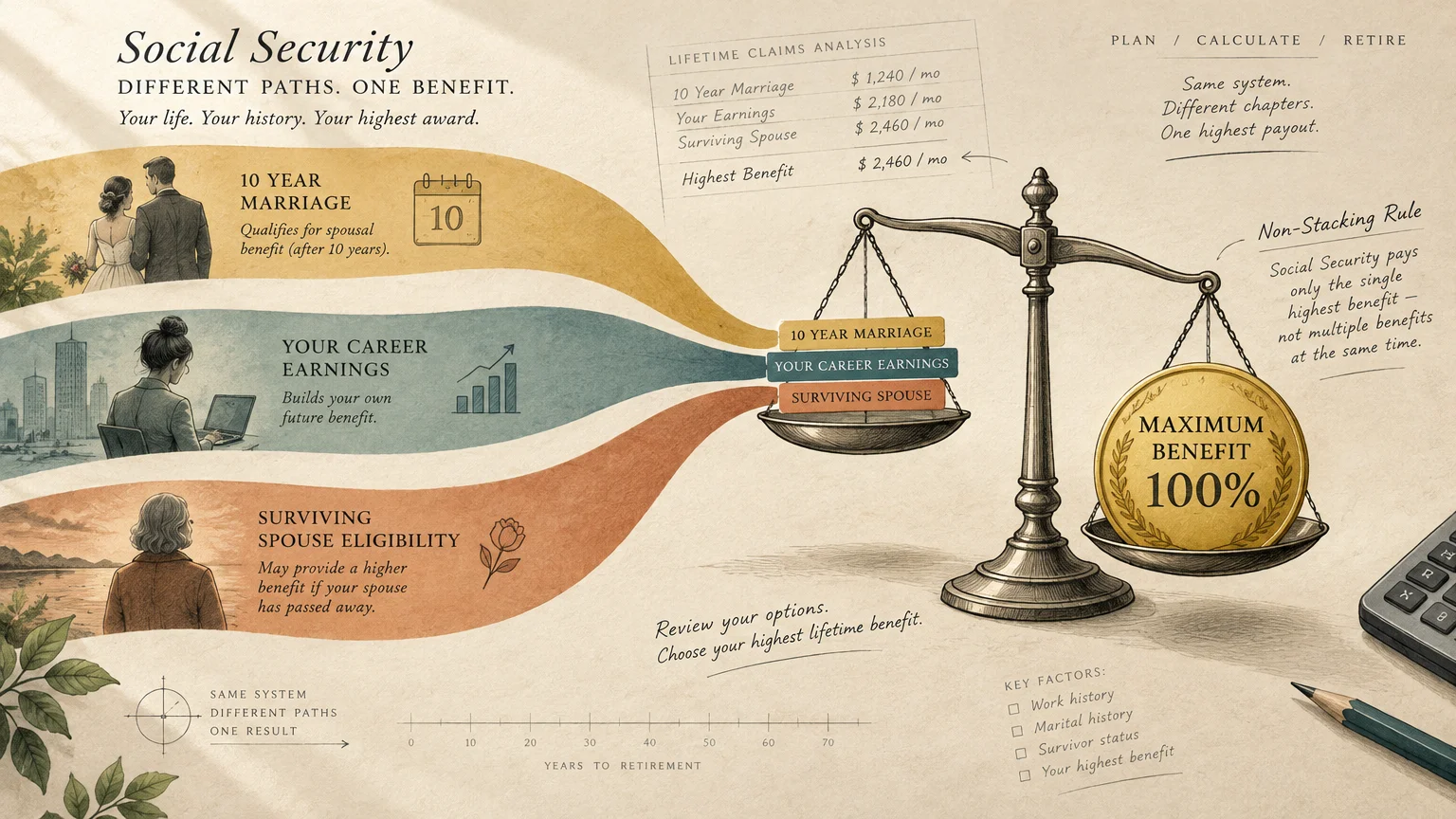
Your marital history directly shapes the size of your monthly retirement check. When you qualify on more than one record, the Social Security Administration pays an amount equal to the single highest benefit, never two full checks stacked together.
Understanding the rules for divorced, widowed, and remarried claimants can add hundreds of dollars to your household budget every month. Comparing spousal versus survivor percentages—and knowing when to switch benefits—protects your long-term cash flow.
With updated 2026 and 2027 benefit limits now set, running these numbers before you file helps you lock in the largest possible payout.
Quick Answers: How Social Security Picks Your Payment
Many families assume they can collect their own retirement check plus a separate check from a former or late spouse. In reality, the Social Security Administration (SSA) calculates your own benefit first and adds a supplement only if the other record pays more.
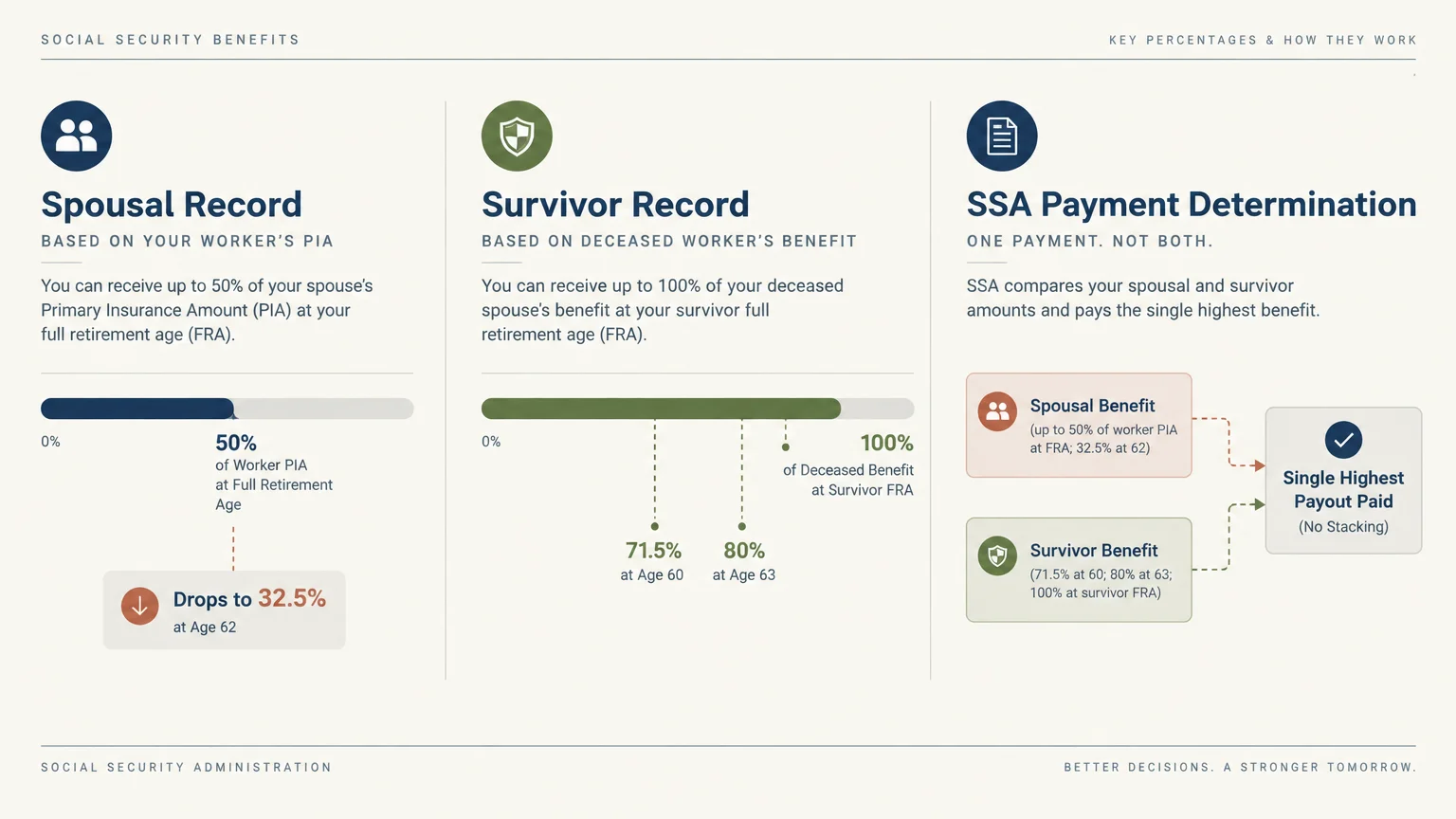
The result is one combined payment equal to whichever benefit is highest. If you qualify on the records of multiple former or deceased spouses, SSA evaluates each option and pays the top single amount.
- Living spouse or ex-spouse: Pays up to 50% of the worker’s Primary Insurance Amount (full retirement age benefit) if you claim at your Full Retirement Age (FRA).
- Deceased spouse or ex-spouse: Pays up to 100% of the deceased worker’s benefit—including any delayed retirement credits they earned—once you reach survivor FRA.
- Remarriage cutoff: Remarrying at any age ends divorced spousal benefits on a living ex-spouse’s record, whereas remarrying at age 60 or later lets you keep survivor benefits.
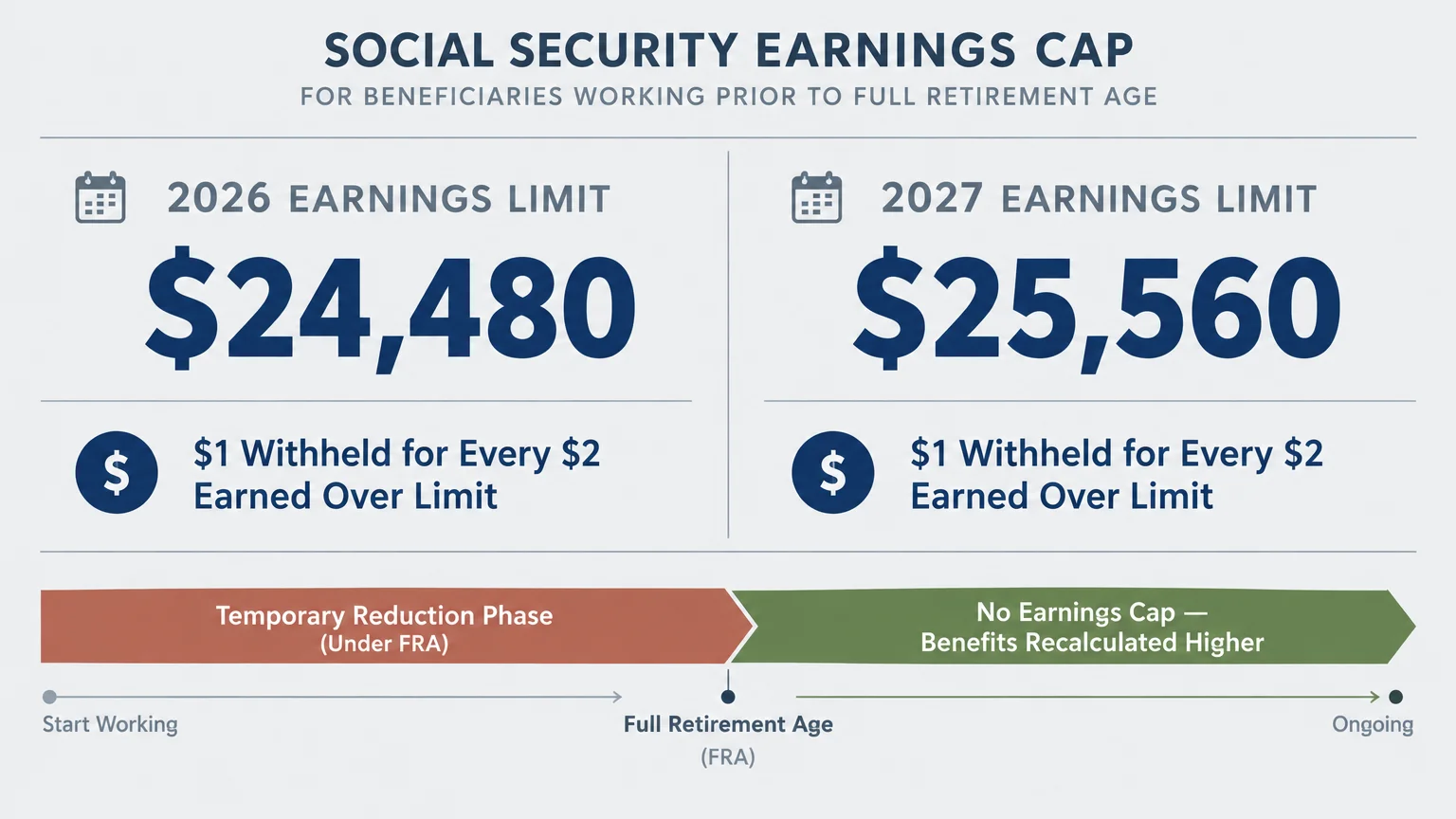
- Earnings cap: Working while collecting before FRA reduces checks temporarily once your wages cross $24,480 in 2026 or $25,560 in 2027.
Your goal is not simply to claim the first check available to you, but to sequence your own record and your family records so your lifetime household income reaches its peak.
Spousal vs. Survivor Benefits: Comparing Your Maximum Payout
The biggest gap in Social Security payouts separates spousal benefits from survivor benefits. Whether your former or current partner is living or deceased changes both your maximum percentage and the earliest age you can apply.
For anyone born in 1960 or later, FRA for retirement and spousal benefits is age 67. For survivor benefits, FRA rises gradually for birth years 1957 through 1962, landing between ages 66 and 67.
Claiming early shrinks your monthly income permanently. A spousal or divorced spouse benefit claimed at age 62 drops from 50% down to just 32.5% of the worker’s Primary Insurance Amount for someone with an FRA of 67.
Survivor benefits start earlier and pay far more. You can file for survivor or surviving divorced spouse benefits at age 60—or age 50 with a qualifying disability—starting at 71.5% of the deceased worker’s benefit.
Waiting longer pushes that survivor share above 75% at age 61, over 80% at age 63, and over 90% at age 65. Holding out until survivor FRA unlocks the full 100% payout.
| Benefit Type | Earliest Claiming Age | Minimum Rate (Early) | Maximum Rate (at FRA) | Includes Worker’s Delayed Credits? |
|---|---|---|---|---|
| Own Retirement Benefit | 62 | Reduced permanently | 100% of own PIA (more up to age 70) | Yes (8% per year up to age 70) |
| Spousal / Divorced Spouse | 62 | 32.5% of worker’s PIA (for FRA 67) | 50% of worker’s PIA | No |
| Survivor / Surviving Divorced Spouse | 60 (50 if disabled) | 71.5% of worker’s benefit | 100% of worker’s benefit | Yes (8% per year up to age 70) |
| Child-in-Care Survivor | Any age | 75% of worker’s PIA | 75% of worker’s PIA | No (tied to PIA) |
Looking at national averages shows how large that difference becomes in real household budgets. Based on SSA data through August 2026, the average retired worker receives $2,094 per month in 2026, rising to $2,170 after the 3.6% 2027 Cost-of-Living Adjustment (COLA).
By comparison, the average spouse of a retired worker collects $989 per month in 2026 and $1,024 in 2027. An aged widow or widower averages $1,938 in 2026 and $2,007 in 2027, while a disabled widow or widower averages $987 in 2026 and $1,022 in 2027.
High earners see an even wider gap between their own maximum and an auxiliary check. The maximum monthly benefit at FRA stands at $4,152 in 2026 and increases to $4,188 in 2027.

How Divorce Rules Affect Your Claiming Power
Divorce does not erase your right to claim on a former spouse’s work history if you meet strict duration rules. To qualify for divorced spouse or surviving divorced spouse benefits, your marriage must have lasted at least 10 continuous years before the final decree.
If you married, divorced, and remarried the same person, SSA counts both periods as one continuous marriage as long as the second wedding happened no later than the calendar year after the divorce.
Many people worry that a clause in their divorce settlement blocks them from filing later. Under SSA rules, any divorce decree waiver giving up rights to an ex-spouse’s Social Security benefits is unenforceable once you satisfy the 10-year marriage test.
Claiming When Your Ex-Spouse Has Not Filed
You do not have to wait for a reluctant ex-spouse to retire before you tap into spousal benefits. Under the two-year independent entitlement rule, you can claim on a living ex-spouse’s record once you turn 62, provided your ex is also at least 62.
The only extra hurdle is timing: your divorce must have been final for at least two continuous years. If your ex-spouse is already receiving benefits, that two-year waiting period does not apply.
Why Your Claim Never Hurts Your Ex-Spouse
Filing on an ex-spouse’s record never reduces the monthly payment sent to your ex-spouse or to their current spouse. Benefits paid to divorced spouses and surviving divorced spouses are also excluded from family maximum reduction limits.
Because your claim stays private and has zero impact on their household cash flow, you do not need your ex-spouse’s permission to apply. You simply provide proof of marriage and divorce when filing through the Social Security Administration.
Widowed Beneficiaries and the Survivor Switching Strategy
Losing a spouse—or a former spouse from a 10-year marriage—unlocks the most flexible planning tool in the Social Security rulebook. Under the Bipartisan Budget Act of 2015, anyone turning 62 on or after January 2, 2016, faces deemed filing rules.
Deemed filing means that applying for a spousal or divorced spousal benefit automatically forces you to file for your own retirement benefit at the same time. You can no longer collect a living spouse’s check alone while letting your own retirement benefit grow.
Crucially, deemed filing does not apply to survivor benefits. As a widow, widower, or surviving divorced spouse, you can still split your claims across two different ages to maximize your total payout.
- Strategy A (Early Survivor, Delayed Own): Claim survivor benefits as early as age 60 to bring immediate income into your household. Leave your own retirement benefit untouched until age 70, letting it grow by 8% per year past FRA before switching to your higher personal check.
- Strategy B (Early Own, Full Survivor): Claim your own reduced retirement benefit at age 62 if your survivor benefit will eventually be larger. Switch to 100% of the survivor benefit once you reach survivor FRA.
Notice that survivor benefits depend heavily on when your late spouse claimed their own check. If your spouse delayed filing past FRA, your survivor benefit captures the delayed retirement credits—8% per year up to age 70—that they earned.
If your late spouse claimed reduced benefits early, a rule called the widow(er)’s limit caps your maximum check. Your payout cannot exceed the higher of what your deceased spouse would receive if still alive or 82.5% of their Primary Insurance Amount.
Child-in-Care and Lump-Sum Death Benefits
Age limits disappear entirely when you are raising a minor or disabled child from the marriage. A surviving spouse or surviving divorced spouse of any age caring for the deceased worker’s entitled child—under age 16 or disabled before age 22—receives 75% of the worker’s Primary Insurance Amount.
Eligible surviving spouses who lived with the worker at the time of death also qualify for a one-time $255 lump-sum death payment. Surviving spouses or children entitled to survivor benefits for the month of death can receive this payment, though divorced spouses living apart do not qualify.
Marriage Length Exceptions and How to Apply
For a current marriage, you normally need at least one year of marriage for spousal benefits and nine months for survivor benefits. SSA waives the one-year spousal rule if you are the parent of your spouse’s child or held certain Social Security or Railroad Retirement eligibility the month before marrying.
The nine-month survivor rule is waived if death was accidental, occurred in active-duty military line of duty, or followed a prior marriage of at least nine months to the same spouse.
Keep one vital administrative rule in mind before trying to file online. You cannot submit a survivor benefit application over the internet; unless an existing spousal benefit converts automatically upon your spouse’s death, you must call 1-800-772-1213 to schedule a phone or in-person appointment.
What Happens When You Remarry
Remarriage alters your benefit eligibility in completely different ways depending on whether your prior spouse is alive or deceased. Getting the timing wrong by even one day can cost you tens of thousands of dollars over retirement.
If you are receiving—or plan to claim—divorced spouse benefits on a living ex-spouse’s record, remarrying at any age ends your eligibility. You can regain access to that ex-spouse’s record only if your subsequent marriage ends through death, divorce, or annulment.
Widows, widowers, and surviving divorced spouses face an age-60 threshold instead. If you remarry before age 60—or before age 50 if you have a qualifying disability—you forfeit survivor benefits on your deceased spouse’s record unless that new marriage later ends.
Remarrying on or after your 60th birthday, or at age 50 or older if disabled at remarriage, protects your survivor rights. You keep full eligibility on your late spouse’s record and can also compare spousal benefits on your new spouse’s record after one year of marriage, choosing whichever check pays more.
You can verify exact monthly payment dates for every benefit category using the official SSA payment schedule.
Government Pensions and Working While Collecting
Two major rules affect how much money actually lands in your bank account each month: public pension offsets and the retirement earnings test. One of those obstacles recently disappeared, while the other still requires careful income budgeting.
Full Repeal of WEP and GPO
For decades, teachers, firefighters, police officers, and certain federal or state workers with pensions from non-covered government jobs watched their Social Security checks shrink. The Windfall Elimination Provision (WEP) cut their personal benefits, and the Government Pension Offset (GPO) slashed or wiped out their spousal and survivor checks.
Signed into law on January 5, 2025, the Social Security Fairness Act repealed both WEP and GPO retroactively for benefits payable for January 2024 and later. December 2023 was the final month those reductions applied.
More than 3.2 million public-sector workers and spouses benefited from this shift. In 2026 and 2027, your non-covered government pension no longer reduces your spousal, divorced spouse, or survivor Social Security payments.
Earnings Limits If You Keep Working
If you claim retirement, spousal, or survivor benefits before reaching FRA and continue earning wages, the Retirement Earnings Test applies. In 2026, anyone under FRA for the entire calendar year faces an earnings limit of $24,480 per year, or $2,040 per month.
In 2027, that limit rises to $25,560 per year, or $2,130 per month. SSA withholds $1 in benefits for every $2 you earn above those caps.
A higher threshold applies during the calendar year you reach FRA. That cap sits at $65,160 per year ($5,430 per month) in 2026 and $67,920 per year ($5,660 per month) in 2027, with $1 withheld for every $3 earned above the limit in months before your FRA birthday month.
Starting in the exact month you reach FRA, the earnings limit disappears completely. Any benefits withheld earlier are not lost forever—SSA recalculates your benefit at FRA and permanently credits back the months you missed.
Because higher household wages plus Social Security can also raise your federal tax bill, review current benefit taxation rules at the IRS or check broader household filing resources at USA.gov Money and Taxes.
Don’t Make These Mistakes
Small missteps with dates, applications, or marital timelines often cause irreversible cuts to your monthly income. Watch out for these frequent errors before locking in your filing decision.
- Remarrying at age 59 instead of waiting for 60: Scheduling a wedding even weeks before turning 60 disqualifies a widow or widower from collecting survivor benefits on a late spouse’s record while that new marriage lasts.
- Waiting for an ex-spouse to file at 65 or 70: Divorced spouses who have been divorced for two continuous years can file independently at 62 once their ex-spouse is 62, rather than missing years of payments.
- Assuming spousal benefits grow past FRA: Unlike your own retirement benefit or a survivor benefit, spousal checks max out at 50% at your FRA and earn zero delayed retirement credits if you wait until age 70.
- Confusing deemed filing with survivor switching: You cannot claim a living spouse’s benefit alone at 62 while delaying your own, but a survivor can still take survivor checks early and switch to a higher personal benefit at 70.
- Skipping a claim because of an old divorce decree: Clauses waiving Social Security rights in divorce paperwork cannot override federal law if your marriage lasted at least 10 years.
When Professional Advice Is Worth It
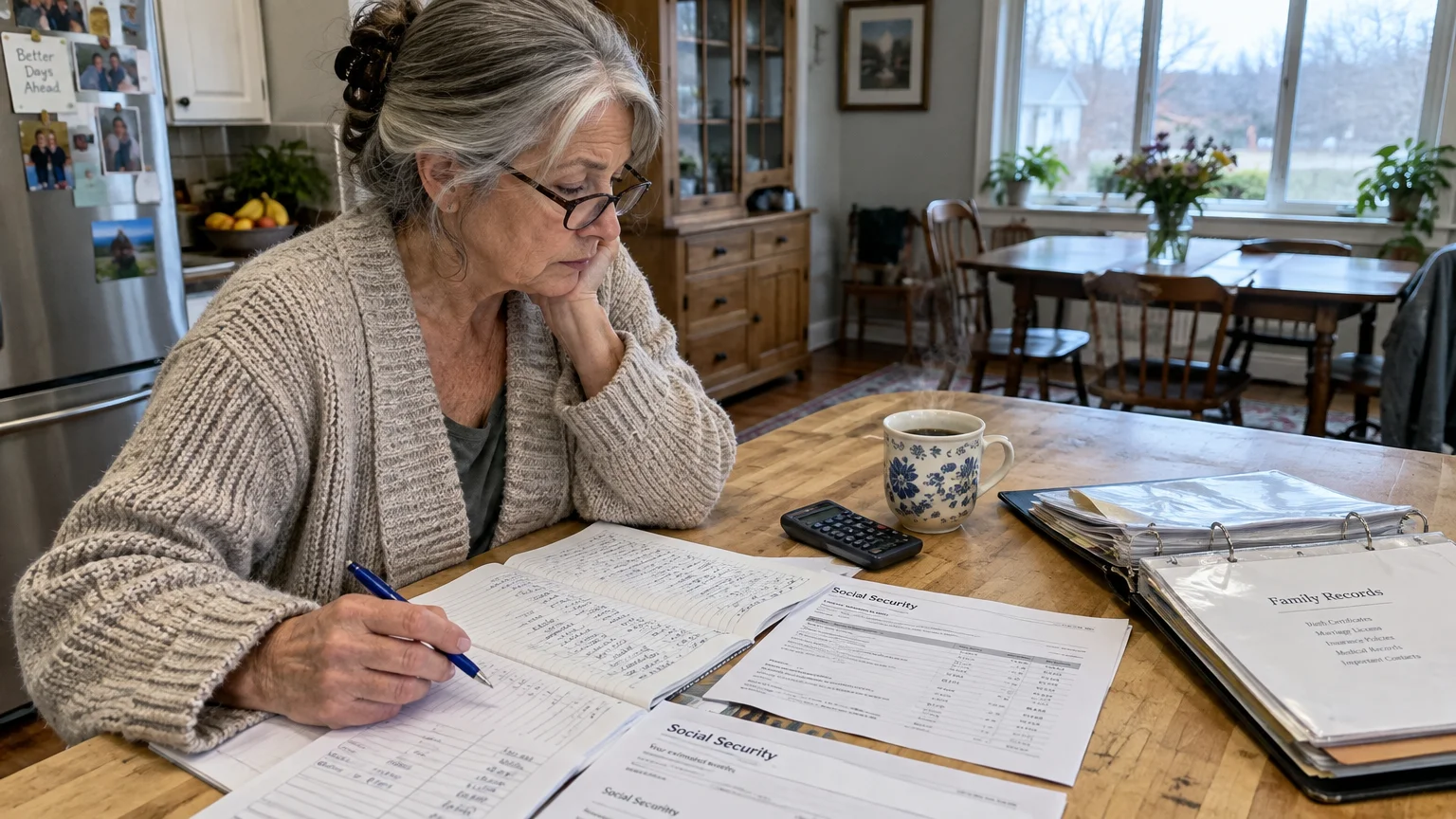
Comparing two or three work records across multiple claiming ages quickly gets complicated, especially when dependent care, eldercare expenses, or remarriage plans are involved. Getting tailored numbers before submitting irreversible paperwork often pays for itself within a few months.
Consider working with a fee-only financial planner if you are weighing survivor switching strategies alongside 401(k) withdrawals, pension elections, or Medicare premium brackets. A planner can model break-even ages so you see how claiming early versus waiting until 70 affects your surviving family cash flow.
Consult a CPA when you plan to keep working before FRA or combine spousal benefits with taxable retirement distributions. A tax professional helps you avoid crossing federal tax thresholds on your Social Security income and manage withholdings cleanly.
Speak with a consumer, family, or elder law attorney if your marriage duration is close to the 10-year mark, if you have questions about guardianship or a disabled adult child’s entitlement, or if complex remarriage timing affects estate planning. Benefits counselors can also help verify older SSA earnings records before you book your filing appointment.
Frequently Asked Questions
Can I collect both my own Social Security and my deceased spouse’s benefit?
No, you cannot stack both checks together for a double payout. SSA pays your own retirement benefit first and adds a survivor supplement only if the survivor benefit is higher, leaving you with a total payment equal to the single largest benefit.
However, because deemed filing does not apply to survivor claims, you can collect one benefit first and switch to the higher benefit at a later age.
What if I was married twice for more than 10 years each?
You can qualify on both former spouses’ records as long as each marriage lasted at least 10 years and you are currently unmarried—or remarried at age 60 or older if claiming as a surviving divorced spouse. SSA reviews every eligible record and pays the single highest benefit amount.
Do divorced spouse benefits count against my ex-spouse’s current spouse?
No, benefits paid to a divorced spouse or surviving divorced spouse never reduce the monthly checks paid to your ex-spouse or their current husband or wife. Your claim is also excluded from Social Security’s family maximum limits.
How much is the Social Security increase for 2027?
SSA announced a 3.6% Cost-of-Living Adjustment for 2027 on October 14, 2026, following the 2.8% COLA applied in 2026. The 3.6% boost takes effect with December 2026 benefits, which arrive in January 2027.
Your Next Step Before Filing
Pull your own earnings statement alongside any marriage certificates, divorce decrees, or death certificates before making a phone appointment with SSA. Calculating your exact 32.5% to 50% spousal range against your 71.5% to 100% survivor range—and factoring in your own age-70 benefit—gives you clear math to claim the largest check available.
Financial outcomes vary based on individual income, credit history, and circumstances. This article provides general guidance only. Consult a qualified financial planner, CPA, or consumer attorney for advice specific to your situation.
Last updated: November 2026. Rates, benefit amounts, and tax rules change—always verify current details at official sources.