
The national average savings account pays just 0.39% APY, while annual consumer inflation recently hit 3.7%. Every month your cash sits in a low-yield account, your real purchasing power quietly shrinks.
Over the five years ending October 2026, U.S. consumer prices climbed 22.0%. You cannot stop prices from rising, yet you can stop leaving idle dollars in accounts that barely pay interest.
Comparing high-yield bank accounts, government bonds, and deposit insurance rules lets you protect your emergency reserves right now. Here is how to audit your accounts and put your cash to work safely.

How Savings vs. Inflation Quietly Shrinks Your Purchasing Power
Your bank statement shows a steady or slightly growing dollar balance, which creates a false sense of security. That balance measures nominal dollars, not what those dollars can actually buy at the grocery store or repair shop.
Data from the U.S. Bureau of Labor Statistics (BLS) shows the Consumer Price Index for All Urban Consumers rose 3.7% over the 12 months ending September 2026. That pace accelerated from 3.4% in August 2026.
Core inflation, which excludes food and energy, stood at 2.6% over that same 12-month stretch. Monthly price pressures stayed firm in October 2026, rising 0.4% after a 0.6% jump in September.
You may notice a gap in official annual inflation reports for October 2026. Because a federal lapse in appropriations prevented survey collection in October 2025, the BLS could not publish 12-month changes for most categories until the November 2026 report arrives on December 10, 2026.
Even without that single annual figure, broader measures confirm that inflation remains stubborn. According to Commerce Department data reported in late October 2026, the Personal Consumption Expenditures price index rose 3.6% year-over-year in September 2026, well above the Federal Reserve’s 2% target.
Meanwhile, bank deposit rates lag far behind rising prices at many traditional institutions. As of November 16, 2026, the Federal Deposit Insurance Corporation (FDIC) reported a national average savings rate of 0.39% and an interest checking average of just 0.07%.
Even traditional money market accounts averaged only 0.64%, and 12-month certificates of deposit averaged 1.81%. Large legacy banks hold massive deposit shares while paying near-zero yields, which pulls these deposit-weighted national averages down.
Losing the savings vs. inflation race hits household budgets especially hard when savings buffers are already thin. Commerce Department figures show Americans saved just 3.8% of disposable personal income in September 2026, down from 5.6% in January 2026.
Findings from the Federal Reserve’s Report on the Economic Well-Being of U.S. Households in 2025 underscore this vulnerability. Only 55% of U.S. adults held enough rainy-day savings to cover three months of expenses, down from 59% in 2021.
In that same survey, 59% of adults reported facing at least one major unexpected expense over the prior 12 months, led by vehicle repairs, home or appliance fixes, and medical bills. Only 63% could cover an unexpected $400 expense with cash, savings, or a credit card paid off at the next statement.
Why the Federal Reserve Rate Environment Matters for Your Cash
Interest rates across the banking system take their cues from the Federal Reserve. At its October 27–28, 2026 meeting, the Federal Open Market Committee voted 10–2 to hold the federal funds target range at 3.75% to 4.00%.
That pause followed a 25-basis-point rate hike in September 2026, the central bank’s first increase since 2023. Two policymakers dissented in favor of another quarter-point hike in October, and the effective federal funds rate stood at 3.88% as of November 19, 2026.
Minutes released on November 18, 2026 showed most officials expected further rate hikes would likely be appropriate. The next meeting is set for December 8–9, 2026. Policymakers project core PCE inflation at 3.4% for 2026 and do not expect a return to 2.0% until 2029.
For everyday savers, this rate environment creates both a warning and an opportunity. Traditional brick-and-mortar banks rarely pass higher benchmark rates on to existing savings customers unless customers threaten to move their balances.
Online banks, competitive credit unions, and U.S. Treasury securities adjust much faster to the 3.75% to 4.00% policy range. Checking your current rate against what competitive institutions pay can immediately add several percentage points to your annual return.

Comparing Your Top Options to Protect Savings From Inflation
No single account works best for every dollar you save. The smartest strategy pairs daily liquidity for emergencies with higher-yielding or inflation-indexed vehicles for cash you will not spend immediately.
High-yield savings accounts (HYSAs): As of late November 2026, top-paying HYSAs without strict balance or direct-deposit hurdles offer roughly 4.25% to 4.70% APY. Promotional offers tied to linked checking and deposit requirements pay up to 5.00% APY for six months before reverting near 4.21% APY.
These accounts keep your cash liquid, compound interest regularly, and carry standard federal deposit insurance. Because their APYs are variable, banks can adjust rates up or down as market conditions shift.
Certificates of deposit (CDs): Top nationally available 12-month to 24-month CDs pay 5.00% to 5.10% APY, with select promotional certificates reaching 5.45% APY. Locking in a fixed rate shields you if market interest rates later fall.
The trade-off is liquidity, because withdrawing principal early triggers an early withdrawal penalty that forfeits months of interest. Always verify penalty terms before locking up cash you might need for a sudden home or auto repair.
Bank money market accounts vs. brokerage money market funds: Competitive bank money market accounts pay 1.50% to 3.90% APY and often include check-writing or debit privileges. Because they are bank deposits, they carry FDIC or NCUA protection.
Brokerage taxable money market mutual funds yielded roughly 3.5% to 3.9% in late 2026, yet they work very differently. Money market funds are investment securities regulated by the SEC, not bank deposits, so they carry no FDIC backing.
Although rare, a money market fund’s share price can fall below $1.00 during severe market stress, as happened to the Reserve Primary Fund in September 2008. Brokerage assets carry SIPC protection up to $500,000 total, including $250,000 for cash, only against broker-dealer failure—never against market losses.
Series I Savings Bonds (I Bonds): For bonds issued between November 1, 2026 and April 30, 2027, the U.S. Treasury set a 5.51% annualized composite rate. That return combines a 1.40% permanent fixed rate—the highest since November 2006—and a 2.04% semiannual inflation rate.
Electronic purchases through TreasuryDirect are capped at $10,000 per Social Security Number per calendar year, and paper tax-refund I bonds are no longer offered. Bonds earn interest for up to 30 years, cannot be cashed during the first 12 months, and forfeit the last three months of interest if redeemed before five years.
U.S. Treasury bills and TIPS: On November 19, 2026, secondary-market Treasury bills yielded 4.05% for four weeks, 4.16% for three months, 4.31% for six months, and 4.39% for one year. Treasury Inflation-Protected Securities (TIPS) adjust principal directly with CPI-U inflation.
As of November 18–20, 2026, the 10-year TIPS constant-maturity real yield stood at 2.88%, while the 5-year TIPS real yield was 2.56%. That real yield represents your guaranteed annual return on top of CPI-U inflation if you hold the bond to maturity.
| Account or Security | Late-2026 Yield Range | Liquidity and Lockup Rules | Protection Type | Income Tax Treatment |
|---|---|---|---|---|
| Traditional Savings (National Avg.) | 0.39% APY | Liquid; bank monthly transaction limits may apply | FDIC or NCUA ($250,000 limit) | Federal, state, and local |
| High-Yield Savings Account | 4.25% to 4.70% APY (promos up to 5.00%) | Liquid; ACH transfers take 1 to 3 business days | FDIC or NCUA ($250,000 limit) | Federal, state, and local |
| Top 12- to 24-Month CDs | 5.00% to 5.10% APY (promos up to 5.45%) | Locked until maturity; early withdrawal penalty | FDIC or NCUA ($250,000 limit) | Federal, state, and local |
| Bank Money Market Account | 1.50% to 3.90% APY (0.64% national avg.) | Liquid; check or transfer limits may apply | FDIC or NCUA ($250,000 limit) | Federal, state, and local |
| Brokerage Money Market Fund | 3.5% to 3.9% (7-day yield) | Liquid within brokerage settlement window | SIPC against broker failure only | Federal; state varies by holdings |
| Series I Savings Bonds | 5.51% composite rate (through Apr. 30, 2027) | 12-month lockup; 3-month penalty under 5 years | Full faith and credit of U.S. government | Federal only; state/local exempt |
| U.S. Treasury Bills | 4.05% to 4.39% | 4 weeks to 1 year; liquid on secondary market | Full faith and credit of U.S. government | Federal only; state/local exempt |
A Step-by-Step Plan to Move Cash Without Disrupting Your Budget
Switching accounts feels intimidating when automatic paychecks, utility drafts, and mortgage payments run through your current bank. Breaking the transition into deliberate steps keeps your bills paid on time while lifting your interest earnings.
Protecting your savings from inflation starts with giving every dollar a clear job—keeping bill money accessible, parking emergency cash in high-yield accounts, and locking surplus funds into inflation-beating instruments.
- Audit every deposit account you currently hold: Log in to your checking, savings, and money market portals to record each APY, minimum balance rule, and monthly maintenance fee waiver requirement. Closing or downgrading dormant accounts stops surprise service charges.
- Assign your cash to clear time buckets: Keep everyday bill money in checking, park your three-month emergency fund in a liquid high-yield savings account, and reserve CDs, T-bills, or I Bonds for cash you will not touch for 12 months or longer.
- Confirm federal deposit insurance before transferring large balances: Verify that your bank carries FDIC insurance or that your credit union is insured by the National Credit Union Administration (NCUA). Coverage reaches $250,000 per depositor or member, per institution, per ownership category such as single, joint, retirement, or trust accounts.
- Check withdrawal limits and funds availability schedules: Although the Federal Reserve removed the federal six-per-month savings withdrawal limit in April 2020 under Regulation D, many banks still cap monthly transfers and charge $5 to $15 excess-withdrawal fees. Confirm incoming transfer hold periods before linking new accounts to recurring bills.
- Automate ongoing deposits to stay ahead of spending: Follow guidance from the Consumer Financial Protection Bureau (CFPB) by separating emergency savings from daily checking and splitting your paycheck direct deposit. Planning ahead to direct 25% of any tax refund straight into savings builds reserves without relying on credit cards.
Keep your old checking account open with a small buffer for at least one full billing cycle after moving direct deposits. Once every recurring debit clears at the new institution, you can close the legacy account cleanly.

How Taxes Affect Your Real Return on Savings
Comparing headline APYs without factoring in taxes gives an incomplete picture of whether your savings beat inflation. What matters for your household budget is your after-tax real return.
Interest earned on traditional savings accounts, HYSAs, bank money market accounts, CDs, and credit union share accounts—even when labeled dividends—counts as ordinary taxable income. You owe federal, state, and local income taxes in the year the interest becomes available to withdraw.
Financial institutions send Form 1099-INT whenever you earn $10 or more in interest during the year. Even if your interest falls below $10, IRS rules require you to report every dollar of taxable interest on your return.
Watch out for cash sign-up bonuses when opening a new checking or high-yield savings account. Banks generally treat promotional cash bonuses as interest income and report them on Form 1099-INT right alongside your regular yield.
U.S. Treasury bills, TIPS, and Series I savings bonds offer a meaningful tax advantage if you live in a high-tax state. Interest from direct U.S. government obligations is subject to federal income tax, yet exempt from all state and local income taxes.
Series I bonds add another layer of tax flexibility because you can generally defer reporting federal interest until you cash the bond or reach its 30-year maturity. If you buy Treasury mutual funds or ETFs instead of individual bills, verify state rules—New York, California, and Connecticut require at least 50% of a fund’s assets in qualifying U.S. obligations to pass through that state tax exemption.

Costly Mistakes to Avoid
Moving money out of a stagnant 0.39% savings account is a strong first move, yet rushed decisions can eat away at your extra interest. Avoid these common traps as you reposition your household cash.
- Chasing promotional APYs without reading the fine print: Some advertised 5.00% APY offers expire after six months, drop near 4.21% APY, or require linked checking accounts and strict monthly direct-deposit thresholds. Missing one qualifying requirement can slash your interest rate to near zero.
- Locking your entire emergency fund in I Bonds or long CDs: Because I Bonds cannot be redeemed for 12 months and carry a three-month interest penalty before five years, they make poor primary emergency funds. Keep unexpected vehicle, home, and medical repair cash in a liquid HYSA.
- Assuming brokerage money market funds carry FDIC insurance: Only bank deposit accounts carry FDIC or NCUA backing. Brokerage money market mutual funds rely on SIPC protection for broker failure, not against net asset value dips below $1.00.
- Exceeding $250,000 in a single ownership category: Deposit insurance limits combine checking, savings, money market accounts, and CDs held in the same ownership category at the same bank. If your cash exceeds $250,000, spread balances across institutions or valid joint and trust ownership categories.
- Using a savings account like a checking account: Making frequent transfers out of savings can trigger $5 to $15 excess-withdrawal fees per transaction or prompt your bank to reclassify the account into low-paying checking.
- Ignoring how inflation erodes uninvested cash over multiple years: Leaving surplus cash beyond your three-month emergency buffer in checking costs real purchasing power when cumulative five-year inflation reaches 22.0%.
Don’t DIY These Decisions
Routine bank shopping and opening an online high-yield savings account are straightforward tasks you can handle yourself. Still, certain complex cash and tax situations call for qualified professional advice.
Consult a CPA or enrolled agent if large CD ladders, multi-year I Bond redemptions, or state tax exemptions on Treasury funds complicate your tax return. A tax professional can also help you estimate quarterly payments when rising interest income pushes up your tax bill.
Work with a fee-only financial planner if your cash reserves far exceed your emergency buffer and you are weighing savings accounts against long-term retirement goals. A planner operating under a fiduciary standard can help you align cash liquidity with broader wealth preservation.
Contact a consumer attorney if a bank freezes your funds unexpectedly, misrepresents FDIC or NCUA deposit coverage, or refuses to refund disputed fees after you submit a formal complaint. Legal counsel can explain your rights under federal banking rules.
Frequently Asked Questions About Savings and Inflation
Is a high-yield savings account enough to beat inflation right now?
Top high-yield savings accounts paying 4.25% to 4.70% APY currently outpace the 3.7% annual CPI inflation rate reported for September 2026 on a pre-tax basis. Because federal and state income taxes reduce your net yield, high earners may only break even after taxes, though they still fare vastly better than the 0.39% national average.
What is the safest inflation savings account option backed by the U.S. government?
Series I Savings Bonds and TIPS directly adjust for inflation and carry the full faith and credit of the U.S. government, with I Bonds yielding 5.51% annualized through April 30, 2027. For daily access without a 12-month lockup, FDIC-insured or NCUA-insured high-yield savings accounts remain the safest liquid choice.
How do I know if my money market account is FDIC-insured?
Verify that you hold a money market deposit account at an FDIC-insured bank or an NCUA-insured credit union rather than a brokerage money market mutual fund. You can confirm any institution’s coverage directly using the official lookup tools on the FDIC or NCUA websites before depositing funds.
Should I move all my savings into a 12-month CD at 5.00% APY?
No, because putting every dollar into a CD leaves you exposed to early withdrawal penalties if an unexpected expense hits. Keep enough cash in a liquid high-yield savings account to cover emergencies, and use 5.00% to 5.10% APY CDs only for surplus funds you will not touch until maturity.
Your Next Step to Protect Your Cash
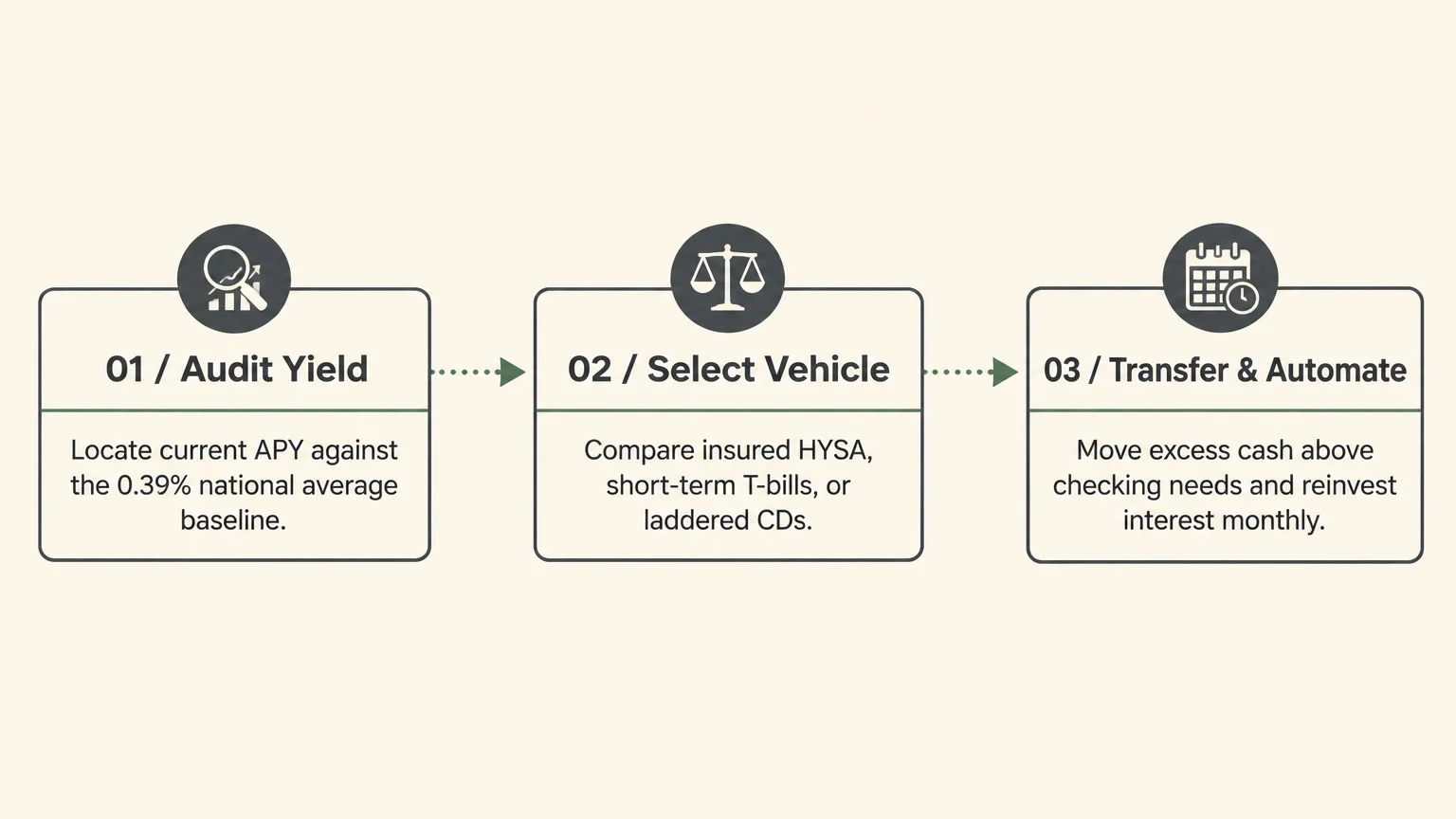
Open your primary bank portal today, check the exact APY on your savings and checking balances, and compare those numbers against current 4.25% to 4.70% high-yield accounts or 5.51% Series I Bonds. Moving idle cash takes less than an hour and immediately puts time back on your side.
This article is for informational purposes only and does not constitute financial, legal, or tax advice. Rates, benefit amounts, and tax rules change regularly—verify current details with the relevant agency or a licensed professional.
Last updated: November 2026. Rates, benefit amounts, and tax rules change—always verify current details at official sources.