You do not need a gated coastal mansion to find where millionaires live. Across the United States, millions of households build seven-figure net worths inside quiet, unassuming zip codes.
Studying these hidden wealth neighborhoods gives you a practical blueprint for your own housing budget. Keeping your fixed shelter costs low frees up cash flow for retirement accounts and diversified investments.
These six stealth wealth communities show what disciplined buying looks like in late 2026, alongside the mortgage math that helps ordinary earners protect their net worth.
How Everyday Millionaires Actually Choose Where to Live
Roughly 23,627,000 net-worth millionaires live in the United States out of 57.5 million worldwide, according to the UBS Global Wealth Report 2026. The country added more than 440,000 new millionaires in 2025 alone, representing nearly half of all new dollar millionaires globally.
Most of these households look very different from television stereotypes. UBS classifies households holding between $1 million and $5 million in assets as Everyday Millionaires, and many live in modest houses on tree-lined suburban streets.
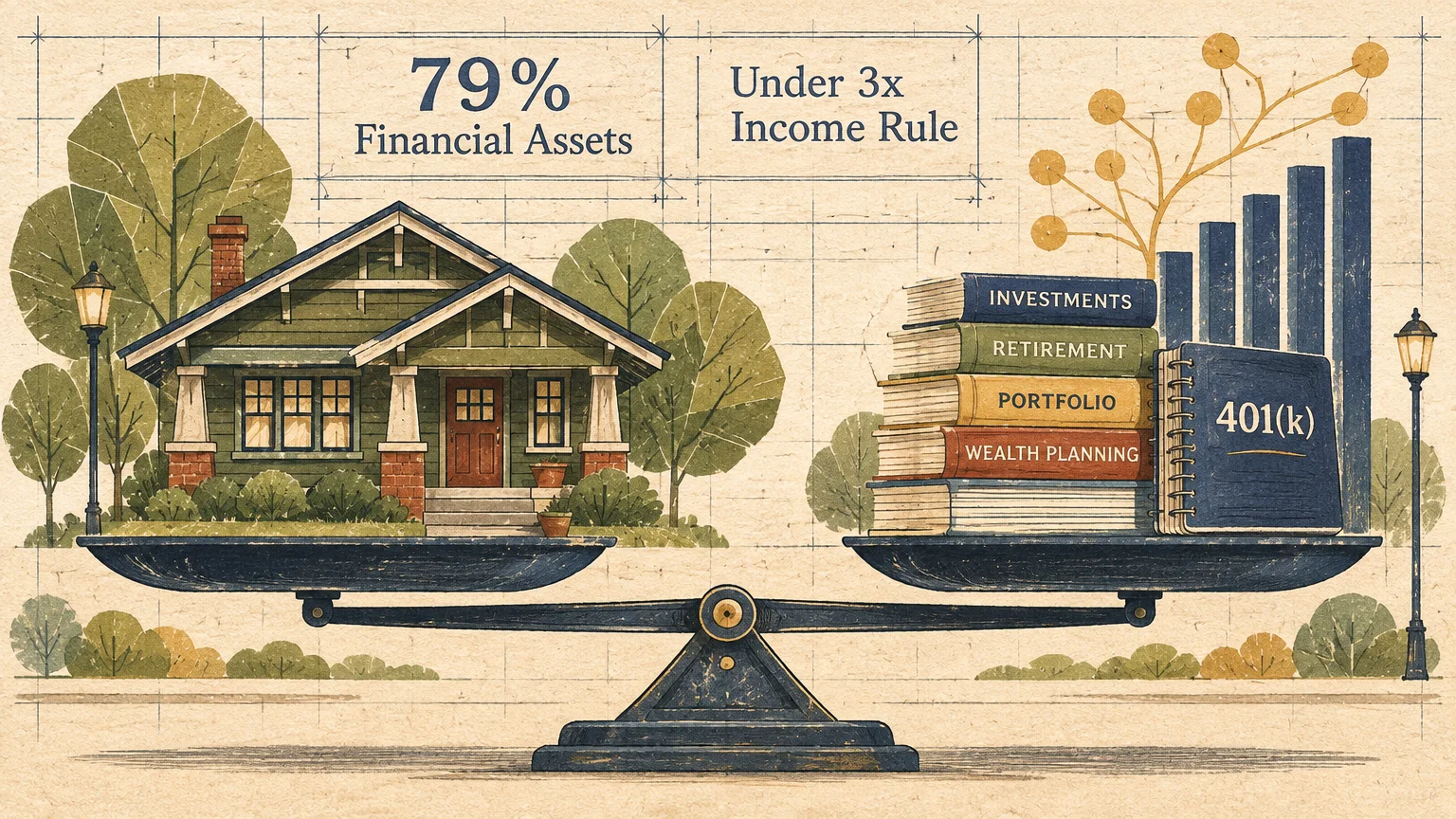
Financial assets—not oversized primary residences—drive most of that net worth. Nearly 79% of U.S. personal wealth sits in financial assets such as stocks rather than real estate.
Career paths inside these quiet wealthy suburbs reflect steady saving over flashy paychecks. Ramsey Solutions surveyed more than 10,000 U.S. millionaires and found that 79% received no inheritance, while eight out of ten invested consistently in a workplace 401(k) plan.
Only 31% of those surveyed millionaires ever averaged $100,000 per year over their careers. Their top five professions were engineers, accountants, teachers, business managers, and attorneys, with medical doctors ranking sixth.
Housing restraint separates high earners who stay broke from disciplined savers who build lasting equity. Research by Sarah Stanley Fallaw at the Affluent Market Institute found that most surveyed millionaires never bought a home costing more than three times their annual income.
Across more than 600 millionaires in that survey, the median original purchase price was $465,000, while their median current home value sat at $850,000—or 3.4 times their current income.
True housing wealth comes from keeping your fixed monthly shelter overhead low enough that your paycheck consistently funds productive investments instead of mortgage interest and ongoing upkeep.
That balance matters even more when you compare median household earnings against national wealth data. U.S. Census figures show nationwide median household income peaked at $87,460 in 2025, while the U.S. Department of Housing and Urban Development set the 2026 national median family income at $106,800.
Owning a sensibly priced home still creates a powerful long-term anchor compared to renting indefinitely. An Aspen Institute analysis of Federal Reserve data found that U.S. homeowners held a median net worth near $400,000—including about $200,000 in home equity—compared with $10,400 for renters.
The Federal Reserve updated its 2022–2025 Survey of Consumer Finances dataset on October 9, 2026, adjusting figures to 2025 dollars. Even with higher borrowing rates, owning within your means remains a central pillar of household balance sheets.
6 Hidden Wealth Neighborhoods Where Millionaires Blend In
To spot stealth wealth in today’s housing market, you need a baseline for national home prices. As of October 31, 2026, the Zillow Home Value Index placed the typical U.S. home value at $364,288, up 1.1% year-over-year.
National sale prices run slightly higher depending on the property mix. The National Association of Realtors reported a median existing-home sale price of $416,700 in October 2026, while Redfin recorded a September 2026 national median sale price of $393,895 across all home types.
These six hidden wealth neighborhoods sit near or moderately above national medians while housing unusually high concentrations of affluent savers and long-term investors.
1. Dundee (Omaha, Nebraska)
Dundee stands as America’s best-known example of stealth wealth in action. Billionaire investor Warren Buffett bought his home in this historic Omaha neighborhood in 1958 for $31,500 and still lives there today.
You will not find sprawling private gates or ostentatious mansions lining Dundee’s brick streets. As of October 31, 2026, Zillow reported a typical home value of $438,707 in Dundee, up 3.8% year-over-year.
While Dundee trades above Omaha’s citywide typical value of $293,001, it sits remarkably close to the national median. Buyers here easily stay well below federal conforming mortgage caps while building equity in a stable Midwestern market.
2. Los Alamos, New Mexico
Perched on a mountain mesa about 35 miles northwest of Santa Fe, Los Alamos looks like a quiet outdoor-recreation town at first glance. Its economic engine is Los Alamos National Laboratory, which employs thousands of physicists, engineers, and technical specialists.
Kiplinger and Phoenix Marketing International previously ranked Los Alamos among the U.S. small towns with the highest concentration of millionaire households. Steady federal research salaries combined with modest local housing costs let engineers max out retirement plans early.
As of October 31, 2026, Zillow placed the typical home value in Los Alamos at $576,479, down 0.5% year-over-year. For dual-income technical households, that price point keeps housing well under three times gross annual earnings.
3. Carmel, Indiana
Just north of Indianapolis, Carmel attracts executives, physicians, and corporate managers who prioritize square footage and municipal efficiency over coastal status symbols. A February 2025 Zillow study found that a typical $1 million home in the Indianapolis metro spans 5,042 square feet.
That figure gives buyers the largest footprint for $1 million of any major U.S. metro, more than double the 2,388-square-foot national average. Even better, most families in Carmel spend far less than $1 million to buy in.
Zillow recorded Carmel’s typical home value at $574,899 as of October 31, 2026, up 4.3% year-over-year, with ZIP code 46033 averaging $590,159. That pricing keeps buyers comfortably inside standard conforming mortgage limits.
4. Edina, Minnesota
Edina sits just southwest of Minneapolis as a textbook quiet wealthy suburb built around mature parks, strong public schools, and established local businesses. Residents drive practical all-wheel-drive vehicles rather than luxury convertibles.
Zillow listed Edina’s typical home value at $617,930 as of October 31, 2026, reflecting steady 4.4% annual appreciation. Even with that modest climb, a buyer putting 20% down stays hundreds of thousands of dollars below jumbo loan territory.
Multi-generational homeowners in Edina frequently pay off their mortgages before retirement, turning those homes into debt-free bases while stock portfolios compound in the background.
5. Bentonville, Arkansas
Once a sleepy Ozark town, Bentonville now serves as the corporate headquarters hub for Walmart and a growing ecosystem of retail suppliers and logistics firms. Corporate directors, software engineers, and supply-chain executives live beside longtime Arkansas families.
As of October 31, 2026, Zillow placed Bentonville’s typical home value at $486,711, up 1.4% year-over-year, compared with $379,452 across surrounding Benton County. Redfin reported an October 2026 average sale price of $435,000, up 6.1% from a year earlier.
High corporate compensation paired with sub-$500,000 home prices creates exceptional savings rates. Families relocating from coastal metros can often buy in cash or lock in 15-year mortgages without straining monthly budgets.
6. Alamo and Orinda, California
When people picture California wealth, they think of Silicon Valley compounds or Malibu beachfront estates. Just across the hills in Contra Costa County, the quiet East Bay towns of Alamo and Orinda house massive concentrations of corporate and tech wealth without the flash.
In the 2026 MoneyLion and GOBankingRates study of 2024 Census data, Alamo ranked seventh nationwide with an average household income of $401,221. Orinda ranked tenth at $376,741.
Wooded canyons, winding roads, and unpretentious ranch homes hide substantial investment portfolios. Residents here often commute or work remotely for Bay Area employers while shielding their wealth behind understated curb appeal.
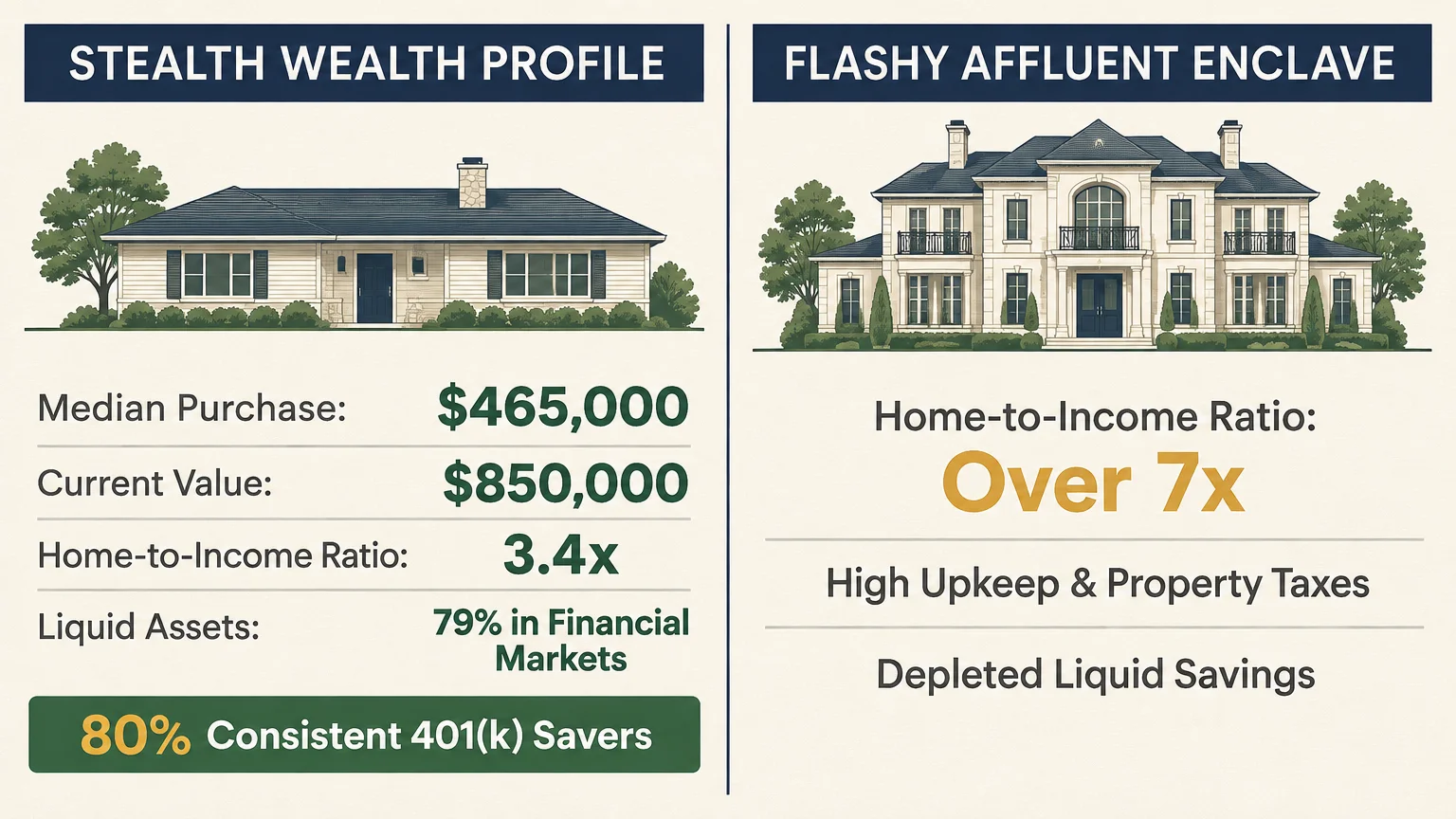
Hidden Wealth Suburbs vs. Flashy Affluent Neighborhoods: By the Numbers
Comparing hidden wealth neighborhoods against America’s highest-ranked affluent neighborhoods highlights why purchase price discipline matters. The 2026 MoneyLion and GOBankingRates rankings—covering communities with at least 5,000 households—placed Scarsdale, New York at number one for the third consecutive year with a $612,591 average income and roughly $1.7 million average home value.
Right behind Scarsdale sat West University Place, Texas at number two ($439,594 average income), Rye, New York at number three ($428,806), Los Altos, California at number four ($417,182 average income and $4.8 million average home value), and Paradise Valley, Arizona at number five ($408,500).
Texas and Ohio also hold pockets of quiet corporate and estate wealth. Dallas–Fort Worth suburbs University Park ($407,253) and Southlake ($384,530) placed inside the top ten alongside Houston’s Bellaire at number eighteen ($335,492), while The Village of Indian Hill outside Cincinnati posted a $1,690,069 Zillow value in October 2026—nearly seven times Ohio’s $244,978 statewide norm.
| Neighborhood or Suburb | Oct. 2026 Typical Home Value or Benchmark | Local Context or Income Signal | Loan Tier (With 20% Down vs. $832,750 Cap) |
|---|---|---|---|
| Dundee (Omaha, NE) | $438,707 (Zillow, +3.8% YoY) | Historic Midwest enclave; above Omaha’s $293,001 norm | Conforming mortgage |
| Bentonville, AR | $486,711 (Zillow, +1.4% YoY) | Corporate headquarters hub; $435,000 Redfin avg. sale | Conforming mortgage |
| Carmel, IN | $574,899 (Zillow, +4.3% YoY) | Indy metro offers 5,042 sq. ft. per $1M spent | Conforming mortgage |
| Los Alamos, NM | $576,479 (Zillow, -0.5% YoY) | National lab workforce; top small-town millionaire density | Conforming mortgage |
| Edina, MN | $617,930 (Zillow, +4.4% YoY) | Established Twin Cities suburb; moderate appreciation | Conforming mortgage |
| The Village of Indian Hill, OH | $1,690,069 (Zillow, +8.4% YoY) | Zero-commerce estate enclave; nearly 7x Ohio’s $244,978 norm | Jumbo mortgage |
| Los Altos, CA | $4,800,000 (2026 benchmark avg.) | #4 wealthiest U.S. suburb ($417,182 average income) | Jumbo mortgage |
Income statistics alone can still hide true net worth in mature neighborhoods. Since 1947, the U.S. Census Bureau has highlighted median household income rather than averages because ultra-high earners pull averages upward.
Yet both figures miss retirees, founders, and long-time homeowners whose wealth sits in appreciated stocks, trusts, and paid-off homes rather than taxable wages. In Old Palo Alto, for example, median income sits near $159,000 and average income near $272,000, even as typical homes trade around $3.7 million.

The Mortgage Math Behind Stealth Wealth in Late 2026
Shopping in quiet wealthy suburbs gives you a major financing advantage when mortgage rates sit above 7%. As of November 19, 2026, Freddie Mac’s Primary Mortgage Market Survey reported an average 7.28% rate on a 30-year fixed-rate mortgage, up from 6.26% one year earlier.
Shorter loan terms still carry meaningful rate relief for disciplined buyers. Freddie Mac reported an average 6.66% on a 15-year fixed-rate mortgage in mid-November 2026, up from 5.54% the previous year.
Borrowing costs climbed back above 7% in fall 2026 after September inflation reached 3.7% year-over-year. The Federal Reserve also lifted its federal funds target range by 0.25 percentage points to 3.75%–4.00% in September 2026 and held steady in October.
Staying under federal conforming loan limits protects you from even steeper borrowing costs. For 2026, the Federal Housing Finance Agency set the baseline conforming loan limit at $832,750 across most U.S. markets.
Mortgages exceeding $832,750 require jumbo financing, which averaged about 7.39% on November 24, 2026, alongside stricter reserve requirements. Dundee, Los Alamos, Carmel, Edina, and Bentonville all allow a buyer putting 20% down—or far less—to stay inside standard conforming limits.
Your down payment tier also controls whether you pay Private Mortgage Insurance (PMI). Putting at least 20% down caps your initial loan-to-value (LTV) ratio at 80% and eliminates PMI from day one.
If you put less than 20% down on a conventional loan, federal rules allow you to request PMI cancellation once your equity reaches 20% (80% LTV) and require automatic cancellation at 78% LTV. Reviewing loan estimates through the Consumer Financial Protection Bureau helps you spot PMI timelines and itemized closing expenses before you sign.
Many affluent buyers skip mortgage interest entirely, especially when downsizing or relocating from expensive coastal markets. Redfin’s 2025 Housing Market Year in Review showed that 30% of U.S. homes sold entirely for cash in 2025, nearly matching the 31% share in 2024.
Still, paying cash or opening a home equity line of credit (HELOC) requires careful math. A home purchase never guarantees automatic wealth creation, because unrecoverable carrying costs—property taxes, homeowner’s insurance, HOA dues, closing costs, and ongoing repairs—drain cash flow every single year.
Buying a $500,000 home instead of a $1.5 million home cuts not just your mortgage payment, but decades of recurring taxes, insurance premiums, and maintenance bills. That compounding savings is the real engine behind stealth wealth.
How to Apply the Stealth Wealth Blueprint to Your Next Move
You do not have to move to Omaha or Bentonville to copy the financial habits of everyday millionaires. Apply these five practical steps whether you are buying your first home, refinancing, or downsizing:
- Anchor your budget near three times gross income. Use the millionaire housing rule as your ceiling rather than your lender’s maximum approval so your monthly budget retains room for retirement contributions.
- Keep your loan inside the $832,750 conforming cap. Targeting homes where an 80% LTV loan stays below the 2026 FHFA limit secures smoother underwriting and avoids jumbo rate spreads.
- Price out total carrying costs before bidding. Add estimated property taxes, homeowner’s insurance, HOA fees, and an annual maintenance reserve to your principal and interest payment before deciding if buying beats renting.
- Weigh 15-year terms against investment returns. With 15-year fixed rates at 6.66% and 30-year rates at 7.28%, compare guaranteed interest savings against after-tax returns from maxing out your workplace retirement plan.
- Lock down your transaction security. MoneyLion’s 2026 analysis notes elevated white-collar fraud risks in affluent suburbs, while the Federal Reserve’s May 2026 Economic Well-Being report found 20% of U.S. adults faced scams in 2025 totaling $100 billion in non-credit-card fraud and $56 billion in direct consumer losses.
Always verify closing wire instructions by calling your title company using a known, independently confirmed phone number. You can review wire-fraud and identity-theft safeguards at Federal Trade Commission Consumer Advice before sending a single dollar of earnest money or closing cash.

Costly Mistakes to Avoid
Even high-earning households routinely sabotage their own net worth during home purchases and equity decisions. Watch out for these four traps before you commit your signature:
- Treating lender approval limits as safe spending targets. Mortgage underwriters qualify buyers using gross income and maximum debt-to-income (DTI) ceilings, leaving zero cushion for childcare, college savings, or job changes.
- Overlooking unrecoverable carrying costs. Comparing a rent check solely against a mortgage principal-and-interest quote ignores property taxes, insurance hikes, HOA assessments, and roof or HVAC replacements.
- Chasing million-dollar status in stretching markets. Redfin reported in June 2024 that 8.5% of U.S. homes—more than eight million properties—were worth $1 million or more, double the 4% share in 2019 and far above NAR’s 1.3% figure from 2005, tempting buyers to overextend just to match neighbors.
- Draining emergency reserves for a 20% down payment. Putting every liquid dollar into home equity leaves you forced onto high-interest credit cards or expensive HELOC borrowing the moment an urgent repair hits.

Don’t DIY These Decisions
Buying real estate inside hidden wealth neighborhoods often looks simple on paper, yet tax, legal, and financing trade-offs carry steep price tags. Bring in qualified specialists at the right moments:
- HUD-approved housing counselor: Consult a counselor through HUD Housing Counseling before your first home purchase, when comparing down-payment assistance programs, or if you need guidance on downsizing or avoiding default.
- Certified Public Accountant (CPA): Hire a CPA when selling a highly appreciated home, calculating capital gains exclusions, evaluating property tax and mortgage interest deductions, or exercising corporate stock grants to fund a cash purchase.
- Fee-only financial planner: Work with an independent fiduciary when deciding whether to pay cash—like 30% of 2025 buyers—prepay a 7.28% mortgage, tap equity via a HELOC, or keep surplus cash invested in brokerage accounts.
- Real estate or consumer attorney: Retain an attorney to review complex title deeds, trust ownership structures, HOA covenants, or disputed closing contracts—and immediately if you encounter wire fraud or identity theft.
Frequently Asked Questions
What defines a hidden wealth neighborhood?
A hidden wealth neighborhood combines modest, unpretentious housing prices with a high share of households holding substantial savings and investments. Residents prioritize financial assets, low debt, and strong local schools over luxury homes and status symbols.
Do most millionaires pay cash for their homes?
About 30% of all U.S. homebuyers paid cash in 2025, and downsizing retirees frequently buy debt-free. However, many working millionaires still use fixed-rate conforming mortgages when borrowing lets their retirement and brokerage investments stay compounded.
How does the 2026 conforming loan limit protect homebuyers?
In 2026, keeping your mortgage at or below the $832,750 FHFA baseline limit avoids jumbo interest rates, which averaged roughly 7.39% in late November 2026. Buying in markets priced between $430,000 and $620,000 makes conforming financing easy to secure.
Why do Census income figures miss stealth wealth?
Since 1947, the Census Bureau has emphasized median household income based on earned wages and taxable income. That snapshot undercounts retired founders, engineers, and long-term savers whose wealth sits inside untaxed stock appreciation, trusts, and paid-off homes.
Pull your current housing budget or mortgage statement today and check whether your target home price sits within three times your annual household income. Redirecting the difference between a modest house and a stretch purchase into diversified investments is the fastest way to build quiet wealth of your own.
This article is for informational purposes only and does not constitute financial, legal, or tax advice. Rates, benefit amounts, and tax rules change regularly—verify current details with the relevant agency or a licensed professional.
Last updated: November 2026. Rates, benefit amounts, and tax rules change—always verify current details at official sources.