
Helping a grown child through a rough patch feels natural, yet recurring transfers quietly drain your future security. When monthly support becomes routine, your household cash flow and retirement timeline absorb the shock.
A March 2025 Savings.com survey found half of U.S. parents provide regular support to adult children, averaging $1,474 per month. Over five years, that outgoing cash equals nearly $88,500 before lost investment growth.
Recognizing six concrete financial warning signs lets you reset household boundaries, protect your retirement savings, and restructure support before the math breaks your budget.
1. Your Monthly Support Outpaces Your Retirement Contributions
Giving money to adult children crosses a critical line when their monthly bills crowd out your retirement deposits. Unlike a young adult with decades of earning ahead, you face a fixed window to fund your post-work paycheck.
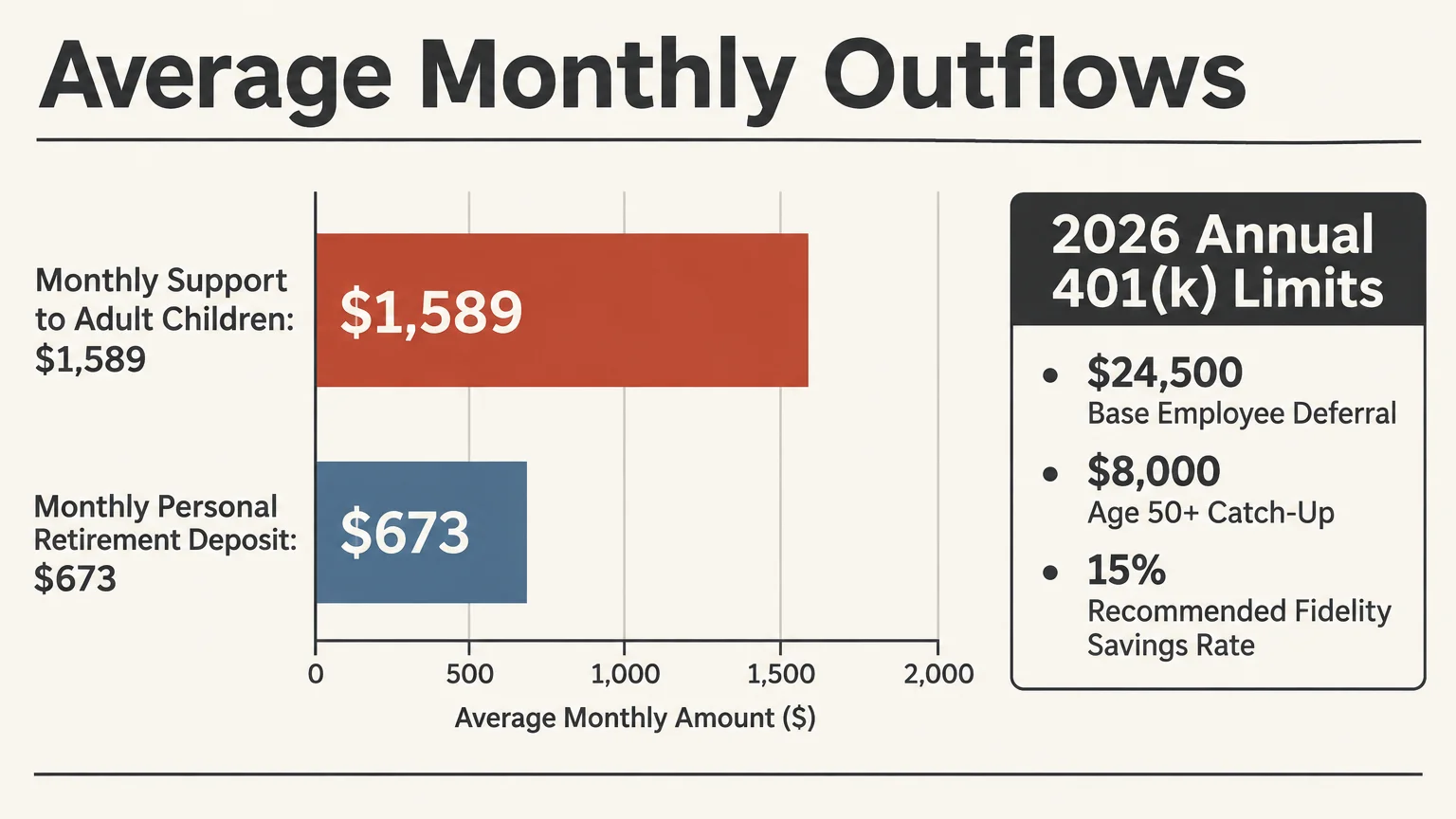
According to Savings.com in March 2025, working parents who support grown children contribute $1,589 per month to their kids compared with just $673 per month to their own retirement accounts. Nearly 50% say they sacrifice financial security, and 79% worry about affording retirement.
Missing peak compounding years carries steep tax and opportunity costs under current IRS limits. For 2026, you can defer up to $24,500 into a 401(k), 403(b), 457, or TSP plan, rising to $25,500 in 2027.
Workers age 50 and older can add an $8,000 catch-up contribution in 2026 for a $32,500 total, or $8,500 in 2027 for $34,000 total. Under SECURE 2.0 rules, savers ages 60 through 63 qualify for a super catch-up of $11,250 in 2026 and $11,750 in 2027.
Traditional and Roth IRAs allow another $7,500 in both 2026 and 2027, plus a $1,100 catch-up for savers age 50 and older. Review current contribution ceilings directly through IRS Retirement Plans before sending another dollar outward.
Fidelity Investments benchmarks from 2026 recommend saving at least 15% of pre-tax income annually, including employer matches. That pace builds toward 6 times your salary saved by age 50, 8 times by age 60, and 10 times by age 67.
If your adult child’s rent check forces you to drop below that 15% threshold, your support exceeds what your retirement math can sustain.
2. You Raid Emergency Savings or Carry Debt to Cover Their Bills
Funding a child’s expenses out of your emergency reserve or on a credit card signals immediate household cash-flow danger. One job loss, roof leak, or medical bill can force you into high-interest borrowing.
Bankrate’s February 2026 Annual Emergency Savings Report found only 47% of U.S. adults hold enough liquid cash to cover a $1,000 emergency. Even more troubling, 29% carry more credit card debt than emergency savings.
Fidelity Investments guidelines for 2026 call for keeping three to six months of essential expenses in liquid savings. Households supporting dependents or managing variable income should aim closer to six months or more.
Fidelity also advises capping total essential expenses, including any ongoing dependent support, at 60% of take-home pay. Breaching that 60% ceiling leaves almost no margin for taxes, repairs, or unexpected health costs.
Chronic financial strain spills directly into work decisions as well. An AARP survey from November 2025 found 42% of supporting parents age 45 and older report financial stress, and 9% retired early due to support demands.
Tapping retirement accounts early to pay a child’s debt triggers ordinary income taxes plus potential penalties, permanently shrinking your future 4% to 5% sustainable withdrawal base.

3. You Co-Sign Loans or Borrow Under Your Own Name
Putting your signature on a child’s auto note, apartment lease, or private student loan turns their cash shortfall into your legal liability. Lenders do not treat a co-signer as a backup helper.
Under the Federal Trade Commission Credit Practices Rule, lenders must issue a statutory Notice to Cosigner spelling out your full obligation. You owe the entire loan balance plus late fees and collection costs, and creditors can pursue you before chasing the primary borrower.
Real-world default rates prove how often parents end up paying. A September 2026 Accredited Debt Relief and Money.com survey found nearly 7 in 10 parent co-signers have made payments on an adult child’s loans or credit cards.
Among those co-signers, 42% pay regularly and 28% step in occasionally, while 38% of baby boomer parents say stepping in damaged their own finances. Experian noted in May 2026 that payments 30 days late or collection accounts can remain on your credit report for up to seven years.
You can review your legal protections and debt dispute rights on the Federal Trade Commission Consumer Advice portal.
Education borrowing carries similar traps for older parents. According to the Federal Reserve report from May 2026, 28% of adults with student debt hold loans taken out for a child or grandchild.
Congress tightened federal borrowing rules under Public Law 119-21, effective July 1, 2026. New Federal Parent PLUS loans are now capped at $20,000 per year and $65,000 lifetime aggregate per dependent undergraduate student, while Graduate PLUS loans were eliminated for new borrowers.
Even with those federal caps, taking on $65,000 per child in Parent PLUS debt right before retirement creates heavy monthly payments that outlast your working years.
4. Your Help Subsidizes Discretionary Lifestyle Spending Without Conditions
Emergency bridge support looks very different from funding daily upgrades, travel, and recurring subscriptions. When parents pay for lifestyle extras, adult children lose accurate feedback on what their own paycheck can afford.
AARP’s November 2025 survey of adults age 45 and older revealed that 75% financially support at least one adult child, averaging roughly $7,000 per year with a $1,400 median. Yet 53% of those adult children could meet their basic needs with money left over.
Recent spending breakdowns show just how deeply parental money blends into routine consumption. In an August 2026 LendingTree survey, 71% of parents with children 18 or older reported providing support at some point, and 44% helped within the past two years.
Common outflows among parents supporting adult kids include non-emergency categories that blur financial boundaries:
- Groceries and dining out: LendingTree (2026) found 53% of recent supporters buy groceries or meals, while Savings.com (2025) put grocery help at 83%.
- Phone plans and streaming: Roughly 35% of parents in LendingTree’s survey and 65% in Savings.com’s poll pay cellphone, internet, or subscription bills.
- Unrestricted cash transfers: LendingTree reported 29% send open-ended cash with no designated bill attached.
- Vacations and leisure: Savings.com found 46% of supporting parents help cover vacations and recreational spending.
- Zero accountability rules: Savings.com noted 23% of supporting parents attach no conditions or timelines to their money.
Meanwhile, average outlays vary sharply by age cohort. Savings.com data from March 2025 showed parents spend $1,813 per month on Gen Z children ages 18 through 28 and $863 per month on Millennials ages 29 through 44.
Paying a 32-year-old’s phone bill, car insurance, or weekend trips with zero conditions masks the true cost of independent adulthood.
5. You Have Never Shared How Support Affects Your Financial Plan
Silent generosity breeds false assumptions on both sides of the kitchen table. When you shield your adult children from the real budget impact of your transfers, they naturally assume you have surplus cash to spare.
Thrivent’s April 2025 Boomerang Kids Survey found that 60% of young adults say their parents have never explained how ongoing support affects the parents’ own financial planning. At the same time, 38% of parents with adult children moving back home say the arrangement hurt their long-term retirement savings.
Housing arrangements often disguise the true dollar transfer. U.S. Census Bureau data released in November 2026 showed 60% of adults ages 18 through 24 and 18% of adults ages 25 through 34 live in a parental home.
Federal Reserve survey data similarly recorded 49% of adults under 30 living with a parent in 2025, up 12 percentage points from 2019. Free room, board, utilities, and family auto insurance add up to substantial hidden subsidies.
Without open budget conversations, temporary help calcifies into permanent expectation. LendingTree’s August 2026 findings showed 32% of recent supporters send money multiple times a month, and 30% expect to keep helping indefinitely.
Treat every dollar you send to an adult child as a direct trade against your own retirement paycheck; if the transfer cuts your savings below 15% of gross income, you cannot afford the gift.
Transparency protects relationships by replacing silent resentment with clear household math.

6. You Trigger Gift Tax Paperwork or Lose Track of Total Outflows
Small transfers made through peer-to-peer apps, shared credit cards, and direct rent payments add up faster than most families realize. Without a written ledger, you may cross federal gift reporting thresholds without noticing.
Data from the U.S. Census Bureau’s 2025 Survey of Income and Program Participation, released in September 2026, highlights the scale of out-of-home support. Roughly 2.6 million U.S. parents gave $26.6 billion in voluntary support in 2024 to 3.7 million adult children age 21 and older living elsewhere, at a median of $4,725 per year.
The IRS sets strict annual gift tax exclusion limits each calendar year. For 2026, you can give up to $19,000 per recipient without filing a federal gift tax return on Form 709, or $38,000 per child if a married couple splits gifts.
For 2027, that annual exclusion rises to $20,000 per recipient, or $40,000 for married couples splitting gifts. Exceeding those limits does not immediately trigger tax, because excess gifts count against your lifetime estate and gift tax exemption.
Under Public Law 119-21 and IRS inflation rules, the lifetime exemption stands at $15 million per individual and $30 million for married couples in 2026. In 2027, it rises to $15.48 million per individual and $30.96 million for couples.
Even if you never owe gift tax, failing to file Form 709 when required creates compliance headaches during estate administration. Worse, sending cash instead of paying providers directly wastes a major statutory exclusion under Internal Revenue Code Section 2503(e).
| Support Method | 2026–2027 Tax Rule | Risk to Parent Finances | Best Use Case |
|---|---|---|---|
| Unrestricted cash or Venmo transfers | Counts toward $19,000 (2026) or $20,000 (2027) annual gift exclusion | High; easy to lose track of totals and encourages ongoing dependency | Rare, one-time emergency bridge with a set end date |
| Direct tuition or medical payments (IRC § 2503(e)) | 100% exempt from annual gift limit and lifetime exemption when paid straight to provider | Low if funded from surplus cash flow outside retirement savings | Helping with tuition or major medical bills without wasting gift caps |
| Co-signed private loans or leases | Not a tax gift unless you make payments; defaults may raise gift accounting questions | Severe; full balance liability plus up to 7 years of credit damage | Avoid unless you hold liquid cash to pay off the balance immediately |
| Federal Parent PLUS loans (post-July 1, 2026) | Capped at $20,000/yr and $65,000 lifetime per dependent undergrad under P.L. 119-21 | High; non-dischargeable debt borne solely by parent into retirement | Only when retirement targets are fully funded and cash flow covers payments |
Errors That Cost Families Thousands
Well-meaning parents often lose thousands of dollars not from generosity itself, but from choosing the wrong legal or tax structure for their help. Fixing these mechanical mistakes preserves cash immediately:
- Routing tuition or medical help through your child’s checking account: Writing a check to your child instead of directly to the university or hospital strips away the unlimited IRC § 2503(e) exclusion and eats into your $19,000 annual gift cap.
- Ignoring statutory dependency and support math: Paying more than half of an adult child’s support does not automatically qualify them as a tax dependent if their gross income exceeds IRS qualifying-relative limits.
- Skipping written promissory notes on large family loans: Calling a $25,000 house down payment a loan without a signed note, repayment schedule, and applicable federal interest rate causes the IRS to reclassify the transfer as a taxable gift.
- Co-signing without checking lender release terms: Many private lenders advertise co-signer release options but reject applications over minor credit blips, trapping parents on the note for a decade or more.
- Draining Roth or traditional IRAs prematurely: Withdrawing retirement principal to bail out a child’s credit card debt forfeits decades of tax-advantaged growth and can push your modified adjusted gross income into higher Medicare premium brackets later.
How to Reset Financial Boundaries Without Cutting Off Real Emergencies
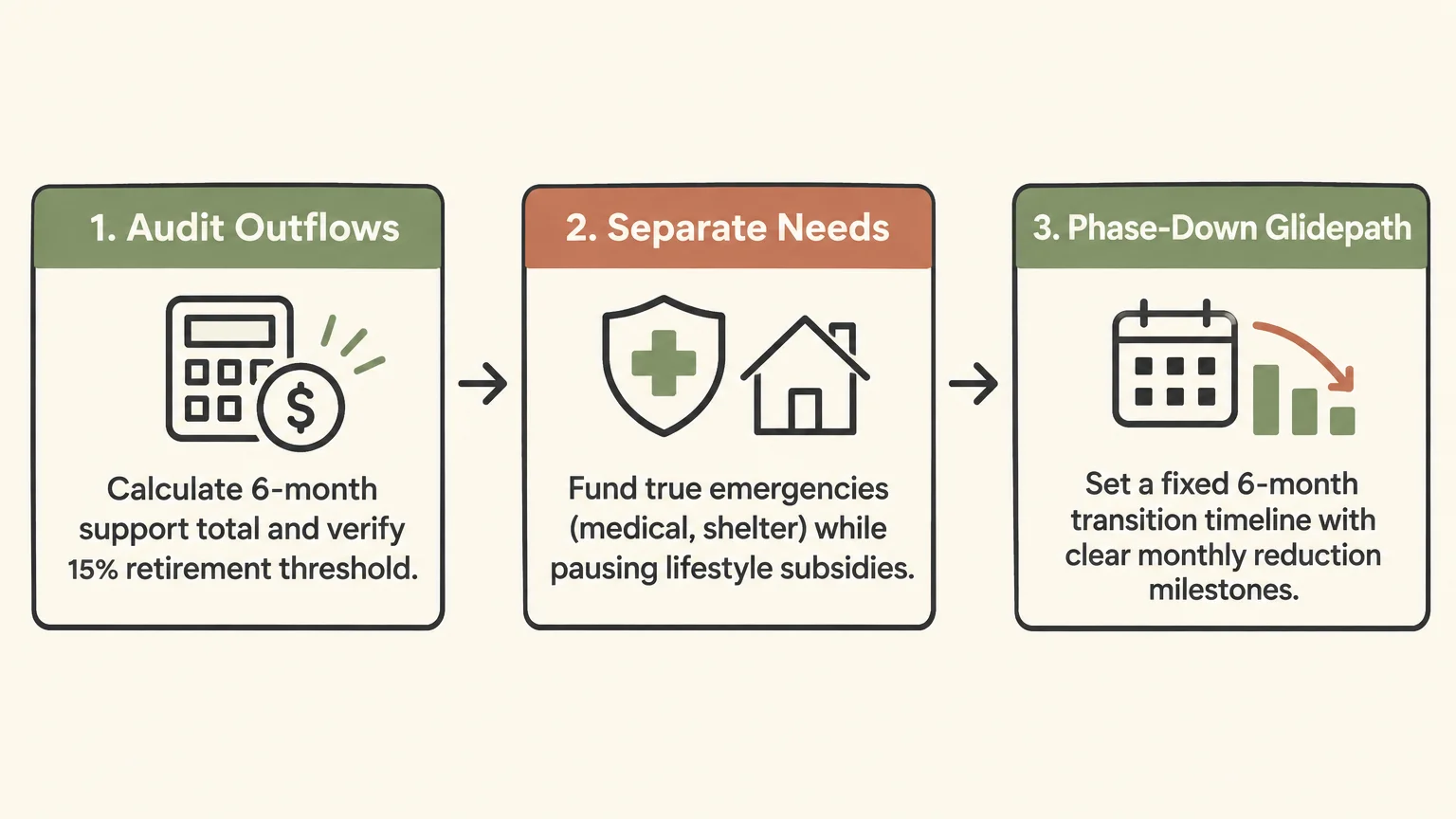
Cutting off recurring support overnight can trigger panic, while dragging your feet drains another year of retirement savings. A structured step-down plan gives your adult child time to adjust while protecting your household budget immediately.
- Audit every dollar over the past 90 days: Total your bank transfers, shared phone lines, auto insurance premiums, grocery runs, and housing subsidies so both partners see the exact monthly outflow.
- Lock in your own savings floor first: Automate your 15% retirement contribution and verify your three-to-six-month emergency fund before calculating how much discretionary cash remains.
- Hold a numbers-based family meeting: Share your target retirement age, your essential-expense cap of 60% of take-home pay, and the exact monthly cost of current subsidies without lecturing or shaming.
- Set a 90-to-180-day phaseout schedule: Replace open-ended support with a fixed exit calendar—for example, covering 100% of rent this month, 50% next month, and 0% by month four.
- Separate bills onto their own accounts: Require your child to move phone plans, streaming subscriptions, and auto insurance into their own name so late fees never hit your credit file.
- Switch emergency help to structured matching or direct aid: If you choose to assist with job training or medical bills, pay the institution directly under IRC § 2503(e) or match documented savings milestones dollar for dollar.
Free budgeting worksheets and debt-management guides from the Consumer Financial Protection Bureau (CFPB) can help your adult child build a standalone monthly cash-flow plan during the transition.
When to Get Expert Help
Family money decisions sit at the intersection of retirement math, tax compliance, and contract law. Bringing in a specialist pays for itself when the dollar amounts threaten your long-term security.
Hire a fee-only financial planner if supporting adult children has stalled your retirement contributions or forced you to consider retiring later. A planner can stress-test your nest egg using a 4% to 5% withdrawal rate and show the exact dollar ceiling you can safely gift.
Consult a Certified Public Accountant (CPA) when your annual transfers approach the $19,000 per-recipient gift exclusion in 2026 ($20,000 in 2027), when you need to file Form 709, or when you want to verify qualifying-relative dependency rules or document an intra-family loan.
Speak with a consumer attorney if a co-signed loan is heading toward default, debt collectors are contacting you, or you need to evaluate your legal exposure under an existing lease or promissory note.
Finally, work with an elder law or estate planning attorney if ongoing support for one adult child risks depleting assets needed for your own long-term care or creates unfair estate imbalances among siblings.
Frequently Asked Questions
How much financial help is normal for adult children?
National medians are far lower than many parents assume. The U.S. Census Bureau reported a median of $4,725 per year for parents supporting out-of-home adult children age 21 and older, while AARP found a $1,400 median among adults age 45 and older.
Even though Savings.com found regular supporters average $1,474 per month, normal should never mean affordable. Keep total essential spending plus dependent support at or below 60% of take-home pay while saving 15% of gross income for retirement.
Do I owe taxes if I give my adult child more than $19,000 in 2026?
Crossing the $19,000 annual gift exclusion in 2026 ($38,000 for married couples splitting gifts) requires filing IRS Form 709, rising to $20,000 per recipient ($40,000 married) in 2027. However, you rarely owe immediate gift tax.
Excess amounts simply reduce your lifetime federal estate and gift tax exemption, which stands at $15 million per individual in 2026 and $15.48 million in 2027. You can avoid the cap entirely by paying tuition or medical providers directly under IRC § 2503(e).
How can I stop paying my adult child’s bills without causing a crisis?
Give your child 60 to 90 days of advance notice paired with a clear step-down calendar. Moving phone lines, insurance policies, and subscriptions into their name one bill at a time prevents missed payments while forcing realistic budgeting.
LendingTree found in August 2026 that 38% of recipient adult children say managing expenses without parental help would be difficult or impossible. Giving them a firm runway lets them pick up extra hours, find roommates, or trim fixed costs.
Should I take out a Parent PLUS loan or co-sign a private student loan?
Neither option is safe if you are within 10 to 15 years of retirement or behind on your savings milestones. Co-signed private loans expose your credit for up to seven years after late payments, and nearly 7 in 10 parent co-signers end up making payments.
Federal Parent PLUS loans carry new caps of $20,000 per year and $65,000 lifetime aggregate per undergraduate student starting July 1, 2026. Only borrow if you can pay the full schedule from surplus cash without cutting retirement contributions.

Take Your First Step This Week
Log into your checking account and retirement portal today to compare your last 30 days of child-related transfers against your retirement deposits. If outgoing family support beats your retirement savings or pushes essential bills past 60% of take-home pay, schedule a boundary conversation this week.
Financial outcomes vary based on individual income, credit history, and circumstances. This article provides general guidance only. Consult a qualified financial planner, CPA, or consumer attorney for advice specific to your situation.
Last updated: November 2026. Rates, benefit amounts, and tax rules change—always verify current details at official sources.