
Leaving a single, large traditional IRA to multiple heirs can trigger an unexpected tax disaster for your family. By splitting your retirement assets across separate accounts today, you give each beneficiary control over their tax brackets and withdrawal timelines.
Under current federal law, most non-spouse heirs must withdraw every dollar from an inherited IRA within a decade. Without proactive planning, these mandatory distributions can thrust your children into their peak earning years and highest tax brackets.
A few strategic adjustments right now will protect your wealth and shield your loved ones from avoidable tax hits.

Why Leaving One Big Traditional IRA Creates a Tax Trap
Many savers spend decades building a substantial nest egg inside a single Traditional IRA. Consolidating funds into one account keeps portfolio management simple while you accumulate wealth.
However, leaving that unified balance to multiple heirs creates administrative friction. When you pass away, your beneficiaries do not inherit your tax rate; they inherit your deferred tax bill.
Recent changes under Public Law 119-21 made individual income tax brackets permanent. Today, federal rates remain fixed at 10%, 12%, 22%, 24%, 32%, 35%, and 37% across seven distinct income tiers.
At the same time, the federal estate tax exemption stands at $15 million per individual, or $30 million for a married couple. Consequently, estate planning taxes rarely threaten family wealth for the vast majority of households.
Instead, inherited IRA taxes represent the single largest financial threat facing modern retirement legacies. Every taxable dollar distributed from a traditional account counts directly as ordinary income to your beneficiaries.
Imagine leaving one retirement account equally to two adult children. One child might work in public service in the 12% federal tax bracket, which applies to taxable income up to $50,400 for single filers.
The other child could work as an executive in the 32% bracket, which covers single incomes from $201,776 to $256,225. Lumping their inheritances into a single shared structure ignores their vastly different financial realities.
When multiple heirs share an account, mandatory withdrawal rules can force them into lockstep. This dynamic frequently forces lower-earning heirs into higher tax brackets against their wishes.
Understanding the IRS 10-Year Rule and Mandatory Annual Withdrawals
Congress fundamentally altered retirement inheritance rules when it passed the SECURE Act. The legislation eliminated the beloved lifetime stretch distribution option for most non-spouse beneficiaries.
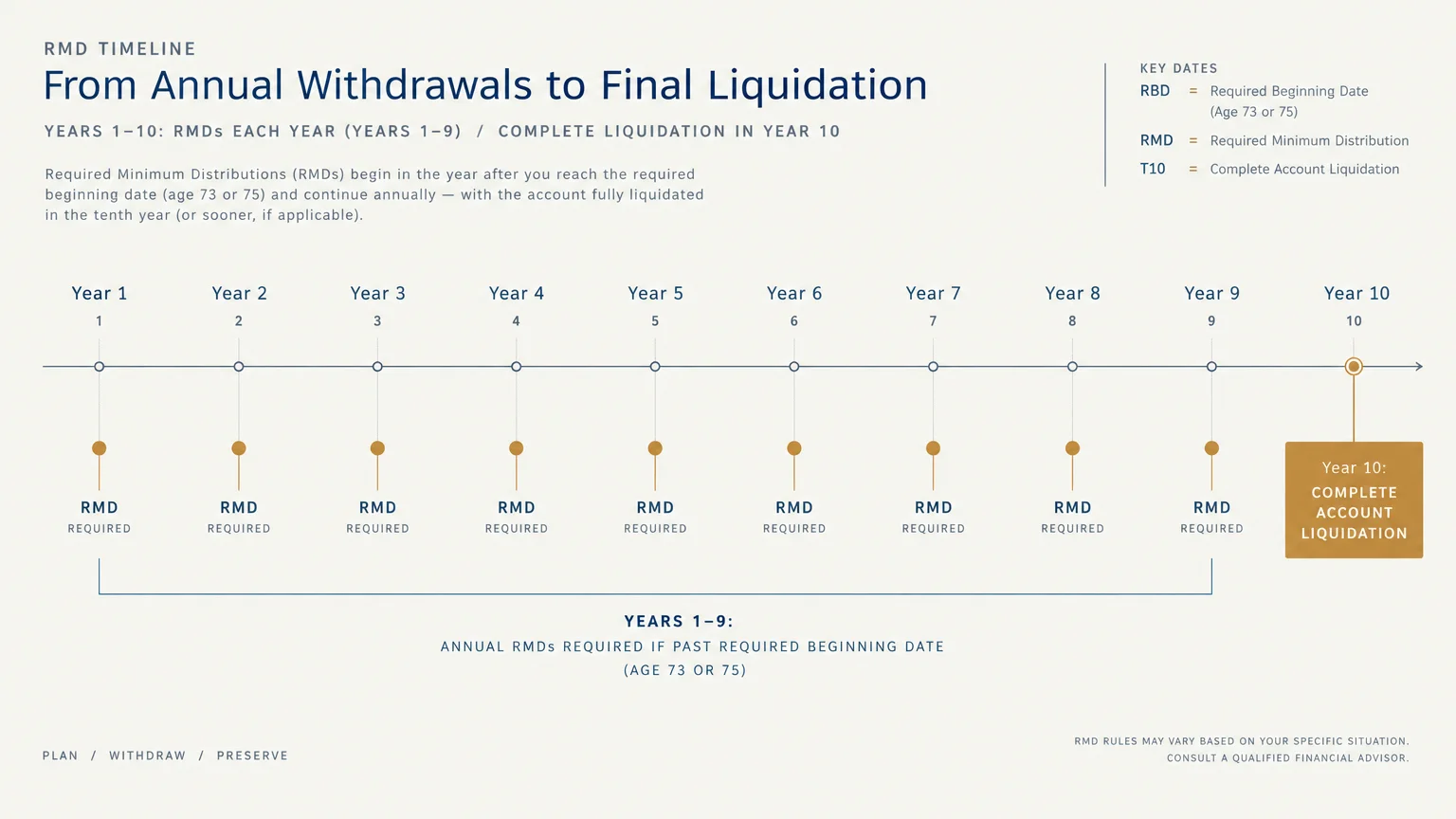
Under the IRA 10-year rule, designated beneficiaries must empty the entire account balance by December 31 of the tenth year following the owner’s death. This condensed timeline forces substantial taxable income into a narrow window.
To complicate matters further, the IRS finalized regulations under 89 FR 58886 that took full effect in 2025. These rules mandate annual Required Minimum Distributions during years one through nine under specific circumstances.
If you die on or after your Required Beginning Date, your beneficiaries cannot simply wait until year ten to liquidate the account. They must take annual distributions based on their single life expectancy throughout the decade.
Under current law, your Required Beginning Date links to age 73 for anyone born between 1951 and 1959. That threshold increases to age 75 in 2033 for individuals born in 1960 or later.
If you pass away before reaching that required age, your heirs face no mandatory annual withdrawals during years one through nine. They must still empty the entire account balance by the end of the tenth year.
Missing a required withdrawal triggers severe penalties from the IRS. Beneficiaries face an excise tax equal to 25% of the missed distribution amount.
The SECURE 2.0 Act reduces that penalty to 10% if the taxpayer corrects the error within a two-year window. Even with the reduction, paying penalties on avoidable administrative oversights wastes family wealth.

Who Still Qualifies for a Lifetime Stretch?
Not all beneficiaries must follow the rigid 10-year liquidation schedule. The law carves out five specific categories of Eligible Designated Beneficiaries who may still stretch distributions over their single life expectancies.
These exceptions include surviving spouses, disabled individuals, chronically ill individuals, and heirs not more than ten years younger than the deceased owner. The final exempt group covers minor children of the account owner.
However, the minor child exception carries a crucial limitation that surprises many parents. IRS regulations define the age of majority strictly as age 21, regardless of individual state statutes.
Once your child turns 21, their life expectancy stretch immediately ends. The 10-year clock begins running on their 21st birthday, requiring full distribution by December 31 of the year they reach age 31.
Grandchildren do not qualify for this minor child stretch exception under any circumstances. Naming a minor grandchild automatically subjects them to the standard 10-year liquidation rule.

Lifetime Account Splitting Versus Post-Death Separation
Treasury regulations include a provision known as the separate account rule. This rule allows multiple beneficiaries named on a single IRA to split the balance into separate inherited accounts after the owner dies.
To utilize this rule, heirs must establish separate inherited IRAs by December 31 of the calendar year following the owner’s death. Dividing the account allows each heir to calculate distributions based on their own personal status.
Another critical deadline occurs on September 30 of the calendar year following death. This designation date determines which named beneficiaries count for distribution purposes.
Between the date of death and September 30, heirs can execute qualified disclaimers or cash out non-individual entities like charities. If a charity remains on the account after September 30, severe complications arise.
Because a charity is a non-designated beneficiary, its presence on an unseparated account can force human heirs into a five-year distribution rule. That accelerated schedule doubles their annual tax burden.
Relying on your heirs to handle post-death separation creates unnecessary risk during a period of grief. Paperwork delays, custodian processing backlogs, or family disagreements can cause heirs to miss statutory deadlines.
Splitting IRA beneficiaries during your lifetime eliminates these post-death hazards entirely. When you divide one large IRA into distinct accounts today, each heir receives their own clean, independent inheritance.
“It’s not how much money you make, but how much money you keep, how hard it works for you, and how many generations you keep it for.” — Robert Kiyosaki

Strategic Asset Placement: Pre-Tax, Roth, and Charitable Dollars
Proactive IRA beneficiary planning involves far more than dividing money into equal mathematical slices. It gives you the power to match specific tax characteristics with the individual financial profiles of your heirs.
Consider dividing your retirement savings into separate Traditional and Roth IRA accounts. You can direct tax-free Roth assets to your highest-earning children who face elevated tax brackets.
Under federal rules, inherited Roth IRAs still fall under the 10-year rule, but withdrawals remain entirely tax-free. Furthermore, inherited Roth accounts never require annual distributions during years one through nine.
A child earning income in the 32% or 35% bracket can let an inherited Roth compound untouched for a full decade. They can withdraw the entire balance tax-free on December 31 of year ten.
Meanwhile, you can leave pre-tax Traditional IRA balances to heirs who earn modest incomes or live in low-tax states. These beneficiaries can absorb taxable withdrawals in the 12% or 22% brackets without triggering heavy tax bills.
If philanthropic giving forms part of your legacy, never name a charity alongside individual family members on the same account. Instead, split off a separate IRA designated entirely for charitable organizations.
Charities pay zero income tax on inherited traditional retirement accounts. Directing pre-tax dollars to non-profits preserves your family’s cash flow while maximizing the social impact of your gift.
Additionally, account owners aged 70½ or older can leverage Qualified Charitable Distributions directly from their IRAs. You can transfer up to $111,000 annually to qualifying charities completely free from federal income taxes.
Comparison of Beneficiary Splitting Strategies
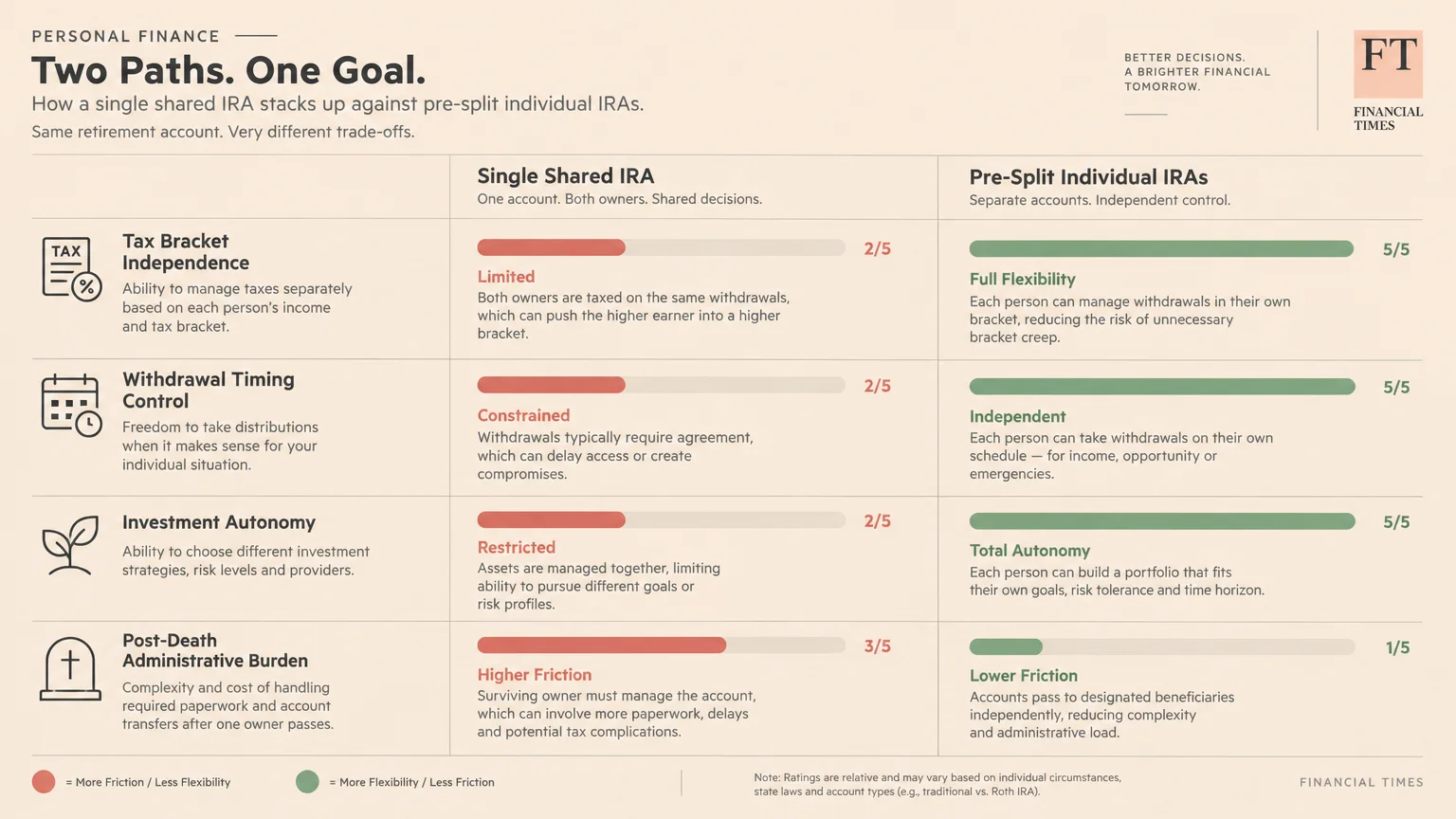
Choosing how to structure your retirement accounts alters the administrative burdens and tax rates your heirs will face. Evaluating these strategies side by side clarifies the advantages of taking action during your lifetime.
| Strategy | Administrative Timing | Tax Flexibility for Heirs | Primary Risks |
|---|---|---|---|
| Single IRA with Multiple Heirs | Post-death only | Very low; heirs must coordinate actions | Missed deadlines force oldest heir’s RMD rules or 5-year payout |
| Post-Death Account Division | Completed by Dec 31 of year after death | Moderate; establishes separate accounts late | Custodian processing errors, missing the deadline, sibling disputes |
| Lifetime Multi-Account Split | Completed while owner is alive | High; each heir controls withdrawals independently | Requires maintaining multiple account numbers during lifetime |
| Targeted Roth vs. Traditional Split | Completed during lifetime conversions | Maximum; pairs asset tax status with heir’s bracket | Incurs upfront taxes during lifetime Roth conversions |
| Dedicated Charitable Carve-Out | Completed while owner is alive | High; isolates taxable entities entirely | Requires clear documentation to maintain overall estate balance |
Evaluating your options helps you identify which structure aligns best with your family’s specific needs. Moving away from a single, shared account provides your heirs with significant tax flexibility.

The Dangerous Pitfall of IRA Trust Planning
Many well-meaning parents establish trusts to control how their children spend inherited retirement funds. While trusts offer asset protection and oversight, naming a trust as an IRA beneficiary carries massive tax risks.
Under federal tax law, trusts reach the top 37% income tax bracket at just $16,250 of undistributed taxable income. In contrast, married couples filing jointly do not hit that top bracket until income reaches hundreds of thousands.
If you utilize an accumulation trust that holds distributions inside the trust entity, the IRS claims more than a third of the growth. Taxes quickly erode the legacy you intended to safeguard.
Conduit trusts pass annual distributions directly through to the trust beneficiary, avoiding the steep entity-level tax bracket. However, under the 10-year rule, a conduit trust must pass the entire account balance to the heir by year ten.
This mandatory payout undermines the protective spendthrift provisions that led parents to establish the trust initially. Splitting separate IRAs directly among adult heirs often provides a cleaner, far more tax-efficient alternative.
Direct beneficiary designations bypass probate completely and avoid entity-level trust taxes. Each child receives their own inherited IRA, allowing them to manage distributions according to their personal tax brackets.
How to Split Your IRA During Your Lifetime
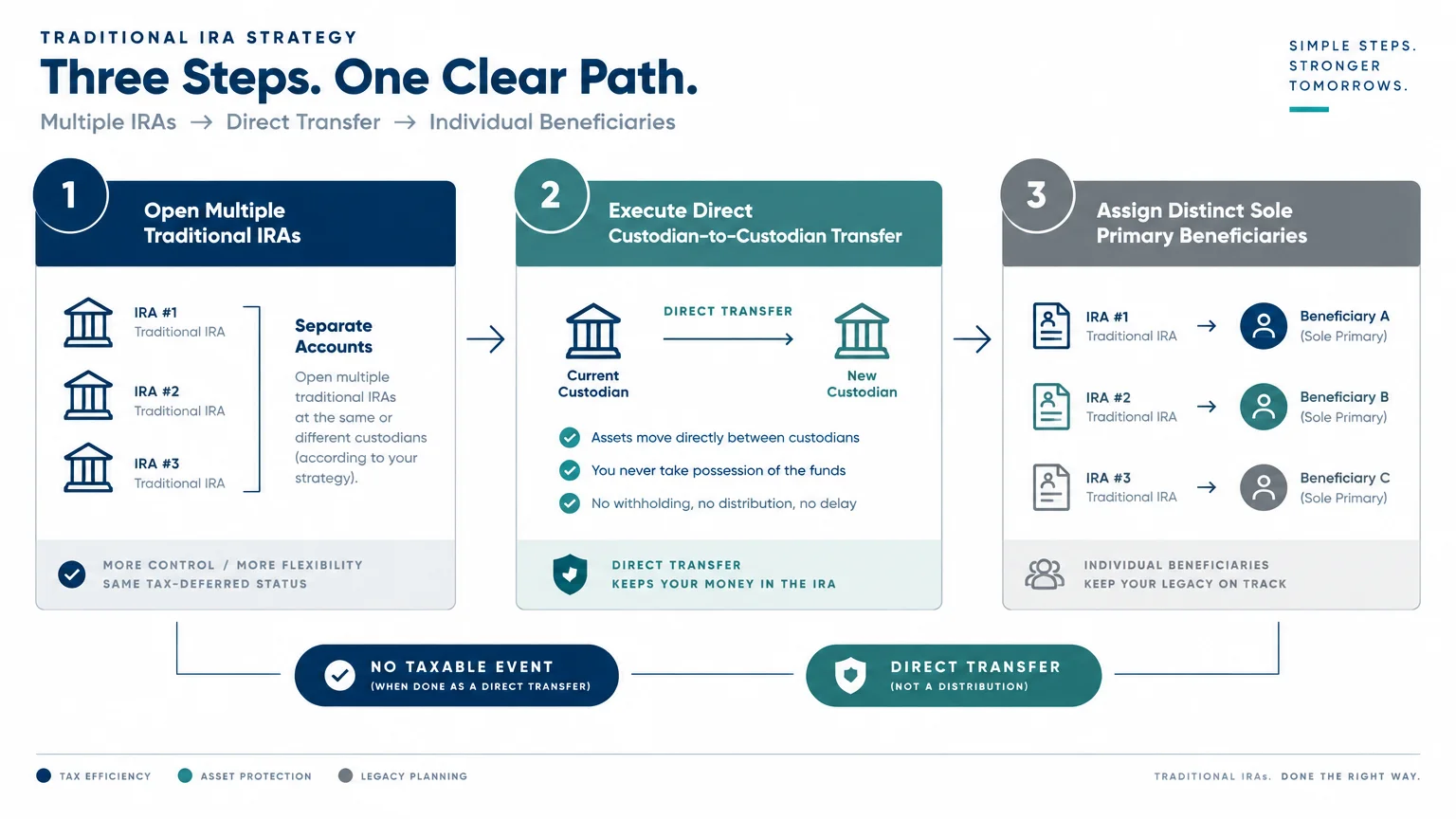
Dividing a single IRA into multiple accounts while you are alive is straightforward and completely tax-free. Federal law allows unlimited trustee-to-trustee transfers between traditional IRAs in your name.
First, review your overall retirement portfolio and list every intended beneficiary. Gather basic information regarding their current income levels, filing statuses, and general financial stability.
Next, contact your financial institution and request the creation of new sub-accounts under your name and Social Security number. For example, you can split one $600,000 IRA into three distinct $200,000 accounts.
Instruct the custodian to execute direct trustee-to-trustee transfers to fund the new accounts. Ensure the custodian does not process these transfers as taxable distributions or indirect 60-day rollovers.
Once funded, submit a customized beneficiary designation form for each separate account. Name one primary beneficiary per account, designating 100% of the proceeds directly to that individual.
Always name secondary or contingent beneficiaries on every account to protect against unexpected life events. If a primary beneficiary predeceases you, contingent designations prevent assets from defaulting to your probate estate.
Finally, review your accounts annually to rebalance allocations and update designations as your family grows. Basic administrative maintenance preserves the integrity of your estate plan over time.

Costly Mistakes to Avoid
Failing to understand beneficiary mechanics can cost your family tens of thousands of dollars in avoidable taxes. Being aware of frequent pitfalls helps keep your hard-earned wealth within your family.
- Naming Your Estate as Primary Beneficiary: Leaving an IRA to your estate revokes designated beneficiary status. This error forces distributions under the restrictive five-year rule or subjects the account to probate costs.
- Co-Mingling Charities with Individuals: Naming a charity on the same IRA as your children can taint the account. If the charity is not cashed out by September 30 of the year following death, all heirs may lose the 10-year rule.
- Overlooking the September 30 Designation Date: If your heirs must execute disclaimers or split accounts post-death, missing this deadline locks in adverse tax treatment. Splitting accounts during lifetime prevents this error completely.
- Ignoring Annual RMDs in Years One Through Nine: For owners who die after their Required Beginning Date, failing to take annual RMDs triggers a 25% penalty. Heirs must calculate single life distributions annually.
- Assuming the Minor Child Stretch Lasts to Age 26: IRS regulations strictly define the age of majority as age 21. At age 21, the 10-year clock begins immediately, regardless of whether the child remains in college.
- Failing to Update Contingent Beneficiaries: Life events such as births, marriages, or divorces alter family structures. Neglecting contingent designations can leave accounts subject to default custodial policies.
Avoiding these common errors requires attention to detail and clear communication with your financial custodian. Taking simple preventative measures today saves your loved ones from severe administrative headaches later.

Don’t DIY These Decisions
While establishing separate IRA accounts is simple, complex family dynamics and substantial balances demand professional guidance. Working with qualified financial and legal professionals ensures your strategy complies with state and federal laws.
Consult a Certified Public Accountant (CPA) or fee-only CERTIFIED FINANCIAL PLANNER™ (CFP®) to run multi-year tax projections. A professional can model the tax impact of lifetime Roth conversions versus passing pre-tax assets to your heirs.
If you have a child with special needs, partner with an estate planning attorney who specializes in special needs trusts. Leaving an IRA directly to a disabled heir can jeopardize essential government benefits.
An attorney can establish an Eligible Designated Beneficiary trust that preserves government assistance while stretching distributions over the child’s lifetime. General templates downloaded from the internet cannot handle these delicate legal nuances.
You can verify professional credentials and find objective consumer resources through the Consumer Financial Protection Bureau. Federal guidance on retirement asset transfers is also accessible through USA.gov Money and Taxes.
Frequently Asked Questions About IRA Beneficiary Planning
Can I split an IRA into multiple accounts without paying taxes?
Yes, you can split your IRA into multiple accounts tax-free at any time. As long as you complete direct trustee-to-trustee transfers between accounts in your name, the transaction generates zero tax liability.
What happens if multiple beneficiaries inherit an unsplit IRA?
Heirs must establish separate inherited IRAs by December 31 of the year following your death. If they miss this deadline, distributions for all heirs must follow the life expectancy of the oldest named beneficiary.
How does the IRS 10-year rule apply to inherited Roth IRAs?
Non-spouse heirs must fully liquidate inherited Roth IRAs by the end of the tenth year following the owner’s death. However, withdrawals are entirely tax-free, and no annual distributions are required during years one through nine.
Does splitting an IRA change my own lifetime Required Minimum Distributions?
No, splitting your IRA does not alter your total lifetime RMD obligations. The IRS calculates your annual distribution based on the aggregate balance of all traditional IRAs you own, regardless of how many accounts hold the funds.
Can I name different beneficiaries on different IRAs?
Yes, you have complete authority to designate different primary and contingent beneficiaries on each separate IRA. This flexibility makes splitting accounts an effective tool for pairing specific assets with individual heirs.
Taking Action to Protect Your Family Legacy
“The best time to plan for a financial goal was 20 years ago. The second best time is today.”
Your retirement assets represent decades of discipline, investment growth, and sacrifice. Taking time to divide your IRA accounts today ensures your family preserves that wealth rather than forfeiting it to unnecessary taxes.
Log in to your retirement portal this week or contact your financial custodian to begin separating your accounts. A few simple paperwork updates will protect your loved ones for decades to come.
Information in this article reflects rules and figures current as of the publication date and may change. Always confirm details directly with your bank, the IRS, the Social Security Administration, or other official sources before making decisions.
Last updated: November 2026. Rates, benefit amounts, and tax rules change—always verify current details at official sources.